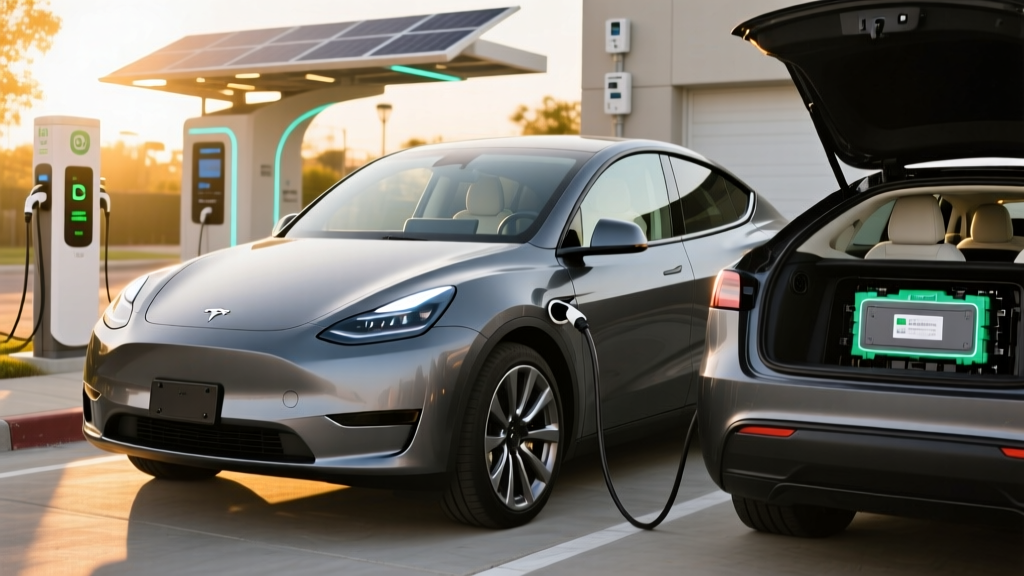
The Tesla Model Y has been the best-selling electric vehicle in the world for several years running, and the 2026 refresh — marketed under the Premium AWD trim — carries forward the Juniper design overhaul introduced in early 2025. With a restyled interior, ventilated front seats, a rear touchscreen, ambient lighting, and slightly revised battery tuning, the 2026 Model Y Premium AWD aims to hold its ground against a rapidly closing field of competitors including the Hyundai Ioniq 5, Ford Mustang Mach-E, and Kia EV6.
But spec sheets only tell part of the story. After logging time behind the wheel and at the charger, here is the data-driven breakdown of what the 2026 Model Y Premium AWD actually delivers in range, charging speed, daily usability, and ownership cost — and whether it still deserves its dominant market position.
2026 Tesla Model Y Premium AWD: Spec Snapshot
| Specification | 2026 Model Y Premium AWD |
|---|---|
| EPA Range | 310 miles |
| Battery (usable) | ~75 kWh, NMC (nickel manganese cobalt) |
| Drivetrain | Dual-motor AWD |
| Horsepower | 384 hp (combined) |
| 0–60 mph | 4.8 seconds |
| Peak DC Fast Charge | 250 kW (Supercharger V3/V4) |
| 10–80% DC Charge Time | ~25 minutes |
| Level 2 Home Charging | 11.5 kW (~44 mi/hr) |
| EPA Efficiency | 111 MPGe combined / 30 kWh/100 mi |
| Cargo Volume (rear seats up / down) | 30.2 / 72.0 cu ft |
| Rear Legroom | 41.6 inches |
| Base MSRP | $44,990 (before destination) |
| Battery & Drive Unit Warranty | 8 years / 120,000 miles |
Real-World Range: What the EPA Sticker Doesn't Tell You
Real-World Expectation: ~255–280 miles at sustained highway speeds (70–75 mph); ~220–250 miles in freezing temperatures with cabin heat running.
The 310-mile EPA figure is competitive for the segment, but real-world results depend heavily on driving style and climate. Tesla's NMC pack delivers strong energy density, yet highway driving at 75 mph pushes consumption closer to 33–35 kWh/100 mi, cutting effective range to roughly 260 miles on a full charge. In cold weather (below 32°F), expect a 15–25% range reduction — a well-documented characteristic of lithium-ion chemistry, not a Tesla-specific flaw.
The Model Y's heat pump (standard since the 2021 refresh) mitigates cold-weather losses better than resistive cabin heaters found in older EVs, but preconditioning the battery via the Tesla app before departure remains essential for maximizing both range and regenerative braking performance in winter.
Charging Speed: DC Fast Charge and Home Level 2
| Charging Method | Power / Rate | Time or Miles Added |
|---|---|---|
| DC Fast Charge (Supercharger V3/V4) | Peak 250 kW | 10–80% in ~25 min |
| DC Fast Charge (50 kW public station) | 50 kW | 10–80% in ~70 min |
| Level 2 Home (48A / 11.5 kW) | 11.5 kW | ~44 miles per hour of charging |
| Level 2 Home (32A / 7.7 kW) | 7.7 kW | ~30 miles per hour of charging |
| Level 1 (120V / 12A) | ~1.4 kW | ~4–5 miles per hour |
Tesla's Supercharger network remains the gold standard for public charging reliability. On a V3 or V4 Supercharger, the Model Y Premium AWD peaks at 250 kW — but like all EVs, it doesn't sustain that rate for the entire session. The charge curve tapers noticeably above 60% State of Charge (SoC), and charging from 80–100% can take as long as the 10–80% portion. For road trips, plan stops around the 10–80% window to minimize time at the charger.
At home, a 48-amp Level 2 wall connector on a 60-amp circuit delivers the full 11.5 kW, replenishing roughly 44 miles of range per hour. Most owners plugging in overnight will wake to a full battery regardless of daily mileage. Home installation typically runs $500–$2,000 depending on panel proximity and whether a 200-amp service upgrade is needed — a factor worth budgeting for before purchase.
With the 2025 industry-wide adoption of the NACS connector, the Model Y natively uses the North American Charging Standard. Non-Tesla CCS-equipped EVs now use adapters to access Superchargers, but Tesla owners enjoy native plug-and-charge compatibility with zero adapter hassle.
Performance and Driving Impressions
The dual-motor AWD powertrain produces 384 combined horsepower and delivers a 4.8-second 0–60 mph time — brisk enough for confident highway merging and passing, if not quite the neck-snapping acceleration of the Performance variant (3.5 seconds). Torque is immediate and linear, as expected from an electric drivetrain.
Ride quality in the Juniper-refreshed Model Y is noticeably improved over pre-2025 versions. Tesla revised the suspension tuning and added acoustic glass, reducing cabin noise at highway speeds. The steering remains quick and precise, though some drivers will note it feels artificially weighted compared to hydraulic or well-tuned electric power steering systems from legacy automakers.
Regenerative braking is strong and enables effective one-pedal driving in most scenarios, though Tesla removed the user-selectable regen strength option several years ago — you get Tesla's chosen level of regen, and it takes some acclimation if you're coming from an EV with adjustable settings.
Interior, Cargo, and Daily Usability
The 2026 Model Y Premium AWD interior benefits from the Juniper refresh: ventilated front seats, ambient lighting strips, a rear-seat 8-inch touchscreen for climate and entertainment control, and improved material quality across the dash and door panels. The minimalist aesthetic remains — there are still no physical buttons for climate or media — but execution quality has closed the gap with competitors like the Hyundai Ioniq 5 and Kia EV6.
Cargo space remains a class-leading advantage. With rear seats upright, you get 30.2 cubic feet behind the second row; fold them flat and the Model Y opens up to 72.0 cubic feet — enough for furniture-store runs or camping gear for a family of four. The front trunk (frunk) adds roughly 4.1 cubic feet for charging cables or a small bag.
Rear legroom measures 41.6 inches, competitive with midsize crossovers, and the panoramic glass roof creates an airy feel — though it does reduce headroom slightly for taller passengers and offers no shade option beyond the factory tint.
Pricing, Trims, and Federal Tax Credit Eligibility
| Trim | Base MSRP | Est. After §30D Credit* |
|---|---|---|
| Model Y Premium AWD | $44,990 | ~$37,490 |
| Model Y Performance AWD | $48,990 | ~$41,490 |
*Federal tax credit eligibility depends on multiple IRS §30D requirements — see checklist below.
The 2026 Model Y Premium AWD starts at $44,990 before the $1,390 destination fee. That positions it above the Hyundai Ioniq 5 (~$42,600 base AWD) but below the BMW iX and Mercedes EQB in the premium electric crossover segment.
- MSRP Cap: Vehicle must have an MSRP at or below $80,000 for SUVs — the Model Y qualifies.
- Buyer Income Cap: Adjusted gross income must not exceed $150,000 (single) / $300,000 (joint filers).
- Battery Sourcing: Critical minerals and battery components must meet phased-in domestic/free-trade-agreement sourcing thresholds that tighten annually. Tesla's US-built battery cells have historically met these requirements, but confirm at point of sale.
- Point-of-Sale Transfer: The credit can be applied at purchase as an instant price reduction rather than claimed on your tax return.
- Final Assembly: Vehicle must undergo final assembly in North America — the Fremont and Austin plants qualify.
Always verify current eligibility at IRS.gov and with your tax professional before purchasing.
Tech, Driver Assistance, and Autopilot
The Model Y's 15.4-inch center touchscreen runs Tesla's proprietary infotainment OS — no Apple CarPlay or Android Auto, a dealbreaker for some buyers but a non-issue for Tesla's loyal user base. Navigation, media, and vehicle controls are all integrated, and over-the-air updates continue to add features post-purchase.
Tesla Autopilot and Full Self-Driving (Supervised) are Level 2 driver-assist systems under SAE classification. The driver must remain fully engaged, hands on or near the wheel, and eyes on the road at all times. These systems are not self-driving. Only Level 4 services like Waymo operate without a human driver — and only in geofenced areas.
Autopilot (standard) includes adaptive cruise control and lane-centering. The optional FSD (Supervised) package adds automated lane changes, traffic light/stop sign recognition, and city-street navigation — impressive in capability but still requiring constant driver oversight. FSD remains a $8,000 add-on or $99/month subscription as of 2026.
Pros and Cons at a Glance
- Class-leading cargo capacity (72 cu ft max)
- Supercharger network access — most reliable public DC charging
- Strong efficiency at 111 MPGe combined
- Quick 4.8s 0–60 with dual-motor AWD
- Over-the-air updates add features post-purchase
- Excellent battery warranty (8 yr / 120,000 mi)
- No Apple CarPlay or Android Auto
- All climate/media controls via touchscreen only
- FSD remains expensive and requires full driver attention
- Cold-weather range loss of 15–25% without preconditioning
- Insurance premiums tend to run higher than segment average
- Glass roof lacks a retractable shade
Who Should Buy the 2026 Model Y Premium AWD?
- You want the most reliable public charging network without adapters
- Cargo versatility is a priority (family hauling, gear, road trips)
- You prefer integrated tech with OTA improvements over CarPlay/Android Auto
- You live in a region with cold winters and value the heat pump and preconditioning
- You need Apple CarPlay/Android Auto (Hyundai Ioniq 5, Kia EV6)
- You prefer physical buttons and a more traditional interior layout
- You want 800V architecture for faster 10–80% charge times (Ioniq 5: ~18 min on 350 kW charger)
- Lower starting price is essential (Chevrolet Equus EV, base Ioniq 5 RWD)
Frequently Asked Questions
What is the real-world range of the 2026 Tesla Model Y Premium AWD?
Expect roughly 255–280 miles at highway speeds and 220–250 miles in freezing weather. The 310-mile EPA estimate assumes a mix of city and moderate-speed driving in mild temperatures.
How fast does it charge at home and on the road?
On a Tesla Supercharger, it peaks at 250 kW and charges from 10–80% in approximately 25 minutes. At home on a 48-amp Level 2 charger, it adds about 44 miles of range per hour — enough for a full overnight charge.
Does the 2026 Model Y qualify for the $7,500 federal EV tax credit?
It is eligible, provided the buyer meets IRS §30D income caps ($150K single / $300K joint), the vehicle's MSRP is under $80K (it is), and battery sourcing requirements are met at time of purchase. The credit can be transferred at point of sale for an instant price reduction. Confirm at IRS.gov.
Is the Model Y still worth buying vs. the Ioniq 5 or EV6?
For Supercharger access, cargo space, and Tesla's software ecosystem, yes. If you prioritize faster peak charging (800V architecture), CarPlay support, or a lower entry price, the Ioniq 5 and EV6 are strong alternatives worth cross-shopping.
What is the battery warranty?
Tesla covers the battery and drive unit for 8 years or 120,000 miles, whichever comes first, with a minimum 70% capacity retention guarantee over that period. This is competitive with the Hyundai/Kia 10-year/100,000-mile battery warranty when accounting for Tesla's higher mileage cap.
Can I tow with the Model Y Premium AWD?
Yes — the Model AWD is rated for up to 3,500 pounds of towing capacity with the factory tow hitch. Expect a significant range reduction (30–40%) when towing near max capacity.
Sources: EPA Fuel Economy, Tesla Official Specifications, IRS §30D Clean Vehicle Credits.