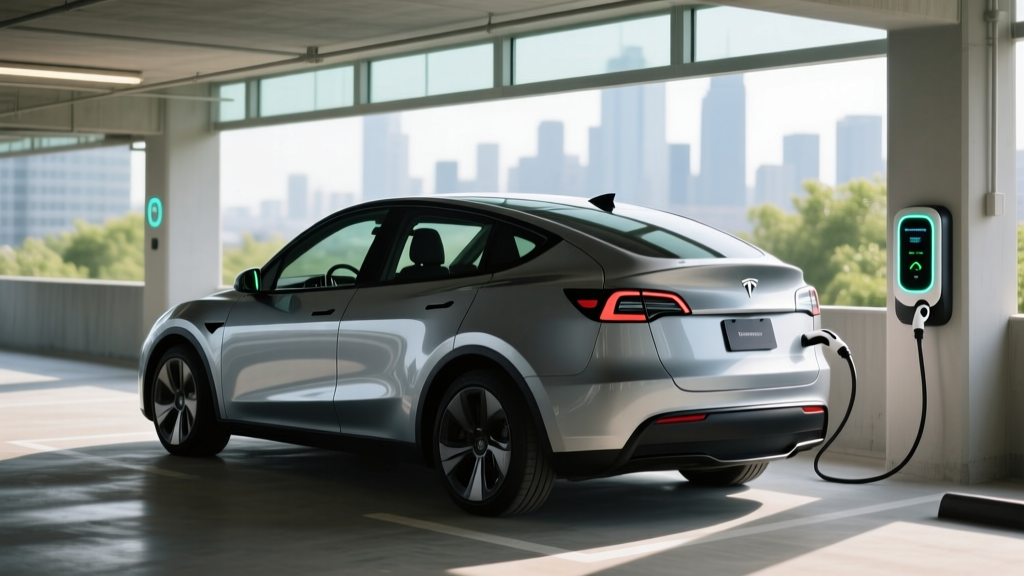
Leasing a Tesla Model Y in 2026 has become a popular entry point for drivers who want access to the Supercharger network and Tesla's tech ecosystem without committing to long-term ownership. But advertised lease rates rarely tell the full story. Between money factors, residual values, mileage caps, and the interplay of federal tax credits, the actual monthly cost of a Model Y lease can vary by hundreds of dollars depending on how you structure the deal.
This guide breaks down what you can expect to pay, how the 2026 Model Y's specs influence lease economics, and whether leasing or buying makes more financial sense for your situation.
2026 Tesla Model Y Lease Rate: The Numbers
Tesla does not offer traditional leases through dealerships the way legacy automakers do. Instead, Tesla provides a finance lease directly through Tesla Financial Services, and in some cases, you can arrange a third-party lease through banks or credit unions that specialize in EV leasing. Here's what the landscape looks like for the 2026 Model Year:
| Trim | MSRP | Est. Monthly Lease (36 mo / 10k mi) | Due at Signing | Money Factor (est.) |
|---|---|---|---|---|
| Long Range RWD | $44,990 | $499–$569 | $4,500–$6,000 | 0.0021–0.0025 |
| Long Range AWD | $47,990 | $539–$619 | $4,500–$6,500 | 0.0021–0.0025 |
| Performance AWD | $52,490 | $599–$689 | $5,000–$7,000 | 0.0022–0.0026 |
Note: These are estimated ranges based on prevailing market conditions and Tesla Financial lease structures in early 2026. Actual rates depend on credit tier, state taxes, and negotiated terms. Third-party lessors may offer different residuals and money factors.
The key variable in any lease is the residual value — what the car is projected to be worth at lease-end. Tesla's residuals have been volatile in recent years as the used EV market fluctuated. For 2026, expect 36-month residuals in the 52–58% range depending on trim, which is slightly below comparable luxury SUVs but reflects the rapid depreciation EVs have experienced.
How the $7,500 Federal Tax Credit Affects Your Lease
Here's where it gets interesting — and where many lessees leave money on the table. Under IRS §30D rules, the federal EV tax credit of up to $7,500 applies to purchases, but there's a critical workaround for leases:
§30D Credit Eligibility Checklist (2026)
- MSRP Cap: Vehicle MSRP must not exceed $80,000 for SUVs (Model Y qualifies at all trims)
- Buyer Income Cap: Modified AGI ≤ $150,000 (single) / $300,000 (joint) for purchase credit
- Battery Sourcing: Critical minerals and battery components must meet phased-in percentage thresholds per IRS guidelines
- Point-of-Sale Transfer: Eligible buyers can transfer the credit to the dealer (or Tesla) at purchase for an immediate price reduction
The lease loophole: When you lease, the $7,500 commercial clean vehicle credit (§45W) goes to the lessor (Tesla Financial or the leasing bank), not to you. The lessor may pass this savings through as a capitalized cost reduction — effectively lowering your monthly payment — but they are not legally required to do so. Always ask explicitly whether the lease quote reflects the passed-through credit.
| Scenario | Monthly Payment (Long Range AWD) | Total 36-Month Cost |
|---|---|---|
| Credit NOT passed through | $589/mo | $26,204 (incl. $5,000 due at signing) |
| Credit fully passed through ($7,500 cap reduction) | $419/mo | $20,084 (incl. $5,000 due at signing) |
That's a difference of over $6,000 across the lease term. Never sign a Tesla lease without confirming how the tax credit is being handled.
Real-World Range and Efficiency: What the EPA Number Doesn't Tell You
The 2026 Model Y Long Range AWD carries an EPA-estimated range of 320 miles on its 78.1 kWh (usable) battery pack, which uses NMC (nickel manganese cobalt) chemistry. The RWD Long Range variant is rated at 307 miles with an LFP (lithium iron phosphate) battery at approximately 60 kWh usable. Here's what that translates to in practice:
Real-World Range Expectations: 2026 Model Y Long Range AWD
EPA Sticker: 320 miles
Highway (70–75 mph, 65°F): ~265–285 miles
City / Suburban Mixed: ~290–310 miles
Cold Weather (30°F, highway): ~220–250 miles (30% reduction is typical for NMC packs without aggressive preconditioning)
Why the gap? EPA testing uses low average speeds and includes regenerative braking recovery. Sustained highway driving at 75 mph consumes significantly more energy. Cold weather increases battery resistance and cabin heating load — the Model Y's heat pump helps but doesn't eliminate the loss.
Efficiency for the Long Range AWD is rated at 122 MPGe combined, or approximately 28 kWh per 100 miles. That's among the most efficient vehicles in its class — Tesla's aerodynamic drag coefficient and drivetrain efficiency remain benchmark standards, as confirmed by fueleconomy.gov data.
Charging Speed: DC Fast Charge and Home Level 2
Charging speed directly impacts road-trip practicality, and the 2026 Model Y continues to use Tesla's proven 400V architecture with the NACS (North American Charging Standard) connector — now the industry standard adopted by Ford, GM, Rivian, and others.
| Charging Level | Power / Rate | Speed | Notes |
|---|---|---|---|
| Level 1 (120V household) | 1.4 kW | ~4 miles/hour | Emergency/trickle only |
| Level 2 (240V home, 48A) | 11.5 kW | ~44 miles/hour | Full charge overnight (~7 hours) |
| DC Fast Charge (V3 Supercharger) | Peak 250 kW | 10–80% in ~22 min | Sustains ~150 kW avg through 50%; tapers sharply above 80% |
| DC Fast Charge (V4 Supercharger) | Peak 250 kW (vehicle-limited) | 10–80% in ~22 min | V4 posts support higher kW, but Model Y's onboard architecture caps at 250 kW |
Charging curve reality check: The 250 kW peak only holds briefly at low state of charge (roughly 5–15% SoC). The sustained average from 10–80% is closer to 150–160 kW. This is normal for 400V architectures — vehicles on 800V platforms (Hyundai Ioniq 5, Kia EV6, Porsche Macan EV) sustain higher rates longer. For most Supercharger stops, plan on 25–30 minutes including plug-in and walk-around time.
Home Level 2 charging at 11.5 kW using a Tesla Wall Connector on a 60A circuit is fast enough to replenish a full day's driving overnight. If your electrical panel supports it, this is the optimal home setup. Budget $800–$2,200 for a professional installation depending on panel proximity and local permit costs.
Performance, Interior Space, and Technology
| Spec | Long Range RWD | Long Range AWD | Performance AWD |
|---|---|---|---|
| 0–60 mph | 5.8 sec | 4.8 sec | 3.5 sec |
| Horsepower | 346 hp | 384 hp | 456 hp |
| Drivetrain | Rear-Wheel Drive | Dual-Motor AWD | Dual-Motor AWD |
| Battery (usable) | ~60 kWh (LFP) | 78.1 kWh (NMC) | 78.1 kWh (NMC) |
| EPA Range | 307 mi | 320 mi | 295 mi |
| Cargo (rear seats up) | 30.2 cu ft | ||
| Cargo (rear seats folded) | 72.1 cu ft | ||
| Rear Legroom | 40.5 in | ||
| Frunk | 4.1 cu ft | ||
| Towing Capacity | 3,500 lbs (with tow package) | ||
Tech highlights: The 2026 Model Y (refreshed "Juniper" generation) features a 15.4-inch center touchscreen, rear-seat 8-inch display, ventilated front seats, ambient lighting, power-folding second row, and Tesla's latest HW4.0 Autopilot computer. The cabin is noticeably quieter than pre-refresh models thanks to acoustic glass and improved insulation.
Driver assistance: Tesla's Basic Autopilot (adaptive cruise + lane centering) is standard. Enhanced Autopilot ($6,000) adds auto lane change, navigate-on-autopilot, and smart summon. Full Self-Driving (Supervised) at $8,000 adds traffic light and stop sign recognition plus city street autosteer. Important: FSD is an SAE Level 2 system — the driver must remain fully engaged and supervising at all times. It is not autonomous driving.
⚠️ FSD (Supervised) Limitations
Tesla's Full Self-Driving remains a Level 2 driver-assist system per SAE classification. The driver is legally and practically responsible for all vehicle operation. FSD may fail to detect construction zones, emergency vehicles, unusual road geometries, and adverse weather conditions. Hands-on-wheel monitoring is enforced. This is not a Level 4 robotaxi system like Waymo.
Warranty Coverage and Long-Term Battery Outlook
Tesla's warranty structure is straightforward but not class-leading:
- Basic Vehicle: 4 years / 50,000 miles
- Battery & Drive Unit (Long Range / Performance): 8 years / 120,000 miles, whichever comes first, with minimum 70% capacity retention
- Battery & Drive Unit (RWD with LFP): 8 years / 100,000 miles, minimum 70% retention
The 70% retention threshold is important context. Tesla's NMC packs have historically degraded about 10–12% over the first 100,000 miles based on fleet data, meaning most owners will stay well above the warranty threshold. LFP packs tend to show less degradation but have lower energy density (hence the shorter range on the RWD model). For a 36-month lease at 10,000 miles per year, battery degradation is a non-issue — you'll return the car with roughly 95%+ capacity remaining.
Is Leasing the Model Y Worth It vs. Buying or Competitors?
Choose to Lease the Model Y If:
- You want lower monthly payments and plan to drive 10,000–12,000 miles/year or less
- You prefer swapping to a new vehicle every 3 years to stay current on tech
- You're uncertain about long-term EV depreciation trends
- You want the lessor to pass through the $7,500 credit as a cap cost reduction regardless of your income eligibility
Choose to Buy the Model Y If:
- You drive more than 12,000 miles/year (lease overage penalties of $0.20–$0.25/mile add up fast)
- You plan to keep the vehicle 5+ years and want to build equity
- You qualify for the full $7,500 §30D credit at purchase (income under caps, battery sourcing met)
- You want to modify the vehicle (wraps, aftermarket wheels, etc.)
Versus key competitors: The Hyundai Ioniq 5 (EPA 305 mi, peak 350 kW DC charging, ~$42,500 base) offers faster charging on 800V architecture and a more distinctive design. The Ford Mustang Mach-E (EPA 320 mi Extended Range, ~$45,995 base) provides a more traditional crossover feel with competitive range. The BMW iX xDrive50 (EPA 316 mi, ~$70,000) targets a more premium segment. None of these competitors, however, match Tesla's Supercharger network density and reliability — which remains a decisive advantage for frequent road-trippers.
Pros
- Best-in-class Supercharger network (20,000+ stalls in North America)
- Excellent efficiency (28 kWh/100mi) keeps charging costs low
- Strong real-world range of 265+ highway miles (Long Range AWD)
- Spacious cargo area (72.1 cu ft) rivals midsize ICE SUVs
- OTA updates continuously add features post-purchase
- Lease structure can capture tax credit without income-cap concerns
Cons
- 250 kW peak DC charge rate trails 800V competitors (Ioniq 5 at 350 kW)
- No Apple CarPlay or Android Auto — Tesla's ecosystem only
- FSD is expensive ($8,000) and still requires full driver supervision
- Tesla's build quality has improved but panel-gap variability remains reported
- Lease mileage penalties are steep if you exceed your allowance
- No physical stalks — turn signals are steering-wheel buttons (Juniper refresh)
Frequently Asked Questions
Can I negotiate a Tesla lease rate?
Not directly with Tesla. Tesla uses a fixed pricing model with no dealer negotiation. However, if you lease through a third-party bank or credit union, you may be able to negotiate the money factor, capitalized cost, or get the lessor to pass through the full $7,500 tax credit as a cap cost reduction. Always compare Tesla Financial's offer with at least two third-party lease quotes.
What happens at the end of a Tesla Model Y lease?
With Tesla Financial leases, you typically must return the vehicle — Tesla has historically not offered a purchase option at lease-end (though this policy has shifted occasionally). Third-party leases may include a purchase option at the residual value. Inspect your contract carefully for disposition fees (typically $395–$495) and excess wear-and-tear standards.
Does the 2026 Model Y qualify for the full $7,500 federal tax credit?
For purchases, yes — the Model Y qualifies for up to $7,500 under IRS §30D, provided the buyer meets income caps ($150K single / $300K joint modified AGI) and the vehicle's battery sourcing meets current-year critical mineral and component thresholds. For leases, the credit goes to the lessor as a commercial vehicle credit — confirm it's passed through to your monthly payment.
How much does it cost to charge a Model Y at home per month?
At the US average electricity rate of ~$0.16/kWh and driving 1,000 miles per month (consuming ~280 kWh), expect to pay roughly $45/month for home charging. This compares to approximately $130–$150/month for gasoline in a comparable 25 MPG AWD SUV at $3.30/gallon. Over a 36-month lease, that's approximately $3,000–$3,800 in fuel savings.
Is the Tesla Model Y a good lease for families?
Yes, if your family fits the space. The 30.2 cu ft cargo area behind the second row accommodates double strollers and groceries. Rear legroom of 40.5 inches is generous for child seats. The 3,500-lb towing capacity handles small trailers. For families regularly needing three rows of seating, the Model X or a three-row competitor like the Kia EV9 is a better fit.
Sources: EPA fueleconomy.gov, IRS §30D Clean Vehicle Credits, Tesla.com official specifications.