2026 Tesla Model Y: The AI Chip Upfront
The 2026 Tesla Model Y arrives with Tesla's Hardware 5 (HW5) AI chip — a processor Tesla claims delivers roughly 5x the compute throughput of the outgoing HW4 computer. For buyers, the AI chip story is less about raw teraflops and more about what it enables: faster object recognition, improved low-light camera processing, and a smoother Full Self-Driving (Supervised) experience. But the Model Y remains a vehicle first, and this review focuses on what actually matters to owners: range, charging speed, interior space, pricing, and whether the HW5 AI chip justifies the upgrade over a 2025 model or a competitor like the Hyundai Ioniq 5 or Ford Mustang Mach-E.
Range, Efficiency, and Real-World Expectations
The 2026 Model Y Long Range AWD carries an EPA-estimated range of 320 miles on its 78.1 kWh (usable) NMC (nickel-manganese-cobalt) battery pack. The base Rear-Wheel-Drive model uses a smaller LFP (lithium iron phosphate) pack at approximately 60 kWh and is rated at 268 miles EPA.
EPA sticker: 320 miles (Long Range AWD)
Highway (70-75 mph, 65°F): Expect 265–285 miles
Cold weather (30°F, highway): Expect 210–240 miles (30–35% loss)
City/regen-heavy driving: 300–315 miles achievable
The Model Y's heat pump helps mitigate cold-weather cabin energy draw, but battery chemistry and physics still dominate. LFP models lose slightly less range percentage in cold but start from a lower EPA baseline.
Efficiency on the Long Range AWD is rated at 122 MPGe combined, or roughly 28 kWh per 100 miles — competitive for the segment. The RWD model edges slightly higher at 125 MPGe combined due to lower weight and single-motor drivetrain losses.
| Spec | RWD (Base) | Long Range AWD | Performance |
|---|---|---|---|
| EPA Range | 268 mi | 320 mi | 295 mi |
| Battery (usable) | ~60 kWh (LFP) | 78.1 kWh (NMC) | 78.1 kWh (NMC) |
| 0–60 mph | 6.5 sec | 4.8 sec | 3.5 sec |
| Horsepower | 315 hp | 384 hp | 456 hp |
| Drivetrain | RWD | Dual-Motor AWD | Dual-Motor AWD |
| MPGe (combined) | 125 | 122 | 115 |
| Peak DC Charge | 170 kW | 250 kW | 250 kW |
| Base MSRP | $44,990 | $48,990 | $53,990 |
Charging Speed: DC Fast, Level 2, and the HW5 Advantage
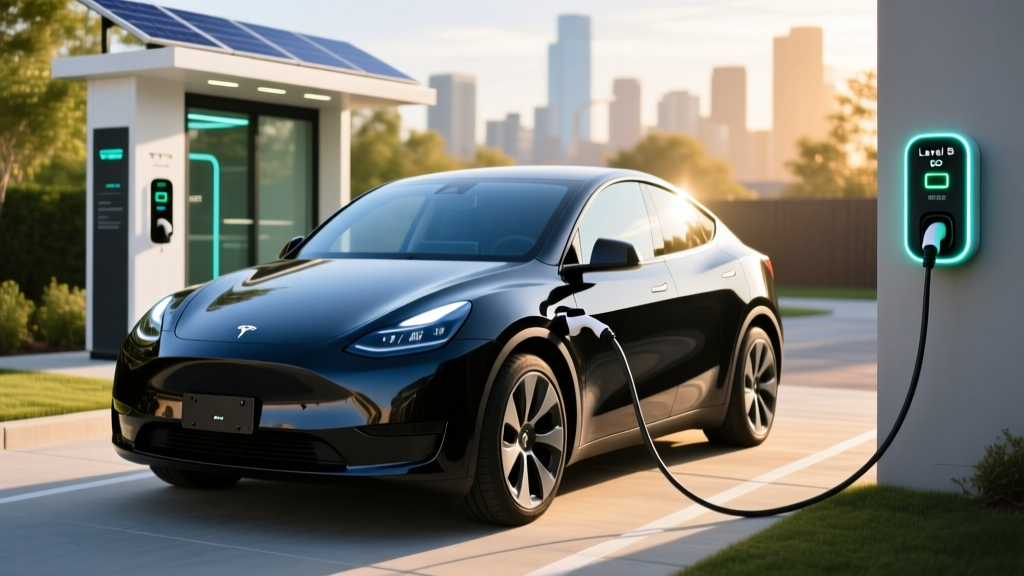
The 2026 Model Y Long Range and Performance trims peak at 250 kW on a DC fast charger (Tesla Supercharger V3 or equivalent CCS/NACS station). The RWD trim with its LFP pack tops out at 170 kW. Tesla's NACS connector is now the industry standard, and the Model Y ships with the native NACS port — no adapter needed for the Supercharger network.
| Charging Level | Power | Miles Added per Hour | Notes |
|---|---|---|---|
| Level 1 (120V) | ~1.4 kW | ~3–5 mi/hr | Emergency/trickle only |
| Level 2 (240V, 48A) | 11.5 kW | ~37–44 mi/hr | Home Wall Connector or equivalent |
| DC Fast (Long Range) | Peak 250 kW | ~18 min (10–80%) | Tapers above 60% SoC |
| DC Fast (RWD/LFP) | Peak 170 kW | ~25 min (10–80%) | LFP can charge to 100% regularly |
On a real Supercharger, expect the Long Range to sustain 200+ kW up to roughly 40% state of charge, then taper progressively. The 10–80% time of approximately 18 minutes holds under optimal conditions (battery preconditioned via navigation routing to the charger). Without preconditioning — say, arriving at a random charger without the car's thermal management preparing the pack — add 5–8 minutes.
The HW5 AI chip plays a subtle role here: Tesla's updated battery management algorithms, powered by the more capable processor, optimize preconditioning timing and charge-curve prediction. In practice, this means marginally better sustained charge rates in marginal conditions (cold ambient temps, partial SoC starts).
Performance and Driving Dynamics
The Model Y Performance drops the 0–60 mph time to 3.5 seconds with 456 horsepower from its dual-motor setup. The Long Range AWD splits the difference at 4.8 seconds and 384 hp. Even the base RWD at 6.5 seconds is brisk by crossover standards.
Ride quality remains the Model Y's most-cited compromise. The 2026 refresh carries over the updated suspension tuning from the "Juniper" refresh introduced in 2025, which softened the low-speed impacts and reduced road noise noticeably compared to pre-2025 cars. It's still firmer than a Hyundai Ioniq 5 or Kia EV6, but the gap has narrowed. Steering is precise, body control is tight, and the low center of gravity makes it feel planted through corners in a way that belies its crossover ride height.
Interior, Cargo, and Daily Practicality
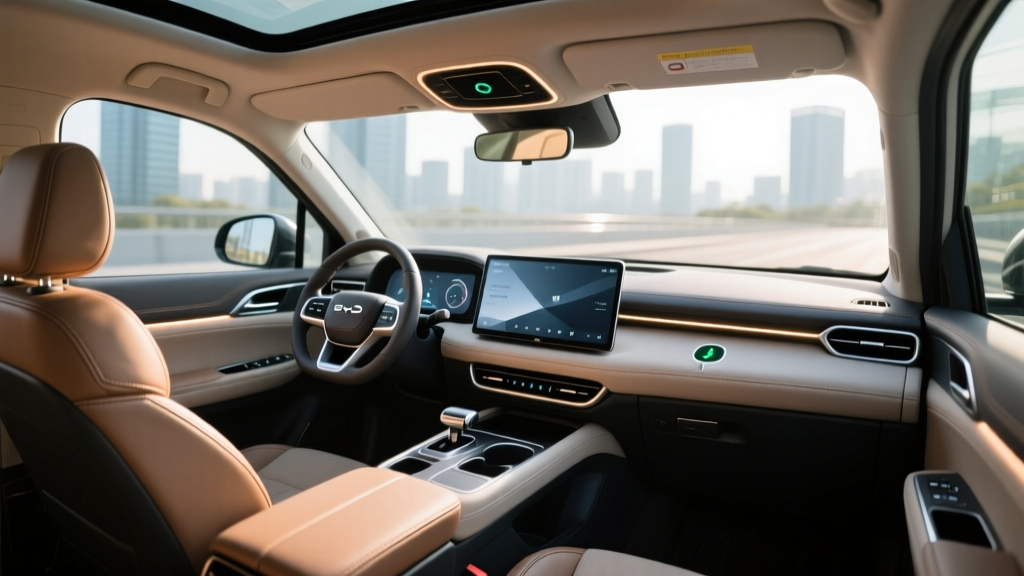
The 2026 Model Y's cabin follows Tesla's minimalist ethos: a single 15.4-inch touchscreen dominates the dash, with a rear 8-inch screen for second-row passengers. Build quality has improved incrementally — panel gaps are tighter, and the ventilated front seats (added in the Juniper refresh) are a welcome upgrade for warm climates.
Cargo volume stands at 30.2 cubic feet behind the second row and 72.1 cubic feet with the rear seats folded. The front trunk (frunk) adds 4.1 cubic feet — useful for charging cables or a small bag. Rear legroom measures 40.5 inches, adequate for adults on longer trips.
Standout tech features include:
- HW5 AI chip powering Autopilot and FSD (Supervised) with improved camera processing
- Sentry Mode with enhanced object detection and reduced battery drain
- Dashcam recording from all external cameras
- Over-the-air updates continuously adding features
- Tesla app integration with climate preconditioning, location sharing, and service scheduling
Notable drawbacks:
- No physical buttons for climate or volume — all touchscreen-mediated
- No Apple CarPlay or Android Auto
- Turn signals on the steering wheel yoke (if equipped) remain polarizing
- Rear visibility is limited by the sloping roofline — reliance on the backup camera is high
Tesla's Autopilot and Full Self-Driving (Supervised) are SAE Level 2 driver-assistance systems. The driver must remain attentive, keep hands on the wheel (or demonstrate engagement via camera monitoring), and be prepared to take over at any moment. This is not autonomous driving. Tesla's "FSD" branding can be misleading — no consumer Tesla is capable of unsupervised self-driving. Only Level 4 services like Waymo operate without a human driver in defined geofenced areas.
Pricing, Tax Credits, and Total Cost
The 2026 Model Y lineup starts at $44,990 for the RWD, $48,990 for the Long Range AWD, and $53,990 for the Performance. Adding FSD (Supervised) costs $8,000 as a one-time purchase or $99/month. Premium interior colors and 20-inch wheels add $1,000–$2,000 each.
| Trim | Base MSRP | §30D Credit Eligible? | Effective Price* |
|---|---|---|---|
| RWD | $44,990 | Yes (if sourcing rules met) | ~$37,490 |
| Long Range AWD | $48,990 | Yes (if sourcing rules met) | ~$41,490 |
| Performance | $53,990 | Yes (if sourcing rules met) | ~$46,490 |
*Effective price assumes full $7,500 federal tax credit under IRS §30D. Actual eligibility depends on buyer income, battery critical-mineral sourcing, MSRP caps, and point-of-sale transfer rules. Consult a tax professional and check IRS.gov for current-year requirements.
- Vehicle MSRP must not exceed $80,000 for SUVs (Model Y qualifies)
- Buyer modified adjusted gross income: ≤$300,000 (joint), ≤$225,000 (head of household), ≤$150,000 (single)
- Battery critical minerals and components must meet escalating domestic-sourcing thresholds (Tesla has historically met these for US-built Model Y, but verify current-year compliance)
- Credit can be transferred to the dealer at point of sale for an immediate price reduction
- Vehicle must be assembled in North America (Model Y is built in Austin, TX and Fremont, CA)
Warranty and Long-Term Ownership
Tesla covers the Model Y with a 4-year/50,000-mile basic warranty and an 8-year/120,000-mile battery and drive unit warranty for Long Range and Performance trims. The RWD (LFP) battery warranty is 8 years/100,000 miles. The battery warranty guarantees at least 70% capacity retention over the warranty period.
Tesla's LFP batteries (in the RWD) historically show slower degradation than NMC packs — many owners report 90%+ capacity retention after 100,000 miles. NMC packs in the Long Range typically settle at 85–90% retention over the same distance. Real-world replacement costs outside warranty range from $12,000–$16,000 for the pack, though complete failures are rare.
Pros, Cons, and Who Should Buy
- Access to the Supercharger network — the most reliable DC fast-charging ecosystem in the US
- HW5 AI chip enables the best vision-based driver-assist system available (with supervision)
- Strong efficiency: 122 MPGe combined means lower electricity costs per mile
- Over-the-air updates continuously improve the vehicle post-purchase
- Spacious cargo area (72.1 cu ft max) with practical frunk
- Competitive pricing after potential $7,500 tax credit
- No Apple CarPlay/Android Auto — a dealbreaker for some buyers
- All-touchscreen interface frustrates drivers who prefer physical controls
- Ride quality, while improved, still trails Hyundai/Kia competitors for comfort
- FSD ($8,000 or $99/mo) remains a Level 2 system despite the premium price
- Insurance costs run 15–25% higher than segment average in many states
- Rear visibility compromised by coupe-like roofline
- Choose the Model Y if: You want Supercharger access for road trips, value OTA updates and tech integration, and want a practical family EV with strong efficiency and cargo space.
- Consider the Ioniq 5 or EV6 instead if: You prioritize ride comfort, want CarPlay/Android Auto, prefer physical buttons, or need 800V charging for faster DC sessions on non-Tesla networks.
- Consider the Mach-E if: You want a more traditional crossover feel, BlueCruise hands-free driving on mapped highways, or prefer a Ford dealer for service.
Frequently Asked Questions
What is the real-world range of the 2026 Tesla Model Y?
The Long Range AWD is EPA-rated at 320 miles, but expect 265–285 miles on highway trips at 70+ mph, and 210–240 miles in freezing weather. City driving with regenerative braking can approach or slightly exceed the EPA number.
How fast does the 2026 Model Y charge?
Long Range and Performance trims peak at 250 kW DC, achieving 10–80% in roughly 18 minutes when the battery is preconditioned. The RWD peaks at 170 kW with a 10–80% time of about 25 minutes. Home Level 2 charging at 11.5 kW adds roughly 37–44 miles per hour.
Does the 2026 Model Y qualify for the federal EV tax credit?
The Model Y has historically qualified for the full $7,500 §30D credit when built with compliant battery sourcing. Eligibility depends on your income, the vehicle's MSRP (under the $80,000 SUV cap), and current-year critical-mineral sourcing rules. Verify at IRS.gov before purchasing.
What does the HW5 AI chip actually do for me?
HW5 provides roughly 5x the compute of HW4, enabling faster and more accurate object detection for Autopilot and FSD (Supervised), better low-light camera performance, and improved Sentry Mode efficiency. It does not make the car autonomous — it makes the Level 2 driver-assist system more responsive and reliable.
Is the 2026 Model Y worth buying over the Hyundai Ioniq 5?
The Model Y wins on Supercharger network access, efficiency (MPGe), OTA updates, and cargo volume. The Ioniq 5 wins on ride comfort, 800V charging speed on CCS networks, CarPlay/Android Auto, and physical controls. Your priority list determines the winner.
How much does FSD cost and is it worth it?
FSD (Supervised) costs $8,000 upfront or $99/month. It remains a Level 2 system requiring driver attention. Most owners find the monthly subscription more sensible than the purchase until Tesla demonstrates true unsupervised capability. Basic Autopilot (included) handles highway lane-keeping and adaptive cruise adequately for most drivers.