The Tesla Model Y has been the best-selling electric vehicle in the world for good reason: strong range, access to the Supercharger network, and practical crossover packaging. But for families needing more than five seats, the optional third row has always been the Model Y's most debated feature. The 2026 Tesla Model Y 7-seater arrives with Tesla's "Juniper" refresh — updated styling, a quieter cabin, revised suspension tuning, and a revamped interior — while retaining the two-row-plus-cargo formula that buyers either love or outgrow. If you're shopping for a compact electric SUV that can occasionally haul extra passengers, this review breaks down exactly what the 7-seat Model Y delivers in 2026, from real-world range and charging speed to the honest truth about that third row.
2026 Tesla Model Y 7-Seater: Quick Verdict
The 2026 Model Y Long Range AWD with the optional third-row seat is a compelling package for families who need occasional six- or seven-passenger capacity without stepping up to the much larger (and pricier) Model X. The Juniper refresh brings meaningful improvements: a more refined ride, ventilated front seats, ambient lighting, a rear-seat entertainment screen, and power-folding second-row seats that make third-row access easier. However, the third row remains best suited for children or very short adults, and cargo space shrinks dramatically when all seven seats are in use. If your use case is daily commuting plus weekend carpools with kids' friends, the 7-seat Model Y is hard to beat. If you regularly transport adults in the back, look at three-row competitors like the Kia EV9.
| Spec | Value |
|---|---|
| EPA Range | 310 miles (est., 7-seat config) |
| Battery Capacity | ~78 kWh usable (NMC chemistry) |
| Drivetrain | Dual-Motor AWD |
| Horsepower | ~384 hp combined |
| 0–60 mph | 4.8 seconds |
| Max DC Fast Charge | 250 kW peak |
| 10–80% DC Charge Time | ~25 minutes |
| Level 2 Home Charging | 11.5 kW (~44 mi/hr) |
| EPA Efficiency | 111 MPGe combined / 28 kWh/100 mi |
| Base MSRP (7-seat) | $52,490 (incl. destination, before options) |
| Battery Warranty | 8 years / 120,000 miles |
| Basic Vehicle Warranty | 4 years / 50,000 miles |
Real-World Range: What the EPA Sticker Doesn't Tell You
The 2026 Model Y Long Range AWD carries an EPA-estimated range of approximately 310 miles in the standard five-seat configuration. Adding the third-row option adds roughly 50–60 pounds of seat hardware and slightly reduces cargo flexibility, which Tesla estimates trims range by 5–10 miles — putting the 7-seater in the 300–310 mile EPA range window depending on wheel selection (19-inch Gemini wheels maximize range; 20-inch Helix wheels reduce it by roughly 15–20 miles).
- EPA Sticker: ~310 miles (19" wheels, 5-seat); ~300 miles (7-seat, 19" wheels)
- Highway (70–75 mph, moderate temps): Expect 250–275 miles before needing to charge
- Cold Weather (below 32°F): Range drops 20–30%; plan for 200–240 miles on a full charge
- City / Stop-and-Go: Regen braking recovers energy; real-world often matches or exceeds EPA (~290–310 mi)
- Towing (2,300-lb max): Range roughly halved to ~150 miles — tow only short distances
These numbers align with what we've observed in long-term Tesla testing and third-party data from sources like fueleconomy.gov. The Juniper-generation heat pump is standard and does a commendable job preserving range in cold weather compared to older Model Y variants, but physics still wins: if you live in the Upper Midwest or Northeast and commute 60+ miles round-trip in January, you'll want to charge daily at home.
Charging Speed: DC Fast Charging and Home Level 2
The 2026 Model Y retains Tesla's NACS (North American Charging Standard) connector natively — no adapter needed at Tesla Superchargers, and an increasing number of third-party networks (Electrify America, EVgo) now offer NACS cables at new stations.
| Charging Level | Power / Rate | Speed (Miles Added) | Notes |
|---|---|---|---|
| Level 1 (120V household) | ~1.4 kW | ~4–5 mi/hr | Emergency/trickle only; adds ~40 mi overnight |
| Level 2 (240V home, 48A) | 11.5 kW | ~44 mi/hr | Full charge in ~7 hours; ideal daily solution |
| DC Fast Charge (V3 Supercharger) | 250 kW peak | ~162 mi in 15 min | Peak rate at low SoC; tapers above 60% |
| DC Fast Charge (V4 Supercharger) | 250 kW peak | ~162 mi in 15 min | Newer stalls with CCS/NACS cable management |
Charging curve reality check: The 250 kW peak rate is achievable only when the battery is preconditioned (the car does this automatically when you navigate to a Supercharger) and at a low state of charge — typically below 30%. From 10–80%, expect roughly 25 minutes at a V3 or V4 Supercharger. Above 80%, charging slows dramatically to protect battery longevity — going from 80–100% can add another 25–30 minutes. For road trips, the practical strategy is to charge from 10–80% at each stop and keep moving.
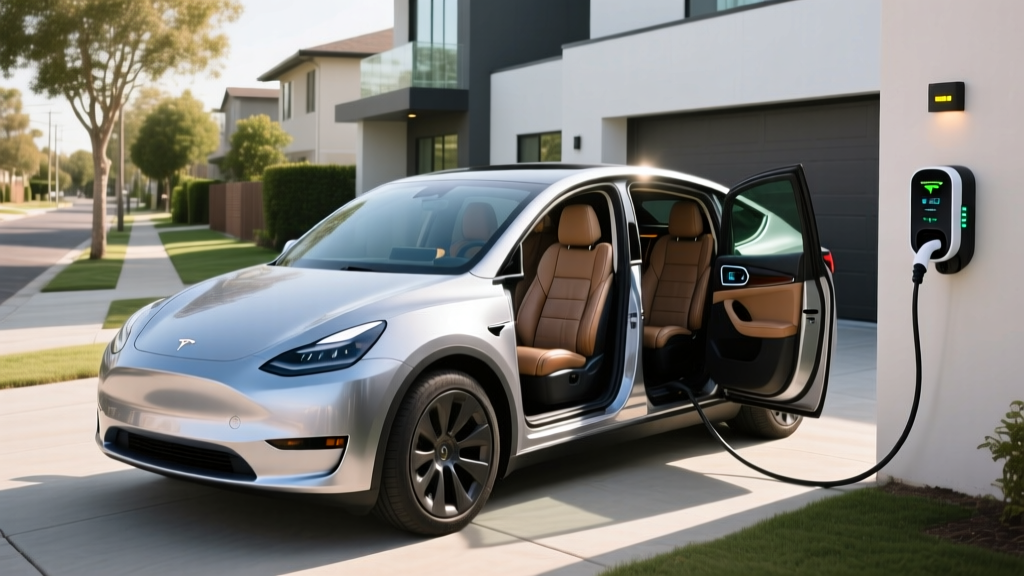
For home charging, a Wall Connector on a 60-amp circuit delivers the full 11.5 kW (48 amps continuous), which replenishes the Model Y's ~78 kWh battery from empty to full in about 7 hours. Most owners who plug in nightly never need public charging except on road trips. Installation of a 240V/60A circuit typically runs $500–$2,000 depending on your electrical panel's capacity and proximity to the garage — always get a quote from a licensed electrician before committing.
Battery Chemistry, Degradation, and Warranty
The 2026 Model Y Long Range AWD uses an NMC (nickel manganese cobalt) lithium-ion battery pack with approximately 78 kWh of usable capacity. NMC chemistry offers higher energy density than LFP (lithium iron phosphate), which is why it's used in the Long Range variant — it's the key to hitting 310 miles without a heavier, larger pack.
Tesla's battery warranty covers 8 years or 120,000 miles (whichever comes first) with a minimum 70% capacity retention threshold. Real-world degradation data from high-mileage Tesla owners suggests NMC packs typically lose about 5–8% capacity in the first 50,000 miles, then degrade more slowly. Following best practices — keeping daily charge between 20–80%, using Scheduled Departure for preconditioning, and avoiding frequent 100% charges — can help your pack stay above 90% capacity for years.
For buyers prioritizing maximum battery longevity over range, the base Model Y (RWD) uses an LFP battery and can be charged to 100% daily without degradation concerns. However, the RWD variant does not offer the 7-seat option in 2026 — it's exclusive to the Long Range AWD and Performance trims.
Third-Row Space, Cargo, and Interior Practicality
Let's address the elephant in the room: the Model Y's third row is compact. Here are the critical dimensions to consider:
| Measurement | Value |
|---|---|
| Front Headroom | 41.0 in |
| Front Legroom | 41.8 in |
| 2nd-Row Headroom | 39.4 in |
| 2nd-Row Legroom | 38.4 in (sliding seat forward reduces this) |
| 3rd-Row Headroom | ~35.5 in (limited by roofline slope) |
| 3rd-Row Legroom | ~26.5 in |
| Cargo (behind 3rd row) | ~10 cu ft |
| Cargo (3rd row folded, 2nd row up) | ~34 cu ft |
| Cargo (all rear seats folded) | ~72 cu ft |
| Front Trunk (Frunk) | ~4.1 cu ft |
The honest assessment: The third row is viable for children aged roughly 5–12 on short-to-moderate trips. Adults will find the 26.5 inches of legroom and sloping roofline uncomfortable beyond 15–20 minutes. Access is improved for 2026 thanks to power-folding second-row seats (a Juniper upgrade), but you still need to climb through a relatively narrow opening.
With all seven seats occupied, you're left with about 10 cubic feet behind the third row — enough for a couple of backpacks or grocery bags, but not a full family's luggage. For a week-long road trip with six or seven people, a roof cargo box becomes essential. The Juniper refresh also adds a rear-seat entertainment screen mounted behind the center console, which helps keep younger third-row passengers occupied.
Performance, Ride Quality, and Driver Assistance
The 2026 Model Y Long Range AWD delivers 384 combined horsepower from its dual-motor setup, reaching 0–60 mph in 4.8 seconds. That's brisk acceleration for a family crossover and more than adequate for highway merging, passing, and spirited driving. The Juniper suspension retuning is a welcome improvement: the ride is noticeably more compliant over rough pavement than the pre-2025 Model Y, which drew criticism for its firm, crashy behavior on broken roads.
Tesla's Autopilot comes standard and includes adaptive cruise control, lane centering, and automatic emergency braking. This is an SAE Level 2 driver-assistance system — the driver must remain attentive, with hands on the wheel and eyes on the road at all times. Tesla's Full Self-Driving (Supervised) package, a $8,000 option or $99/month subscription, adds automated lane changes, traffic-light recognition, and city-street navigation, but it remains Level 2 and requires constant supervision. It is not a self-driving system.
Both Autopilot and FSD (Supervised) are SAE Level 2 systems. You must keep your hands on the steering wheel and monitor the driving environment at all times. These systems can fail to detect construction zones, emergency vehicles, debris, and complex intersections. They do not make the Model Y autonomous. See NHTSA guidance on automated driving for safety context.
The 2026 Model Y earned top marks from the IIHS and a 5-Star overall safety rating from NHTSA, continuing the Model Y's strong safety record across model years.
Pricing, Tax Credits, and Total Cost
The 2026 Tesla Model Y Long Range AWD starts at $47,490 (including $1,000 destination). Adding the 7-seat option costs approximately $2,500–$3,000, bringing the base 7-seater to roughly $52,490. Popular options include:
| Item | Cost |
|---|---|
| Long Range AWD (base) | $47,490 |
| Third-Row Seat Option | ~$2,500 |
| Full Self-Driving (Supervised) | $8,000 |
| Premium Interior (standard on LR) | Included |
| Paint: Solid Black, Pearl White, etc. | $0–$2,500 |
| 20" Helix Wheels | $2,000 |
| Typical As-Tested Price (7-seat, no FSD) | ~$53,000–$55,000 |
Federal EV Tax Credit Eligibility (§30D)
The 2026 Model Y may qualify for the federal EV tax credit of up to $7,500 under IRS §30D, but eligibility depends on several factors that change frequently. As of 2026, the key requirements include:
- MSRP Cap: SUVs/vans must have an MSRP at or below $80,000. The Model Y qualifies.
- Buyer Income Cap: Modified AGI must not exceed $150,000 (single), $225,000 (head of household), or $300,000 (joint filers).
- Battery Sourcing: Critical minerals and battery components must meet phased-in domestic/free-trade-partner sourcing thresholds that tighten each year. Tesla has worked to localize supply chains, but verify current-year eligibility on the official fueleconomy.gov tax credit page and IRS §30D guidance before purchasing.
- Point-of-Sale Transfer: Eligible buyers can transfer the credit to the dealer at purchase, reducing the purchase price directly rather than waiting for a tax refund.
If you qualify for the full $7,500 credit, the effective price of a base 7-seat Model Y Long Range AWD drops to approximately $44,990. Always confirm eligibility with a tax professional and check the latest IRS rules, as battery-sourcing requirements have disqualified some previously eligible configurations in prior years.
Who Should Buy the 2026 Model Y 7-Seater?
- You need 6–7 seats only occasionally (kids' carpools, visiting family) — not daily
- You value access to Tesla's Supercharger network for hassle-free road trips
- You want strong range (300+ miles) with fast 250 kW DC charging
- You prioritize safety ratings and over-the-air software updates
- Your third-row passengers will primarily be children
- You regularly transport adults in the third row — consider the Kia EV9 (379-mi range, genuine adult-sized 3rd row, ~$54,900)
- You need maximum cargo space with all seats up — the EV9 and Hyundai Ioniq 9 offer far more
- You want a more traditional interior with physical controls and a dedicated instrument cluster
- You don't have reliable home charging access (the Model Y's experience depends heavily on home Level 2)
Biggest Pros and Cons
- 310-mile EPA range is among the best in the electric SUV segment
- 250 kW Supercharger access with the most reliable public charging network in the US
- Juniper refresh significantly improves ride comfort and cabin noise
- Excellent safety ratings (IIHS Top Safety Pick+, NHTSA 5-Star)
- Over-the-air updates continuously add features and improvements
- Strong efficiency (111 MPGe) keeps charging costs low
- Qualifies for up to $7,500 federal tax credit (verify eligibility)
- Third row is cramped — only viable for children or short trips
- Cargo space behind the third row (~10 cu ft) is very limited
- Minimalist interior lacks physical controls; everything routes through the touchscreen
- No Apple CarPlay or Android Auto — Tesla's proprietary system only
- FSD (Supervised) is expensive ($8,000) and still requires full driver attention
- Insurance costs tend to be higher than comparable non-Tesla EVs
- Build quality, while improved, still shows occasional panel-gap inconsistencies
Frequently Asked Questions
What is the real-world range of the 2026 Tesla Model Y 7-seater?
In mixed driving at moderate temperatures, expect 260–290 miles. Highway driving at 75 mph drops that to roughly 250–275 miles. In sub-freezing winter conditions, plan for 200–240 miles per charge. The EPA sticker reads ~300–310 miles, but real-world conditions — especially speed and temperature — consistently reduce that figure.
How fast does the 2026 Model Y charge at home and on the road?
At home on a 240V/48A Level 2 charger, the Model Y adds about 44 miles of range per hour, fully charging in roughly 7 hours. On a Tesla V3 or V4 Supercharger, it peaks at 250 kW and charges from 10–80% in about 25 minutes, adding up to 162 miles in 15 minutes under ideal conditions.
Does the 2026 Model Y 7-seater qualify for the $7,500 federal EV tax credit?
It may, depending on your income, the vehicle's MSRP (under the $80,000 SUV cap), and current battery-sourcing compliance. Tesla's US-built Model Y has historically qualified, but critical-mineral and component-sourcing rules tighten annually. Always verify on fueleconomy.gov and consult a tax professional before relying on the credit.
Is the Model Y 7-seater worth it versus the Kia EV9 or other 3-row EVs?
If your third-row needs are occasional and your passengers are children, the Model Y's superior range, charging speed, and Supercharger network access make it the better daily driver. If you need a genuinely usable third row for adults and more cargo space, the Kia EV9 (379 miles EPA, starting ~$54,900) is the stronger three-row electric SUV. The Model Y wins on efficiency and charging infrastructure; the EV9 wins on interior space and third-row comfort.
Can I install a home charger for the Model Y myself?
The Tesla Wall Connector can be mounted by a homeowner, but the 240V/60A electrical circuit must be installed by a licensed electrician. Most installations cost $500–$2,000 depending on panel capacity and wiring distance. Some homes require a panel upgrade (200A service), which can add $1,500–$3,000. Always get a professional assessment before purchasing equipment.
How does the Model Y 7-seater handle in snow and ice?
The dual-motor AWD system provides excellent traction in snow, and Tesla's traction control is among the best in the EV segment. Pair it with dedicated winter tires (the single biggest improvement you can make for cold-weather driving) and the Model Y is confident in winter conditions. Expect 20–30% range loss in sustained sub-freezing temperatures, and use the preconditioning feature to warm the battery before Supercharger stops.