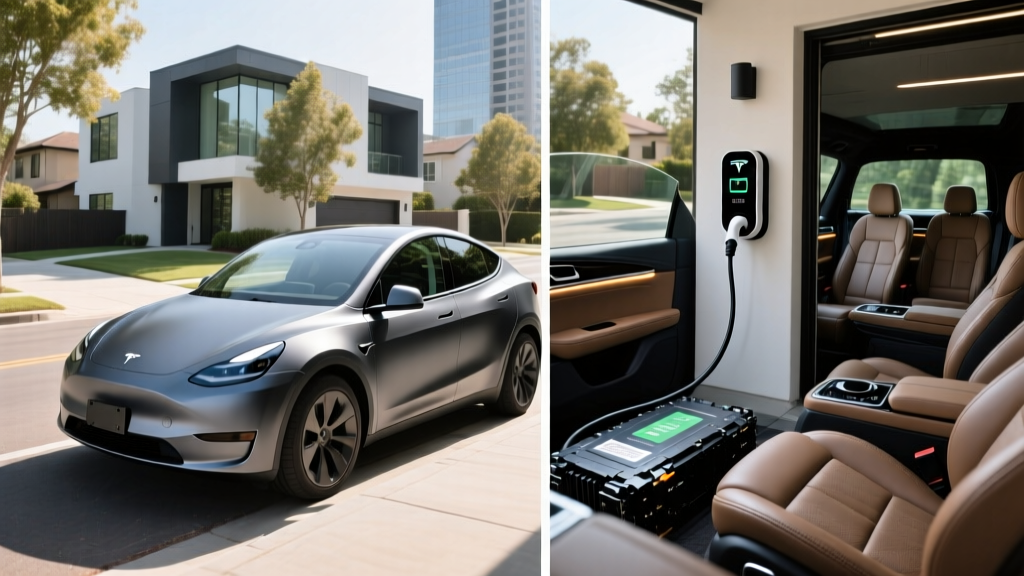
The Tesla Model Y has long dominated the electric crossover segment, but for families needing more than five seats, the options have been limited. The 2026 Tesla Model Y with the optional third-row seat changes that equation, offering a six-passenger layout in one of the most efficient and best-selling EVs on the market. But shoehorning a third row into a midsize crossover inevitably involves compromises. This review examines the 6-seat Tesla Model Y's real-world range, charging performance, pricing after federal tax credits, and whether that extra row is genuinely usable or simply a marketing checkbox.
Quick Verdict: Who Should Consider the 6-Seat Model Y?
The 6-seat Tesla Model Y is best suited for families who occasionally need to transport five or six passengers — think school carpools, visiting grandparents, or weekend outings with friends — but don't need the full-time third-row space of a larger SUV like the Tesla Model X or Rivian R1S. The third row works well for children and shorter adults on trips under an hour. For daily commuting with all six seats occupied, taller passengers will find the rear row cramped. If your use case involves frequent full-capacity hauling, a three-row dedicated SUV is the better choice. For everyone else, the 6-seat Model Y delivers outstanding efficiency, access to the Supercharger network, and a compelling price point in the electric family-hauler segment.
2026 Tesla Model Y 6-Seat: Full Specifications
| Specification | Value |
|---|---|
| EPA Estimated Range | 320 miles |
| Battery Capacity (Usable) | ~78 kWh (NMC chemistry) |
| Drivetrain | Dual-Motor All-Wheel Drive |
| Horsepower | 384 hp (combined) |
| 0–60 mph | 4.8 seconds |
| Max DC Fast-Charge Rate | 250 kW (peak) |
| 10–80% DC Fast Charge | ~25 minutes |
| Level 2 Home Charging | 11.5 kW (~44 miles/hr) |
| MPGe (Combined) | 122 MPGe |
| Efficiency | 28 kWh/100 mi |
| Seating Capacity | 6 (2+2+2 layout) |
| Cargo (Behind 3rd Row) | ~12 cu ft |
| Cargo (3rd Row Folded) | ~34 cu ft |
| Cargo (All Rows Folded) | ~72 cu ft |
| 3rd-Row Legroom | ~26.5 inches |
| Base MSRP (Long Range AWD) | $44,630 |
| 6-Seat Option | +$2,000 |
| As-Tested (6-Seat, No Add-Ons) | $46,630 |
| Battery & Drive Unit Warranty | 8 years / 120,000 miles |
| Basic Vehicle Warranty | 4 years / 50,000 miles |
Range and Efficiency: EPA Numbers vs. Real-World Driving
The 2026 Model Y Long Range AWD carries an EPA-estimated range of 320 miles. Adding the third-row seat option adds approximately 60–80 pounds of hardware but does not materially alter the EPA rating, as Tesla certifies the vehicle platform rather than individual option configurations. However, real-world range depends heavily on driving conditions, and the 6-seat configuration typically means more passengers and cargo — which does affect consumption.
- City / suburban driving (moderate climate): 290–310 miles — regenerative braking recovers energy in stop-and-go traffic.
- Highway driving at 70–75 mph: 255–280 miles — aerodynamic drag dominates at sustained speed.
- Cold weather (below 32°F) mixed driving: 220–260 miles — battery heating and cabin HVAC reduce effective range by 15–30%.
- Full passenger + cargo load, highway, cold: 200–235 miles — worst-case scenario for road-trip planning.
At 122 MPGe combined and 28 kWh per 100 miles, the Model Y remains one of the most efficient electric crossovers available. For context, the Ford Mustang Mach-E Extended Range AWD achieves 101 MPGe combined, and the Hyundai Ioniq 5 AWD lands at 110 MPGe. Tesla's powertrain efficiency, aided by the heat pump standard on all trims, gives it an edge in both range and operating cost. According to fueleconomy.gov, the Model Y Long Range AWD costs approximately $550 per year in electricity at 15,000 miles of annual driving — roughly one-third the fuel cost of a comparable gasoline crossover.
Charging Performance: DC Fast Charging and Home Setup
Charging speed is where the Model Y's 400-volt architecture shows its age compared to 800-volt competitors like the Hyundai Ioniq 5 and Kia EV6. The Model Y peaks at 250 kW on a V3 Supercharger or equivalent CCS/NACS DC fast charger, but that peak is not sustained throughout the session.
| Charging Level | Power | Speed (Miles Added) | Notes |
|---|---|---|---|
| Level 1 (120V household) | ~1.4 kW | ~5 miles/hour | Emergency/top-up only; full charge takes 55+ hours |
| Level 2 (240V, 48A) | 11.5 kW | ~44 miles/hour | Full charge in ~7 hours; ideal for overnight home charging |
| DC Fast (Peak) | 250 kW | ~162 miles in 15 min | Peak rate from ~10–30% SoC; tapers significantly above 60% |
| DC Fast (10–80%) | Avg ~150 kW | ~25 minutes | Sustained rate drops as SoC climbs; preconditioning essential |
Charging curve reality: The Model Y's charge rate peaks near 250 kW at a low state of charge (10–20% SoC) and tapers progressively. From 60–80%, expect rates closer to 80–100 kW. This means the commonly cited "10–80% in 25 minutes" is achievable only if you arrive at the charger with preconditioning active — the car must navigate to a Supercharger or manually precondition the battery. Skipping preconditioning in cold weather can add 10–15 minutes to your session.
For home charging, Tesla's Wall Connector at $475 (hardware only) delivers up to 11.5 kW on a 60-amp circuit. A professional installation typically costs $500–$2,000 depending on your electrical panel's proximity to the garage and whether a panel upgrade (to 200A service) is needed. Budget $1,200–$2,500 total for a complete home Level 2 setup. For most owners, overnight Level 2 charging covers all daily driving needs and eliminates routine visits to public chargers.
Performance and Driving Dynamics
The 2026 Model Y Long Range AWD produces 384 combined horsepower from its dual-motor setup, delivering a 4.8-second 0–60 mph time. That's brisk for a family crossover — quicker than the Mach-E Premium AWD (5.1 sec) and the Ioniq 5 AWD (5.2 sec). Instant torque from the electric motors provides confident highway merging and passing, even with a full load of six passengers.
Ride quality has improved with the 2025 refresh, which introduced revised suspension tuning and acoustic glass. The Model Y absorbs highway imperfections more competently than earlier model years, though it still favors firmness over plushness. The low center of gravity from the under-floor battery pack keeps body roll minimal in corners, and the steering is precise if somewhat artificial in feel.
Tesla's Autopilot comes standard and includes Traffic-Aware Cruise Control and Autosteer (lane-centering). This is an SAE Level 2 driver-assistance system — the driver must remain engaged, hands on or near the wheel, and eyes on the road at all times. Full Self-Driving (Supervised) is available as a $8,000 option or $99/month subscription, adding automatic lane changes, navigation-guided on/off-ramp handling, and traffic-light recognition. Despite the name, FSD remains Level 2 and requires active supervision. It is not a self-driving system.
Interior, Third-Row Usability, and Cargo Space
The Model Y's cabin follows Tesla's minimalist ethos: a single 15.4-inch touchscreen handles infotainment, climate, and vehicle settings, with a secondary 8-inch screen for rear passengers. Material quality is good for the price point, with vegan leather upholstery and soft-touch surfaces on the dashboard and door panels.
Third-row reality: The 6-seat option uses a 2+2+2 layout with two individual seats in the third row. Legroom in the third row is approximately 26.5 inches — sufficient for children aged 4–12 or shorter adults on brief trips. Headroom is tight for anyone over 5'6" due to the sloping roofline. The second-row seats slide forward to improve third-row access, but this reduces second-row legroom from a generous 41.6 inches to roughly 34 inches. Entry and exit to the third row requires some agility; the door opening is narrower than a dedicated three-row SUV.
Cargo space is the most significant trade-off. With the third row upright, you get approximately 12 cubic feet — enough for a few grocery bags or a compact stroller, but not both simultaneously. Fold the third row flat, and cargo volume expands to roughly 34 cubic feet, competitive with five-seat midsize crossovers. With all rear rows folded, maximum capacity reaches about 72 cubic feet. The front trunk (frunk) adds approximately 4 cubic feet for charging cables or a small bag.
Pricing, Tax Credits, and Ownership Costs
The 2026 Tesla Model Y Long Range AWD starts at $44,630 MSRP (including destination). The 6-seat third-row option adds $2,000, bringing the entry price to $46,630. Popular add-ons include:
- Full Self-Driving (Supervised): +$8,000 or $99/month
- Premium interior colors (Midnight Silver, Deep Blue, etc.): +$1,000–$2,000
- 20-inch Induction wheels: +$2,000 (reduces range to ~303 miles)
Federal EV Tax Credit (IRS §30D)
For 2026, the Tesla Model Y Long Range AWD qualifies for up to $7,500 in federal tax credits under IRS §30D, provided both the buyer and the vehicle meet eligibility requirements. The credit can now be transferred to the dealer at the point of sale, effectively reducing your purchase price by $7,500 upfront rather than waiting for a tax refund.
- MSRP cap: Vehicle MSRP must not exceed $80,000 for SUVs — Model Y qualifies ✓
- Buyer income cap: Modified AGI ≤ $150,000 (single), ≤ $225,000 (head of household), ≤ $300,000 (joint) — verify your status
- Battery sourcing: Critical minerals and battery components must meet phased percentage thresholds from US/free-trade partners — Tesla's current supply chain qualifies the Model Y for the full $7,500 as of early 2026, but this is subject to change. Confirm at fueleconomy.gov before purchasing.
- Point-of-sale transfer: Available — reduce your out-of-pocket cost at the dealer
Eligibility rules change frequently. Consult a tax professional and verify current status on irs.gov before relying on credit amounts.
| Configuration | MSRP | After $7,500 Credit |
|---|---|---|
| Long Range AWD + 6-Seat (base) | $46,630 | $39,130 |
| + Premium Paint ($2,000) | $48,630 | $41,130 |
| + FSD + Premium Paint | $56,630 | $49,130 |
5-Year Ownership Cost Snapshot
At $39,130 after the federal credit, the 6-seat Model Y is one of the most affordable electric six-passenger vehicles available. Over five years and 75,000 miles, estimated operating costs include:
- Electricity (home charging, $0.14/kWh national avg): ~$2,940
- Insurance (national avg for Model Y): ~$9,500–$12,000 (EV insurance premiums are typically 15–25% higher than comparable ICE vehicles)
- Maintenance: ~$800–$1,200 (no oil changes; tire rotation, cabin filter, wiper fluid)
- Estimated depreciation: ~$14,000–$18,000 over 5 years (EVs have shown higher depreciation variability; Tesla's resale values fluctuate with price cuts and market demand)
Compared to a gasoline three-row crossover averaging 24 MPG at $3.40/gallon, the Model Y saves roughly $4,000–$5,000 in fuel costs over five years, partially offset by higher insurance.
Pros and Cons of the 6-Seat Model Y
Pros
- Access to Tesla's Supercharger network — the most reliable and extensive DC fast-charging network in the US
- Class-leading efficiency at 122 MPGe / 28 kWh/100 mi
- Eligible for full $7,500 federal tax credit (as of early 2026)
- Strong performance: 4.8-second 0–60 with dual-motor AWD
- Over-the-air updates continuously add features
- Low maintenance costs compared to ICE vehicles
- Excellent safety ratings (IIHS Top Safety Pick+ in prior model years)
Cons
- Third row is tight — best for children or short trips only
- Only ~12 cu ft of cargo behind the third row
- 400V architecture limits sustained DC fast-charge speed vs. 800V rivals
- No Apple CarPlay or Android Auto — Tesla's proprietary infotainment only
- FSD ($8,000) remains Level 2 despite the name; value proposition is debated
- Insurance costs are higher than average for the segment
- Minimal physical controls — everything through the touchscreen
How It Compares: 6-Seat Model Y vs. Key Competitors
The 6-seat Model Y occupies a narrow niche. Direct competitors offering six or seven seats in an electric package include the Kia EV9 (3-row, 6/7-seat), the Tesla Model X (3-row, 6/7-seat), and the Rivian R1S (3-row, 7-seat). Here's how the numbers stack up:
| Spec | Tesla Model Y 6-Seat | Kia EV9 Land AWD | Tesla Model X 6-Seat |
|---|---|---|---|
| EPA Range | 320 mi | 280 mi | 335 mi |
| Battery (Usable) | ~78 kWh (NMC) | 99.8 kWh (NMC) | ~95 kWh (NMC) |
| DC Fast Charge (Peak) | 250 kW | 210 kW | 250 kW |
| 10–80% DC Time | ~25 min | ~24 min | ~28 min |
| 0–60 mph | 4.8 sec | 7.7 sec | 3.8 sec |
| 3rd-Row Legroom | ~26.5 in | ~30.2 in | ~32.7 in |
| Cargo Behind 3rd Row | ~12 cu ft | ~21 cu ft | ~26 cu ft |
| Base MSRP (AWD, 6-Seat) | $46,630 | $63,600 | $79,990 |
| After $7,500 Credit | $39,130 | $56,100 | $72,490 |
| MPGe (Combined) | 122 | 97 | 109 |
Choose the 6-seat Model Y if: Budget is a priority, you rarely fill all six seats, most trips are under 200 miles, and you value Supercharger access and efficiency above all else.
Choose the Kia EV9 if: You need a genuinely usable third row for adults, more cargo space with all seats up, and 800V charging architecture. You'll pay ~$17,000 more but gain substantially in interior volume.
Choose the Model X if: You want Tesla's ecosystem with a proper third row, falcon-wing doors for easier rear access, and Performance-model speed — but at nearly double the price.
Frequently Asked Questions
What is the real-world range of the 6-seat Tesla Model Y?
The EPA rates the Model Y Long Range AWD at 320 miles. In real-world driving, expect 290–310 miles in city/suburban conditions, 255–280 miles on the highway at 70+ mph, and 220–260 miles in cold weather (below freezing). A full passenger and cargo load in winter highway conditions can reduce range to approximately 200–235 miles. Plan road trips using a 20% buffer below EPA figures for comfortable margins.
How fast does the 6-seat Model Y charge at home and on the road?
On a Level 2 home charger (240V, 48A), the Model Y charges at 11.5 kW, adding about 44 miles of range per hour — a full charge from empty takes roughly 7 hours, ideal for overnight use. On DC fast chargers, it peaks at 250 kW but averages around 150 kW across a 10–80% session, completing that charge in approximately 25 minutes with battery preconditioning active.
Does the 6-seat Tesla Model Y qualify for the $7,500 federal tax credit?
As of early 2026, yes — the Model Y Long Range AWD qualifies for the full $7,500 under IRS §30D, and the credit can be transferred at the point of sale. However, you must meet income caps ($300,000 joint / $150,000 single), and the vehicle's battery sourcing must comply with critical-mineral and component requirements. These rules are subject to change. Verify current eligibility at irs.gov and on fueleconomy.gov before purchasing.
Is the third row in the Model Y practical for adults?
For short trips, adults under 5'6" can manage, but the 26.5 inches of legroom and sloping roofline make it uncomfortable for longer drives. The third row is best suited for children aged 4–12 or occasional use by smaller adults. If you regularly carry six adults, the Kia EV9 or Tesla Model X offers meaningfully more rear space.
Is the 6-seat Model Y worth buying over a five-seat version?
If you need six seats even occasionally, the $2,000 option cost is justified — it avoids the need for a second vehicle or a much more expensive three-row SUV. If you never need more than five seats, skip the third row: you'll gain roughly 22 additional cubic feet of cargo space (with the rear seats folded) and a slightly lighter vehicle. The 5-seat configuration is the more practical daily driver for most buyers.
How does insurance cost compare for the Model Y?
Model Y insurance averages $1,900–$2,400 per year depending on your state, driving record, and coverage level. That's typically 15–25% higher than a comparable gasoline crossover, driven by higher repair costs for EV-specific components and Tesla's aluminum/steel mixed construction. Shop quotes from multiple insurers — Tesla also offers its own insurance product in many states, which uses real-time driving data to set premiums and can be competitive for safe drivers.
What's the battery warranty, and how long will it last?
Tesla warrants the Model Y's battery and drive units for 8 years or 120,000 miles, whichever comes first, with a minimum 70% capacity retention threshold. Real-world data from high-mileage Tesla owners suggests the NMC battery typically retains 85–90% capacity at 100,000 miles when charged primarily on Level 2 and kept between 20–80% SoC for daily use. Battery replacement out of warranty currently costs approximately $12,000–$16,000, though prices have been trending downward.