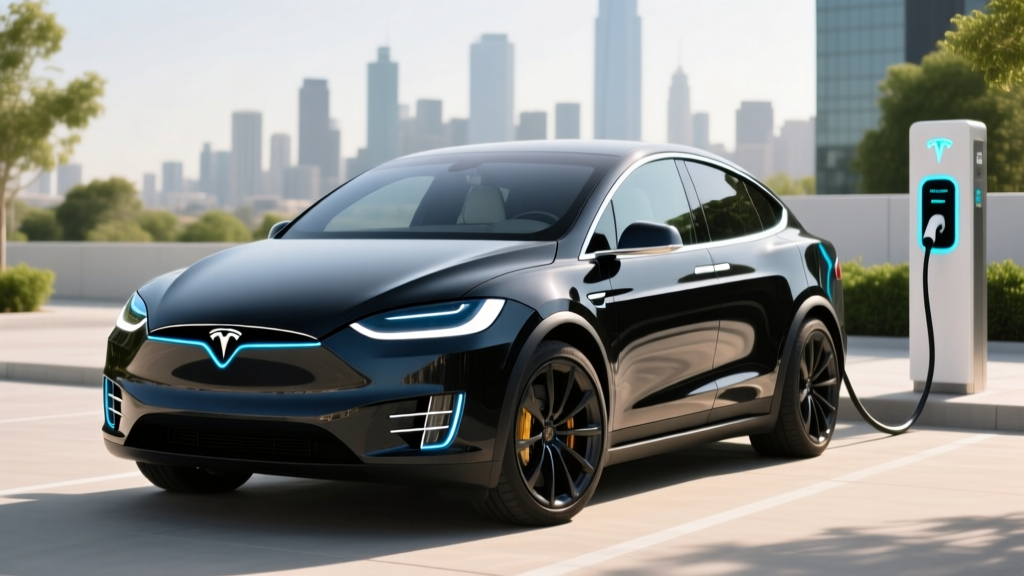
The 2026 Tesla Model X Plaid remains one of the most extreme propositions in the electric SUV market: a three-row family hauler that hits 60 mph in 2.5 seconds while offering over 300 miles of EPA-estimated range. It's a vehicle that tries to be everything at once — track weapon, road-trip cruiser, and daily school-run shuttle — and largely succeeds, though not without compromises that its six-figure price tag makes hard to ignore.
For 2026, the Model X Plaid carries over with minor software and efficiency refinements but retains the tri-motor all-wheel-drive powertrain, 100 kWh battery pack, and the same polarizing yoke-first interior philosophy that has defined it since the 2021 refresh. Here's everything a prospective buyer needs to know — with real numbers, not marketing fluff.
2026 Tesla Model X Plaid Specs at a Glance
| Specification | 2026 Model X Plaid |
|---|---|
| EPA Range | 326 miles |
| Battery (usable) | ~100 kWh, NMC (nickel manganese cobalt) |
| Drivetrain | Tri-Motor AWD |
| Horsepower | 1,020 hp |
| 0–60 mph | 2.5 seconds |
| Top Speed | 163 mph |
| Peak DC Fast Charge | 250 kW (Supercharger V3/V4) |
| 10–80% DC Charge Time | ~32 minutes |
| Level 2 Home Charging | 11.5 kW (~34 mi/hr on Wall Connector) |
| EPA Efficiency | 99 MPGe combined (34 kWh/100 mi) |
| Seating | 5, 6, or 7 passengers |
| Cargo (behind 3rd row) | ~15.0 cu ft |
| Cargo (max, all rows folded) | ~77.5 cu ft |
| Towing Capacity | 5,000 lbs |
| Battery Warranty | 8 years / 150,000 miles (70% retention) |
| Base MSRP | $94,990 (before destination) |
Real-World Range: What the EPA Number Doesn't Tell You
The EPA rates the 2026 Model X Plaid at 326 miles on a full charge. That figure comes from the vehicle's 100 kWh NMC battery pack and a combined-cycle test that blends city and highway driving at moderate temperatures. In practice, your mileage will vary considerably depending on how and where you drive.
- Mixed city/suburban (65°F): ~300–320 miles — close to EPA sticker
- Highway cruising (70–75 mph, 65°F): ~250–275 miles — aerodynamic drag at speed is the Plaid's biggest efficiency penalty
- Cold weather (20°F, highway): ~200–230 miles — NMC chemistry loses 20–30% in deep cold without preconditioning; the heat pump helps but doesn't eliminate the hit
- Towing (loaded trailer, ~3,500 lbs): ~160–190 miles — expect range to roughly halve under sustained towing loads
The Model X Plaid's efficiency of 99 MPGe combined (34 kWh per 100 miles) is respectable for a 5,100+ lb tri-motor SUV, but it trails the dual-motor Model X Long Range (rated at 102 MPGe and 348 miles EPA) by a meaningful margin. If maximum range matters more than 0–60 bragging rights, the Long Range variant is the more pragmatic choice.
According to fueleconomy.gov, the Model X Plaid consumes roughly 34 kWh per 100 miles in combined driving. At the national average residential electricity rate of ~$0.17/kWh (EIA, 2025), that translates to about $5.78 per 100 miles of home charging — competitive with a gas SUV getting roughly 18 mpg at $3.50/gallon.
Charging Speed: DC Fast Charging and Home Setup
Charging speed is where the Model X Plaid's age starts to show against newer competitors built on 800-volt architectures. The Plaid tops out at 250 kW on DC fast charging via Tesla's Supercharger V3 and V4 network. That's a peak rate — the sustained rate is considerably lower as the battery management system tapers current to protect the NMC cells.
| Charging Method | Max Power | Charging Speed | Notes |
|---|---|---|---|
| Level 1 (120V outlet) | ~1.4 kW | ~3–4 mi/hr | Emergency/trickle only — impractical for daily use |
| Level 2 (240V, Wall Connector) | 11.5 kW | ~34 mi/hr | Full charge in ~9 hours; ideal overnight solution |
| DC Fast (Supercharger V3/V4) | 250 kW peak | 10–80% in ~32 min | Peak rate only sustained briefly; tapers above 50% SoC |
| DC Fast (CCS adapter, 3rd-party) | ~150–170 kW typical | 10–80% in ~40–50 min | Varies by network; Electrify America, EVgo |
The 10–80% charge time of roughly 32 minutes is acceptable for road-trip rest stops but noticeably slower than 800V rivals like the Hyundai Ioniq 9 or Kia EV9 GT, which can complete the same swing in 18–20 minutes. Tesla's charging curve peaks aggressively in the 10–30% SoC window (often hitting 245–250 kW) then steadily tapers — by 60% SoC, you're typically seeing 120–140 kW, and above 80% the rate drops below 50 kW.
Preconditioning matters. Navigate to a Supercharger using the car's built-in routing and the battery will warm to optimal temperature before arrival, unlocking the full charge curve. Show up to a Supercharger without preconditioning on a cold day, and your peak rate may be cut in half for the first 10–15 minutes.
At home, the Tesla Wall Connector on a 60-amp circuit delivers 11.5 kW (48 amps continuous), adding roughly 34 miles of range per hour. A full overnight session easily replenishes a day's driving for all but the most extreme commuters. Installation typically requires a 240V/60A circuit; expect $800–$2,000 for a standard install, potentially more if your electrical panel needs an upgrade to 200A service.
Performance: 1,020 Horsepower in a Family SUV
The numbers are staggering and they feel even more violent in person. The tri-motor setup — one motor on the front axle, two on the rear — produces 1,020 horsepower and launches the Model X Plaid from 0–60 mph in 2.5 seconds (with rollout subtracted, as Tesla measures it; expect ~2.7–2.8 seconds in real-world roll-out). That puts it in supercar territory in a vehicle with falcon-wing rear doors and a third row.
Acceleration isn't a parlor trick limited to launch mode. The instant torque delivery means highway passing is trivially easy, and the dual rear motors provide torque vectoring that keeps the Plaid surprisingly composed through corners for its 5,185-lb curb weight. The adaptive air suspension lowers the ride height in Sport mode, reducing the center of gravity, but physics is physics — this is not a sports car in the twisties.
The Plaid's regenerative braking system is strong enough for effective one-pedal driving in most scenarios, though Tesla has reduced the maximum regen aggressiveness compared to earlier software versions. The blended mechanical brakes provide adequate stopping power, but repeated hard stops will reveal the limits of the brake cooling system on a vehicle this heavy.
Interior, Cargo, and Technology
The Model X interior remains a study in minimalism and compromise. The 17-inch center touchscreen is brilliant and responsive, running Tesla's latest software with a revamped navigation stack, improved voice commands, and access to the full Tesla app ecosystem. The secondary 8-inch rear touchscreen for climate and entertainment controls is a nice touch for second-row passengers.
The yoke steering wheel is standard on the Plaid and remains the most divisive feature in the vehicle. Some owners adapt within a week; others never find it intuitive for low-speed maneuvers and parking. A conventional round wheel is available as a no-cost option — and most experienced EV reviewers recommend choosing it unless you have strong preferences.
Cargo capacity is practical but not class-leading. Behind the third row, you get roughly 15 cubic feet — enough for a few grocery bags or a couple of carry-ons. Fold the third row and you open up approximately 37 cubic feet; fold both rear rows and the maximum 77.5 cubic feet of space is competitive with midsize gas SUVs. The front trunk (frunk) adds another ~6.6 cubic feet, useful for charging cables or a small bag.
Second-row legroom measures approximately 40.9 inches, and third-row legroom is a tight 32.7 inches — fine for children on short trips but cramped for adults on longer journeys. The six-seat configuration (with second-row captain's chairs) offers the best passenger comfort and easier third-row access.
On the technology front, the Model X Plaid includes:
- Autopilot (standard): Adaptive cruise control, lane-keeping, and traffic-aware features — SAE Level 2 driver assist requiring full driver engagement
- Full Self-Driving (Supervised) ($8,000 option): Adds automatic lane changes, Navigate on Autopilot, Smart Summon, and traffic light/stop sign recognition — still Level 2, still requires active supervision
- HEPA air filtration with Bioweapon Defense Mode
- 22-speaker audio system with immersive sound
- Gaming-capable processor supporting AAA titles on the center display while parked
Pricing, Trims, and Federal Tax Credit Eligibility
The 2026 Tesla Model X Plaid starts at $94,990 (plus a $1,995 destination charge), placing it firmly in luxury-SUV territory. The dual-motor Model X Long Range starts at approximately $79,990, offering more range and a lower price for buyers who don't need tri-motor performance.
| Trim | Base MSRP | With Destination | Federal §30D Credit | Effective Price |
|---|---|---|---|---|
| Model X Long Range | $79,990 | $81,985 | Up to $7,500* | ~$74,485* |
| Model X Plaid | $94,990 | $96,985 | Up to $7,500* | ~$89,485* |
*Federal tax credit eligibility under IRS §30D is subject to multiple requirements that change periodically. Key constraints for 2026 include:
- MSRP cap: SUVs/vans/pickups must be at or below $80,000 MSRP. The Model X Plaid at $94,990 exceeds this cap and does NOT qualify for the federal credit. The Model X Long Range at $79,990 is below the cap and may qualify.
- Buyer income limits: Modified AGI must not exceed $150,000 (single), $225,000 (head of household), or $300,000 (joint filers)
- Battery sourcing requirements: Increasing percentages of critical minerals and battery components must be sourced from the U.S. or free-trade-agreement countries — Tesla's supply chain has been progressively qualifying, but specific eligibility varies by production batch
- Point-of-sale transfer: Qualified buyers can transfer the credit to the dealer at purchase, reducing the upfront price rather than waiting for a tax refund
The bottom line on tax credits: The Model X Plaid does not qualify for the $7,500 federal EV tax credit because its MSRP exceeds the $80,000 SUV cap. Buyers considering the Model X Long Range may qualify depending on income, battery sourcing, and other IRS requirements — consult IRS.gov §30D guidance and a tax professional before relying on credit eligibility.
Ownership Costs: Warranty, Insurance, and Maintenance
Tesla covers the Model X Plaid battery and drive unit with an 8-year / 150,000-mile warranty with a minimum 70% capacity retention guarantee. The limited vehicle warranty runs 4 years / 50,000 miles. These terms are standard for the luxury EV segment, though some competitors (Hyundai, Kia) offer longer basic warranties.
Maintenance costs are significantly lower than a comparable gas SUV — no oil changes, no transmission fluid, no spark plugs. Expect to budget for tire replacement (the Plaid's 22-inch performance tires wear quickly under 1,020 hp; expect 15,000–25,000 miles per set at $300–$450 per tire), cabin air filter replacement, brake fluid checks, and wiper fluid. Annual maintenance typically runs $300–$600.
Insurance is the hidden cost. The Model X Plaid's combination of high repair costs, expensive parts, and extreme performance pushes premiums well above segment average. Expect annual insurance costs of $3,500–$5,500+ depending on your state, driving record, and coverage level — roughly 30–50% more than a similarly priced gas SUV. Get quotes before committing to a purchase.
2026 Tesla Model X Plaid: Pros and Cons
- Supercar-level 2.5-second 0–60 mph in a three-row SUV
- 326-mile EPA range is solid for the performance class
- Access to the Tesla Supercharger network — the most reliable and widespread DC fast-charging ecosystem in North America
- Falcon-wing rear doors provide dramatic curb appeal and wide second-row access
- Over-the-air updates continuously add features and refinements
- 5,000-lb towing capacity with integrated trailer brake controller option
- Best-in-class infotainment and software experience
- $94,990 MSRP exceeds the $80,000 federal tax credit cap — no §30D eligibility
- 250 kW peak DC charging lags behind 800V competitors (Ioniq 9, EV9 GT, Lucid Gravity)
- Yoke steering wheel is polarizing and impractical for some drivers
- Third-row seating is tight for adults on longer trips
- Build quality and panel gaps, while improved, still trail German luxury rivals
- Insurance premiums are significantly above average
- Highway range drops to ~250–275 miles at sustained 70+ mph speeds
- FSD (Supervised) remains a $8,000 option that delivers Level 2 — not autonomous driving
How the Model X Plaid Stacks Up Against Competitors
The Model X Plaid's closest competitors in the high-performance electric SUV segment include the Lucid Gravity Touring, BMW iX M70, and the Mercedes-AMG EQE SUV. Each makes different trade-offs:
- Lucid Gravity Touring (~$95,000): More range (440+ mi EPA est.), faster 900V charging architecture, more conventional interior — but a younger service network and no Supercharger access (yet)
- BMW iX M70 (~$111,500): Superior interior materials, excellent ride quality, ~314 mi EPA range — but significantly more expensive and slower to 60 (3.6 sec)
- Mercedes-AMG EQE 53 SUV (~$110,000): Lavish interior, strong performance — but less range (~230 mi EPA) and much higher pricing
The Model X Plaid's strongest competitive advantage remains the Supercharger network. For buyers who road-trip frequently, the reliability and density of Tesla's charging infrastructure is a tangible, daily benefit that specs alone don't capture. According to Tesla's Supercharger page, the network now includes over 65,000 Superchargers globally, with increasing NACS adoption by Ford, GM, Rivian, and others validating the connector standard.
Who Should Buy the 2026 Tesla Model X Plaid?
- You want the fastest-accelerating three-row SUV money can buy and the novelty will never wear off
- You have reliable home charging access and road-trip primarily along Supercharger corridors
- You value Tesla's software ecosystem, OTA updates, and mobile app integration above traditional luxury materials
- You need 5,000-lb towing capability with zero tailpipe emissions
- Tax credit ineligibility doesn't affect your purchase decision at this price point
- Maximum range is your priority — the Model X Long Range (348 mi) or Lucid Gravity (440+ mi) serve you better
- You want the fastest possible DC charging for frequent long-distance driving
- Build quality and interior materials matter more than straight-line speed
- You need a usable third row for regular adult passengers
- You're counting on the federal tax credit to offset purchase cost
Frequently Asked Questions
What is the real-world range of the 2026 Tesla Model X Plaid?
The EPA rates it at 326 miles combined. In real-world driving, expect roughly 300–320 miles in mild city/suburban conditions, 250–275 miles at sustained highway speeds (70–75 mph), and 200–230 miles in cold weather (below freezing). Towing can reduce range to 160–190 miles.
How fast does the Model X Plaid charge at home and on the road?
On DC fast charging (Tesla Supercharger), it peaks at 250 kW and charges from 10–80% in approximately 32 minutes. At home on a Level 2 Wall Connector (11.5 kW), it adds about 34 miles of range per hour, fully replenishing overnight in roughly 9 hours.
Does the 2026 Model X Plaid qualify for the federal EV tax credit?
No. The Model X Plaid's MSRP of $94,990 exceeds the $80,000 cap for SUVs under the IRS §30D clean vehicle credit. The lower-priced Model X Long Range ($79,990) may qualify, subject to buyer income limits, battery sourcing requirements, and other IRS rules. Always verify current eligibility on IRS.gov.
Is the Model X Plaid worth it versus the Lucid Gravity or BMW iX?
It depends on your priorities. The Plaid wins on raw acceleration (2.5 sec 0–60), Supercharger network access, and software experience. The Lucid Gravity offers significantly more range and faster charging; the BMW iX M70 delivers a more refined interior and ride quality. If performance and Tesla's ecosystem are paramount, the Plaid is the pick. If range and luxury finish matter more, consider the alternatives.
How long will the Model X Plaid battery last?
Tesla warranties the battery for 8 years or 150,000 miles with a minimum 70% capacity retention. Real-world data from Tesla's fleet suggests NMC packs typically retain 85–90% capacity after 100,000 miles under normal use. Avoiding frequent 100% charges and minimizing DC fast charging in extreme temperatures can extend long-term battery health.
Is Tesla's Full Self-Driving actually self-driving?
No. FSD (Supervised) is an SAE Level 2 driver-assistance system. It requires the driver to remain fully attentive, keep hands on the steering yoke/wheel, and be ready to intervene immediately. It can handle highway lane changes, navigate on-ramps, and recognize traffic signals, but it cannot handle all driving scenarios autonomously. No consumer Tesla vehicle is self-driving.