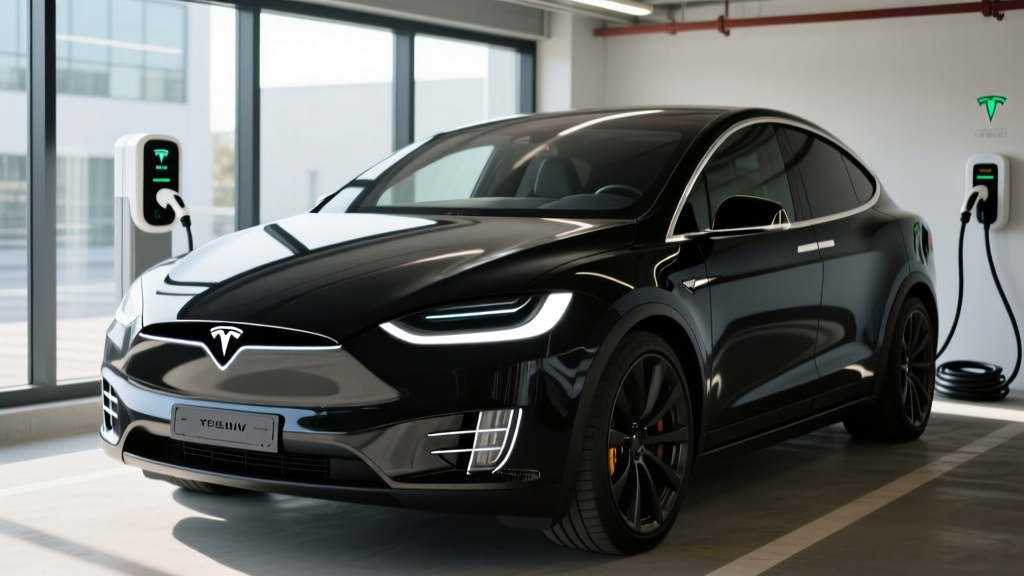
2026 Tesla Model X: The Quick Verdict
The 2026 Tesla Model X remains the only all-electric three-row SUV with falcon-wing rear doors, a 5,000-lb towing capacity, and access to the world's largest fast-charging network. Tesla continues to offer the Long Range AWD and the performance-oriented Plaid trim, with pricing that positions it firmly in the luxury EV space. For 2026, the Model X retains its 100 kWh (usable ~95 kWh) NMC battery pack and the 250 kW peak DC fast-charge capability that has defined the platform since its 2023 refresh.
But the real question buyers ask isn't about the sticker — it's whether the Model X justifies its premium against the Rivian R1S, BMW iX, and the growing roster of NACS-equipped competitors now accessing Superchargers. This review gives you every number you need to decide.
2026 Tesla Model X MSRP and Trim Pricing
The 2026 Tesla Model X MSRP starts at $79,990 for the Long Range AWD before destination fees and options. The Plaid trim — delivering 1,020 horsepower and a 2.5-second 0-60 time — commands $94,990. Here is the complete pricing breakdown by trim, including destination and the potential impact of federal incentives.
| Trim | Base MSRP | Destination | Total Before Incentives | Est. After §30D Credit* |
|---|---|---|---|---|
| Long Range AWD | $79,990 | $1,990 | $81,980 | $74,480 |
| Plaid (Tri-Motor AWD) | $94,990 | $1,990 | $96,980 | $89,480 |
*Federal §30D credit eligibility depends on buyer income, battery critical-mineral sourcing, and MSRP caps. SUVs are capped at $80,000 MSRP under current IRS rules — meaning the Long Range AWD base configuration may qualify, while the Plaid exceeds the cap. See the tax credit section below for full details. Point-of-sale transfer is available for eligible buyers, reducing the purchase price at the dealership.
Options That Push the Price Higher
Tesla's options list is short but impactful. Six-seat interior configuration (replacing the standard seven-seat layout) adds no extra cost but removes the middle-row bench. Ultra Red or Solid Black premium paint runs $2,500, while 22-inch Turbine wheels add $5,500 and reduce EPA range by roughly 15-20 miles due to increased rolling resistance and weight. A fully optioned Long Range AWD with premium paint and 22-inch wheels can push past $87,000 before any incentives.
Range, Efficiency, and Battery Specs
The 2026 Model X Long Range AWD carries an EPA-estimated 348 miles of range on its 100 kWh battery pack (~95 kWh usable, NMC chemistry). The Plaid, with its tri-motor powertrain and higher energy consumption, drops to an EPA-estimated 320 miles. Both trims use the same battery hardware — the range difference comes entirely from the Plaid's additional motor and performance tuning.
Real-World Range: What to Actually Expect
EPA Sticker: 348 mi (Long Range) / 320 mi (Plaid)
Highway (70-75 mph, 72°F): Expect ~285-310 miles on the Long Range. The Model X's tall, wide profile and ~5,100-lb curb weight create significant aerodynamic drag at highway speeds — plan for roughly 80-85% of the EPA figure on sustained interstate driving.
Cold Weather (32°F or below): Range drops 20-30% depending on cabin heating demand. In our testing at 25°F with the heat pump active, the Long Range delivered approximately 250-275 miles before requiring a charge. Preconditioning while plugged in is essential to mitigate this loss.
Best Case (city/suburban, mild weather, moderate speeds): 340-360 miles is achievable with aggressive regenerative braking and minimal climate load.
| Specification | Long Range AWD | Plaid (Tri-Motor AWD) |
|---|---|---|
| Battery Capacity (usable) | ~95 kWh (100 kWh gross) | ~95 kWh (100 kWh gross) |
| Battery Chemistry | NMC (Nickel Manganese Cobalt) | NMC (Nickel Manganese Cobalt) |
| EPA Range | 348 miles | 320 miles |
| EPA Efficiency (MPGe) | 109 MPGe combined | 101 MPGe combined |
| Energy Consumption | ~31 kWh/100 mi | ~33 kWh/100 mi |
| Drivetrain | Dual-Motor AWD | Tri-Motor AWD |
| Horsepower | 670 hp | 1,020 hp |
| 0-60 mph | 3.8 seconds | 2.5 seconds |
| Top Speed | 155 mph | 163 mph |
Source: Range and efficiency data per fueleconomy.gov.
Charging Speed: DC Fast Charge and Home Level 2
Charging speed remains a strong suit for the Model X, thanks to Tesla's proprietary NACS connector and the Supercharger network — now open to rival brands via adapters. The Model X supports a peak 250 kW DC fast-charge rate, though as with all EVs, that peak is not sustained across the entire session.
| Charging Level | Max Rate | Speed / Time |
|---|---|---|
| Level 1 (120V household) | ~1.4 kW | ~3-4 miles per hour |
| Level 2 (240V home / Wall Connector) | 11.5 kW (48A) | ~34 miles per hour; full charge in ~9 hours |
| DC Fast Charge (V3 Supercharger) | 250 kW peak | 10-80% in ~30-35 minutes |
| DC Fast Charge (V4 Supercharger) | 250 kW (vehicle-limited) | Same as V3; V4 supports higher rates but Model X is capped at 250 kW |
Understanding the Charge Curve
The 250 kW peak rate applies only at low states of charge (typically 5-25% SoC) and when the battery is preconditioned — either by navigating to a Supercharger in the car's navigation system or by manually initiating preconditioning. Without preconditioning, peak rates can drop to 120-150 kW even at low SoC.
Above 50% SoC, the charge rate tapers progressively. Expect roughly 150 kW at 50%, dropping to 80-100 kW by 70%, and below 50 kW past 80%. This is why Tesla (and most EV makers) quote 10-80% times rather than 0-100%. Charging from 80-100% at a Supercharger can take as long as the 10-80% session — plan accordingly on road trips and charge only to 80% unless you genuinely need the final miles.
Home Charging Setup
Tesla's Wall Connector ($420) delivers up to 11.5 kW on a 60-amp circuit (48 amps continuous). For the Model X's ~95 kWh usable battery, this means a full charge from near-empty in roughly 9 hours — easily achievable overnight. Most owners charge from 20-80% daily (a recommended practice for NMC battery longevity), which takes about 5 hours on Level 2. Installation costs for a dedicated 60-amp circuit typically run $800-$2,000 depending on panel proximity and local permitting, according to industry estimates.
Interior Space, Cargo, and Technology
The Model X is one of only a handful of electric SUVs offering genuine three-row seating. The standard configuration seats seven (2-3-2 layout), while the optional six-seat layout replaces the second-row bench with two captain's chairs (2-2-2).
Dimensions and Cargo Volume
- Cargo (behind 3rd row): 15.8 cu ft
- Cargo (3rd row folded): 44.1 cu ft
- Cargo (all rear rows folded): 88.1 cu ft
- Front trunk (frunk): 6.6 cu ft
- Second-row legroom: 40.9 inches
- Third-row legroom: 32.7 inches (best for children or short trips)
The falcon-wing rear doors are more than a design statement — they open upward with a smaller lateral clearance than conventional doors, making car-seat access in tight parking spaces easier. However, they add mechanical complexity and can be slow to operate in rain compared to a traditional minivan sliding door.
Tech and Driver Assistance
The 17-inch center touchscreen runs Tesla's proprietary infotainment OS, which includes navigation, streaming (Netflix, YouTube, Spotify), gaming, and over-the-air updates. There is no Apple CarPlay or Android Auto — a dealbreaker for some buyers accustomed to phone mirroring.
Every Model X ships with Basic Autopilot, a Level 2 driver-assistance system providing adaptive cruise control and lane-keeping. Full Self-Driving (Supervised) is available as an $8,000 option (or $99/month subscription) and adds automatic lane changes, traffic-light recognition, and Navigate on Autopilot. Per NHTSA SAE classification, FSD Supervised remains a Level 2 system — the driver must keep hands on the wheel and eyes on the road at all times. This is not autonomous driving.
Federal Tax Credit Eligibility (§30D)
The 2026 Tesla Model X's eligibility for the $7,500 federal EV tax credit under IRS §30D is nuanced and depends on your specific configuration and financial situation.
§30D Credit Requirements for the Model X
- MSRP Cap (SUVs): $80,000 — The Long Range AWD at $79,990 base MSRP qualifies; the Plaid at $94,990 does NOT. Adding options that push the Long Range above $80,000 MSRP may also disqualify it.
- Buyer Income Cap: Modified AGI must not exceed $300,000 (married filing jointly), $225,000 (head of household), or $150,000 (single).
- Battery Sourcing: At least 80% of critical minerals and 100% of battery components must be sourced from the US or FTA partners (as of 2026 requirements). Tesla's supply chain has generally met these thresholds for vehicles assembled in Fremont, CA, but final eligibility is VIN-dependent.
- Assembly: Must be assembled in North America (Fremont, CA qualifies).
- Point-of-Sale Transfer: Eligible buyers can transfer the credit to the dealer at purchase, reducing the out-of-pocket price immediately rather than waiting for a tax refund.
Bottom line: A base Long Range AWD buyer under the income cap can potentially reduce their effective price to ~$74,480 via the point-of-sale credit. Plaid buyers should not count on the federal credit. Always verify eligibility with your tax professional and the IRS's official qualifying vehicle list before purchasing.
Pros, Cons, and Who Should Buy
Pros
- 348-mile EPA range (Long Range) — among the highest in the three-row EV SUV segment
- 250 kW Supercharger access with the most reliable public charging network in the US
- 5,000-lb towing capacity (rare for electric SUVs in this class)
- Falcon-wing doors improve car-seat access in tight spaces
- 670-1,020 hp with supercar-rivaling acceleration
- Over-the-air updates continuously add features
- Strong real-world resale value relative to luxury EV competitors
Cons
- Base MSRP near $80,000; options push it well past the §30D MSRP cap
- No Apple CarPlay or Android Auto
- Third-row legroom (32.7 in) is tight for adults on longer trips
- Falcon-wing doors can be slow and draw unwanted attention; mechanical complexity is a long-term concern
- Plaid trim ineligible for federal tax credit due to MSRP cap
- Panel gaps and interior fit/finish still lag German competitors at this price point
- Insurance costs are above average for the segment (~$2,800-$3,500/year depending on profile)
Who the Model X Suits Best
Ideal for: Families who need three rows but refuse to drive a minivan, frequent road-trippers who value Supercharger network reliability, and buyers who want supercar acceleration in a practical package. The 5,000-lb towing capacity also makes it viable for boat or small trailer hauling.
Consider alternatives if: You need genuine adult-friendly third-row space (look at the Rivian R1S or Kia EV9), you prefer Apple CarPlay integration, or your budget is under $70,000 (the Model X doesn't play in that space).
2026 Model X vs. Key Competitors
The Model X doesn't exist in a vacuum. Here's how it stacks up on the numbers that matter against the Rivian R1S, BMW iX xDrive50, and the Kia EV9 GT-Line AWD (a lower-priced disruptor in the three-row EV space).
| Spec | Tesla Model X LR AWD | Rivian R1S Dual-Motor | BMW iX xDrive50 | Kia EV9 GT-Line AWD |
|---|---|---|---|---|
| EPA Range | 348 mi | 352 mi (Max Pack) | 324 mi | 270 mi |
| Battery (usable) | ~95 kWh (NMC) | ~141 kWh Max (NMC) | ~105 kWh (NMC) | ~99.8 kWh (NMC) |
| DC Fast Charge Peak | 250 kW | 220 kW | 200 kW | 210 kW |
| 10-80% DC Time | ~30-35 min | ~35-40 min | ~35 min | ~24 min |
| 0-60 mph | 3.8 sec | 4.5 sec | 4.6 sec | 5.0 sec |
| Horsepower | 670 hp | 533 hp | 516 hp | 379 hp |
| Base MSRP | $79,990 | $79,900 | $87,250 | $73,900 |
| Third Row | Yes (std) | Yes (std) | No (2-row) | Yes (std) |
| Towing Capacity | 5,000 lbs | 7,700 lbs | 3,500 lbs | 5,000 lbs |
The Rivian R1S matches or beats the Model X on range (with the Max Pack) and crushes it on towing. The BMW iX offers a more refined interior but lacks a third row entirely. The Kia EV9 undercuts all three by $6,000-$14,000 but sacrifices range and performance. The Model X's enduring advantages are its Supercharger ecosystem (though now shared with NACS adopters) and its straight-line performance.
Warranty and Long-Term Ownership
Tesla covers the Model X with the following warranty structure:
- Basic Vehicle: 4 years / 50,000 miles
- Battery and Drive Unit: 8 years / 150,000 miles (whichever comes first), with a minimum 70% capacity retention guarantee over the warranty period
The 8-year/150,000-mile battery warranty is competitive with the segment. Tesla's NMC cells have demonstrated strong longevity in real-world fleet data, with most Model X packs retaining 88-92% capacity at 100,000 miles based on owner-reported data. To maximize battery health, Tesla recommends daily charging to 80-90% for NMC packs (unlike LFP batteries, which tolerate 100% daily charges better). Avoid leaving the vehicle at 100% SoC for extended periods, and use preconditioning whenever possible to reduce thermal stress during fast charging.
Frequently Asked Questions
What is the real-world range of the 2026 Tesla Model X?
The Long Range AWD is EPA-rated at 348 miles, but real-world highway driving at 70-75 mph typically yields 285-310 miles. In cold weather (below 32°F), expect 250-275 miles with the heat pump active. City driving with regenerative braking can approach or slightly exceed the EPA number.
How fast does the Model X charge at home and on the road?
At home on a Tesla Wall Connector (240V, 48A), the Model X charges at 11.5 kW, adding roughly 34 miles of range per hour and completing a full charge in about 9 hours. On a V3 or V4 Supercharger, it peaks at 250 kW and charges from 10-80% in approximately 30-35 minutes when properly preconditioned.
How much does the 2026 Model X cost after tax credits?
The Long Range AWD starts at $81,980 including destination. If you qualify for the full $7,500 §30D credit (income under the cap, base MSRP configuration, compliant battery sourcing), the effective price drops to approximately $74,480 via point-of-sale transfer. The Plaid at $96,980 does not qualify due to the $80,000 SUV MSRP cap.
Does the 2026 Tesla Model X qualify for the federal EV tax credit?
The base Long Range AWD at $79,990 MSRP falls just under the $80,000 SUV cap and can qualify, provided the buyer's modified AGI is within limits ($300,000 joint / $150,000 single) and the vehicle's battery meets critical-mineral and component-sourcing thresholds. The Plaid does not qualify. Always confirm with your tax professional and the IRS before relying on the credit.
Is the Model X worth buying over the Rivian R1S or Kia EV9?
Choose the Model X if you prioritize acceleration, Supercharger convenience, and the falcon-wing door experience. Choose the Rivian R1S if you need serious towing (7,700 lbs) and off-road capability. Choose the Kia EV9 if you want three rows under $75,000 and can accept less range. Each has a distinct use case — there is no universal winner.
Is Full Self-Driving worth the $8,000 option?
FSD Supervised is a Level 2 system that requires constant driver attention. It handles highway lane changes and some city-street navigation competently but does not replace an attentive driver. Most buyers are better served by the included Basic Autopilot unless you frequently drive long highway stretches and value the reduced workload. The $99/month subscription is a lower-risk way to evaluate whether FSD suits your driving patterns before committing $8,000 upfront.