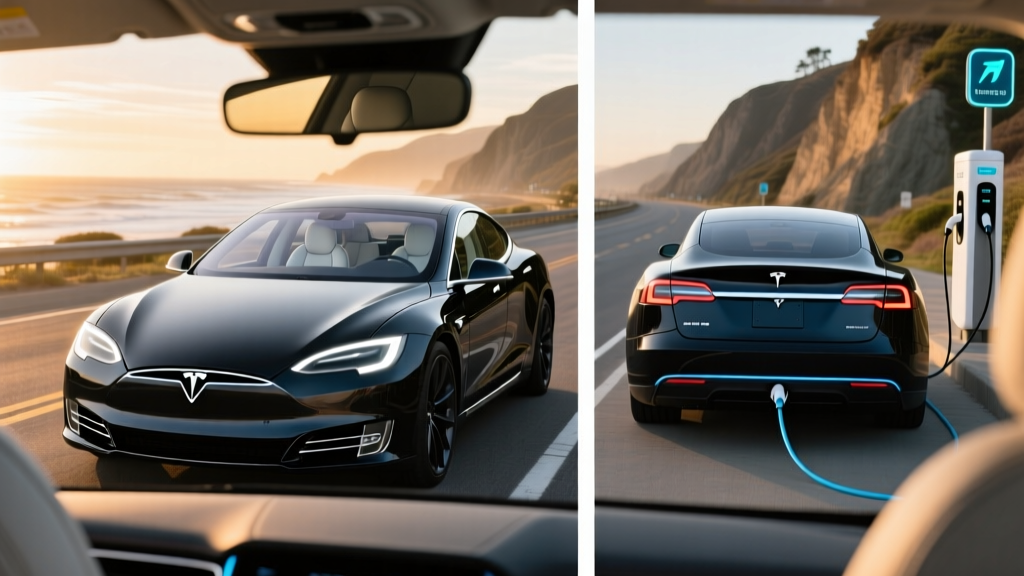
The Tesla Model S invented the premium electric sedan category over a decade ago, and the 2026 version remains the benchmark that every luxury EV competitor measures itself against. But with the Lucid Air, BMW i7, and Mercedes EQS closing the gap on build quality and interior refinement, does the original luxury Tesla still justify its six-figure price tag? We spent time with the 2026 Model S Long Range and Model S Plaid to give you the exact numbers — range, charging curves, real-world efficiency, and ownership economics — so you can decide.
Quick Verdict: Who Should Buy the 2026 Model S?
The 2026 Model S is built for buyers who prioritize driving range, access to the Supercharger network, and blistering straight-line performance over traditional luxury signifiers like massaging seats or hand-stitched leather. If your definition of a luxury Tesla centers on technology dominance, road-trip capability, and software that improves via OTA updates, nothing else matches this package. If you want whisper-quiet cabin isolation, concierge-level dealer service, and artisanal interior materials, the Lucid Air Grand Touring or BMW i7 xDrive60 may serve you better.
Choose the Model S Plaid if: You need 1,020 hp, a 1.99-second 0-60 time, and track-day bragging rights — and accept a 35-mile range penalty.
Look elsewhere if: Rear-seat luxury, ride comfort on rough pavement, or traditional dealership service are top priorities.
Range, Efficiency, and the Real-World Reality
The 2026 Model S Long Range carries a 100 kWh battery pack (approximately 95 kWh usable) using NMC (nickel manganese cobalt) chemistry — chosen for its higher energy density compared to the LFP cells Tesla uses in the base Model 3 and Model Y. That chemistry trade-off gives the Model S its range advantage but requires more careful long-term charging habits to minimize degradation (more on that below).
| Spec | Long Range | Plaid |
|---|---|---|
| EPA Range | 402 miles | 367 miles |
| Battery (usable) | ~95 kWh (NMC) | ~95 kWh (NMC) |
| MPGe (combined) | 124 MPGe | 116 MPGe |
| Efficiency | 27 kWh/100 mi | 29 kWh/100 mi |
| Drivetrain | Dual-motor AWD | Tri-motor AWD |
| Horsepower | 670 hp | 1,020 hp |
| 0-60 mph | 3.1 sec | 1.99 sec |
| Top Speed | 155 mph | 200 mph |
| Cargo Volume | 28 cu ft (rear seats up) | 28 cu ft (rear seats up) |
| Rear Legroom | 35.4 in | 35.4 in |
| Base MSRP | $89,990 | $108,990 |
The EPA rates the Model S Long Range at 402 miles. In our highway-heavy mixed driving at 70-75 mph in moderate temperatures, expect 330-360 miles before needing to charge. In cold weather (below 32°F), range can drop to 270-300 miles due to battery resistance and cabin heating demands. City driving with regenerative braking can push closer to the EPA sticker — we've seen 380+ miles in stop-and-go commuting. The Plaid's tri-motor setup and stickier tires reduce real-world highway range to roughly 300-320 miles.
For context, the EPA's fueleconomy.gov listing confirms the 124 MPGe combined figure for the Long Range. That translates to roughly 27 kWh consumed per 100 miles driven — among the most efficient large luxury sedans available, though the lighter Lucid Air Grand Touring achieves up to 146 MPGe on a smaller battery.
Charging Speed: DC Fast, Level 2, and the Supercharger Advantage
Tesla's charging ecosystem remains the strongest argument for the Model S. The 2026 model supports NACS natively (no adapter needed), and V4 Supercharger stalls now deliver up to 250 kW to the Model S — though sustained rates depend heavily on battery temperature and state of charge.
| Charging Method | Power / Rate | Speed / Time |
|---|---|---|
| DC Fast Charge (V4 Supercharger) | Peak 250 kW | 10-80% in ~25 min |
| DC Fast Charge (3rd-party CCS via adapter) | Up to ~150 kW | 10-80% in ~38 min |
| Level 2 (Tesla Wall Connector, 48A) | 11.5 kW | ~34 miles per hour of charging |
| Level 2 (Generic J1772 w/ adapter, 32A) | 7.7 kW | ~23 miles per hour of charging |
| Level 1 (120V household) | ~1.4 kW | ~4 miles per hour of charging |
Charging curve reality check: The Model S peaks at 250 kW only between roughly 10-30% state of charge. From 30-60%, the rate tapers to approximately 170-200 kW, and above 80% it drops sharply to under 60 kW to protect the NMC cells. This means the advertised 10-80% time of ~25 minutes is accurate, but a 10-90% session will take closer to 40 minutes. Always precondition the battery via the car's navigation-routed preconditioning before arriving at a Supercharger — skipping this step in cold weather can cut your peak charge rate by 40% or more.
At home, the Tesla Wall Connector on a 60-amp circuit (48 amps continuous) delivers 11.5 kW, which adds about 34 miles of range per hour. A full overnight charge from 20% to 90% takes roughly 6-7 hours — more than enough for daily use. Installation costs for a Wall Connector typically run $500-$2,000 depending on whether your electrical panel needs an upgrade to 200 amps.
Performance: Long Range vs. Plaid
The Model S Long Range delivers 670 horsepower from its dual-motor setup (one permanent-magnet motor front, one induction motor rear). The 3.1-second 0-60 mph time places it firmly in supercar territory from just a few years ago, and the instant torque delivery makes it feel even quicker in real-world passing situations. All-wheel drive is standard, with torque vectoring managed electronically.
The Plaid steps up to a tri-motor configuration — one front, two rear — producing 1,020 horsepower. Tesla's claimed 1.99-second 0-60 mph time requires a prepped surface and rollout subtraction, but even in normal conditions, the Plaid hits 60 in roughly 2.3 seconds. It's violently fast in a way that never stops being entertaining, though the 35-mile EPA range penalty and $19,000 price premium over Long Range are meaningful trade-offs.
Ride quality has improved since the 2021 refresh with the adaptive air suspension, but the Model S still transmits more road imperfections than a Mercedes EQS or BMW i7. The yoke steering remains controversial — it offers unobstructed screen visibility but requires a learning curve for low-speed parking maneuvers. A conventional round wheel is available at no extra cost.
Interior, Tech, and the Luxury Question
This is where the "luxury Tesla" debate gets complicated. The 2026 Model S interior features vegan leather upholstery, a 17-inch center touchscreen (now with improved resolution and faster processing), a 12.3-inch digital instrument cluster, and a rear 8-inch touchscreen for passengers. The 22-speaker audio system is genuinely excellent — among the best in any sedan at any price.
However, the cabin materials still don't match the Lucid Air's available Nappa leather, open-pore wood, and wool-blend fabrics. Panel gaps have improved significantly since the Fremont factory's earlier years, but at this price point, competitors offer more handcrafted interiors. The minimalist design philosophy means almost every function — including glovebox release, mirror adjustment, and vent direction — is controlled through the touchscreen, which some buyers love and others find frustrating.
Standout tech features:
- Autopilot (standard): SAE Level 2 driver assistance with adaptive cruise, lane centering, and automatic lane changes. The driver must remain engaged at all times — this is not self-driving.
- Full Self-Driving Supervised ($8,000 option): Enhanced Level 2 system with city-street navigation, traffic light recognition, and parking lot maneuvering. Still requires active driver supervision.
- OTA updates: Tesla regularly pushes software improvements — new features, efficiency tweaks, and UI refinements arrive wirelessly.
- Sentry Mode & Dashcam: Built-in camera system records incidents and provides 360-degree surveillance when parked.
- Frunk + liftback: 5.3 cu ft front trunk plus the hatchback-style rear opening makes the Model S far more practical than a traditional luxury sedan.
Notable drawbacks:
- No Apple CarPlay or Android Auto — Tesla's proprietary system is the only option
- Rear-seat comfort trails German competitors (narrower seat cushion, less thigh support)
- Service center availability varies by region — some owners face multi-week wait times for body work
- No heads-up display, despite competitors offering them at lower prices
Pricing, Tax Credits, and Total Cost
The 2026 Model S Long Range starts at $89,990 (including destination), and the Plaid starts at $108,990. Adding FSD Supervised, premium paint colors, and 21-inch wheels can push an as-tested Long Range past $100,000.
| Trim | Base MSRP | As-Tested (typical) | §30D Credit Eligible? |
|---|---|---|---|
| Long Range | $89,990 | ~$93,500 | Yes — up to $7,500* |
| Plaid | $108,990 | ~$118,000 | Yes — up to $7,500* |
Federal tax credit details (§30D): The Model S qualifies for the full $7,500 federal EV tax credit under current IRS rules, available as a point-of-sale transfer to the dealer (effectively reducing your purchase price at delivery). However, eligibility is subject to strict requirements:
- MSRP cap: Sedans must be under $55,000 — but the Model S is classified as a large sedan/SUV by the IRS, which carries an $80,000 MSRP cap. Both trims qualify. (Verify on IRS.gov)
- Income cap: Modified adjusted gross income must not exceed $300,000 (joint filers), $225,000 (head of household), or $150,000 (single filers).
- Battery sourcing: Critical minerals and battery component requirements phase in annually. Tesla's North American battery supply chain currently satisfies these requirements, but always confirm with your dealer at time of purchase.
- Point-of-sale transfer: Since 2024, you can transfer the credit to the dealer at purchase, reducing your out-of-pocket cost immediately rather than waiting for a tax refund.
Consult a tax professional before relying on credit eligibility — rules change, and individual circumstances vary.
Warranty, Battery Longevity, and Ownership Costs
Tesla covers the Model S with a 4-year/50,000-mile basic limited warranty and an 8-year/150,000-mile battery and drive unit warranty. The battery warranty guarantees retention of at least 70% of original capacity during the coverage period. If degradation exceeds 30% within 8 years or 150,000 miles, Tesla will repair or replace the pack.
For NMC chemistry specifically, long-term data from high-mileage Model S owners shows typical degradation of 8-12% over the first 100,000 miles, with the curve flattening significantly afterward. To maximize battery lifespan:
- Set daily charge limit to 80-90% (the car's battery management system allows this)
- Avoid leaving the car at 100% state of charge for extended periods
- Use DC fast charging for road trips, not daily commuting (Level 2 is gentler on NMC cells)
- Precondition the battery in cold weather before driving or charging
A full battery replacement outside of warranty currently runs approximately $15,000-$22,000 depending on the pack, though this cost has trended downward and may continue to decrease as battery technology matures.
Insurance premiums for the Model S are notably higher than average — expect $2,500-$4,000 annually depending on your driving record, location, and coverage level. Tesla's own insurance product, available in many states, uses real-time driving data and can sometimes undercut traditional carriers for safe drivers.
Model S vs. Key Luxury EV Competitors
| Spec | Tesla Model S LR | Lucid Air GT | BMW i7 xDrive60 | Mercedes EQS 580 |
|---|---|---|---|---|
| EPA Range | 402 mi | 516 mi | 318 mi | 371 mi |
| Starting Price | $89,990 | $125,600 | $124,200 | $127,350 |
| 0-60 mph | 3.1 sec | 3.0 sec | 4.5 sec | 4.1 sec |
| Max DC Charge | 250 kW | 300 kW | 195 kW | 200 kW |
| Charging Network | Supercharger (native) | CCS + SC adapter | CCS + SC adapter | CCS + SC adapter |
| Rear Legroom | 35.4 in | 37.2 in | 42.1 in | 41.7 in |
The Lucid Air Grand Touring wins on range and efficiency but costs $35,000 more and has a less proven service network. The BMW i7 and Mercedes EQS deliver significantly more rear-seat luxury and traditional dealership support but sacrifice range and performance. The Model S occupies a unique middle ground: the best charging infrastructure, strong performance, competitive range, and a price that undercuts the German flagship EVs — if you can accept the more spartan interior approach.
- 402-mile EPA range (Long Range) is among the best in any EV sedan
- Native Supercharger access — the most reliable DC fast-charging network in the US
- 670 hp / 3.1-sec 0-60 as standard; Plaid is absurdly fast
- Over-the-air updates continuously improve the vehicle
- Hatchback cargo versatility (28 cu ft) beats every traditional sedan competitor
- Qualifies for full $7,500 federal tax credit
- Interior materials and rear-seat comfort trail Lucid, BMW, and Mercedes at this price
- No Apple CarPlay / Android Auto
- Yoke steering is polarizing (round wheel available)
- Service center wait times can be lengthy in some markets
- Insurance premiums run 30-50% above average for the class
- NMC battery requires more careful charging habits than LFP
Frequently Asked Questions
What is the real-world range of the 2026 Tesla Model S?
The EPA rates the Model S Long Range at 402 miles. In real-world highway driving at 70-75 mph in moderate temperatures, expect 330-360 miles. Cold weather (below freezing) can reduce range to 270-300 miles. City driving with regenerative braking can approach the EPA figure. The Plaid averages about 300-320 miles in real-world highway use.
How fast does the Model S charge at home and on the road?
On a V4 Supercharger, the Model S peaks at 250 kW and charges from 10-80% in approximately 25 minutes. At home on a Tesla Wall Connector (48A / 11.5 kW), it adds about 34 miles of range per hour, so an overnight session from 20-90% takes roughly 6-7 hours. Always precondition the battery before DC fast charging to achieve peak speeds.
Does the 2026 Model S qualify for the $7,500 federal EV tax credit?
Yes. The Model S qualifies for the full §30D credit under current IRS rules, available as a point-of-sale transfer. Eligibility requires the buyer to meet income caps ($300K joint / $150K single), and the vehicle must satisfy battery-sourcing requirements — which Tesla's supply chain currently meets. Always verify at purchase time, as rules can change. See IRS.gov for the latest.
Is the Model S worth buying over the Lucid Air or BMW i7?
It depends on your priorities. Choose the Model S if Supercharger access, proven software, strong performance, and a lower starting price matter most. Choose the Lucid Air if maximum range (516 mi) and interior quality are paramount and budget allows. Choose the BMW i7 if rear-seat luxury, traditional dealer service, and ride comfort are your top criteria.
How long will the Model S battery last?
Tesla warranties the battery for 8 years / 150,000 miles with a 70% capacity retention guarantee. Real-world NMC degradation data from high-mileage owners shows approximately 8-12% loss over the first 100,000 miles, with the rate slowing significantly afterward. Many Model S packs have exceeded 200,000 miles with 80%+ capacity retained. Following recommended charging practices (daily limit 80-90%, minimize DC fast charging) extends longevity.
Is Tesla's FSD actually self-driving?
No. Full Self-Driving (Supervised) is an SAE Level 2 driver-assistance system. Despite the name, it requires active driver supervision — hands on the wheel, eyes on the road — at all times. It can navigate city streets, stop lights, and highways with impressive capability, but it makes errors and the driver is legally responsible. Only Level 4 services like Waymo operate without a human driver, and those are limited to specific geofenced areas.
Sources: EPA fueleconomy.gov, Tesla.com Model S specifications, IRS §30D clean vehicle credits.