Quick Verdict: The 2026 Tesla Model 3 at 0% APR
The 2026 Tesla Model 3 remains the benchmark compact electric sedan, and Tesla's recurring 0% APR financing offers make it one of the most affordable EVs to finance in its class. With up to 363 miles of EPA range, a 250 kW peak DC fast-charging rate, and a starting MSRP around $38,990 before incentives, the Model 3 Long Range AWD delivers exceptional value — especially when you factor in monthly savings from promotional financing. Below, we break down every spec, real-world expectation, and ownership cost so you can decide if now is the right time to buy.
| Spec | Long Range AWD | Performance AWD | RWD (Standard) |
|---|---|---|---|
| EPA Range | 363 mi | 330 mi | 272 mi |
| Battery (usable) | ~79 kWh (NMC) | ~79 kWh (NMC) | ~60 kWh (LFP) |
| Peak DC Fast Charge | 250 kW | 250 kW | 170 kW |
| 10–80% DC Time | ~25 min | ~25 min | ~30 min |
| Level 2 Home Charge | 11.5 kW (~44 mi/hr) | 11.5 kW (~44 mi/hr) | 11.5 kW (~44 mi/hr) |
| 0–60 mph | 4.2 sec | 2.9 sec | 5.8 sec |
| Horsepower | ~384 hp | ~510 hp | ~271 hp |
| Drivetrain | Dual-Motor AWD | Dual-Motor AWD | RWD |
| MPGe (combined) | 131 MPGe | 118 MPGe | 132 MPGe |
| Base MSRP | $47,740 | $52,990 | $38,990 |
Real-World Range: What to Actually Expect
EPA Sticker: 363 miles (Long Range AWD) | 272 miles (RWD)
Real-World Highway (70 mph, 72°F): Expect ~300–320 miles for the Long Range; ~225–240 miles for the RWD.
Cold-Weather (20°F, mixed driving): Plan for 20–30% range loss, dropping the Long Range to roughly 250–270 miles and the RWD to ~185–200 miles. Tesla's heat pump helps mitigate this compared to older EVs, but physics still applies.
The Long Range AWD's 363-mile EPA rating is among the highest of any compact EV sedan. In practice, the Model 3's efficiency (approximately 26 kWh/100 mi for the Long Range) is excellent thanks to its low drag coefficient (Cd 0.219) and refined thermal management. On a 250-mile highway trip in mild weather, you'll arrive with roughly 50–70 miles of buffer. In winter, precondition the battery via the Tesla app before departing to minimize range loss — the heat pump will pull energy from the grid rather than the pack if plugged in.
The RWD model uses a lithium iron phosphate (LFP) battery, which trades energy density for longevity and cost. Tesla recommends charging LFP packs to 100% regularly, unlike NMC chemistry where 80–90% daily limits prolong lifespan. This partially offsets the RWD's shorter EPA range for daily commuting.
Charging Speed: DC Fast, Level 2, and Home Setup
| Charging Level | Power | Speed (Miles Added) | Notes |
|---|---|---|---|
| Level 1 (120V) | ~1.4 kW | ~3–4 mi/hr | Emergency/trickle only |
| Level 2 (240V, 48A) | 11.5 kW | ~44 mi/hr | Full overnight charge in 7–8 hrs |
| DC Fast (Supercharger V3) | 250 kW peak | ~175 mi in 15 min | 10–80% in ~25 min; tapers above 80% |
| NACS Compatibility | Native | — | Tesla's connector; no adapter needed at Superchargers |
The Model 3's charging curve is well-managed. On a V3 Supercharger, the Long Range peaks at 250 kW up to roughly 40% state of charge (SoC), then tapers through 150 kW, 100 kW, and finally ~50 kW as you approach 80%. The 10–80% window takes approximately 25 minutes under ideal conditions (preconditioned battery, warm weather). Above 80%, expect another 20–25 minutes to reach 100% — so plan your stops accordingly on road trips.
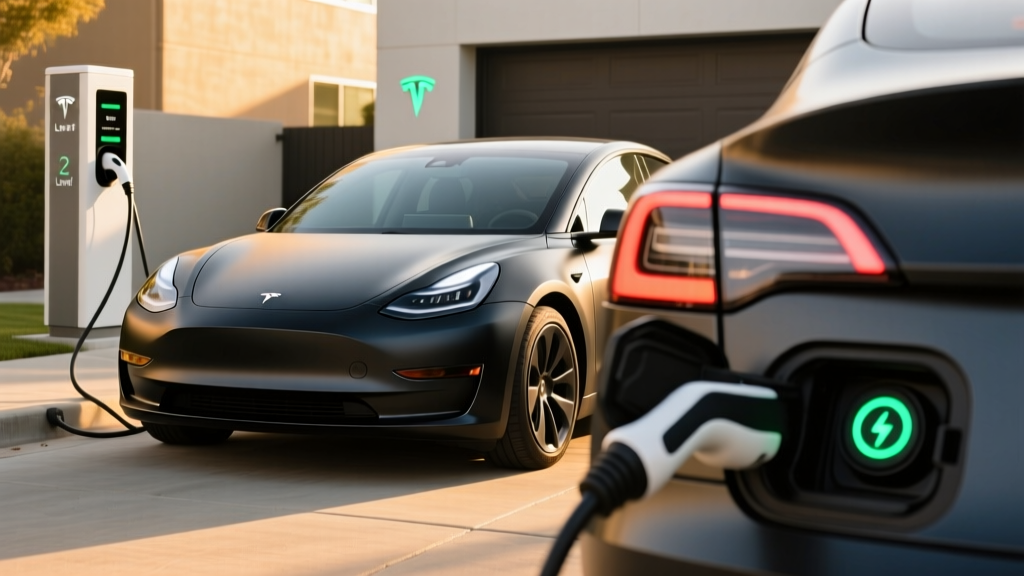
For home charging, Tesla's Wall Connector at 48 amps on a 60-amp circuit delivers the full 11.5 kW. A typical 200-mile daily commute replenishes in under 5 hours overnight. Installation costs for a 240V/60A circuit typically range from $500 to $2,000 depending on panel proximity and local permitting — factor this into your purchase budget. Always consult a licensed electrician for final specs.
Performance and Driving Dynamics
The Model 3 lineup spans three distinct personalities. The RWD model's 5.8-second 0–60 time is adequate for commuting, with single-motor rear-wheel drive providing a sporty, tail-happy feel on dry pavement. The Long Range AWD's 4.2-second sprint is genuinely quick for a family sedan, and dual-motor all-wheel drive provides confident traction in rain and light snow. The Performance model's 2.9-second 0–60 time puts it in supercar territory, with track-tuned suspension, larger brakes, and 20-inch wheels.
All trims share Tesla's low center of gravity (battery pack under the floor) and precise steering. The Highland refresh brought a quieter cabin, improved ride quality with frequency-selective dampers, and ventilated front seats. Regenerative braking offers two modes (Standard and Low), though Tesla removed full one-pedal driving — you'll still use the brake pedal for complete stops.
Interior, Tech, and Cargo Space
The Model 3's minimalist interior centers on a 15.4-inch touchscreen that controls everything — climate, media, navigation, and vehicle settings. There is no instrument cluster; speed and range display on the upper-left corner of the main screen. The rear passengers get an 8-inch screen for climate and media controls, a welcome addition from the Highland update.
Notable tech features include:
- Tesla Autopilot (standard): SAE Level 2 adaptive cruise + lane centering — driver must remain engaged at all times
- Full Self-Driving Supervised ($8,000 option): Enhanced lane changes, autosteer on city streets, traffic light recognition — still SAE Level 2, not autonomous
- Sentry Mode and Dashcam: 360-degree camera recording with cloud alerts
- Over-the-air updates: Regular feature additions and performance improvements
- Phone-as-key: Bluetooth-based entry and start, no fob needed
Important: Tesla Autopilot and FSD (Supervised) are SAE Level 2 driver-assistance systems. The driver must keep hands on the wheel and eyes on the road. Tesla's camera-based monitoring enforces this. This is not "self-driving" — only Level 4 robotaxi services like Waymo operate without a human driver.
Cargo space measures 23 cubic feet in the rear trunk (with a wide hatch opening) plus a 3.1-cubic-foot front trunk (frunk). Total passenger volume is 97 cubic feet, with 42.4 inches of front legroom and 35.3 inches in the rear. Taller rear passengers (6'2"+) will find headroom tight due to the sloping roofline.
Pricing, Tax Credits, and the 0% APR Advantage
Tesla periodically offers 0% APR financing for 36, 48, or even 60 months on the Model 3, typically for well-qualified buyers through Tesla's captive finance arm. At 0% APR over 60 months, a $47,740 Long Range AWD costs $795/month with zero interest — compared to roughly $895/month at a 5% APR. That's a savings of approximately $6,000 in interest over the loan term, which effectively lowers the vehicle's total cost of ownership significantly.
| Trim | Base MSRP | §30D Credit (max) | Effective Price* | Monthly at 0% APR/60mo |
|---|---|---|---|---|
| RWD | $38,990 | Up to $7,500 | ~$31,490 | ~$650 |
| Long Range AWD | $47,740 | Up to $7,500 | ~$40,240 | ~$796 |
| Performance AWD | $52,990 | Up to $7,500 | ~$45,490 | ~$899 |
*Effective price assumes full $7,500 credit eligibility. Actual credit depends on battery sourcing, buyer income, and MSRP caps. See IRS rules below.
Federal Tax Credit Eligibility (§30D)
The federal EV tax credit under IRS §30D offers up to $7,500, but eligibility depends on multiple factors for 2026:
- MSRP Cap: Sedans must be under $55,000 — all Model 3 trims qualify
- Buyer Income Cap: AGI ≤ $150,000 (single), $225,000 (head of household), $300,000 (joint)
- Battery Sourcing: $3,750 requires critical minerals from FTA countries; $3,750 requires battery components manufactured in North America. Tesla has progressively shifted Model 3 battery sourcing to meet these requirements, but confirm current-year eligibility at purchase
- Point-of-Sale Transfer: As of 2024, you can transfer the credit to the dealer at purchase, reducing the sale price directly rather than waiting for a tax refund
- Consult a tax professional to confirm your specific eligibility — rules are subject to change
Warranty and Long-Term Ownership
Tesla covers the Model 3 with a 4-year/50,000-mile basic limited warranty and an 8-year/120,000-mile battery and drive unit warranty (Long Range/Performance) or 8-year/100,000-mile (RWD). The battery warranty guarantees retention of at least 70% of original capacity during the coverage period. Based on Tesla's fleet data and third-party analyses, Model 3 batteries typically degrade 10–12% over the first 150,000 miles, with the degradation curve flattening significantly after the initial 30,000 miles.
Maintenance costs are minimal: no oil changes, no spark plugs, no transmission fluid. Cabin air filter replacement (~$50–80 every 2 years), brake fluid checks, and tire rotations are the primary recurring expenses. Expect tire wear to be slightly higher than a gas sedan due to the vehicle's weight and instant torque — budget for a set of four tires ($800–$1,400) every 30,000–40,000 miles.
How the Model 3 Compares to Key Rivals
The Model 3's closest competitors include the Hyundai Ioniq 6 (EPA 361 mi, starting ~$37,500), the BMW i4 eDrive40 (EPA 301 mi, starting ~$57,000), and the Polestar 2 (EPA 276 mi, starting ~$49,900). The Model 3 Long Range edges the Ioniq 6 on range by 2 miles and undercuts it on Supercharger network access — Tesla's proprietary network remains the most reliable DC fast-charging ecosystem in the US. The BMW i4 offers a more traditional luxury interior and physical controls but costs nearly $10,000 more for less range. The Polestar 2, while beautifully designed, trails significantly on range and charging speed.
Where the Model 3 wins decisively: charging infrastructure reliability, over-the-air software updates, and the lowest cost-per-mile of range in its segment when the 0% APR offer is active. Where it falls short: no physical buttons or stalks (turn signals are on the steering wheel face), limited rear-seat headroom, and the camera-only vision system for Autopilot has drawn scrutiny from NHTSA regarding phantom braking events.
Pros and Cons
Pros
- Class-leading 363-mile EPA range (Long Range AWD)
- 250 kW DC fast charging with 175 miles in 15 minutes
- Supercharger network — the most reliable US charging infrastructure
- 0% APR financing dramatically lowers total cost of ownership
- Excellent efficiency at 131 MPGe combined
- Over-the-air updates continuously add features
- Strong resale value relative to EV market
- 8-year/120,000-mile battery warranty
Cons
- No physical controls — everything runs through the touchscreen
- Rear-seat headroom is tight for tall passengers
- Turn signals on the steering wheel face take adaptation
- FSD (Supervised) costs $8,000 and remains SAE Level 2
- Camera-only Autopilot has phantom braking reports
- No Apple CarPlay or Android Auto
- Insurance premiums tend to be 15–25% above segment average
Who Should Buy the 2026 Tesla Model 3?
Choose the Model 3 RWD if: You commute under 50 miles daily, have home Level 2 charging, want the lowest entry price, and value LFP battery longevity over maximum range. Effective price after tax credit can drop below $32,000.
Choose the Model 3 Long Range AWD if: You take regular road trips (200+ miles), live in a region with cold winters (AWD traction + range buffer), or simply want the best range-per-dollar in the EV market. The 0% APR offer makes this the sweet spot.
Choose the Model 3 Performance if: You want sports-car acceleration in a daily driver, prioritize handling, and don't mind sacrificing 33 miles of range and paying a $5,000+ premium.
Look elsewhere if: You need physical buttons, require maximum rear-seat space for car seats, or prefer Apple CarPlay integration. Consider the Hyundai Ioniq 6 or BMW i4 instead.
Frequently Asked Questions
What is the real-world range of the 2026 Tesla Model 3?
The Long Range AWD achieves an EPA-estimated 363 miles, but expect ~300–320 miles in real-world highway driving at 70 mph, and 250–270 miles in cold weather (20°F). The RWD model is EPA-rated at 272 miles with real-world highway driving around 225–240 miles.
How fast does the Model 3 charge at home and on road trips?
At home on a 240V Level 2 charger (11.5 kW), the Model 3 adds approximately 44 miles of range per hour, fully recharging overnight in 7–8 hours. On a Tesla V3 Supercharger, it peaks at 250 kW and charges from 10–80% in about 25 minutes, adding up to 175 miles in 15 minutes.
Does the 2026 Tesla Model 3 qualify for the $7,500 federal tax credit?
All Model 3 trims fall under the $55,000 MSRP cap for sedans. Eligibility for the full $7,500 depends on your adjusted gross income (≤$150K single, ≤$300K joint), and the battery's critical-mineral and component sourcing meeting IRS §30D requirements. The credit can be transferred at point of sale. Confirm current-year eligibility with your tax professional.
Is the 0% APR financing offer real, and how do I qualify?
Tesla periodically offers 0% APR for 36–60 months on the Model 3 through its financing partners. Qualification typically requires excellent credit (720+ FICO). Check Tesla's current offers page, as promotional terms change monthly. At 0% APR on a $47,740 Long Range, you pay $795/month over 60 months with zero interest — saving roughly $6,000 compared to a 5% loan.
How does the Model 3 compare to the Hyundai Ioniq 6?
The Ioniq 6 SE Long Range offers 361 miles of EPA range (2 miles less than the Model 3 LR) and starts around $37,500. However, the Model 3 has superior Supercharger network access, faster DC charging (250 kW vs. Ioniq 6's ~235 kW on 800V architecture), and Tesla's OTA update ecosystem. The Ioniq 6 offers a more conventional interior with physical climate controls and Apple CarPlay.
What does it cost to charge a Model 3 at home vs. gas?
At the US average electricity rate of ~$0.17/kWh, fully charging the Long Range's 79 kWh battery costs about $13.40 for 363 miles — roughly 3.7 cents per mile. A comparable gas sedan at 30 MPG and $3.40/gallon costs about 11.3 cents per mile. Annual fuel savings for a 12,000-mile driver: approximately $900–$1,100.
How long will the Model 3 battery last?
Tesla's battery warranty covers 8 years/120,000 miles with at least 70% capacity retention. Fleet data shows typical degradation of 10–12% over 150,000 miles, after which the curve flattens. Many Model 3 owners report 85–90% capacity at 100,000 miles. The LFP battery in the RWD model may last longer due to the chemistry's superior cycle life, though with lower energy density.