Are 2026 Tesla Lease Deals Worth It? The Numbers Behind the Sticker
Tesla's leasing program has become one of the most searched pathways into EV ownership, and for good reason: lower monthly payments, no long-term battery degradation risk, and the ability to upgrade as technology evolves. But lease deals on Tesla vehicles require careful analysis beyond the advertised monthly payment. Residual values, mileage caps, disposition fees, and the interaction with federal tax credits all shift the true cost equation.
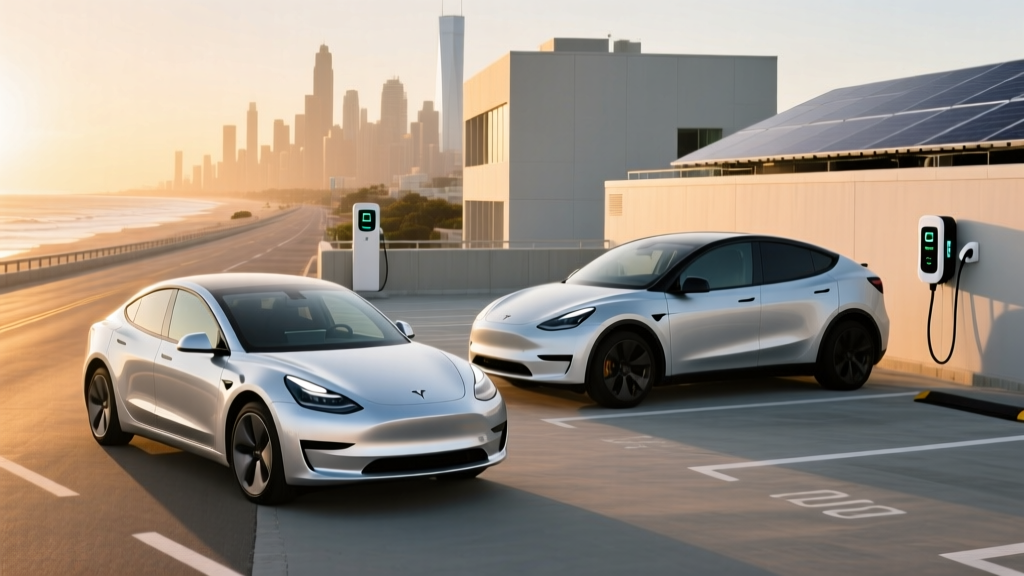
This profile breaks down the two most-leased Tesla models for 2026 — the refreshed Model 3 and the Model Y — with exact range figures, charging data, pricing, and a framework for deciding whether a Tesla lease makes financial sense versus buying or choosing a competitor.
2026 Tesla Model 3: Specifications & Real-World Range
The 2026 Tesla Model 3 continues with the "Highland" refresh architecture introduced in late 2023, featuring improved suspension tuning, acoustic glass, ventilated front seats, and a rear touchscreen for passengers. For 2026, Tesla offers the Model 3 in Long Range RWD, Long Range AWD, and Performance trims.
| Spec | Model 3 Long Range AWD | Model 3 Performance |
|---|---|---|
| EPA Range | 341 miles | 315 miles |
| Battery (usable) | ~75 kWh (NMC) | ~75 kWh (NMC) |
| Drivetrain | Dual-Motor AWD | Dual-Motor AWD |
| Horsepower | ~384 hp | ~510 hp |
| 0–60 mph | 4.2 seconds | 2.9 seconds |
| Efficiency | 132 MPGe / 25 kWh/100mi | 120 MPGe / 28 kWh/100mi |
| Max DC Fast Charge | 250 kW | 250 kW |
| 10–80% DC Time | ~27 minutes | ~27 minutes |
| Level 2 Home Charge | 11.5 kW (~44 mi/hr) | 11.5 kW (~44 mi/hr) |
| Cargo Volume | 23 cu ft (trunk + frunk) | 23 cu ft |
| Rear Legroom | 35.3 inches | 35.3 inches |
| Base MSRP | $47,740 | $54,990 |
2026 Tesla Model Y: Specifications & Real-World Range
The 2026 Model Y receives the "Juniper" refresh, mirroring the Model 3's improvements with a redesigned front fascia, full-width light bar, rear passenger screen, adaptive damping on higher trims, and improved NVH levels. It remains Tesla's best-selling vehicle globally and competes directly with the Hyundai Ioniq 5, Ford Mustang Mach-E, and BMW iX3.
| Spec | Model Y Long Range AWD | Model Y Performance |
|---|---|---|
| EPA Range | 320 miles | 290 miles |
| Battery (usable) | ~75 kWh (NMC) | ~75 kWh (NMC) |
| Drivetrain | Dual-Motor AWD | Dual-Motor AWD |
| Horsepower | ~384 hp | ~510 hp |
| 0–60 mph | 4.8 seconds | 3.5 seconds |
| Efficiency | 122 MPGe / 27 kWh/100mi | 110 MPGe / 30 kWh/100mi |
| Max DC Fast Charge | 250 kW | 250 kW |
| 10–80% DC Time | ~28 minutes | ~28 minutes |
| Level 2 Home Charge | 11.5 kW (~40 mi/hr) | 11.5 kW (~40 mi/hr) |
| Cargo Volume | 76 cu ft (rear seats folded) | 76 cu ft |
| Rear Legroom | 36.5 inches | 36.5 inches |
| Base MSRP | $49,990 | $55,490 |
Charging Speed Deep Dive: DC Fast & Home Level 2
Charging speed remains a top concern for prospective Tesla lessees. Both the Model 3 and Model Y peak at 250 kW on V3 Superchargers, but sustained charge rates tell a more complete story.
| Charging Method | Power (kW) | Miles Added Per Hour | Notes |
|---|---|---|---|
| Level 1 (120V outlet) | 1.4 kW | ~4–5 mi/hr | Emergency/trickle only |
| Level 2 (240V, 48A) | 11.5 kW | ~40–44 mi/hr | Full charge overnight (7–8 hrs) |
| DC Fast (V3 Supercharger) | Peak 250 kW | ~1,000 mi/hr (at peak) | 10–80% in ~27–28 min |
| DC Fast (V4 Supercharger) | Peak 250 kW* | ~1,000 mi/hr (at peak) | *Model 3/Y limited to 250 kW; future vehicles may exceed |
Charge Curve Reality: The 250 kW peak occurs only between roughly 10–30% State of Charge. From 30–60%, the rate tapers to approximately 150–170 kW. Above 80%, charging slows dramatically to protect battery health, dropping below 50 kW. This is why Tesla and the EPA quote 10–80% times rather than 0–100% — the final 20% can add 20+ minutes.
Supercharger Network Advantage: As of 2026, Tesla operates over 18,000 V3/V4 Superchargers in North America. Non-Tesla EVs now access many Superchargers via NACS adapters or built-in NACS ports, but Tesla owners still benefit from native plug-and-charge integration, real-time stall availability in navigation, and generally higher uptime rates than third-party networks like Electrify America or EVgo.
2026 Tesla Lease Pricing: Monthly Payments, Residuals & Total Cost
Tesla lease deals vary by model, trim, term length (typically 36 months), annual mileage allowance (10,000, 12,000, or 15,000 miles), and regional incentives. Below are representative 2026 lease structures based on publicly available Tesla lease calculator data and third-party aggregators.
| Model & Trim | MSRP | Est. Monthly Lease (36 mo, 12k mi/yr) | Due at Signing | Residual Value (%) |
|---|---|---|---|---|
| Model 3 Long Range AWD | $47,740 | $550–$650 | $3,500–$5,500 | ~55–58% |
| Model 3 Performance | $54,990 | $650–$750 | $4,000–$6,000 | ~52–55% |
| Model Y Long Range AWD | $49,990 | $600–$700 | $4,000–$6,000 | ~58–62% |
| Model Y Performance | $55,490 | $700–$800 | $4,500–$6,500 | ~55–58% |
Lease vs. Buy Economics: Leasing shields you from battery degradation risk and residual value uncertainty — a meaningful consideration as EV technology evolves rapidly. However, you forfeit equity buildup and face a disposition fee (~$395) at lease end unless you purchase the vehicle or lease another Tesla. Mileage overage charges run $0.20–$0.25 per mile, making leases expensive for high-mileage drivers.
Critical Tax Credit Note: Under IRS §30D rules, the federal EV tax credit of up to $7,500 is available for purchases, not leases, in most interpretations. However, some lessors pass through the credit as a capitalized cost reduction, effectively lowering your monthly payment. Tesla's lease calculator may reflect this benefit, but confirm directly with Tesla or your tax advisor. Income caps apply: $150,000 (single), $225,000 (head of household), $300,000 (joint). MSRP caps: $55,000 for sedans (Model 3), $80,000 for SUVs/trucks (Model Y). Battery sourcing and critical mineral requirements also apply — verify current-year eligibility at IRS.gov.
Battery Chemistry, Warranty & Long-Term Degradation
Both the Model 3 and Model Y Long Range and Performance trims use NMC (Nickel Manganese Cobalt) battery chemistry, prioritizing energy density and cold-weather performance over cycle life. Tesla's Standard Range trims (when available) use LFP (Lithium Iron Phosphate) chemistry, which offers longer cycle life and can be charged to 100% daily without degradation concerns, but sacrifices ~10–15% range and performs less optimally in extreme cold.
Battery Warranty: Tesla covers the battery and drive unit for 8 years or 120,000 miles (whichever comes first) for Long Range and Performance trims, with a minimum 70% capacity retention threshold. This is competitive with Hyundai's 10-year/100,000-mile warranty and exceeds the federal mandate of 8 years/100,000 miles.
Real-World Degradation Data: According to Tesla's 2025 Impact Report and third-party aggregators like Recurrent Auto, Model 3/Y batteries typically lose 5–8% capacity over the first 100,000 miles, with degradation slowing significantly thereafter. Most owners report 90%+ State of Health at 50,000 miles. Leasing eliminates long-term degradation anxiety, as you return the vehicle before significant capacity loss occurs.
Pros & Cons: Leasing a 2026 Tesla
Pros
- Supercharger Network: Access to 18,000+ reliable DC fast chargers with native plug-and-charge integration — still the gold standard for road-trip charging.
- OTA Updates: Continuous software improvements add features, optimize efficiency, and refine Autopilot without dealership visits.
- Lower Monthly Payments: Lease payments are typically 20–30% lower than loan payments for the same vehicle, improving cash flow.
- No Depreciation Risk: EV residual values remain volatile; leasing transfers that risk to the lessor.
- Performance & Tech: Instant torque, one-pedal driving, industry-leading infotainment, and optional FSD (Supervised) capability.
Cons
- No Purchase Option at Lease End (in most cases): Tesla historically does not allow lessees to buy the vehicle at lease end, though policies can shift — confirm before signing.
- Mileage Restrictions: 10k–15k annual caps with $0.20–$0.25/mile overage charges penalize high-mileage drivers.
- Panel Gaps & Build Quality: While improved post-Highland/Juniper, Tesla's fit-and-finish still trails legacy automakers like BMW or Hyundai in consistency.
- Minimal Physical Controls: Nearly all functions route through the 15.4" touchscreen — no physical stalks, buttons for climate, or traditional instrument cluster.
- Insurance Costs: Tesla insurance premiums run 15–30% higher than comparable ICE vehicles due to repair costs and specialized parts. Get quotes before committing.
Tesla vs. Key Competitors: Is Leasing a Tesla the Best Move?
The Model 3 and Model Y face stiff competition in 2026. Here's how they stack up against the most common cross-shopped alternatives:
| Attribute | Tesla Model Y LR | Hyundai Ioniq 5 LR AWD | Ford Mustang Mach-E ER AWD |
|---|---|---|---|
| EPA Range | 320 mi | 290 mi | 305 mi |
| Max DC Charge | 250 kW | 240 kW (10–80% in 18 min) | 150 kW (10–80% in 45 min) |
| Base MSRP | $49,990 | $52,600 | $51,995 |
| Cargo Volume | 76 cu ft | 59 cu ft | 59.7 cu ft |
| Charging Network | Tesla Supercharger (native) | NACS (Supercharger access via adapter) | NACS (Supercharger access via adapter) |
| Physical Controls | Minimal (touchscreen-centric) | Mix of touch + physical buttons | Mix of touch + physical buttons |
| Tax Credit (§30D) | Eligible (verify sourcing) | Eligible (U.S.-built) | Eligible (U.S.-built) |
Verdict: Tesla wins on charging infrastructure integration, efficiency, and cargo space. Hyundai's Ioniq 5 charges faster (18-minute 10–80% vs. Tesla's 28 minutes) and offers a more conventional interior with physical buttons. Ford's Mach-E trails on charging speed but appeals to buyers wanting a more traditional dealership experience and physical controls. If Supercharger access and OTA updates are priorities, Tesla remains the benchmark. If you value faster DC charging, build quality consistency, or physical buttons, cross-shop aggressively.
Frequently Asked Questions
What is the real-world range of the 2026 Tesla Model 3 and Model Y?
The Model 3 Long Range AWD achieves an EPA-estimated 341 miles, but expect 280–300 miles in real-world highway driving and 220–250 miles in freezing temperatures. The Model Y Long Range AWD is EPA-rated at 320 miles, with real-world highway range of 260–280 miles and winter range of 200–230 miles. Cold weather, high speeds, and aggressive acceleration all reduce range below EPA estimates.
How fast does a 2026 Tesla charge at home and on DC fast chargers?
On a Level 2 home charger (240V, 48A, 11.5 kW), the Model 3 adds ~44 miles per hour and the Model Y adds ~40 miles per hour — a full charge takes 7–8 hours overnight. On a V3 Supercharger, both peak at 250 kW and charge from 10–80% in approximately 27–28 minutes. Charging slows significantly above 80% to protect battery health.
How much does a 2026 Tesla cost after tax credits?
The Model 3 Long Range AWD starts at $47,740 MSRP. If you purchase (not lease) and meet IRS §30D income caps ($150k single / $300k joint) and battery sourcing requirements, you may qualify for up to $7,500 in federal tax credits, reducing effective cost to ~$40,240. Lease deals may pass through the credit as a cap cost reduction, but this varies — confirm with Tesla. The Model Y Long Range at $49,990 also qualifies under the $80,000 SUV MSRP cap, subject to the same income and sourcing rules.
Does the 2026 Tesla Model 3 or Model Y qualify for the federal EV tax credit?
Both models are currently eligible for up to $7,500 under §30D, provided the buyer meets income caps, the vehicle MSRP is below the threshold ($55k for sedans, $80k for SUVs), and battery/critical mineral sourcing requirements are satisfied. However, sourcing rules tighten annually, and eligibility can change mid-year. Always verify current status at IRS.gov or consult a tax professional before purchase.
Is leasing a Tesla better than buying in 2026?
Leasing makes sense if you drive under 15,000 miles annually, want lower monthly payments, prefer to upgrade every 3 years, and want to avoid long-term battery degradation risk. Buying makes sense if you drive high mileage, want to build equity, plan to keep the vehicle 5+ years, or want to claim the full $7,500 federal tax credit (which applies to purchases, not leases, in most cases). Run the numbers for your specific mileage, income, and ownership horizon.
What are the biggest drawbacks of leasing a Tesla?
The primary drawbacks are mileage restrictions (with $0.20–$0.25/mile overage fees), no purchase option at lease end in most cases, and forfeiture of the federal tax credit unless the lessor passes it through as a cap cost reduction. Additionally, Tesla's build quality consistency, while improved, still trails legacy luxury brands, and insurance costs run 15–30% higher than comparable ICE vehicles.
Who should lease a 2026 Tesla Model 3 or Model Y?
The Model 3 suits tech-forward commuters, solo drivers or couples, and road-trippers who value efficiency and Supercharger access. The Model Y suits small families, cargo-haulers, and buyers needing AWD and higher ground clearance. Both are ideal for lessees with home charging access, moderate annual mileage (under 15k), and a desire to stay current with rapidly evolving EV technology without long-term commitment.
Sources: EPA range and efficiency data from fueleconomy.gov. Federal tax credit rules from IRS.gov. Tesla specifications from Tesla's official 2026 model pages. Real-world degradation data from Recurrent Auto and Tesla Impact Reports.