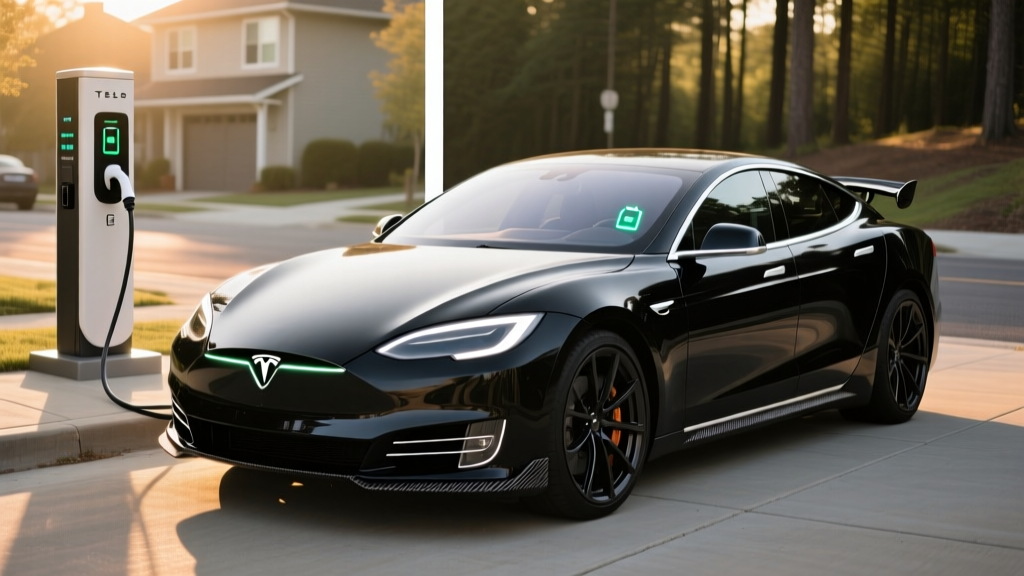
The 2024 Tesla Model S Plaid occupies a rare position in the electric vehicle market: a four-door sedan that posts supercar acceleration numbers while delivering over 350 miles of real-world highway range. With 1,020 horsepower from its tri-motor all-wheel-drive powertrain, the Plaid variant of Tesla's flagship sedan remains one of the quickest production cars ever built. But beyond the headline 1.99-second 0-60 mph claim, how does it function as a daily driver, a road-trip companion, and a long-term ownership proposition?
We've analyzed EPA data, real-world driving logs, DC fast-charging curves, and current federal incentive rules to give you the complete picture of what owning a 2024 Model S Plaid actually looks like in 2026.
2024 Tesla Model S Plaid: Full Specifications
| Specification | Value |
|---|---|
| EPA Estimated Range | 396 miles (19" wheels) / 359 miles (21" wheels) |
| Battery Capacity (Usable) | ~95 kWh (NMC chemistry) |
| Drivetrain | Tri-Motor AWD (1 front, 2 rear) |
| Horsepower | 1,020 hp |
| 0-60 mph | 1.99 seconds (with rollout subtracted) |
| Top Speed | 200 mph |
| Max DC Fast Charge Rate | 250 kW (peak) |
| 10-80% DC Fast Charge Time | ~27 minutes |
| Level 2 Home Charging | 11.5 kW / ~34 miles per hour |
| EPA Efficiency | 120 MPGe combined / 28 kWh/100 mi |
| Cargo Volume | 28.0 cu ft (rear) + ~5.3 cu ft (frunk) |
| Base MSRP | $89,990 (before destination) |
| Battery & Drive Unit Warranty | 8 years / 150,000 miles |
Range and Efficiency: EPA vs. the Real World
The EPA rates the 2024 Model S Plaid at 396 miles on the combined cycle when equipped with the standard 19-inch Tempest wheels. Opt for the 21-inch Arachnid wheels and that figure drops to 359 miles — a meaningful 37-mile reduction driven entirely by increased rolling resistance and aerodynamic drag from the wider, stickier rubber.
EPA Sticker: 396 mi (19" wheels) / 359 mi (21" wheels)
Highway driving (70-75 mph, 65°F): Expect ~320-340 mi on 19" wheels; ~290-310 mi on 21" wheels. The Plaid's tri-motor drivetrain and performance-oriented tire compound consume more energy at sustained speed than a dual-motor Model S Long Range.
Cold weather (30°F or below): Range drops 20-30% depending on cabin heating demands and battery preconditioning. Plan for ~260-290 mi in freezing conditions on 19" wheels. Tesla's heat pump helps, but the physics of cold lithium-ion cells and cabin heating are unavoidable.
City / mixed commuting: You'll see numbers closest to the EPA sticker — 360-390 mi — thanks to regenerative braking recapturing energy at lower speeds.
Efficiency lands at 120 MPGe combined, which translates to roughly 28 kWh per 100 miles. That's less efficient than a Model 3 Long Range (~25 kWh/100 mi) but competitive for a 4,766-pound performance sedan. On fueleconomy.gov, the Plaid's energy consumption is listed in line with other high-performance EVs like the Porsche Taycan Turbo S.
Charging Speed: DC Fast Charging and Home Setup
Tesla's Supercharger network remains one of the most reliable DC fast-charging ecosystems available, and the Model S Plaid takes full advantage of V3 Supercharger stalls.
| Charging Level | Power | Speed (Miles Added) | Notes |
|---|---|---|---|
| Level 1 (120V household) | ~1.4 kW | ~3-4 mi/hr | Emergency/trickle only; impractical for daily use |
| Level 2 (240V home / Wall Connector) | 11.5 kW (48A) | ~34 mi/hr | Full charge in ~9-10 hours; ideal overnight setup |
| DC Fast Charge (V3 Supercharger) | 250 kW (peak) | ~200 mi in 15 min | 10-80% in ~27 min; tapers significantly above 80% |
| DC Fast Charge (CCS adapter / third-party) | Up to 250 kW | Varies by station | Tesla includes CCS adapter; compatible with Electrify America, EVgo, etc. |
A few ownership realities about the Plaid's charging profile:
- Peak vs. sustained charge rate: The 250 kW figure is a peak, not a sustained rate. In practice, the Plaid charges at 250 kW only between roughly 10-25% state of charge. The curve tapers to ~150 kW by 50% SoC and drops further to ~60-80 kW by 70% SoC. This is why the 10-80% time is ~27 minutes rather than the ~15 minutes a flat 250 kW rate would suggest.
- Preconditioning matters: Navigate to a Supercharger using the car's built-in navigation, and the battery will automatically precondition (warm up) to accept peak charge rates. Arriving at a charger cold can add 5-10 minutes to your session.
- Home charging investment: A Tesla Wall Connector on a 60A circuit delivers the full 11.5 kW (48A continuous). Installation typically runs $500-$1,500 if your electrical panel has capacity, or $2,000-$4,000+ if a panel upgrade to 200A is needed. Consult a licensed electrician for your specific setup.
- CCS compatibility: Tesla now ships vehicles with a NACS (Tesla) charge port and includes a CCS adapter, so the Plaid can use non-Tesla DC fast chargers. This expands your road-trip options considerably.
Performance: 1,020 HP and the Tri-Motor Advantage
The numbers are staggering and deserve context. The Plaid's tri-motor layout — one motor on the front axle and two on the rear — produces 1,020 horsepower and enables a claimed 1.99-second 0-60 mph time (Tesla's figure includes a 1-foot rollout subtraction, standard in drag-strip timing). Independent testing by outlets like Motor Trend has recorded 0-60 times in the 2.1-2.3 second range without rollout, which is still ferociously quick.
Beyond straight-line speed, the torque-vectoring rear motors provide genuine handling benefits. The Plaid can micro-adjust torque delivery to each rear wheel independently, improving corner-exit grip and stability. The result is a sedan that feels far more agile than its ~4,766-pound curb weight suggests.
The Plaid also features Tesla's latest adaptive air suspension, which adjusts ride height and damping based on driving mode. In Comfort, it soaks up highway imperfections credibly. In Sport, it firms up and drops the ride height for track use — though the Michelin Pilot Sport 4S tires (on 21" wheels) are the limiting factor on a road course before the powertrain ever is.
Interior, Tech, and Daily Usability
The Model S interior has been significantly refreshed from earlier generations, though it remains a polarizing space compared to the material richness of a Porsche Taycan or Mercedes EQS.
Infotainment and Displays
The 17-inch center touchscreen runs Tesla's latest software with an AMD Ryzen processor — response times are snappy, and the interface is clean. A 12.3-inch driver instrument cluster replaces the old minimalist approach, and a rear-seat 8-inch touchscreen handles climate and entertainment for passengers. The yoke steering wheel is standard; a round wheel is available at no extra charge if you request it at order time.
Driver Assistance: Autopilot and FSD (Supervised)
Tesla Autopilot and Full Self-Driving (Supervised) are SAE Level 2 driver-assistance systems. They provide adaptive cruise control, lane centering, and automatic lane changes, but the driver must remain fully engaged — hands on the wheel (or torque applied to the yoke), eyes on the road. These are not self-driving systems. Tesla's camera-only vision stack is capable in well-marked highway scenarios but can struggle with construction zones, faded lane markings, and adverse weather.
FSD (Supervised) costs $8,000 as a one-time purchase or $99/month as a subscription (pricing as of late 2024). Whether it's worth the premium depends on your commute profile and tolerance for beta-level software behavior.
Cargo and Passenger Space
The Model S offers 28.0 cubic feet of rear cargo space (with rear seats up) — usable for road-trip luggage for four. The front trunk (frunk) adds roughly 5.3 cubic feet for charging cables or a small bag. Rear-seat legroom measures 35.4 inches, adequate for adults on longer drives, though the floor-mounted battery means a slightly elevated seating position compared to a traditional sedan.
Pricing, Trims, and Federal Tax Credit Eligibility
The 2024 Tesla Model S Plaid carries a base MSRP of $89,990, plus a $1,390 destination charge, bringing the out-the-door starting price to approximately $91,380 before any options, taxes, or fees.
| Item | Cost |
|---|---|
| Base MSRP (Plaid) | $89,990 |
| Destination Fee | $1,390 |
| 21" Arachnid Wheels (optional) | $4,500 |
| FSD (Supervised) — purchase | $8,000 |
| FSD (Supervised) — subscription | $99/month |
| Paint: Ultra Red or other premium | $2,000 - $2,500 |
Does the 2024 Model S Plaid Qualify for the Federal EV Tax Credit?
Short answer: No. Under the IRS §30D Clean Vehicle Credit rules, the federal tax credit for new EVs is capped at vehicles with an MSRP of $55,000 or less for sedans (and $80,000 for SUVs, vans, and trucks). At $89,990, the Model S Plaid exceeds the sedan MSRP cap by a wide margin and does not qualify for the up-to-$7,500 federal credit.
- MSRP Cap: ≤$55,000 for sedans; ≤$80,000 for SUVs/trucks/vans
- Buyer Income Cap: ≤$150,000 (single) / ≤$225,000 (head of household) / ≤$300,000 (joint)
- Battery Sourcing: Critical minerals and battery components must meet phased-in domestic/free-trade sourcing thresholds
- Final Assembly: Must occur in North America
- Point-of-Sale Transfer: Eligible buyers can transfer the credit to the dealer for an immediate price reduction
The Model S Plaid fails the MSRP cap requirement. Always verify current rules at IRS.gov, as regulations are subject to change. Consult a tax professional for your specific situation.
Some states offer their own EV incentives that may apply regardless of MSRP — check your state's energy or DMV website for details, as these vary widely by jurisdiction.
Warranty and Long-Term Battery Outlook
Tesla covers the Model S Plaid's battery pack and drive units with an 8-year / 150,000-mile warranty (whichever comes first), with a guaranteed minimum capacity retention of 70% over that period. The basic vehicle limited warranty runs 4 years / 50,000 miles.
The Plaid uses a nickel-manganese-cobalt (NMC) battery chemistry, which offers higher energy density than LFP (lithium iron phosphate) but is somewhat more sensitive to long-term degradation from repeated 100% charges and DC fast charging. Tesla recommends daily charging to 80-90% for NMC packs and reserving 100% charges for road trips. Following this guidance, owners typically see 5-10% degradation over the first 50,000 miles, with the curve flattening significantly afterward.
Full battery replacement out of warranty is expensive — estimates range from $15,000 to $22,000 depending on labor and pack availability — but the 150,000-mile coverage window and NMC longevity data suggest most owners will never face this cost.
Who Should Buy the 2024 Tesla Model S Plaid?
- You want supercar acceleration in a practical four-door sedan with genuine trunk and frunk space
- You road-trip frequently and value the Supercharger network's reliability
- You want 350+ real-world miles of range without sacrificing performance
- You prefer Tesla's software ecosystem, OTA updates, and mobile app integration
- Interior material luxury is a priority — the Taycan, EQS, and i7 offer more premium cabins
- You want to qualify for the $7,500 federal tax credit (the Plaid's MSRP disqualifies it)
- You need more than ~28 cu ft of cargo space for family hauling (consider the Model X or a performance SUV)
- You prefer a more traditional driving feel with physical controls and a conventional steering wheel as standard
Pros and Cons
- 1.99-sec 0-60 mph — among the quickest production cars ever sold
- 396-mi EPA range (19" wheels) is exceptional for a performance EV
- Access to the Tesla Supercharger network for reliable road-trip charging
- Tri-motor torque vectoring provides genuine handling benefits
- OTA software updates continuously add features and refinements
- Spacious rear cargo area + frunk for a performance sedan
- $89,990+ MSRP disqualifies it from the federal §30D tax credit
- Interior materials don't match the price point of German luxury rivals
- Yoke steering is polarizing and takes significant adaptation
- Camera-only Autopilot/FSD can be inconsistent in construction zones and bad weather
- 21" wheels reduce range by 37 EPA miles and degrade ride quality
- High insurance premiums relative to the segment average
Frequently Asked Questions
What is the real-world range of the 2024 Tesla Model S Plaid?
On 19-inch wheels, expect 320-340 miles in warm highway driving and 360-390 miles in city/mixed commuting. On 21-inch wheels, subtract roughly 30 miles from those figures. In cold weather (below 30°F), plan for a 20-30% reduction, bringing highway range to approximately 260-290 miles on 19" wheels.
How fast does the Model S Plaid charge at home and on the road?
On a Level 2 Tesla Wall Connector (48A / 11.5 kW), the Plaid gains about 34 miles of range per hour, reaching a full charge from empty in roughly 9-10 hours — ideal for overnight charging. On a V3 Supercharger, it peaks at 250 kW and charges from 10-80% in approximately 27 minutes, though the charge curve tapers significantly above 50% state of charge.
Does the 2024 Model S Plaid qualify for the $7,500 federal EV tax credit?
No. The IRS §30D credit caps eligible sedans at an MSRP of $55,000. At $89,990, the Model S Plaid exceeds this limit and does not qualify. State-level incentives may still apply depending on your jurisdiction — check your state energy office for current programs.
How does the Model S Plaid compare to the Porsche Taycan Turbo S?
The Taycan Turbo S offers a more luxurious interior, superior steering feel, and 800V architecture enabling faster peak charging (~270 kW, 10-80% in ~22 min on compatible chargers). However, the Taycan Turbo S has significantly less EPA range (~246 miles for the Turbo S sedan) and starts at a higher MSRP (~$187,400). The Plaid wins on range and value; the Taycan wins on interior quality and driving engagement.
Is the yoke steering wheel worth it?
The yoke offers an unobstructed view of the instrument cluster and a race-car aesthetic, but it requires relearning how to handle low-speed turns, three-point turns, and parking maneuvers where hand-over-hand input is natural. Tesla offers a round steering wheel at no additional cost — request it at order time if you're unsure. Many owners who initially chose the yoke report switching to the round wheel on subsequent orders.
What does long-term battery degradation look like?
The Plaid's NMC battery typically shows 5-10% capacity loss over the first 50,000 miles, after which degradation slows considerably. Tesla's warranty guarantees at least 70% capacity retention for 8 years or 150,000 miles. Best practices: charge to 80-90% daily, avoid frequent 100% charges, and precondition before DC fast charging to minimize thermal stress.
Sources: fueleconomy.gov, Tesla Model S specifications, IRS §30D Clean Vehicle Credit.