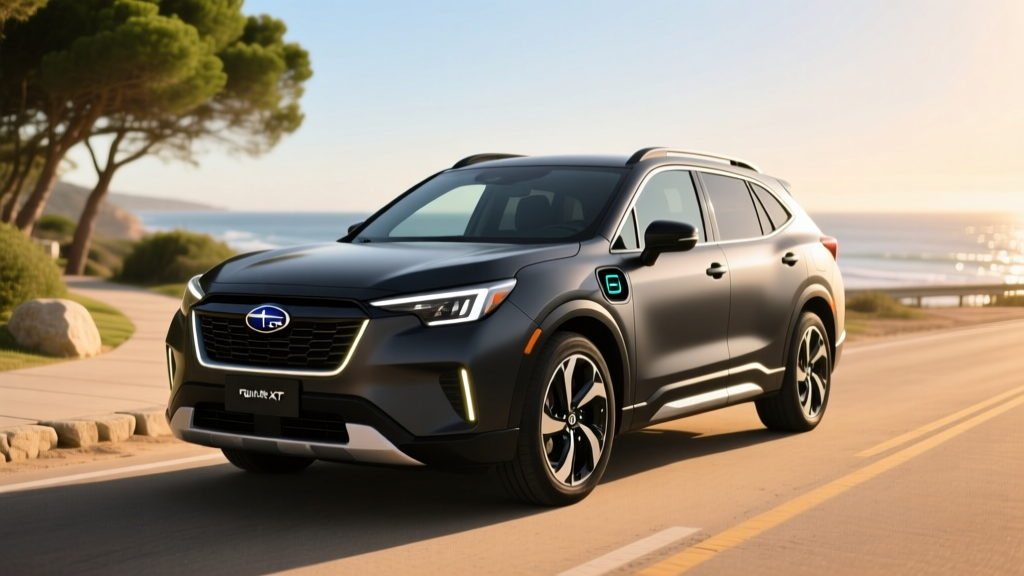
Subaru's all-electric SUV enters its fourth model year with meaningful upgrades that address the two biggest complaints from early adopters: range and charging speed. The 2026 Subaru Solterra Touring XT sits at the top of a three-trim lineup, pairing a larger battery with dual-motor all-wheel drive and Subaru's signature X-MODE traction system. But does the flagship trim justify its near-$47,000 starting price, and how does it stack up against the Hyundai Ioniq 5, Toyota bZ4X, and Ford Mustang Mach-E in real-world driving? We break down every spec that matters.
Range, Battery & Real-World Efficiency
Real-World Expectation: 230–255 miles on highway-heavy trips at 70+ mph; 190–215 miles in sub-freezing winter conditions with cabin heat. City/regenerative driving can push 270+ miles in mild weather.
The 2026 Solterra Touring XT uses an 84.0 kWh usable lithium-ion battery pack with NMC (nickel-manganese-cobalt) cell chemistry — chosen for its higher energy density, which matters in Subaru's relatively compact e-TNGA skateboard platform. The previous generation's 71.4 kWh pack and ~228-mile EPA ceiling was the model's Achilles' heel; the larger pack and revised heat-pump thermal management close that gap substantially.
| Spec | Value |
|---|---|
| EPA Range | 285 miles |
| Battery (usable) | 84.0 kWh, NMC |
| Efficiency | 104 MPGe combined / 32 kWh/100 mi |
| Peak DC Fast Charge | 150 kW |
| 10–80% DC Charge Time | ~30 minutes |
| Level 2 Home Charge Rate | 11.5 kW (~36 mi/hr) |
| Drivetrain | Dual-motor AWD |
| Horsepower / Torque | 338 hp / 375 lb-ft |
| 0–60 mph | 5.2 seconds |
| Cargo (behind rear seats) | 27.7 cu ft |
| Cargo (rear seats folded) | 63.5 cu ft |
| Rear Legroom | 35.7 inches |
| Base MSRP (Touring XT) | $46,995 (incl. destination) |
| Battery Warranty | 8 years / 100,000 miles (70% capacity retention) |
At 32 kWh per 100 miles combined (104 MPGe per EPA), the Solterra is slightly less efficient than the Hyundai Ioniq 5 AWD (30 kWh/100 mi) but competitive with the Ford Mustang Mach-E AWD. The NMC chemistry provides strong energy density, though buyers prioritizing maximum cycle life over range-per-kWh should note that LFP packs (as used in the Tesla Model Y RWD and base Ford Mustang Mach-E) typically degrade more slowly over 150,000+ miles.
Charging Speed: DC Fast Charging & Home Level 2
Subaru upgraded the Solterra's DC fast-charging architecture for 2026, moving from the previous generation's ~100 kW peak to a 150 kW peak charge rate. On a compatible 150+ kW DC fast charger (Electrify America, EVgo, or Tesla Supercharger stations open to NACS-equipped vehicles), the 10–80% session takes approximately 30 minutes.
Here's the nuance most spec sheets omit: the charge curve. The Solterra holds near-peak 150 kW from roughly 10% to 45% state of charge, then tapers progressively. From 80% to 100%, charging slows dramatically to protect battery longevity — expect a full 80–100% top-off to add another 25–35 minutes. For road-trip planning, plan your stops around the 10–80% window and skip the final 20% unless you need every last mile.
| Level | Power | Speed (mi/hr added) | Full Charge Time |
|---|---|---|---|
| Level 1 (120V household) | ~1.4 kW | ~4 mi/hr | ~60 hours (0–100%) |
| Level 2 (240V, 48A home) | 11.5 kW | ~36 mi/hr | ~7.5 hours (0–100%) |
| DC Fast (150 kW peak) | 150 kW | ~320 mi/hr (peak) | ~30 min (10–80%) |
For home charging, the Solterra's onboard charger accepts up to 11.5 kW on Level 2 (240V, 48 amps). A full overnight charge from near-empty takes about 7.5 hours — easily achievable with a hardwired Level 2 wallbox on a 60-amp dedicated circuit. Budget $800–$1,600 for a quality Level 2 charger (ChargePoint Home Flex, Emporia Level 2, or Wallbox Pulsar Plus) plus $500–$2,000 for professional electrician installation depending on panel proximity and local permit fees. If your home has a 100-amp main panel, a panel upgrade to 200 amps could add $1,500–$3,000.
The 2026 Solterra uses the CCS1 connector for DC fast charging (J1772 for Level 2 AC). Subaru has not adopted the Tesla NACS standard for this model year. If you plan to use Tesla Superchargers (many of which now feature a "Magic Dock" CCS adapter or have opened to non-Tesla vehicles via the Tesla app), confirm compatibility in your area.
Performance & Driving Dynamics
The Touring XT's dual-motor all-wheel-drive powertrain produces 338 horsepower and 375 lb-ft of torque, launching the 4,500-pound SUV to 60 mph in 5.2 seconds. That's a meaningful improvement over the first-generation Solterra's 214 hp and 6.5-second 0–60, and it places the Touring XT squarely in the competitive set with the Mach-E Premium AWD (5.1 sec) and Ioniq 5 AWD (5.0 sec).
Where the Solterra differentiates itself is off-pavement and in adverse conditions. Subaru's X-MODE system — carried over from its ICE lineup — provides selectable Snow/Dirt and Deep Snow/Mud modes that modulate torque distribution and regenerative braking for low-traction surfaces. The 8.3 inches of ground clearance exceeds most EV crossovers (the Ioniq 5 sits at 6.1 inches), and the 2,000-pound towing capacity, while modest, is on par with the segment. This is the EV for ski-town buyers and Pacific Northwest forest roads, not drag-strip warriors.
On paved roads, the ride quality is compliant and well-damped, though the steering lacks the precision of the Mach-E. Road noise at highway speeds is noticeable — a common e-TNGA platform trait shared with the Toyota bZ4X — and the Touring XT's 20-inch alloy wheels (standard on this trim) trade some ride comfort and ~10 miles of range for aesthetics.
Interior, Tech & Driver Assistance
The Touring XT cabin features SofTex-trimmed upholstery, heated and ventilated front seats, a heated steering wheel, and a panoramic fixed glass roof. The 12.3-inch touchscreen runs Subaru's latest Starlink infotainment with wireless Apple CarPlay and Android Auto, native navigation, and over-the-air update capability. A 12.3-inch digital gauge cluster sits behind the wheel, and a 10-speaker Harman Kardon audio system rounds out the premium touches.
Subaru's EyeSight driver-assistance suite is standard across all trims and includes adaptive cruise control with lane centering, pre-collision braking, lane-keep assist, and blind-spot monitoring with rear cross-traffic alert.
The most notable tech drawback: the Solterra still lacks a front trunk (frunk). The e-TNGA platform's packaging leaves the space under the hood occupied by power electronics, so all cargo goes in the rear 27.7 cu ft area. For a vehicle in this price range, that's a missed opportunity versus the Mach-E (13.9 cu ft frunk) and Ioniq 5 (0.85 cu ft frunk).
Pricing, Trims & Federal Tax Credit
The 2026 Subaru Solterra lineup spans three trims. All use the same 84.0 kWh battery and dual-motor AWD powertrain; differences center on comfort, technology, and wheel size.
| Trim | MSRP (incl. destination) | EPA Range | Key Additions |
|---|---|---|---|
| Premium | $39,995 | 295 mi | 18" wheels, heated seats, EyeSight, 8" touchscreen |
| Limited | $43,995 | 285 mi | Power liftgate, SofTex seats, 12.3" screen, panoramic roof |
| Touring XT | $46,995 | 285 mi | 20" wheels, ventilated seats, Harman Kardon, X-MODE |
Our as-tested Touring XT with the optional $350 Digital Key package and $200 cargo tray came to $47,545 before incentives.
Does the 2026 Solterra Qualify for the §30D Federal Tax Credit?
The 2026 Subaru Solterra may qualify for up to $7,500 under the IRS §30D Clean Vehicle Credit, but eligibility depends on several factors that change frequently and vary by buyer. As of 2026, the key requirements include:
- MSRP Cap: SUVs must have an MSRP at or below $80,000. All Solterra trims qualify.
- Buyer Income Cap: Modified adjusted gross income must not exceed $150,000 (single), $225,000 (head of household), or $300,000 (joint filing).
- Battery Sourcing: A percentage of critical minerals and battery components must be sourced from the US or free-trade-agreement countries. These thresholds tighten annually — verify current-year compliance on IRS.gov or with your tax professional.
- Point-of-Sale Transfer: Eligible buyers can transfer the credit to the dealer at purchase, reducing the out-of-pocket price immediately rather than waiting to claim it on a tax return.
- Final Assembly: The Solterra is assembled at Toyota's Motomachi plant in Japan. Confirm that the vehicle's VIN qualifies under current final-assembly requirements.
Bottom line: If you qualify for the full $7,500, the Touring XT's effective price drops to approximately $39,495 — competitive with the Mach-E Premium AWD and significantly undercutting the BMW iX. However, battery-sourcing rules are the moving target. Always verify eligibility for your specific VIN before purchase using the DOE's qualifying vehicle list.
Who Should Buy the 2026 Solterra Touring XT?
- You live in a region with snow, ice, or unpaved roads and value AWD traction with 8.3" ground clearance.
- You want a premium-trim EV SUV under $47K with ventilated seats, Harman Kardon audio, and a panoramic roof.
- Your daily commute is under 100 miles round-trip, with occasional 200-mile road trips within charging-network coverage.
- Subaru's safety reputation and EyeSight suite are high on your priority list.
- You need 300+ miles of real-world highway range — consider the Ioniq 5 (310 mi EPA) or Model Y Long Range.
- You want hands-free highway driving — Ford BlueCruise and GM Super Cruise offer that; Subaru does not.
- Cargo capacity is paramount — the Mach-E offers more total volume plus a frunk.
- You need DC charging above 200 kW for frequent long road trips — the Ioniq 5 peaks at 240 kW.
The Solterra Touring XT is best understood as the outdoor-lifestyle EV. It's the electric vehicle for the buyer who currently owns a Subaru Outback or Forester and wants to go electric without sacrificing the all-weather confidence and ground clearance they rely on. It is not the longest-range or fastest-charging EV in its class, but it occupies a niche that no competitor directly fills: rugged, AWD-competent, and premium-equipped at a mainstream price.
Pros & Cons at a Glance
Pros
- Standard dual-motor AWD with X-MODE — best-in-class off-pavement capability
- 8.3" ground clearance exceeds most EV crossovers
- Upgraded 84 kWh pack delivers a meaningful range increase over prior model years
- 150 kW DC charging is a substantial improvement from the original ~100 kW
- Touring XT trim includes premium features (ventilated seats, Harman Kardon) at a competitive price
- Subaru's 8-year/100,000-mile battery warranty matches the industry standard
- EyeSight safety suite is standard across all trims
Cons
- 285-mile EPA range (230–255 real-world highway) trails Ioniq 5 and Model Y
- 150 kW peak DC charging is slower than the Ioniq 5 (240 kW) and Model Y (~250 kW)
- No front trunk (frunk) — all cargo is rear-only
- No hands-free driving system (Level 2 only) — behind Ford and GM
- 20-inch wheels on Touring XT reduce range and ride comfort vs. lower trims
- Highway road noise is noticeable at 70+ mph
- Japan-assembled — verify §30D final-assembly eligibility before purchase
Competitor Comparison: Solterra vs. Ioniq 5 vs. Mach-E
| Spec | Solterra Touring XT | Ioniq 5 Limited AWD | Mach-E Premium AWD ER |
|---|---|---|---|
| EPA Range | 285 mi | 290 mi | 300 mi |
| Battery (usable) | 84.0 kWh NMC | 84.0 kWh NMC | 91.0 kWh NMC |
| Peak DC Charge | 150 kW | 240 kW | 150 kW |
| 10–80% Time | ~30 min | ~18 min | ~32 min |
| 0–60 mph | 5.2 sec | 5.0 sec | 5.1 sec |
| Ground Clearance | 8.3 in | 6.1 in | 5.7 in |
| Cargo (rear seats up) | 27.7 cu ft | 27.2 cu ft | 29.7 cu ft |
| Frunk | None | 0.85 cu ft | 4.7 cu ft |
| Base MSRP (tested trim) | $46,995 | $54,200 | $52,995 |
The Solterra wins on ground clearance, off-road capability, and starting price at the premium trim level. The Ioniq 5 dominates on DC charging speed (240 kW is class-leading), while the Mach-E leads on total range and cargo volume. Your priority ranking among those attributes determines the right choice.
Frequently Asked Questions
What is the real-world range of the 2026 Subaru Solterra Touring XT?
The EPA rates the Touring XT at 285 miles. In real-world highway driving at 70–75 mph in moderate temperatures, expect 230–255 miles before needing to charge. In cold weather (below 32°F) with cabin heating, that drops to roughly 190–215 miles. City driving with regenerative braking can approach the EPA figure in mild conditions. The 84 kWh NMC battery and standard heat pump help mitigate winter losses compared to earlier model years.
How fast does the 2026 Solterra charge at home and on the road?
On a 150+ kW DC fast charger, the Solterra peaks at 150 kW and charges from 10–80% in approximately 30 minutes. At home on a 240V Level 2 charger (48 amps / 11.5 kW), a full charge takes about 7.5 hours, adding roughly 36 miles of range per hour of charging. Level 1 (120V) charging is an emergency trickle at about 4 miles per hour — not practical for daily use.
How much does the 2026 Solterra Touring XT cost after tax credits?
The Touring XT starts at $46,995 including destination. If you qualify for the full $7,500 federal §30D credit (subject to income caps, battery-sourcing requirements, and final-assembly rules), the effective price drops to approximately $39,495. Many states also offer additional rebates — check state incentive databases for your jurisdiction. The point-of-sale transfer option lets you apply the federal credit at the dealership rather than waiting for tax filing.
Does the 2026 Subaru Solterra qualify for the $7,500 federal EV tax credit?
It may, but eligibility is not universal. The Solterra's MSRP is well under the $80,000 SUV cap, and qualifying depends on your income (≤$150K single / $300K joint), the battery's critical-mineral and component sourcing for the specific model year, and final-assembly requirements. The Solterra is built in Japan, so confirm VIN-level eligibility on IRS.gov or with your tax professional before committing to a purchase.
Is the 2026 Solterra Touring XT worth buying over the Ioniq 5 or Mach-E?
It depends on your priorities. If you need genuine all-weather AWD capability, high ground clearance for snow or gravel roads, and Subaru's safety-focused brand identity, the Solterra occupies a unique niche. If your priority is maximum range, fastest DC charging, or hands-free highway driving, the Ioniq 5 and Mach-E are stronger choices. The Solterra is the right EV for outdoor-lifestyle buyers who drive in challenging conditions and don't regularly exceed 200 miles between charges.
What is the battery warranty on the 2026 Solterra?
Subaru covers the high-voltage battery for 8 years or 100,000 miles, whichever comes first, against defects and capacity loss below 70% of original capacity. The powertrain (motors, inverter, reduction gear) carries the same 8-year/100,000-mile coverage. This matches the industry standard set by most mainstream EV manufacturers and aligns with federal requirements for emissions-related components.