The Subaru Solterra has always occupied a curious space in the EV market: it's the go-to electric vehicle for buyers who want Subaru's legendary all-weather capability wrapped in a battery-electric package. Developed jointly with Toyota (its platform twin is the bZ4X), the 2026 Subaru Solterra EV arrives with meaningful charging-speed improvements and a slightly expanded battery that addresses the most common criticism leveled at earlier model years. But does it do enough to compete against the Hyundai Ioniq 5, Ford Mustang Mach-E, and Tesla Model Y in an increasingly crowded compact electric SUV segment? We break down every spec that matters.
2026 Subaru Solterra: Quick Verdict
The 2026 Solterra is a competent, comfortable, and genuinely capable all-wheel-drive EV that excels in cold climates and rough weather. Its standard symmetrical AWD, 8.3 inches of ground clearance, and X-MODE traction system make it the most off-road-credible vehicle in its class. However, its DC fast-charging speed — while improved over the 2023-2024 models — still trails segment leaders, and its real-world highway range remains modest compared to rivals priced similarly. It's a strong pick for Subaru loyalists and cold-climate commuters who prioritize traction and build quality over maximum range or fastest charging.
Range, Battery, and Efficiency
| Specification | 2026 Subaru Solterra |
|---|---|
| Battery Capacity (usable) | 74.4 kWh (NMC lithium-ion) |
| EPA Estimated Range | 228 miles (Premium/Limited trims with 20" wheels); up to 252 miles (base 18" wheels) |
| MPGe (Combined) | |
| Efficiency | 31 kWh/100 miles |
| Drivetrain | Dual-motor AWD (standard all trims) |
The Solterra uses an NMC (nickel-manganese-cobalt) battery chemistry, which offers higher energy density than LFP alternatives but requires more careful thermal management and benefits from avoiding routine 100% charges for daily use. Subaru recommends charging to 80% for daily driving and reserving 100% for long trips — a practice that extends long-term battery health.
Charging Speed: DC Fast Charge and Home Level 2
| Charging Level | Power / Rate | Time or Miles Added |
|---|---|---|
| Level 1 (120V household) | ~1.4 kW | ~4 miles per hour |
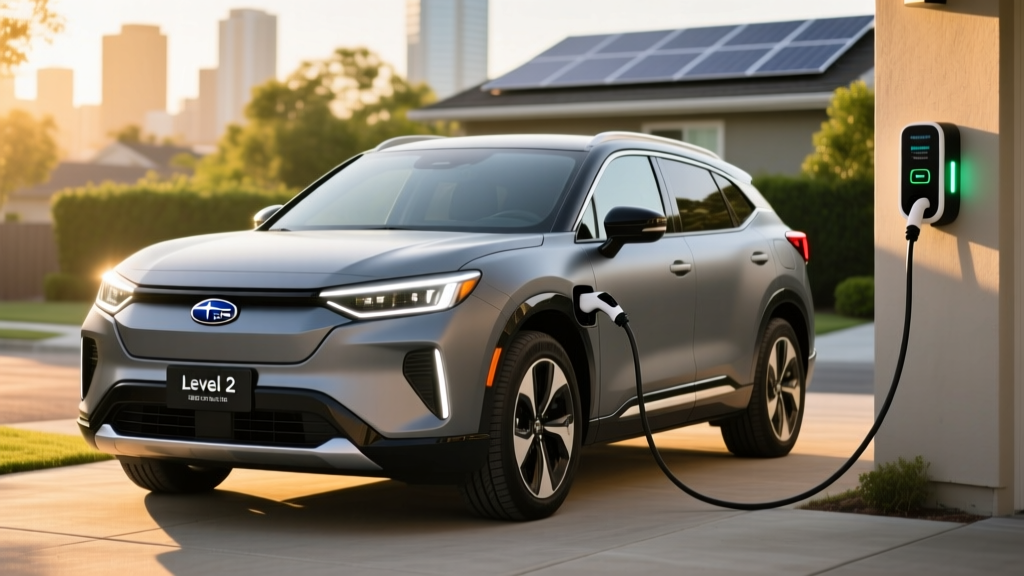
| Level 2 (240V home) | 7.2 kW (onboard charger limit) | ~23 miles per hour; 0–100% in ~11 hours |
| DC Fast Charge (CCS) | Peak ~150 kW | 10–80% in approximately 35 minutes |
The 2026 Solterra's DC fast-charging peak of roughly 150 kW represents a step up from the ~100 kW peak of earlier model years, but it still falls behind the Hyundai Ioniq 5 (which peaks near 240 kW on 800V architecture) and the Tesla Model Y (~250 kW on V3 Superchargers). On a 150 kW CCS charger, the Solterra sustains its peak rate only up to roughly 30% State of Charge (SoC), after which the charge curve tapers progressively. Expect the 10–80% session to take about 35 minutes under ideal battery-preconditioned conditions.
Preconditioning matters here. The Solterra's battery thermal management system needs to warm the pack before it will accept peak DC charge rates. In cold weather, always use the navigation system to route to a DC fast charger — this triggers automatic battery preconditioning. Without it, a cold-soaked battery in winter may accept only 40–60 kW initially, extending your 10–80% session to 50+ minutes.
At home on a Level 2 (240V) charger, the 7.2 kW onboard charger adds about 23 miles of range per hour. A full overnight charge from near-empty takes roughly 11 hours, which is manageable for daily use. Note that the 7.2 kW onboard charger is somewhat conservative — competitors like the Ioniq 5 and Ford Mach-E offer 10.9–11.5 kW Level 2 acceptance, meaning faster home top-ups.
Performance, Drivetrain, and Driving Dynamics
| Performance Spec | 2026 Solterra |
|---|---|
| Horsepower | 215 hp (combined dual-motor) |
| Torque | 248 lb-ft |
| 0–60 mph | 6.5 seconds |
| Drivetrain | Dual-motor AWD (front 109 hp + rear 106 hp) |
| Ground Clearance | 8.3 inches |
| Towing Capacity | Not rated for towing |
The Solterra's 215 hp and 6.5-second 0–60 time place it squarely in the adequate-but-not-thrilling category. For comparison, the dual-motor Hyundai Ioniq 5 hits 60 mph in about 5.0 seconds, and the Tesla Model Y Long Range does it in roughly 4.8 seconds. The Solterra is not slow by any means — it merges onto highways and passes with confidence — but Subaru has clearly prioritized all-weather traction and ride comfort over outright acceleration.
Where the Solterra genuinely shines is in adverse conditions. The standard dual-motor AWD with Subaru's X-MODE traction management system provides excellent grip on snow, ice, mud, and loose gravel. The 8.3 inches of ground clearance exceeds nearly every competitor in the segment, and the Grip Control low-speed crawl function makes it surprisingly capable on unpaved trails. If you live in the Mountain West, New England, or anywhere with real winters, the Solterra's all-weather competence is a legitimate differentiator.
Interior, Cargo, and Technology
The 2026 Solterra's cabin is functional, well-assembled, and spacious for its footprint. Subaru uses a mix of soft-touch materials on the upper dashboard and harder plastics lower down — typical for this price segment.
| Dimension | Measurement |
|---|---|
| Front Legroom | 42.1 inches |
| Rear Legroom | 35.7 inches |
| Cargo (behind rear seats) | 27.7 cu ft |
| Cargo (rear seats folded) | 56.9 cu ft |
| Frunk (front trunk) | Not available |
The 27.7 cubic feet of rear cargo space is competitive with the Toyota bZ4X (27.7 cu ft) but trails the Hyundai Ioniq 5 (32.5 cu ft) and the Ford Mustang Mach-E (29.7 cu ft). There is no frunk — the space under the hood houses power electronics. Rear-seat legroom is adequate for adults on shorter trips, though taller passengers may wish for more knee room.
Infotainment: A 12.3-inch touchscreen runs Subaru's Starlink multimedia system with wireless Apple CarPlay and Android Auto, native navigation, and cloud-connected services. The interface is responsive enough, though it lacks the visual polish of Hyundai's or Tesla's systems. Physical knobs for climate control are retained — a welcome ergonomic choice.
Driver Assistance (SAE Level 2): Subaru's EyeSight driver-assist suite is standard and includes adaptive cruise control with lane centering, automatic emergency braking, lane-keep assist, and blind-spot monitoring. The new Subaru Safety Sense 4.0 adds improved pedestrian detection and intersection collision avoidance. Importantly, EyeSight is an SAE Level 2 driver-assist system — it is not self-driving, and you must keep your hands on the wheel and eyes on the road at all times.
Pricing, Trims, and Federal Tax Credit Eligibility
| Trim | Base MSRP | Est. After §30D Credit* |
|---|---|---|
| Premium (18" wheels) | $39,995 | ~$32,495 |
| Limited (20" wheels) | $43,495 | ~$35,995 |
| Touring (20" wheels, premium pkg) | $47,195 | ~$39,695 |
*Estimated prices assume full $7,500 federal tax credit eligibility under IRS §30D. Point-of-sale transfer available at participating dealers.
All 2026 Solterra trims fall under the $80,000 MSRP cap for SUVs under §30D, making them potentially eligible for the full $7,500 federal tax credit. However, eligibility is not automatic — buyers must meet several requirements:
- Buyer income caps: Modified AGI must not exceed $150,000 (single), $225,000 (head of household), or $300,000 (married filing jointly)
- Battery sourcing rules: The vehicle's battery components must meet increasing percentages of US/FTA-country manufacturing, and critical minerals must meet sourcing thresholds — these thresholds tighten annually. Check the latest IRS guidance on IRS.gov for current-year compliance.
- Point-of-sale transfer: As of 2024, buyers can transfer the credit to the dealer at purchase, reducing the purchase price directly rather than waiting for a tax refund. The dealer must be registered with the IRS Energy Credits portal.
- Tax liability: If claiming the credit on your tax return (not point-of-sale), you must have sufficient federal tax liability to absorb the credit. It is non-refundable.
Consult a tax professional and verify current-year eligibility on fueleconomy.gov before finalizing your purchase — battery-sourcing compliance can shift between model years and production batches.
Warranty and Long-Term Battery Outlook
| Warranty Coverage | Term |
|---|---|
| New Vehicle Limited | 3 years / 36,000 miles |
| Powertrain | 5 years / 60,000 miles |
| EV Battery Components | 8 years / 100,000 miles |
| Battery Capacity Retention | Guaranteed ≥70% SoH for 8 years / 100,000 miles |
Subaru guarantees the Solterra's high-voltage battery will retain at least 70% of its original capacity (State of Health) over 8 years or 100,000 miles — in line with industry norms from Toyota, Hyundai, and Ford. Real-world degradation data from 2023-2024 Solterra owners suggests the NMC pack holds up well, with typical 2-year SoH readings around 94–96% under normal use. Avoiding repeated DC fast-charging sessions to 100% and minimizing exposure to extreme heat will help preserve capacity long-term.
Who Should Buy the 2026 Subaru Solterra?
- You live in a cold/snowy climate and prioritize AWD traction and ground clearance
- You're a current Subaru owner who values brand familiarity and dealer relationships
- Your daily commute is under 80 miles round-trip, with occasional 150-mile trips
- You want a comfortable, well-built compact SUV and don't need maximum cargo volume
- Home Level 2 charging is available and you can charge overnight
- You regularly drive 250+ miles between charges on road trips (the Ioniq 5 or Model Y offers more range + faster charging)
- You need fast DC charging for frequent highway travel (Solterra's ~150 kW peak and 35-min 10-80% trails the 800V competition)
- Cargo space is a priority (Ioniq 5 and Mach-E offer more cubic feet)
- You want a frunk for extra storage
2026 Solterra vs. Key Competitors
| Spec | Subaru Solterra | Hyundai Ioniq 5 (AWD) | Tesla Model Y (LR AWD) |
|---|---|---|---|
| EPA Range | 228–252 mi | 290 mi | 320 mi |
| Battery (usable) | 74.4 kWh (NMC) | 77.4 kWh (NMC) | ~75 kWh (NMC) |
| Peak DC Charge | ~150 kW | ~240 kW (800V) | ~250 kW |
| 10–80% DCFC Time | ~35 min | ~18 min | ~20 min |
| 0–60 mph | 6.5 sec | 5.0 sec | 4.8 sec |
| AWD Standard? | Yes (all trims) | Optional | Yes (LR AWD) |
| Ground Clearance | 8.3 in | 6.1 in | 6.6 in |
| Starting MSRP (AWD) | $39,995 | ~$50,100 | ~$48,990 |
The Solterra's primary advantage is value: standard AWD across all trims at a base price thousands below its AWD competitors, plus superior ground clearance. Its weaknesses — range, charging speed, and cargo space — are measurable trade-offs for that price and capability advantage.
Pros and Cons
- Standard dual-motor AWD on every trim — no FWD base model to avoid
- Class-leading 8.3" ground clearance and genuine off-road/trail capability
- X-MODE traction system and Grip Control for snow, mud, and gravel
- Competitive base pricing with AWD included
- Comfortable ride quality and well-insulated cabin
- Physical climate control knobs retained
- Strong Subaru dealer network, especially in rural and cold-weather markets
- Real-world highway range of ~210–225 miles trails key competitors
- DC fast-charging speed (~150 kW peak, ~35 min 10–80%) lags 800V rivals
- No frunk (front trunk) for additional storage
- 7.2 kW onboard Level 2 charger is slower than class leaders (10.9–11.5 kW)
- Rear-seat legroom is tight for taller passengers
- Infotainment system is functional but lacks visual refinement
- Cold-weather range loss of 20–30% requires route planning on longer winter trips
Frequently Asked Questions
What is the real-world range of the 2026 Subaru Solterra?
The EPA rates the Solterra at up to 252 miles (18" wheels) or 228 miles (20" wheels). In real-world mixed driving at highway speeds, expect roughly 210–225 miles. In cold weather below freezing, plan for 160–190 miles depending on driving style and cabin heating use.
How fast does the Solterra charge at home and on the road?
On a Level 2 home charger (240V), the Solterra charges at up to 7.2 kW, adding about 23 miles per hour — a full charge takes roughly 11 hours. On DC fast chargers, it peaks at approximately 150 kW, reaching 10–80% in about 35 minutes when the battery is preconditioned.
Does the 2026 Subaru Solterra qualify for the $7,500 federal EV tax credit?
All Solterra trims fall under the $80,000 MSRP cap for SUVs. However, buyer eligibility depends on income caps ($150K single / $300K joint), battery-sourcing compliance, and tax liability. The credit can be transferred at point-of-sale to participating dealers. Verify current-year rules at IRS.gov and consult a tax professional.
Is the Subaru Solterra worth buying over the Hyundai Ioniq 5 or Tesla Model Y?
If you prioritize all-weather capability, ground clearance, standard AWD, and a lower starting price, the Solterra is a strong choice. If you need maximum range, the fastest charging, or more cargo space, the Ioniq 5 and Model Y are more compelling. The Solterra is best suited to cold-climate commuters who charge at home and rarely need 250+ miles of range in a single drive.
What is the Solterra's battery warranty?
Subaru covers the high-voltage battery for 8 years or 100,000 miles, guaranteeing at least 70% capacity retention (State of Health) over that period. This matches the industry-standard EV battery warranty.
Can the Subaru Solterra tow?
No. The 2026 Solterra is not rated for towing. If you need an EV with towing capability, look at the Ford F-150 Lightning, Rivian R1S, or Hyundai Ioniq 5 (up to 2,300 lbs when equipped with the tow package).