Tesla Tow Hitch Installation: Which Models Support Towing and What It Costs
If you're researching Tesla tow hitch installation, you're likely weighing whether your Tesla can handle a bike rack, cargo carrier, or light trailer — and what the real-world trade-offs look like. Tesla offers factory tow hitches on select models, but not all trims support them, and aftermarket options come with warranty caveats. This guide breaks down every Tesla model's towing capability, hitch installation costs, range impact under load, and the specs you need before bolting anything to the rear subframe.
Tesla's approach to towing has evolved significantly. The Model Y and Model X both offer factory-installed tow hitches with integrated wiring harnesses, while the Cybertruck ships with a robust receiver as standard. The Model 3, however, does not receive a factory hitch option in the U.S. market, limiting owners to aftermarket solutions. Below, we profile the three Tesla models most relevant to towing buyers, with full specs, pricing, and real-world ownership data.
2026 Tesla Model Y: The Most Popular Tesla for Towing
The Model Y remains Tesla's volume leader and the model most buyers consider when evaluating Tesla tow hitch installation. For 2026, the refreshed Model Y (internally called "Juniper") continues to offer a factory tow hitch as a dealer-installed or port-installed accessory on Long Range and Performance trims.
| Spec | Value |
|---|---|
| EPA Range | 320 miles |
| Battery Capacity | ~75 kWh usable (NMC chemistry) |
| Drivetrain | Dual-Motor AWD |
| Horsepower | 384 hp combined |
| 0-60 mph | 4.8 seconds |
| Max DC Fast Charge | 250 kW (peak) |
| 10-80% DC Charge Time | ~25 minutes |
| Level 2 Home Charge Rate | 11.5 kW (~44 mi/hr) |
| MPGe (Combined) | 122 MPGe |
| Efficiency | 28 kWh/100 mi |
| Towing Capacity | 3,500 lbs |
| Hitch Type | 1.25" receiver (factory) / 2" aftermarket |
| Cargo Volume | 72 cu ft (rear seats folded) |
| Rear Legroom | 41.6 inches |
| Battery Warranty | 8 years / 120,000 miles |
| Base MSRP | $44,990 |
Tesla Model Y Tow Hitch: Factory vs. Aftermarket
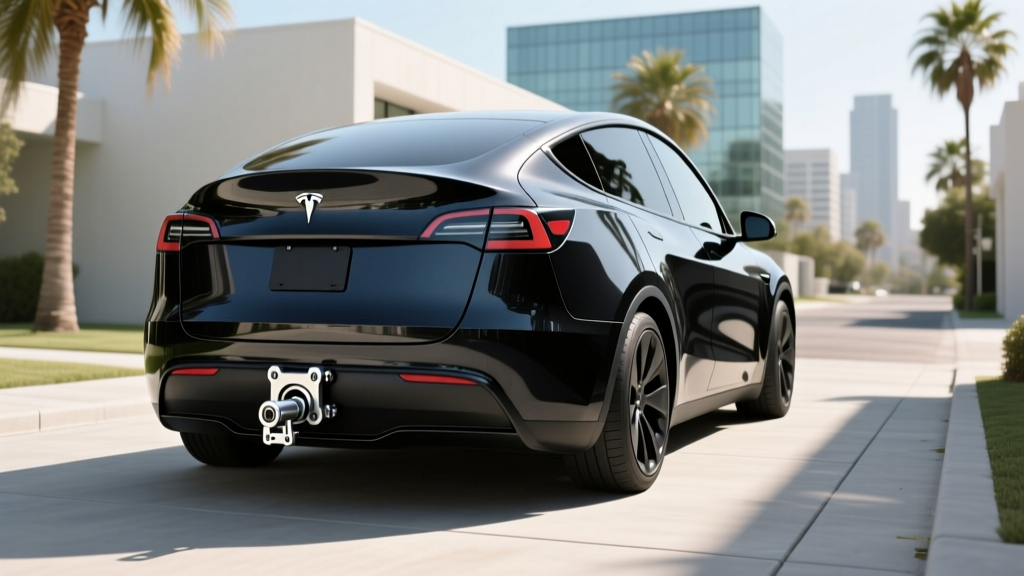
Tesla's factory tow hitch for the Model Y uses a 1.25-inch receiver and includes a 7-pin wiring harness integrated into the vehicle's electrical system. The factory hitch is rated for 3,500 lbs towing and 350 lbs tongue weight. Installation at a Tesla Service Center typically runs $1,200-$1,500 including parts and labor, though pricing varies by region.
Aftermarket options from brands like EcoHitch, Curt, and Draw-Tite offer 2-inch receivers rated up to 3,500 lbs. These typically cost $250-$450 for the hardware alone, with professional installation adding $300-$600. The key risk: aftermarket hitches that require cutting or modifying the rear bumper or subframe may affect your vehicle's structural warranty. Tesla's position has historically been that non-factory modifications to the chassis can void related warranty claims.
| Option | Hardware Cost | Labor Cost | Total | Receiver Size |
|---|---|---|---|---|
| Tesla Factory Hitch (Service Center) | $800-$900 | $400-$600 | $1,200-$1,500 | 1.25" |
| EcoHitch (Aftermarket) | $350-$420 | $300-$500 | $650-$920 | 2" |
| Curt Class III (Aftermarket) | $250-$320 | $300-$500 | $550-$820 | 2" |
| DIY Install (Aftermarket) | $250-$420 | $0 | $250-$420 | Varies |
2026 Tesla Model X: The Heavy-Duty Towing Option
The Model X remains Tesla's towing champion among SUVs, with a 5,000-lb rating that outclasses the Model Y by a significant margin. For buyers who need to pull a mid-size travel trailer, boat, or horse trailer, the Model X is the only current Tesla SUV that qualifies.
| Spec | Value |
|---|---|
| EPA Range | 335 miles |
| Battery Capacity | ~95 kWh usable (NMC chemistry) |
| Drivetrain | Dual-Motor AWD |
| Horsepower | 670 hp |
| 0-60 mph | 3.8 seconds |
| Max DC Fast Charge | 250 kW (peak) |
| 10-80% DC Charge Time | ~30 minutes |
| Level 2 Home Charge Rate | 11.5 kW (~34 mi/hr) |
| MPGe (Combined) | 102 MPGe |
| Towing Capacity | 5,000 lbs |
| Hitch Type | 2" receiver (factory standard) |
| Cargo Volume | 88.1 cu ft (rear seats folded) |
| Battery Warranty | 8 years / 150,000 miles |
| Base MSRP | $74,990 |
The Model X comes with a 2-inch Class III receiver standard on all trims, along with a 7-pin connector and Tesla's trailer sway mitigation software. This is a genuine advantage over the Model Y: no aftermarket compromise, no warranty ambiguity, and a larger receiver compatible with weight-distribution hitches for heavier loads.
However, the Model X's higher weight (5,100+ lbs curb weight) and less aerodynamic profile mean real-world range while towing drops sharply. Expect 170-210 miles of effective range when pulling a 4,000-lb trailer at highway speeds — adequate for regional trips with Supercharger stops, but requiring careful planning for longer hauls.
2026 Tesla Cybertruck: Built for Towing, With Caveats
The Cybertruck ships with a 2-inch receiver hitch as standard equipment and carries an 11,000-lb towing rating — more than double the Model X. Tesla designed the truck's stainless-steel exoskeleton and rear subframe around heavy-duty utility, and the hitch integrates directly into the structural bed floor.
| Spec | Value |
|---|---|
| EPA Range | 318 miles (AWD) |
| Battery Capacity | ~123 kWh usable (NMC) |
| Drivetrain | Dual-Motor AWD / Tri-Motor (Cyberbeast) |
| Horsepower | 600 hp (AWD) / 845 hp (Cyberbeast) |
| 0-60 mph | 4.1 sec (AWD) / 2.6 sec (Cyberbeast) |
| Max DC Fast Charge | 350 kW (peak, at V4 Superchargers) |
| 10-80% DC Charge Time | ~22 minutes (V4) |
| Level 2 Home Charge Rate | 11.5 kW (~26 mi/hr) |
| Towing Capacity | 11,000 lbs |
| Hitch Type | 2" receiver (standard) |
| Bed Length | 6 ft (vault) |
| Battery Warranty | 8 years / 120,000 miles |
| Base MSRP (AWD) | $79,990 |
The Cybertruck's towing capacity is exceptional, but real-world range under load remains the limiting factor. Independent testing has shown range reductions of 45-60% when towing near max capacity. An 11,000-lb trailer at highway speeds can reduce effective range to 130-170 miles, making long-distance towing feasible only along well-spaced Supercharger corridors. Tesla's integrated trailer brake controller and tow-mode software help manage energy consumption, but physics dictates that a heavy, boxy truck pulling a heavy trailer will consume energy rapidly.
Range Impact: What Towing Really Does to Your Battery
This is the single most important factor for anyone considering Tesla tow hitch installation. Towing dramatically increases energy consumption, and the effect is not linear — it compounds with speed, trailer frontal area, and weight.
| Model | Unloaded Range | Light Load (~1,500 lbs) | Heavy Load (~3,500 lbs) | Max Load |
|---|---|---|---|---|
| Model Y LR (3,500-lb cap) | 320 mi | ~210-230 mi | ~150-180 mi | ~150 mi |
| Model X LR (5,000-lb cap) | 335 mi | ~240-260 mi | ~190-220 mi | ~170 mi (5,000 lbs) |
| Cybertruck AWD (11,000-lb cap) | 318 mi | ~220-240 mi | ~170-200 mi | ~130-170 mi (11,000 lbs) |
Key factors that worsen range loss while towing:
- Aerodynamic drag — An enclosed cargo trailer creates far more drag than an open utility trailer of the same weight. Frontal area matters more than mass at highway speeds.
- Speed — Energy consumption increases with the square of speed. Dropping from 70 mph to 60 mph can recover 15-25% of lost range.
- Terrain — Mountain grades can double or triple energy consumption. Regenerative braking recovers some energy on descents, but not all.
- Temperature — Cold weather reduces battery efficiency and increases cabin heating load, compounding the towing penalty.
Federal Tax Credit Eligibility for Tesla Models in 2026
Under IRS Section 30D, the federal clean vehicle credit offers up to $7,500 for qualifying new EVs. However, eligibility depends on MSRP caps, buyer income limits, battery component sourcing, and critical mineral requirements — all of which are subject to change.
| Model | Base MSRP | SUV MSRP Cap ($80,000) | Income Cap (MFJ) | Estimated Credit |
|---|---|---|---|---|
| Model Y LR AWD | $44,990 | Under cap ✓ | $300,000 | $3,750-$7,500* |
| Model X LR | $74,990 | Under cap ✓ | $300,000 | $3,750-$7,500* |
| Cybertruck AWD | $79,990 | Under cap ✓ | $300,000 | $3,750-$7,500* |
*Credit amount depends on battery sourcing compliance. Tesla has shifted some battery production and mineral sourcing to meet §30D requirements, but the exact credit amount ($3,750 for meeting one requirement, $7,500 for both battery components and critical minerals) varies by production batch and model year. Consult a tax professional and check the latest IRS guidance at irs.gov before purchasing. The point-of-sale transfer option allows dealers to apply the credit as a down-payment reduction if you qualify.
Pros and Cons of Towing with a Tesla
Pros
- Instant torque provides strong, smooth acceleration even under load — no transmission hunting
- Regenerative braking reduces wear on mechanical brakes during descents
- Integrated trailer sway control on Model X and Cybertruck
- Lower per-mile "fuel" cost when towing vs. gas trucks (electricity vs. diesel)
- No idle emissions at campsites or job sites
- Supercharger network provides reliable DC fast charging along major corridors
Cons
- Range drops 40-60% under heavy towing loads — the single biggest limitation
- Supercharger stalls are not designed for pull-through towing; you may need to unhitch
- Model Y's 1.25" factory hitch limits accessory compatibility (most bike racks need 2")
- Aftermarket hitch installation may void related warranty coverage
- No Tesla model matches the 10,000+ lb towing of heavy-duty ICE trucks (F-250, 2500HD) without the Cybertruck
- Charging takes longer when battery is hot from sustained towing
Is a Tesla Worth Buying for Towing vs. Competitors?
Choose Tesla for Towing If:
- You primarily tow light-to-moderate loads (bike racks, small utility trailers, pop-up campers under 3,000 lbs)
- Your towing trips are regional (under 200 miles) or along Supercharger-dense corridors
- You want a daily driver that also tows — not a dedicated tow vehicle
- Lower operating costs matter more than maximum range under load
Look at ICE or Hybrid Trucks If:
- You regularly tow 5,000+ lbs over long distances (300+ miles) without reliable charging access
- You need pull-through fueling/charging at truck stops
- You require a weight-distribution hitch on a Model Y (not supported on the 1.25" factory receiver)
- Your towing is in remote areas without DC fast-charging infrastructure
Compared to the Ford F-150 Lightning (10,000-lb towing, 230-320 mi range, ~$55,000 base), the Cybertruck offers similar towing capacity but at a significantly higher price. The Rivian R1S and R1T offer 7,700-lb and 11,000-lb towing respectively, with comparable range penalties under load. For light-duty towing, the Model Y is competitive with any compact SUV on the market; for heavy-duty work, Tesla's options narrow to the Cybertruck alone.
Frequently Asked Questions About Tesla Tow Hitch Installation
Can I install a tow hitch on a Tesla Model 3?
Tesla does not offer a factory tow hitch for the U.S.-market Model 3 (2026 model year). Some European Model 3 variants do receive a factory hitch, but U.S. models lack the structural reinforcement and wiring provisions. Aftermarket hitches exist but are rated for bike racks and cargo carriers only (typically 200 lbs tongue weight, zero towing capacity). Installing an aftermarket hitch on a Model 3 for towing is not recommended and may void structural warranty coverage.
Does a Tesla tow hitch affect Supercharging?
The hitch itself does not interfere with Supercharging. However, if a bike rack or cargo carrier is mounted on the hitch, it may partially block the rear camera and ultrasonic sensors. More importantly, if you're towing a trailer, most Supercharger stalls are not designed for pull-through parking — you'll need to unhitch the trailer or find a charging location that accommodates vehicles with trailers, such as some Electrify America or EVgo stations with pull-through layouts.
How much range do I lose towing with a Tesla?
Expect a 30-40% range reduction with a light load (1,000-1,500 lbs, open trailer) and 45-60% with a heavy or aerodynamically poor load (3,000+ lbs, enclosed trailer at highway speed). The most efficient towing scenario is a low-profile, lightweight trailer at moderate speeds (55-60 mph) in warm weather. Always plan charging stops at 50% of your expected range to maintain a safety margin. See the EPA's fueleconomy.gov for baseline efficiency data.
Is the Tesla factory hitch worth the premium over aftermarket?
For warranty peace of mind and electrical integration, yes — especially on the Model Y. The factory hitch includes a 7-pin connector that integrates with the vehicle's lighting and trailer brake systems, and Tesla's tow-mode software activates automatically when a trailer is connected. Aftermarket hitches save $500-$900 but may require separate wiring harnesses, and any chassis modification carries warranty risk. If you only need a hitch for a bike rack (no trailer), an aftermarket 2-inch receiver from a reputable brand is a reasonable compromise.
Does towing affect the Tesla battery warranty?
Towing within the manufacturer's rated capacity does not void the battery or powertrain warranty. Tesla's 8-year/120,000-mile (Model Y) or 8-year/150,000-mile (Model X) battery warranty covers defects and capacity degradation below 70%. However, consistently towing at or near maximum capacity accelerates battery cycle wear. If you plan to tow frequently, expect slightly faster long-term degradation — though this is a gradual effect, not a warranty concern, as long as you stay within rated limits.
What's the best Tesla for towing in 2026?
For light towing (bike racks, small trailers, under 3,500 lbs), the Model Y Long Range offers the best balance of price, efficiency, and practicality. For mid-weight trailers (3,500-5,000 lbs), the Model X is the only current Tesla SUV with adequate capacity and a proper 2-inch factory receiver. For heavy-duty towing (5,000-11,000 lbs), the Cybertruck AWD is Tesla's sole option — capable but expensive, with significant range penalties under maximum load.