Quick Verdict: An Electric Truck Built for the Job Site and the Trail
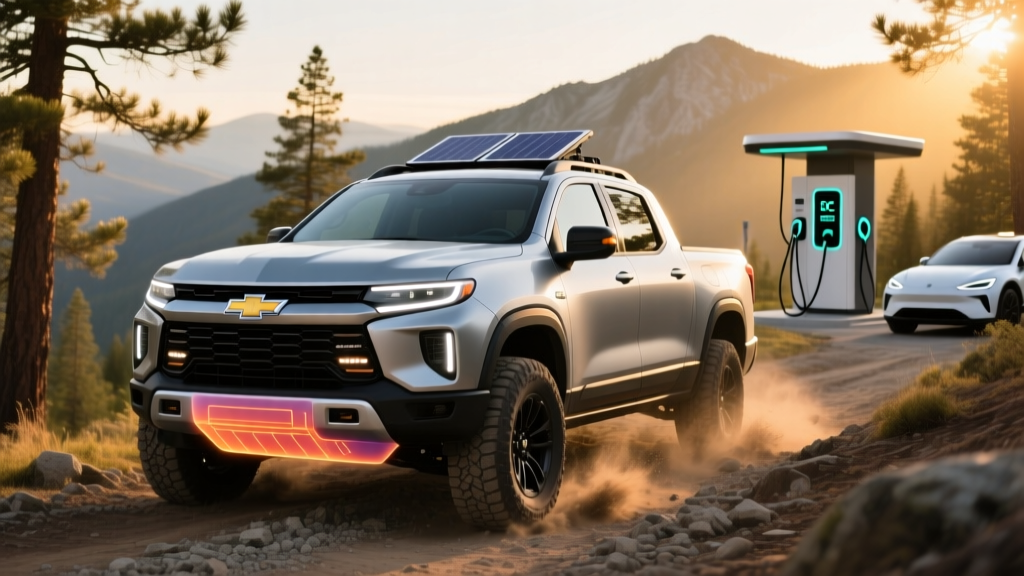
The 2026 Silverado EV Trail Boss arrives as Chevrolet's most off-road-capable electric pickup, slotting between the luxury-oriented RST and the fleet-focused Work Truck in GM's Ultium-based Silverado EV lineup. With a factory lift, 35-inch all-terrain tires, underbody skid plates, and GM's adaptive air suspension tuned for dirt, the Trail Boss targets buyers who want electric torque on the trail without sacrificing the range and payload that make a truck useful Monday through Friday.
But capability comes with physics trade-offs. The Trail Boss's larger tires and lifted stance reduce efficiency compared to the aero-optimized RST, and its sheer weight—over 9,000 pounds curb—means charging curves taper hard above 80% State of Charge (SoC). This review breaks down every number that matters: real-world range, actual charge speeds, total cost after federal incentives, and whether the Trail Boss justifies its premium over the Ford F-150 Lightning Tremor and Rivian R1T Tri-Motor.
Range, Battery, and Real-World Efficiency
| Spec | Value |
|---|---|
| EPA Est. Range | ~340 miles |
| Battery Capacity (Usable) | ~200 kWh (est., NMC) |
| Drivetrain | Dual-Motor AWD (e4WD) |
| Horsepower | ~665 hp (Wide Open Watts mode) |
| Torque | ~780 lb-ft |
| 0–60 mph | ~4.2 seconds (est.) |
| Max Towing | ~10,000 lbs |
| Max Payload | ~1,400 lbs |
| MPGe (Combined) | ~59 MPGe (est.) |
| Efficiency | ~57 kWh/100 mi |
| Base MSRP | ~$85,000 (est.) |
| Battery/Powertrain Warranty | 8 yr / 100,000 mi |
The Trail Boss shares GM's largest Ultium battery pack with the Silverado EV RST—a module-dense NMC (nickel manganese cobalt) architecture rated at roughly 200 kWh usable. However, the EPA range drops significantly versus the RST's 440-mile sticker. The Trail Boss's 35-inch Goodyear Wrangler Territory RT tires, 2-inch factory lift, and less aerodynamic ride height increase rolling resistance and drag, pulling the estimated EPA rating down to approximately 340 miles.
EPA Sticker: ~340 miles
Mixed highway/city (65–70 mph): Expect ~280–310 miles in moderate temperatures
Sustained highway (75+ mph): ~250–270 miles
Cold weather (below 32°F): ~220–260 miles depending on cabin heat usage and preconditioning
Towing (5,000+ lb trailer): ~150–180 miles
The Trail Boss's off-road tires and boxy profile hit efficiency hard at highway speeds. Unlike the RST, which benefits from active aero shutters and lower ride height, the Trail Boss is optimized for ground clearance, not drag coefficient. Preconditioning the battery before DC fast charging—and using seat heaters instead of cabin air when possible—will help preserve range in winter.
For context, the EPA's fueleconomy.gov database shows that full-size electric pickups average 2.0–2.5 kWh per mile under mixed driving. The Trail Boss's off-road hardware pushes it toward the higher end of that spectrum, especially on unpaved surfaces where low-speed traction demands constant torque vectoring.
Charging Speed: DC Fast, Level 2, and the Curve Reality
Charging a 200 kWh battery is an exercise in patience and planning. GM rates the Silverado EV platform for up to 350 kW peak DC fast charging on 800-volt-capable stations, but the Trail Boss's real-world charge curve tells a more nuanced story.
| Charging Level | Power (kW) | Speed | Notes |
|---|---|---|---|
| Level 1 (120V household) | ~1.4 kW | ~3 mi/hr | Emergency/trickle only; full charge in 6+ days |
| Level 2 (240V / 48A home) | 11.5 kW | ~23 mi/hr | Full charge in ~15 hours; ideal overnight |
| Level 2 (240V / 80A) | 19.2 kW | ~38 mi/hr | Requires upgraded panel; full charge in ~10 hours |
| DC Fast (peak) | Up to 350 kW | ~100 mi in 10 min (peak) | Only on 350 kW+ stations (e.g., Electrify America, Tesla Supercharger V4) |
| DC Fast (10–80%) | Avg ~200 kW sustained | ~40–45 minutes | Curve tapers sharply above 80% SoC |
| DC Fast (80–100%) | ~50–70 kW | ~45–60 additional minutes | Not recommended for routine use |
The critical number here is the 10–80% time of approximately 40–45 minutes. While GM advertises 350 kW peak capability, that rate only holds between roughly 15–40% SoC on a compatible charger. Above 60%, the battery management system throttles current to protect cell longevity, and above 80%, charging slows to a crawl. This is normal for large NMC packs—thermal management of 200+ kWh of cells under high current generates significant heat.
For home charging, most Trail Boss owners will install a Level 2 wall connector on a 60-amp circuit (delivering 48 amps continuous / 11.5 kW). This adds roughly 23 miles of range per hour and fully replenishes the pack overnight in about 15 hours. If your daily driving is under 100 miles, a 40-amp circuit (9.6 kW) is sufficient and cheaper to install. Always consult a licensed electrician to verify your panel has 200-amp service before committing to an 80-amp circuit.
The Silverado EV uses the NACS (North American Charging Standard) connector natively, granting direct access to Tesla's Supercharger network without an adapter—a significant advantage over older CCS1-equipped trucks that require a CCS-to-NACS adapter at Tesla stalls. For non-Tesla networks like Electrify America and EVgo, GM includes a NACS-to-CCS adapter in the vehicle.
Performance, Drivetrain, and Off-Road Capability
The Trail Boss's dual-motor all-wheel-drive system (GM calls it e4WD) delivers power to both axles independently, with torque vectoring that simulates a locking rear differential through brake-based traction control. In Wide Open Watts mode—the Silverado EV's performance setting—the powertrain produces an estimated 665 horsepower and 780 lb-ft of torque, launching the 9,000+ pound truck to 60 mph in approximately 4.2 seconds.
That's remarkably quick for a vehicle this heavy, but the Trail Boss isn't a drag-strip truck. Its engineering focus is low-speed off-road crawling and trail confidence. The 2-inch lift provides approximately 11.5 inches of ground clearance, and the adaptive air suspension can raise the body an additional inch in Off-Road mode for maximum breakover angle. Approach, departure, and breakover angles are competitive with the F-150 Lightning Tremor, though the Rivian R1T's quad-motor tank turns remain unique in the segment.
Underbody protection includes steel skid plates for the battery enclosure, front differential, and transfer case area—a critical addition given that the Ultium battery pack sits low in the chassis. GM has engineered the pack enclosure for IP67 water ingress protection (submersion to 1 meter for 30 minutes), but the Trail Boss adds reinforced rocker panels to guard against rock strikes on technical trails.
Towing capacity is rated at approximately 10,000 pounds, down from the RST's 12,000-pound maximum due to the Trail Boss's off-road suspension tuning and tire selection. Payload sits around 1,400 pounds. If you plan to tow regularly, factor in the severe range reduction—towing a 5,000-pound enclosed trailer at highway speed will cut your range roughly in half, making 150–180 miles a realistic maximum between charges.
Interior, Cargo, and Technology
The Silverado EV's cabin is a clean-sheet design, sharing nothing with the internal-combustion Silverado 1500. The Trail Boss trim features a 17.7-inch diagonal infotainment touchscreen running GM's latest Ultifi software platform, an 11-inch digital instrument cluster, and a head-up display. Wireless Apple CarPlay and Android Auto are standard, along with a Wi-Fi hotspot and over-the-air update capability.
GM's Super Cruise hands-free driver-assistance system is available on the Trail Boss, covering over 750,000 miles of pre-mapped divided highways in the US and Canada. It is important to understand that Super Cruise is a SAE Level 2 system: the driver must remain attentive, and the system monitors eye gaze via an infrared camera on the steering column. It will disengage and alert the driver if attention lapses. This is not autonomous driving—it is an advanced cruise control and lane-centering system that reduces fatigue on long highway stretches.
Cargo space benefits from the Silverado EV's unique Multi-Flex Midgate, a folding partition between the bed and cabin that extends the effective bed length from 5 feet 11 inches to over 10 feet when the rear seats are folded and the midgate is opened. The 5-foot 11-inch standard bed (with midgate closed) offers approximately 55 cubic feet of volume. A front trunk (frunk) adds roughly 10.5 cubic feet of lockable, weatherproof storage—useful for charging cables, tools, or groceries.
Passenger space is generous. Front legroom measures approximately 45.2 inches, and rear legroom is approximately 43.8 inches—comparable to a crew-cab Silverado 1500. The flat floor (no transmission tunnel) makes the rear middle seat genuinely usable for an adult on shorter trips.
Pricing, Trims, and Federal Tax Credit Eligibility
| Item | Amount |
|---|---|
| Base MSRP (Trail Boss) | ~$85,000 |
| As-Tested (with options/packages) | ~$92,000–$96,000 |
| Federal §30D Tax Credit (max) | Up to $7,500 (if eligible) |
| Effective Price After Max Credit | ~$77,500 |
| Destination Charge | ~$2,095 |
The 2026 Silverado EV Trail Boss is expected to carry a base MSRP near $85,000, positioning it above the F-150 Lightning Tremor (~$78,000) and below the Rivian R1T Tri-Motor Adventure (~$99,000). Fully loaded with the premium interior package, 22-inch wheels (for highway use; swap to 20s off-road), and the Max Trailering package, as-tested pricing will likely reach $92,000–$96,000.
Regarding the federal EV tax credit (IRS §30D), eligibility for the Silverado EV Trail Boss is not guaranteed for every buyer. Under current 2026 rules, the credit is worth up to $7,500 and can be transferred to the dealer as a point-of-sale discount. However, several conditions apply:
- MSRP Cap: Pickup trucks must have an MSRP at or below $80,000 to qualify. The Trail Boss's estimated $85,000 base price likely exceeds this cap, which would disqualify it from the §30D credit unless GM restructures pricing or the IRS adjusts thresholds.
- Buyer Income Limits: Modified adjusted gross income (MAGI) must not exceed $150,000 (single), $225,000 (head of household), or $300,000 (joint filers).
- Battery Sourcing: The credit is split into two halves—$3,750 for critical minerals and $3,750 for battery component assembly—each with escalating domestic-content and free-trade-agreement sourcing requirements that tighten annually. GM has been aggressively onshoring Ultium cell production at US plants (Lansing, MI; Spring Hill, TN), but final credit amounts depend on the specific battery batch in your vehicle.
- FEOC Restriction: Vehicles containing battery components from a "foreign entity of concern" (typically Chinese-owned supply chains) are disqualified entirely.
Given the MSRP cap issue, buyers should verify current eligibility on IRS.gov and consult a tax professional before relying on the credit in their purchase calculation. If the Trail Boss exceeds the $80,000 truck cap, the only federal incentive available would be through a lease structure (where the §45W commercial credit may apply to the lessor, who can pass savings to the lessee).
Ownership Costs, Warranty, and Long-Term Value
GM covers the Silverado EV's battery and powertrain with an 8-year / 100,000-mile warranty, guaranteeing that the pack will retain at least 70% of its original capacity during that period. The bumper-to-bumper limited warranty is 3 years / 36,000 miles. Based on GM's Ultium degradation data from fleet vehicles and the Chevrolet Bolt EUV (which uses earlier-generation NMC cells), owners can expect approximately 8–12% capacity loss over the first 100,000 miles under normal use—meaning a 340-mile new-truck range would degrade to roughly 300–310 miles by year eight.
Insurance costs for the Silverado EV are notably higher than the gas Silverado 1500. Industry data suggests full-coverage premiums averaging $2,800–$3,500 annually, driven by the vehicle's high repair costs (aluminum body panels, sensor-dense bumpers, and battery replacement expense). Get quotes from your insurer before purchase.
Charging costs vary dramatically by region and method. At the US average residential electricity rate of ~$0.17/kWh (per EIA data), fully charging the Trail Boss's ~200 kWh pack at home costs approximately $34. At public DC fast chargers (typically $0.35–$0.55/kWh), a 10–80% session runs $25–$40. For a driver covering 15,000 miles per year at 57 kWh/100 mi, annual electricity costs range from ~$1,450 (home-only) to ~$3,650 (public-only)—compared to roughly $2,400 in gasoline for a gas Silverado 1500 at 19 MPG combined and $3.50/gallon.
How It Compares: Trail Boss vs. Lightning Tremor vs. R1T
| Spec | Silverado EV Trail Boss | F-150 Lightning Tremor | Rivian R1T Tri-Motor |
|---|---|---|---|
| EPA Range | ~340 mi | ~310 mi | ~350 mi |
| Battery (kWh) | ~200 | ~150 | ~149 |
| 0–60 mph | ~4.2 sec | ~4.5 sec | ~3.0 sec |
| Peak DC Charge | 350 kW | ~150 kW | ~220 kW |
| 10–80% DC Time | ~42 min | ~45 min | ~35 min |
| Towing | ~10,000 lbs | ~10,000 lbs | ~11,000 lbs |
| Ground Clearance | ~11.5 in | ~10.5 in | ~14.9 in (max) |
| Base MSRP | ~$85,000 | ~$78,000 | ~$99,000 |
| §30D Eligible? | Likely No (MSRP cap) | Yes (under $80K) | Yes (under $80K base) |
The F-150 Lightning Tremor offers a lower entry price and confirmed tax-credit eligibility, making it the value pick for off-road-capable electric truck buyers. However, its smaller battery means shorter range and slower DC charging. The Rivian R1T Tri-Motor is the performance and off-road king—with quad-motor tank turns, up to 14.9 inches of ground clearance via air suspension, and the quickest acceleration—but it commands a steep premium and has a smaller service network.
The Trail Boss occupies a middle ground: more range than the Lightning, more off-road hardware than the RST, and GM's growing Ultium service infrastructure. Its biggest vulnerability is the MSRP-cap tax credit issue, which could add $7,500 to its effective cost versus the Lightning Tremor.
- Massive 200 kWh battery delivers strong range even with off-road penalties
- 350 kW peak DC charging (fastest in the off-road truck segment)
- Multi-Flex Midgate enables 10+ foot bed length
- Super Cruise hands-free driving on 750,000+ miles of highway
- NACS native — direct Tesla Supercharger access
- Steel skid plates and IP67 battery protection
- Likely exceeds $80,000 MSRP cap for §30D tax credit
- Heavy: 9,000+ lbs impacts tire wear and braking distance
- 10–80% charge time of ~42 minutes is long for road trips
- Towing range drops to ~150–180 miles with a moderate trailer
- Off-road tires generate noticeable highway noise vs. all-seasons
- No rear steering (unlike GMC Sierra EV Denali) hurts low-speed maneuverability
Who Should Buy the 2026 Silverado EV Trail Boss?
Choose the Silverado EV Trail Boss if:
- You need a full-size truck bed with serious off-road capability and want the longest possible range for an off-road EV
- You have reliable home Level 2 charging and rarely need to DC fast-charge above 80%
- You value GM's Super Cruise for highway commuting and road trips
- You tow occasionally but not daily (towing range is a real constraint)
Look elsewhere if:
- The $7,500 federal tax credit is essential to your budget — consider the F-150 Lightning Tremor instead
- You tow heavy trailers long distances regularly — a diesel or PHEV may still be more practical
- You want the quickest, most agile off-road EV — the Rivian R1T is more capable on technical terrain
- You don't have home charging access — a 200 kWh pack is expensive and slow to fill on public infrastructure alone
Frequently Asked Questions
What is the real-world range of the 2026 Silverado EV Trail Boss?
The EPA estimate is approximately 340 miles, but real-world highway driving at 70+ mph will yield closer to 280–310 miles in moderate weather. In cold conditions (below freezing), expect 220–260 miles. Towing a trailer cuts range roughly in half, to around 150–180 miles.
How fast does the Trail Boss charge at home and on the road?
On a home Level 2 charger at 11.5 kW (48 amps), it adds about 23 miles per hour and fully charges in roughly 15 hours. On a 350 kW DC fast charger, it peaks at 350 kW but averages around 200 kW from 10–80%, taking approximately 40–45 minutes. Charging above 80% adds another 45–60 minutes due to taper.
Does the 2026 Silverado EV Trail Boss qualify for the $7,500 federal tax credit?
It is unlikely. The IRS §30D credit caps eligible pickup trucks at $80,000 MSRP, and the Trail Boss's estimated $85,000 base price exceeds that threshold. Buyers should verify current eligibility at IRS.gov and consult a tax professional. Leasing may unlock savings through the commercial §45W credit passed through the lessor.
Is the Silverado EV Trail Boss worth buying over the F-150 Lightning Tremor?
The Trail Boss offers significantly more range (~340 vs. ~310 miles), faster DC charging (350 kW vs. ~150 kW), and a larger battery. However, the Lightning Tremor is roughly $7,000 cheaper at base and likely qualifies for the full $7,500 tax credit—creating a potential $14,500 effective price gap. If range and charge speed are priorities, the Trail Boss wins. If value matters more, the Tremor is the smarter buy.
How long will the Trail Boss battery last?
GM warranties the Ultium battery for 8 years / 100,000 miles with a minimum 70% capacity retention guarantee. Based on NMC degradation curves, expect roughly 8–12% capacity loss over 100,000 miles under normal use. Battery replacement cost, if needed out of warranty, is estimated at $18,000–$28,000 for a pack this size, though prices are declining annually.
Can the Trail Boss go off-road safely with the battery underneath?
Yes. GM equips the Trail Boss with steel skid plates covering the battery enclosure, front differential, and transfer case area. The battery pack is rated IP67 for water submersion. However, extreme rock-crawling or high-speed desert running still carries risk of impact damage, and any battery case puncture requires immediate professional inspection.