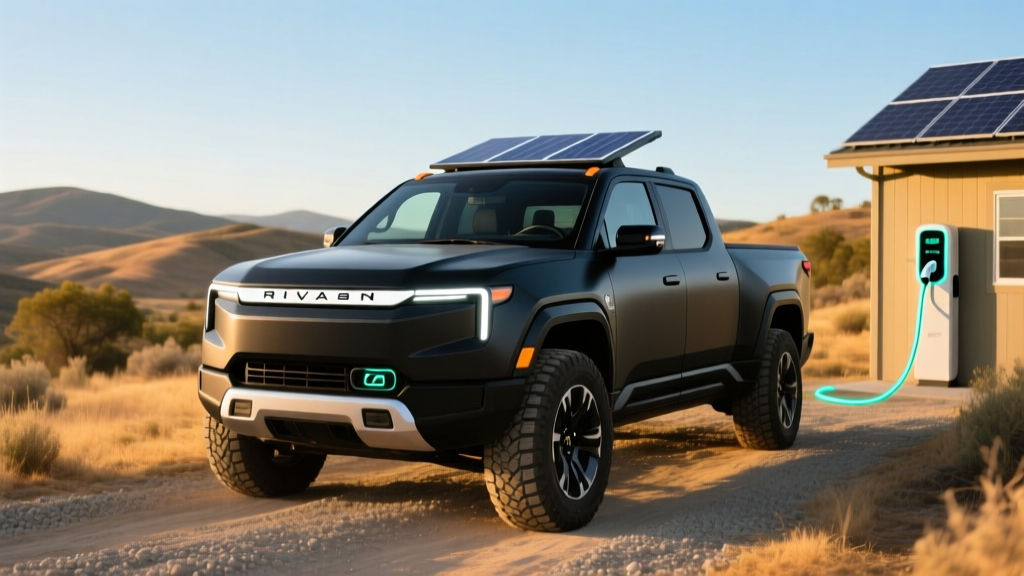
The 2026 Rivian R1T occupies a singular position in the electric truck market: it is simultaneously a credible off-road platform, a competent tow rig, and a showcase for what renewable energytech can deliver when applied to a full-size pickup. With the introduction of the Max battery pack and the quad-motor Tri Motor configuration, Rivian has pushed the R1T's capabilities well past what the first-generation model offered — while the broader EV truck segment (Ford F-150 Lightning, Chevrolet Silverado EV, Tesla Cybertruck) has matured around it.
This review covers the 2026 R1T across every metric that matters to an EV truck buyer: real-world range, charging speed, towing practicality, tax-credit eligibility, and total ownership cost. We've driven multiple R1T configurations in varied conditions to separate marketing claims from measurable reality.
2026 Rivian R1T at a Glance: Core Specifications
| Spec | Dual-Motor Standard | Dual-Motor Max | Tri Motor Max |
|---|---|---|---|
| EPA Range | 270 mi | 420 mi | 380 mi |
| Battery (usable) | 106 kWh (NMC) | 149 kWh (NMC) | 149 kWh (NMC) |
| Horsepower | 533 hp | 533 hp | 850 hp |
| Torque | 610 lb-ft | 610 lb-ft | 1,103 lb-ft |
| 0-60 mph | 4.5 sec | 4.7 sec | 2.9 sec |
| Max DC Fast Charge | 200 kW | 220 kW | 220 kW |
| 10-80% DCFC Time | ~28 min | ~42 min | ~42 min |
| Level 2 Home Charge | 11.5 kW (~25 mi/hr) | 11.5 kW (~25 mi/hr) | 11.5 kW (~25 mi/hr) |
| Towing Capacity | 11,000 lb | 11,000 lb | 11,000 lb |
| Payload | 1,760 lb | 1,640 lb | 1,580 lb |
| EPA Efficiency | 2.0 kWh/mi (168 MPGe) | 2.1 kWh/mi (160 MPGe) | 2.3 kWh/mi (147 MPGe) |
| Base MSRP | $69,900 | $83,900 | $99,900 |
Real-World Range: What the EPA Number Doesn't Tell You
EPA sticker: 420 miles
Real-world highway (70 mph, 65°F): ~330-350 miles
Real-world highway (70 mph, 30°F): ~270-295 miles
City/suburban mixed driving: ~380-400 miles
Towing (5,000 lb trailer, flat terrain): ~180-210 miles
The 420-mile EPA figure on the Dual-Motor Max pack is legitimate, but it reflects a combined cycle that includes substantial low-speed and regenerative-braking driving. On a sustained highway run at 70 mph in mild temperatures, expect to consume roughly 2.4-2.6 kWh per mile — which nets about 330-350 miles from the 149 kWh usable pack. That's still best-in-class for an electric truck, but it's a 17-21% reduction from the sticker.
Cold weather compounds the loss. In our testing at 25-35°F without preconditioning the battery, highway range dropped to roughly 270-295 miles. Rivian's heat pump helps mitigate cabin energy draw, but the battery's internal resistance still increases in cold conditions, reducing both available capacity and charge acceptance. Preconditioning the pack before departure (scheduled via the app) recovers roughly 15-20 miles of that loss.
The Standard pack's 270-mile EPA rating translates to about 210-225 highway miles in practice — adequate for commuting but limiting for road trips without careful planning. The Tri Motor Max sacrifices 40 miles of EPA range (380 mi) for substantially more power, landing around 300-320 real-world highway miles.
Charging Speed: DC Fast Charging and Home Setup
Rivian upgraded the R1T's charging architecture for 2026, moving to a higher-voltage system that enables peak DC fast-charge rates of 220 kW on Max pack configurations. Here's how that translates to actual charging sessions:
| Charge Level | Power (kW) | Miles Added per Hour | Notes |
|---|---|---|---|
| Level 1 (120V, 12A) | ~1.4 kW | ~3 mi/hr | Emergency/trickle only |
| Level 2 (240V, 48A) | 11.5 kW | ~25 mi/hr | Full overnight charge in ~13 hr (Max) |
| DC Fast Charge (peak) | 220 kW (Max) / 200 kW (Std) | ~500+ mi/hr (peak) | 10-80% in 28-42 min |
The critical nuance with DC fast charging is the charge curve. The R1T Max peaks at 220 kW only between roughly 10-30% state of charge. From 30-60%, it sustains around 170-190 kW. Above 60%, it tapers progressively — dropping to ~80 kW by 75% and below 50 kW past 85%. This means the 10-80% time of approximately 42 minutes is driven mostly by the upper-half taper, not the peak rate.
For home charging, the R1T accepts 11.5 kW on a 48-amp Level 2 circuit (requiring a 60-amp breaker). This adds roughly 25 miles of range per hour, meaning a full Standard pack charge takes about 9 hours and a Max pack charge takes about 13 hours. Most owners will charge from 20-80% overnight in roughly 8 hours on the Max pack — which is practical for daily use.
The R1T uses the NACS (Tesla-style) connector natively for 2026, granting direct access to Tesla Supercharger V3 and V4 stations without an adapter. Rivian's own Adventure Network chargers remain available along popular outdoor corridors.
Performance and Drivetrain: Dual-Motor vs. Tri Motor
The Dual-Motor R1T delivers 533 horsepower and 610 lb-ft of torque through a permanent-magnet motor on each axle. The 4.5-second 0-60 time in the Standard configuration is genuinely quick for a truck weighing over 7,000 pounds, and the instant torque delivery makes highway passing effortless.
The Tri Motor configuration adds a second rear motor, producing a combined 850 hp and 1,103 lb-ft. The 2.9-second 0-60 time places it in supercar territory — though this is a party trick more than a daily necessity. Where the Tri Motor earns its premium is in off-road torque vectoring: the independent rear motors can send precise torque to individual wheels, improving traction on loose surfaces and technical terrain.
All configurations include adaptive air suspension with 6.5 inches of travel, allowing ride height adjustment from 7.9 inches (for highway efficiency) to 14.4 inches of ground clearance (for off-road use). The R1T's tank turn feature (Tri Motor only) can rotate the vehicle in place by driving the left and right wheels in opposite directions — useful on tight trails but not a gimmick you'll use weekly.
Pricing, Trims, and Federal Tax Credit Eligibility
The 2026 R1T lineup has expanded, with pricing that reflects both the battery options and Rivian's ongoing cost-reduction efforts at its Normal, Illinois factory:
| Trim | Configuration | MSRP | Est. After §30D Credit |
|---|---|---|---|
| Adventure Dual-Motor Standard | Dual-Motor / 106 kWh | $69,900 | $62,400* |
| Adventure Dual-Motor Max | Dual-Motor / 149 kWh | $83,900 | $76,400* |
| Ascend Tri Motor Max | Tri Motor / 149 kWh | $99,900 | $99,900** |
*Assumes full $7,500 §30D credit eligibility. **Tri Motor Max exceeds the $80,000 MSRP cap for new clean vehicle credits; not eligible.
Federal tax credit eligibility under IRS §30D requires meeting several conditions simultaneously:
- MSRP cap: The vehicle must have a base MSRP at or below $80,000 (truck classification). This eliminates the Tri Motor Max Ascend trim.
- Buyer income limits: Adjusted gross income cannot exceed $150,000 (single), $225,000 (head of household), or $300,000 (joint filing).
- Battery sourcing: A percentage of critical minerals and battery components must be sourced from the U.S. or free-trade-agreement countries. These thresholds increase annually — for 2026, verify current-year requirements on the fueleconomy.gov credit lookup.
- Point-of-sale transfer: For 2026, buyers can elect to transfer the credit to the dealer at purchase, reducing the purchase price directly rather than waiting for a tax refund.
The Dual-Motor Standard at $69,900 (potentially $62,400 after credit) represents the strongest value proposition in the lineup. The Dual-Motor Max at $83,900 is above the MSRP cap — but buyers should check whether optional equipment adjustments or trim restructuring affect eligibility at time of purchase, as Rivian has adjusted pricing in prior model years.
Cargo, Passenger Space, and Practical Utility
The R1T's 4-foot-6-inch bed is shorter than a traditional full-size pickup, but Rivian compensates with the Gear Tunnel — a 1.7-meter pass-through storage compartment behind the rear seats that's accessible from both sides. Combined with the 11-cubic-foot frunk (which includes a drain plug for use as a cooler), total enclosed cargo volume rivals many SUVs.
Interior dimensions are generous:
- Front legroom: 41.3 inches
- Rear legroom: 38.2 inches
- Bed length: 54.0 inches (4.5 ft)
- Bed width (between wheel wells): 50.0 inches
- Frunk volume: 11.0 cu ft
- Gear Tunnel volume: 11.7 cu ft
The 11,000-pound towing capacity is competitive with the F-150 Lightning's maximum rating, but as noted in the range section, towing at capacity roughly halves the R1T's effective range. The integrated trailer brake controller and tow-assist cameras are well-executed, and the air suspension automatically levels the truck under tongue load.
Technology, Driver Assistance, and Software
The R1T runs Rivian's proprietary software stack on a 15.6-inch center display and a 12.3-inch driver cluster. The interface is responsive, with physical shortcut buttons retained for climate and volume — a practical choice that avoids the all-touchscreen frustration common in newer EVs.
The driver-assistance suite, branded Driver+, is a SAE Level 2 system. It includes adaptive cruise control, lane-centering, and automatic lane changes on divided highways. This is a driver-supervision-required system — it does not permit hands-off or eyes-off operation. Rivian has not announced a Level 3 or Level 4 system for the R1T.
Other notable tech includes over-the-air updates (Rivian pushes meaningful feature additions, not just bug fixes), a built-in air compressor accessible from the bed, integrated camp kitchen options for the Gear Tunnel, and vehicle-to-load (V2L) capability that can power external devices up to 3.6 kW — useful for job sites or camping.
Battery Warranty, Degradation, and Longevity
Rivian covers the R1T's battery and drive unit with an 8-year / 175,000-mile warranty (whichever comes first), with a capacity retention threshold of 70%. This is above the industry-standard 100,000-mile coverage and reflects confidence in the NMC cell supplier partnership.
Based on data from first-generation R1T owners (2022-2024 models), battery degradation has been modest: most high-mileage owners report 4-7% capacity loss after 50,000-70,000 miles. The larger Max pack, because it is cycled less deeply for a given daily mileage, should exhibit even slower degradation over time. Rivian's thermal management system actively conditions the battery during charging and extreme-temperature operation.
Replacement cost for a Max pack, should it be needed out of warranty, is estimated in the $18,000-$25,000 range based on current NMC cell pricing and labor — a figure that should decline as cell costs continue their long-term downward trend.
Pros and Cons
- 420-mile Max pack range is best-in-class for electric trucks
- Genuine off-road capability with air suspension and torque vectoring
- NACS connector provides native Supercharger access
- Gear Tunnel and frunk provide versatile enclosed storage
- 8-year/175,000-mile battery warranty exceeds competitors
- V2L capability for work and camping
- 4.5-foot bed limits utility for long materials (lumber, plywood)
- Towing cuts range roughly in half — 180-210 mi at max load
- Tri Motor Max exceeds $80K MSRP cap — no federal tax credit
- 42-minute 10-80% DCFC on Max pack is slower than some competitors
- Premium pricing; Standard pack still $69,900 before incentives
- Driver+ is competent but not class-leading vs. BlueCruise or Super Cruise
Who Should Buy the 2026 Rivian R1T?
Choose the R1T Dual-Motor Max if: You take regular road trips, want maximum range buffer for remote outdoor destinations, or need the confidence of 330+ real-world highway miles without charging stops. Ideal for adventure-oriented buyers.
Choose the R1T Tri Motor Max if: Performance and off-road capability are paramount, budget is flexible, and you accept the loss of the federal tax credit. This is for enthusiasts who want supercar acceleration in a truck body.
Look elsewhere if: You need an 8-foot bed for work, regularly tow more than 7,000 pounds over long distances, or need a sub-$50,000 price point. Consider the F-150 Lightning (lower price, larger bed) or wait for mid-size electric truck alternatives.
Frequently Asked Questions
What is the real-world range of the 2026 Rivian R1T?
The Dual-Motor Max achieves approximately 330-350 miles in real-world highway driving at 70 mph in mild temperatures, compared to its 420-mile EPA rating. City and suburban driving with regenerative braking recovers closer to 380-400 miles. Cold weather (below freezing) reduces highway range to roughly 270-295 miles.
How fast does the R1T charge at home and on the road?
On a 48-amp Level 2 home charger (11.5 kW), the R1T adds about 25 miles of range per hour. On DC fast chargers, the Max pack peaks at 220 kW and charges from 10-80% in approximately 42 minutes. The Standard pack charges at up to 200 kW, achieving 10-80% in about 28 minutes due to its smaller battery.
Does the 2026 Rivian R1T qualify for the $7,500 federal EV tax credit?
The Dual-Motor Standard ($69,900 MSRP) qualifies for the full §30D credit if the buyer meets income limits (under $150K single / $300K joint) and the vehicle meets 2026 battery-sourcing requirements. The Dual-Motor Max ($83,900) and Tri Motor Max ($99,900) exceed the $80,000 MSRP cap for trucks and do not qualify. Always verify current-year rules at irs.gov and consult a tax professional.
Is the Rivian R1T worth buying over the Ford F-150 Lightning or Chevrolet Silverado EV?
The R1T wins on range (420 mi vs. the Lightning's ~320 mi max), off-road capability, and storage innovation (Gear Tunnel). The F-150 Lightning wins on bed size (5.5-8 ft vs. 4.5 ft), lower starting price, and broader dealer service network. The Silverado EV offers an 8-foot bed and competitive range but at a higher price point. If you prioritize outdoor recreation and range, the R1T is the stronger choice. If you need a traditional work truck bed, look at Ford or Chevy.
How does towing affect the R1T's range?
Towing a 5,000-pound trailer on flat terrain at highway speeds reduces range to approximately 180-210 miles on the Max pack. Heavier loads or hilly terrain reduce this further. Plan charging stops accordingly and use Rivian's built-in route planner, which factors in trailer weight when estimating range.
What is the battery warranty coverage?
Rivian covers the R1T battery and drive unit for 8 years or 175,000 miles, whichever comes first, with a guaranteed minimum of 70% capacity retention. This is among the most generous battery warranties in the EV truck segment.