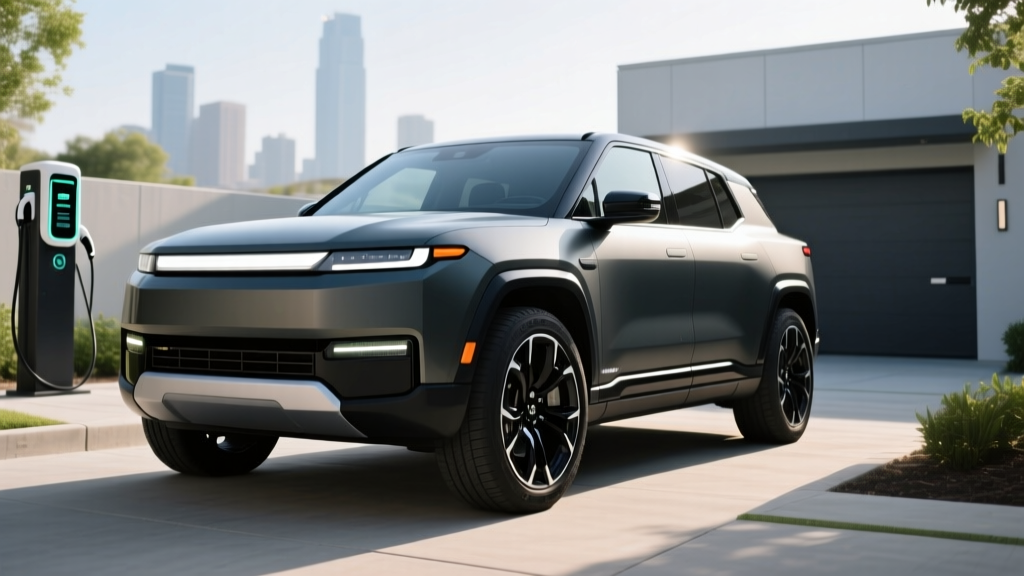
The Rivian R1S occupies a rare lane: a three-row electric SUV that genuinely handles off-road duty while delivering sports-car acceleration on pavement. For the 2026 model year, Rivian has streamlined the R1S lineup around its second-generation drive system introduced in mid-2024, with updated software, improved efficiency, and refined thermal management. But at what cost? Let's break down the 2026 Rivian R1S MSRP across every trim, pair it with real-world range and charging data, and determine whether the numbers justify the premium.
2026 Rivian R1S MSRP by Trim Level
Rivian structures the R1S around battery pack size and motor configuration rather than traditional luxury tiers. The 2026 lineup carries forward the Dual-Motor, Performance Dual-Motor, Tri-Motor, and Quad-Motor configurations, paired with Standard, Large, and Max battery packs. Here's the current MSRP structure before any incentives or destination fees:
| Configuration | Battery Pack | EPA Range | MSRP (est.) |
|---|---|---|---|
| Dual-Motor Standard | ~95 kWh (NMC) | ~270 mi | $79,900 |
| Dual-Motor Large | ~114 kWh (NMC) | ~340 mi | $86,400 |
| Dual-Motor Max | ~149 kWh (NMC) | ~400 mi | $94,900 |
| Performance Dual-Motor Large | ~114 kWh (NMC) | ~321 mi | $91,400 |
| Tri-Motor Large | ~114 kWh (NMC) | ~310 mi | $102,900 |
| Tri-Motor Max | ~149 kWh (NMC) | ~370 mi | $111,400 |
| Quad-Motor Large | ~114 kWh (NMC) | ~295 mi | $109,900 |
| Quad-Motor Max | ~149 kWh (NMC) | ~350 mi | $118,400 |
Destination adds $1,800. The Adventure and Ascend interior packages add between $2,500 and $5,500 depending on materials. Paint upgrades (Rivian's premium colors like Midnights and Canyon Red) run $1,000–$2,500. A fully loaded Tri-Motor Max with Ascend trim and 22-inch Sport wheels can push past $120,000 before credits.
EPA Range vs. Real-World Expectations
The R1S's efficiency varies significantly by configuration. The Dual-Motor Large achieves an EPA-rated 76 MPGe combined (roughly 44 kWh/100 mi), while the Quad-Motor Max drops to around 69 MPGe (49 kWh/100 mi). The heavier Max pack and four-motor drivetrain exact a measurable toll. For buyers prioritizing maximum miles between charges, the Dual-Motor Max at 400 miles EPA and approximately 72 MPGe represents the efficiency sweet spot in the lineup.
According to fueleconomy.gov, the Dual-Motor Large R1S posts 78 MPGe city / 73 MPGe highway. These are strong numbers for a 6,800-pound SUV, though they lag the Tesla Model X (102 MPGe combined) and are competitive with the BMW iX xDrive50 (86 MPGe combined).
Battery Chemistry, Capacity, and Longevity
All 2026 R1S configurations use nickel-manganese-cobalt (NMC) lithium-ion cells supplied primarily by Samsung SDI. Rivian has not adopted LFP (lithium iron phosphate) chemistry for the R1 platform — the energy density requirements for a large SUV with 400-mile aspirations demand NMC's higher Wh/kg ratio. The trade-off is that NMC cells are more sensitive to sustained high-state-of-charge storage; Rivian recommends daily charging to 85% and reserving 100% for road trips.
| Pack | Usable Capacity | Chemistry | Warranty |
|---|---|---|---|
| Standard | ~95 kWh | NMC | 8 yr / 175,000 mi |
| Large | ~114 kWh | NMC | 8 yr / 175,000 mi |
| Max | ~149 kWh | NMC | 8 yr / 175,000 mi |
Rivian's battery warranty guarantees 70% capacity retention over 8 years or 175,000 miles — whichever comes first. This is more generous than the industry-standard 8-year/100,000-mile coverage offered by most competitors and reflects confidence in the Gen 2 pack's thermal management. Real-world degradation data from early Gen 1 R1S owners (2022–2023 models) suggests approximately 5–7% loss after 50,000 miles, which projects to roughly 12–15% loss at 150,000 miles — well within the warranty threshold.
Charging Speeds: DC Fast Charging and Home Level 2
The R1S Gen 2 platform supports DC fast charging at up to 220 kW peak on NACS-compatible chargers (Rivian transitioned to the North American Charging Standard port for all 2025+ models). Here's what that translates to in practice:
| Charging Level | Power / Rate | Time / Miles Added |
|---|---|---|
| Level 1 (120V) | 1.4 kW | ~3–4 mi/hr |
| Level 2 (240V, 48A) | 11.5 kW | ~25–28 mi/hr |
| Level 2 (240V, 60A) | 14.4 kW | ~31–35 mi/hr |
| DC Fast Charge (peak) | 220 kW | 10–80% in ~27 min (Large pack) |
| DC Fast Charge (sustained avg) | ~150 kW | 10–80% in ~33 min (Max pack) |
The charging curve matters more than peak numbers. The R1S Large pack sustains above 180 kW from roughly 10% to 40% state of charge, then tapers progressively. From 60% to 80%, expect speeds closer to 90–110 kW. The Max pack, with its larger 149 kWh capacity, charges at higher absolute kW for longer but takes proportionally more time to fill — plan for roughly 35–40 minutes for a 10–80% session at a 350 kW Electrify America or Tesla Supercharger V4 station.
For home charging, Rivian recommends a 60-amp circuit with a hardwired Level 2 wall connector. At 11.5 kW (48A), a depleted Large pack recharges fully in about 10 hours. Overnight charging from 20% to 80% takes roughly 6 hours — ideal for daily replenishment. The onboard charger maxes at 14.4 kW, so installing a 60A circuit extracts the maximum home charging speed the R1S can accept.
Performance: 0–60, Horsepower, and Drivetrain
The R1S lineup spans an enormous performance envelope:
| Configuration | Horsepower | Torque (lb-ft) | 0–60 mph | Drivetrain |
|---|---|---|---|---|
| Dual-Motor | 533 hp | 610 | 4.5 sec | AWD |
| Performance Dual-Motor | 665 hp | 828 | 3.5 sec | AWD |
| Tri-Motor | 850 hp | 1,100+ | 2.9 sec | AWD |
| Quad-Motor | 1,025 hp | 1,198 | 2.6 sec | AWD (individual wheel) |
The Quad-Motor's individual wheel torque vectoring enables features like Tank Turns (360-degree pivot on loose surfaces) and precise low-speed rock crawling. The Tri-Motor adds a rear-axle dual-motor setup that delivers 850 hp while retaining most of the Quad's capability at a lower price and weight penalty. For most buyers, the Dual-Motor's 533 hp and 4.5-second 0–60 already outpace virtually every gas-powered three-row SUV on the market.
Towing capacity peaks at 7,700 pounds across all configurations with the Max tow package — sufficient for a mid-size travel trailer or boat. Note that towing at capacity reduces range by approximately 40–50%, meaning a Dual-Motor Large towing 7,000 pounds will see effective range drop to roughly 170–190 miles.
Federal Tax Credit and Total Cost
The 2026 R1S's eligibility for the IRS §30D federal EV tax credit requires careful attention to current rules. Under IRS guidelines, the credit amounts to up to $7,500, split between a $3,750 critical-minerals requirement and a $3,750 battery-components requirement. As of 2026, the following constraints apply:
- MSRP cap: SUVs must have an MSRP at or below $80,000 to qualify. This means only the Dual-Motor Standard ($79,900) and Dual-Motor Large ($86,400 — over cap, does NOT qualify) configurations may be eligible. In practice, only the base Dual-Motor Standard falls under the cap.
- Buyer income limits: Modified adjusted gross income must not exceed $300,000 (joint filers), $225,000 (head of household), or $150,000 (single).
- Battery sourcing: Critical minerals and battery components must meet escalating domestic-sourcing thresholds. Rivian's Samsung SDI cells have historically met the critical-minerals requirement but face challenges on the component-manufacturing prong as of 2025+ rules. Confirm eligibility at the point of sale.
- Point-of-sale transfer: Buyers can transfer the credit to the dealer for an immediate price reduction at purchase, rather than waiting for a tax refund.
| Item | Amount |
|---|---|
| Base MSRP | $79,900 |
| Destination Fee | +$1,800 |
| Federal §30D Credit (max, if eligible) | –$7,500 |
| Effective Price (best case) | ~$74,200 |
| Effective Price (no credit) | ~$81,700 |
Interior Space, Cargo, and Technology
The R1S accommodates up to seven passengers in a 2-3-2 layout, or six with optional second-row captain's chairs. Cargo volume measures:
- Behind third row: 10.6 cu ft (limited — adequate for a few grocery bags)
- Behind second row (third row folded): 46.7 cu ft
- Behind first row (all rear rows folded): 88.2 cu ft
- Front trunk (frunk): 11.0 cu ft — lockable, drainable, ideal for wet gear or charging cables
Third-row legroom measures 30.4 inches — usable for children or short-trip adults but tight for long journeys. Second-row legroom at 36.5 inches is comfortable. Front-row space is generous at 41.3 inches of legroom.
The 15.6-inch center touchscreen runs Rivian's proprietary software, which has matured significantly since launch. Wireless Apple CarPlay and Android Auto are not supported — Rivian's native interface handles navigation, media, and vehicle settings. The 12.3-inch digital instrument cluster and 6.8-inch rear touchscreen round out the display array. The Rivian app provides remote preconditioning, charge scheduling, location tracking, and software update management.
Driver assistance comes via Rivian's Highway Assist and Lane Centering — a Level 2 SAE system requiring continuous driver engagement. It performs competently on divided highways but does not offer hands-free operation like GM's Super Cruise or Ford's BlueCruise. Rivian has signaled a more advanced driver-assist system for future OTA updates, but as of the 2026 model year, hands-on-wheel supervision is mandatory.
How the R1S Stacks Up Against Competitors
| Spec | Rivian R1S Dual-Motor Large | Tesla Model X LR | BMW iX xDrive50 | Kia EV9 GT-Line AWD |
|---|---|---|---|---|
| EPA Range | 340 mi | 335 mi | 324 mi | 270 mi |
| MSRP | $86,400 | $81,630 | $89,500 | $75,900 |
| 0–60 mph | 4.5 sec | 3.8 sec | 4.4 sec | 5.0 sec |
| Seating | 7 | 5/6/7 | 5 | 6/7 |
| DC Fast Charge Peak | 220 kW | 250 kW | 200 kW | 236 kW |
| Towing Capacity | 7,700 lb | 5,000 lb | 3,500 lb | 5,000 lb |
| Federal Credit Eligible | No (MSRP > $80K) | No (MSRP > $80K) | No | Partial (some trims) |
The R1S's advantages are clear: best-in-class towing, genuine off-road capability (14.9 inches of ground clearance in Max Ride Height mode, wading depth to 36 inches), and the most flexible adventure-oriented design. The Model X counters with Supercharger network access, falcon-wing rear doors, and slightly quicker acceleration. The iX offers a more refined luxury interior but only seats five. The EV9 undercuts all three on price and qualifies for partial credits on lower trims, but sacrifices range and performance.
Pros, Cons, and Who Should Buy
Pros
- 400-mile Max pack option (Dual-Motor)
- Class-leading 7,700-lb towing capacity
- Genuine off-road capability with air suspension
- 8-year/175,000-mile battery warranty
- Generous frunk + flexible cargo layout
- Strong over-the-air update track record
Cons
- Most trims exceed $80K federal credit cap
- No wireless CarPlay/Android Auto
- Third-row legroom tight for adults
- Driver-assist lags Super Cruise/BlueCruise
- High insurance premiums ($2,400–$3,600/yr avg.)
- Charging taper above 80% extends session time
Decision Framework
Choose the R1S if: You need three rows, tow regularly, plan off-pavement adventures, and want 340+ miles of range without range-extender compromises.
Consider alternatives if: Federal tax credit eligibility is a dealbreaker (look at the EV9 or lower-trim Model X), you need best-in-class driver-assist for highway commuting, or you primarily drive in cities where the R1S's 215-inch length feels cumbersome.
Frequently Asked Questions
What is the real-world range of the 2026 Rivian R1S?
The EPA rates the Dual-Motor Large at 340 miles. Real-world highway driving at 70–75 mph yields approximately 280–300 miles in mild weather and 240–260 miles in freezing temperatures. The Max pack variant extends these figures proportionally, with real-world highway range around 340–360 miles in favorable conditions.
How fast does the R1S charge at home and on the road?
At home on a 240V/60A Level 2 circuit, the R1S charges at up to 14.4 kW, adding roughly 31–35 miles per hour. On a DC fast charger, it peaks at 220 kW and charges from 10–80% in approximately 27 minutes for the Large pack. Expect 35–40 minutes for the Max pack due to its larger capacity.
Does the 2026 Rivian R1S qualify for the federal EV tax credit?
Only the Dual-Motor Standard at $79,900 MSRP falls under the $80,000 SUV cap for IRS §30D eligibility, and even then, battery-sourcing rules may limit the credit to $3,750 (partial). All other trims exceed the MSRP cap and do not qualify. State-level incentives may still apply. Always verify current eligibility on irs.gov and with your tax professional.
Is the R1S worth buying over the Tesla Model X?
If you prioritize off-road capability, higher towing capacity (7,700 vs. 5,000 lbs), and a more adventure-oriented design, the R1S wins. If Supercharger network reliability, hands-free-capable driver assist (FSD Supervised), and slightly quicker acceleration matter more, the Model X has advantages. Both are strong vehicles — the right choice depends on your use case.
What are the biggest ownership costs beyond MSRP?
Insurance averages $2,400–$3,600 annually depending on state and driving record. Home Level 2 charger installation runs $800–$2,000 (equipment + electrician). Electricity costs vary by region but average $0.14–$0.18/kWh nationally, translating to roughly $0.06–$0.08 per mile driven — significantly less than gasoline at current prices. Tire replacement for the R1S's 275/50R21 or 285/45R22 tires runs $1,200–$1,800 for a set of four.
How does Rivian's warranty compare?
Rivian covers the battery and drive unit for 8 years or 175,000 miles (whichever comes first), with a 70% capacity retention guarantee. The limited vehicle warranty is 5 years / 60,000 miles. This battery coverage exceeds most competitors (typically 8yr/100K) and reflects the Gen 2 platform's improved thermal management.