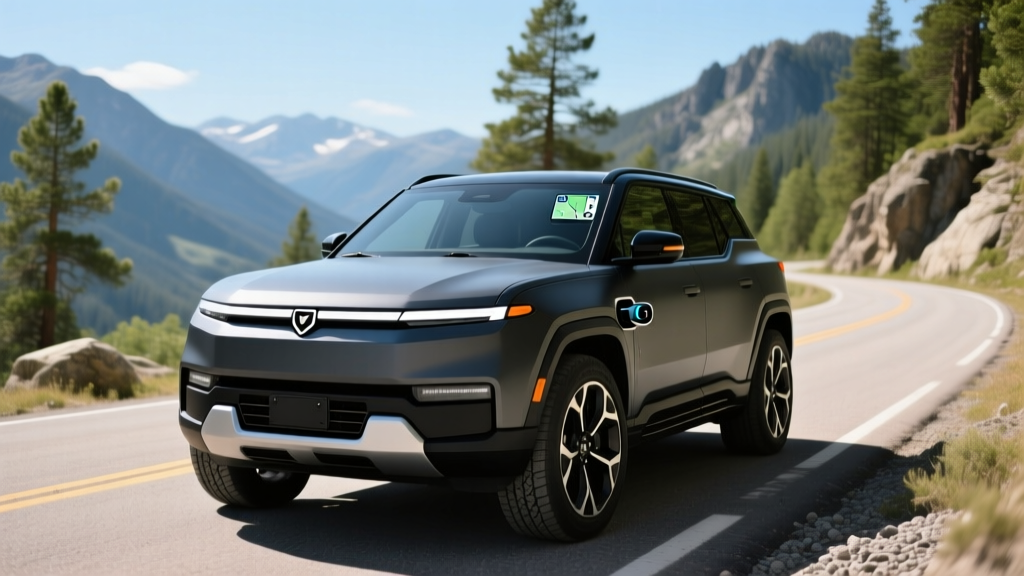
The 2026 Rivian R1S enters its second generation as one of the most capable three-row electric SUVs on the market, blending serious off-road credentials with family-hauler practicality. But for buyers researching safety, real-world efficiency, and total ownership cost, the spec sheet only tells part of the story. This review digs into what the 2026 Rivian R1S IIHS safety evaluations reveal, how its EPA range translates to actual highway miles, and whether the federal tax credit actually applies to your purchase.
Real-World Range Reality Check
EPA Estimated: Up to 410 miles (Max Pack, Dual-Motor) | 352 miles (Large Pack) | 270 miles (Standard Pack)
Expect in practice: Highway driving at 70+ mph drops range by roughly 10–15%. In freezing temperatures (below 32°F), plan for 20–30% range loss depending on cabin heating demand and whether you precondition. The Max Pack's 410-mile sticker is impressive, but a realistic road-trip range is closer to 340–360 miles in mild conditions and 280–310 miles in deep winter.
IIHS Safety Ratings and Crashworthiness
The Insurance Institute for Highway Safety (IIHS) has evaluated the Rivian R1S across its core crashworthiness and crash-avoidance tests. For the 2026 model year, the R1S carries forward the structural improvements introduced with the Gen 2 platform update, which strengthened the B-pillar and door-sill reinforcements.
In the moderate overlap front test, the R1S earned a Good rating — the highest score — with minimal intrusion into the occupant compartment. The updated side-impact test (which IIHS made more stringent in 2024, using a heavier barrier at higher speed) also returned a Good rating, reflecting Rivian's structural upgrades. Head restraint and seat evaluations scored Good across all rows.
Where the R1S faces tougher scrutiny is in crash avoidance. The standard automatic emergency braking (AEB) system performs well in vehicle-to-vehicle scenarios, but the vehicle-to-pedestrian detection at night has drawn Acceptable rather than Good scores in prior evaluations — a factor that can prevent a Top Safety Pick award. Headlight performance varies by trim: the adaptive LED units on Adventure and Ascend trims rate Good, while base configurations may fall to Acceptable.
Driver-Assist Clarity: SAE Level 2
Rivian's Highway Assist and Adaptive Cruise with Lane Centering are SAE Level 2 driver-assistance features. This means the system can manage steering and speed simultaneously, but the driver must remain fully engaged — hands on or near the wheel, eyes on the road. This is not autonomous driving. Rivian does not currently offer a hands-free system comparable to GM's Super Cruise or Ford's BlueCruise on mapped highways.
Powertrain, Battery, and Performance Specs
The 2026 R1S is available in three battery configurations and two drive systems. Rivian's Gen 2 platform uses a mix of NMC (nickel manganese cobalt) cells for the Large and Max packs (sourced from Samsung SDI) and LFP (lithium iron phosphate) cells for the Standard pack. The chemistry distinction matters: LFP offers a longer cycle life and can be charged to 100% daily without degradation concerns, but it is heavier and less energy-dense. NMC delivers more range per kilogram but benefits from a daily charge limit of 80–90% for longevity.
| Specification | Standard Pack (LFP) | Large Pack (NMC) | Max Pack (NMC) |
|---|---|---|---|
| Usable Battery Capacity | ~92 kWh | ~128 kWh | ~149 kWh |
| EPA Range (Dual-Motor) | 270 mi | 352 mi | 410 mi |
| Drivetrain | Dual-Motor AWD | Dual-Motor AWD / Tri-Motor AWD | Dual-Motor AWD / Tri-Motor AWD |
| Horsepower (Dual / Tri) | 533 hp | 533 hp / 850 hp | 533 hp / 850 hp |
| 0–60 mph (Dual / Tri) | 4.5 sec | 4.5 sec / 2.9 sec | 4.5 sec / 2.9 sec |
| MPGe (Combined) | ~69 MPGe | ~73 MPGe | ~70 MPGe |
| Efficiency (kWh/100 mi) | ~48 | ~46 | ~48 |
The Tri-Motor AWD variant — available with the Large or Max pack — adds a third rear motor, pushing output to 850 hp and dropping the 0–60 time to a supercar-rivaling 2.9 seconds. For a three-row, 7,000-pound SUV, that figure borders on absurd. More practically, the Tri-Motor setup provides torque-vectoring capability that improves traction on loose surfaces and adds a dedicated "Performance" drive mode.
Charging Speed: DC Fast and Home Level 2
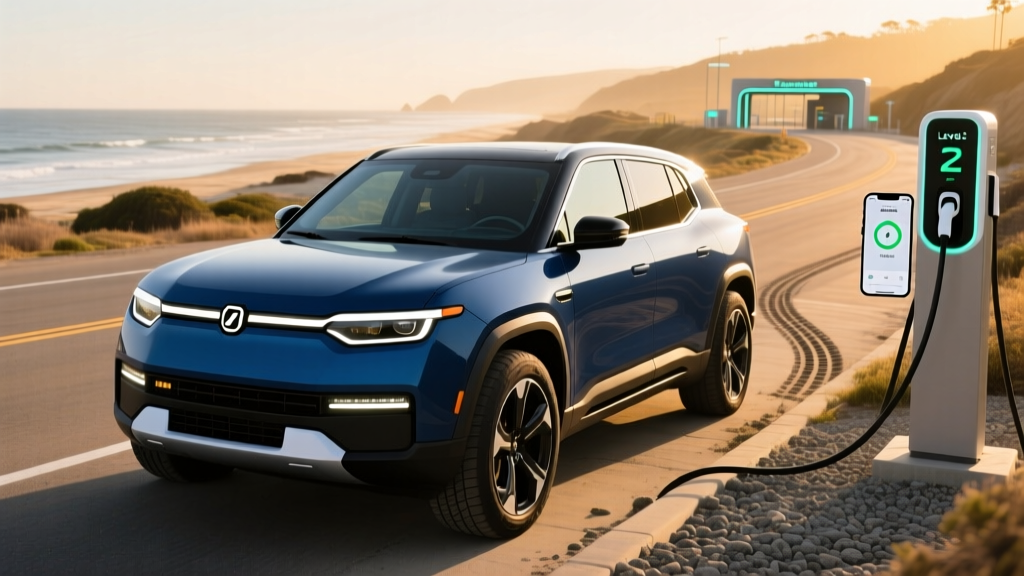
Charging is where Gen 2 R1S owners see a meaningful improvement over the first-generation platform. The 2026 R1S supports a peak DC fast-charge rate of 220 kW (Max Pack) and 200 kW (Large Pack) on a CCS1 or NACS connector — Rivian now ships vehicles with the native NACS port, granting access to Tesla Supercharger V3 and V4 stalls without an adapter.
| Charging Level | Power / Rate | What You Get |
|---|---|---|
| Level 1 (120V household) | ~1.4 kW | ~3–4 miles per hour |
| Level 2 (240V home, 48A) | 11.5 kW | ~25–30 miles per hour; full charge in 10–14 hours |
| DC Fast Charge (peak) | 200–220 kW | 10–80% in ~21–27 minutes (depending on pack size) |
| DC Fast Charge (sustained avg.) | ~140–160 kW | Real-world average across the 10–80% curve |
A critical note on the charge curve: the 220 kW peak applies only at a low state of charge (roughly 10–25% SoC) and tapers progressively. By 60% SoC, expect roughly 120–130 kW; above 80%, the rate drops sharply to protect the battery, which is why most road-trip charging stops target the 10–80% window. The ~21-minute 10–80% claim for the Max Pack assumes a preconditioned battery and a 350 kW-capable charger. On a 150 kW Electrify America or EVgo station, plan for 30–35 minutes.
At home, the R1S's 11.5 kW onboard charger is competitive. On a 48-amp Level 2 circuit (requiring a 60-amp breaker), you'll add roughly 25–30 miles of range per hour — enough to fully replenish even the Max Pack overnight. Always consult a licensed electrician to confirm your panel can support a 60-amp dedicated circuit; older 100-amp service panels may require an upgrade ($1,500–$3,000).
Pricing, Trims, and Federal Tax Credit Eligibility
The 2026 R1S lineup spans three trims — Adventure, Ascend, and the new Performance — with pricing that reflects its premium positioning.
| Trim / Configuration | Base MSRP | Federal Tax Credit (§30D) | Effective Price (if eligible) |
|---|---|---|---|
| Adventure, Standard Pack, Dual-Motor | $79,900 | Up to $7,500 | ~$72,400 |
| Adventure, Large Pack, Dual-Motor | $87,900 | Up to $7,500 | ~$80,400 |
| Ascend, Large Pack, Dual-Motor | $94,900 | Up to $7,500 | ~$87,400 |
| Ascend, Max Pack, Tri-Motor | $109,900 | Up to $7,500 | ~$102,400 |
| Performance, Max Pack, Tri-Motor | $114,900 | Up to $7,500 | ~$107,400 |
The R1S qualifies as an SUV under IRS §30D rules, which sets the MSRP cap at $80,000 for SUVs. This means only the Adventure Standard Pack at $79,900 clears the cap at base MSRP. Adding options (tow package, premium wheels, upgraded interior) to that trim can push the sticker above $80,000 and disqualify it. Higher trims and larger battery packs exceed the cap outright.
Beyond the MSRP cap, buyer eligibility requires:
- Income limits: Modified AGI ≤ $150,000 (single), $225,000 (head of household), $300,000 (joint)
- Battery sourcing: A percentage of critical minerals and battery components must be sourced from the US or FTA-partner nations — Rivian's Samsung SDI cells and supply-chain compliance determine whether a specific VIN qualifies for the full $7,500 or a partial $3,750
- Point-of-sale transfer: As of 2024, you can transfer the credit to the dealer at purchase, reducing your out-of-pocket cost immediately rather than waiting for tax filing
- VIN verification: Always confirm eligibility on the dealer's window sticker and cross-reference with the IRS clean vehicle report before signing
Consult a tax professional to confirm your individual eligibility — credit rules are subject to change, and state-level incentives (California's CVRP, Colorado's Innovative Motor Vehicle Credit, etc.) may stack on top.
Interior Space, Cargo, and Family Practicality
The R1S seats up to seven passengers in a 2-3-2 configuration. Second-row captain's chairs (reducing capacity to six) are available on Ascend and Performance trims and are strongly recommended for car-seat families — the outboard positions offer dedicated LATCH anchors and significantly easier third-row access.
| Dimension | Measurement |
|---|---|
| Front headroom | 41.2 in |
| Front legroom | 41.6 in |
| Second-row legroom | 38.4 in |
| Third-row legroom | 30.2 in |
| Cargo (behind 3rd row) | 10.6 cu ft |
| Cargo (3rd row folded) | 46.7 cu ft |
| Cargo (all rear rows folded) | 83.5 cu ft |
| Front trunk (frunk) | 11.1 cu ft |
| Towing capacity (max) | 7,700 lbs |
The 30.2 inches of third-row legroom is the R1S's most honest limitation. It accommodates children and short-trip adults, but it does not rival the third row of a Kia EV9 (which offers 32.0 inches). The 10.6 cu ft of cargo space behind the third row is tight for a family road trip with all seats occupied — you'll want a hitch-mounted cargo carrier or roof box for long hauls with seven aboard.
The 11.1 cu ft frunk is a standout feature, large enough for charging cables, a grocery run, or a soft cooler. Combined with the 7,700-pound tow rating (with the Max Tow package), the R1S is one of the most capable towing EVs available — though expect range to drop 30–50% while towing a heavy trailer at highway speeds.
Tech, Software, and Ownership Experience
Rivian's infotainment runs on a custom 15.6-inch landscape touchscreen with a 12.3-inch digital instrument cluster. The system is responsive, over-the-air updatable, and integrates a built-in trip planner that accounts for elevation, temperature, and charging-station availability. Apple CarPlay and Android Auto are not supported — a deliberate choice by Rivian, which argues its native system offers deeper vehicle integration. Some buyers will find this refreshing; CarPlay loyalists will not.
The R1S includes a suite of driver-assistance features under the "Driver+" umbrella: adaptive cruise control, lane centering, automatic emergency braking, blind-spot monitoring, and a 360-degree camera system. The Highway Assist feature works on divided highways but requires continuous driver supervision (Level 2). It does not currently support hands-free operation or automatic lane changes without driver confirmation.
Notable tech highlights include:
- Camp Mode: Maintains climate control and powers 120V/240V outlets overnight, turning the R1S into a mobile basecamp
- Powered tonneau-style cargo cover and integrated air suspension that lowers for loading
- Quad-Motor torque vectoring (on Tri-Motor with software-enabled tank turn capability for low-speed off-road maneuvering)
- Gear Tunnel (available as an accessory): a pass-through storage compartment between the rear wheels, adding ~11 cu ft of secure, weatherproof storage
Drawbacks worth noting: the R1S's ride quality on the standard 21-inch wheels is firm, especially on rough pavement — the available air suspension helps but adds cost. Panel-gap consistency has improved in Gen 2 but still draws occasional owner complaints. Service center availability remains limited outside major metro areas, though Rivian's mobile service vans cover many regions.
Warranty and Long-Term Battery Outlook
| Coverage | Terms |
|---|---|
| Basic vehicle warranty | 5 years / 60,000 miles |
| Battery & powertrain warranty | 8 years / 120,000 miles |
| Battery capacity retention threshold | 70% of original capacity during warranty period |
The 8-year / 120,000-mile battery warranty exceeds the federal minimum (8/100,000) and aligns with Tesla and Hyundai's coverage. Rivian guarantees the battery will retain at least 70% of its original capacity during the warranty period — a standard industry threshold, though some competitors (Hyundai/Kia) guarantee 70% over 10 years/100,000 miles on certain models.
For the NMC packs (Large and Max), long-term degradation data is still accumulating given the Gen 2 platform's recency. Early Gen 1 R1S owners have reported roughly 3–5% capacity loss over the first 40,000 miles, with the curve flattening thereafter — consistent with typical NMC behavior. The LFP Standard Pack should degrade more slowly over time and tolerates regular 100% charging, making it a pragmatic choice for daily commuters who can charge at home nightly.
Who Should Buy the 2026 Rivian R1S?
Decision Framework
Choose the R1S if:
- You need three rows plus genuine off-road and towing capability (7,700 lbs)
- You want a premium EV SUV with distinctive design and strong software
- You have home Level 2 charging and regularly drive 200+ miles between charges
- You value the frunk, Camp Mode, and outdoor-oriented features
Look elsewhere if:
- Third-row adult comfort is a priority (the Kia EV9 offers more space)
- Your budget is below $75,000 — the R1S doesn't reach that price point
- You depend on Apple CarPlay or Android Auto
- You need hands-free highway driving (GM Super Cruise or Ford BlueCruise vehicles)
Pros and Cons at a Glance
Pros
- Class-leading EPA range (410 mi Max Pack) for a three-row EV SUV
- Tri-Motor performance: 850 hp, 2.9-sec 0–60 in a 7-seat vehicle
- 7,700-lb tow rating with integrated trailer brake controller option
- Native NACS port for Tesla Supercharger access without adapter
- LFP option for daily 100% charging without degradation worry
- Frunk + Gear Tunnel accessory offer best-in-class storage versatility
Cons
- Third-row legroom (30.2 in) is tight for adults on long drives
- Most trims exceed the $80,000 MSRP cap for the federal tax credit
- No Apple CarPlay or Android Auto support
- Driver-assist is Level 2 only — no hands-free highway mode
- Service center footprint still growing outside major metros
- Firm ride on standard wheels without air suspension
How the R1S Stacks Up Against Key Competitors
The R1S's most direct rival is the Kia EV9, which starts significantly lower (~$55,000) and offers a more usable third row, though with less range (EPA 304 mi max) and no towing capability close to the Rivian. The Tesla Model X remains a benchmark for falcon-wing drama and Supercharger convenience, but its interior quality and pricing volatility make it a less predictable ownership proposition. The BMW iX offers a more luxurious two-row experience but lacks a third row entirely.
For buyers who prioritize safety credentials, the R1S's IIHS performance is solid but has not yet earned a Top Safety Pick designation as of early 2026 — headlight ratings and nighttime pedestrian AEB are the typical gatekeepers. Check IIHS's latest R1S ratings page for updates as new test results publish.
Frequently Asked Questions
What is the real-world range of the 2026 Rivian R1S?
The EPA rates the Max Pack Dual-Motor at 410 miles. In real-world highway driving at 70 mph in moderate temperatures, expect 340–360 miles. In cold weather (below freezing), plan for 280–310 miles. The Standard Pack's 270-mile EPA rating translates to roughly 220–240 miles on the highway.
How fast does the R1S charge at home and on the road?
At home on a 48-amp Level 2 charger (11.5 kW), the R1S adds 25–30 miles of range per hour — a full overnight charge for any pack size. On a DC fast charger, the Max Pack peaks at 220 kW and charges from 10–80% in roughly 21 minutes under ideal conditions. Real-world stops on 150 kW chargers take 30–35 minutes for the same window.
Does the 2026 Rivian R1S qualify for the federal EV tax credit?
Only partially. The §30D credit caps SUV MSRP at $80,000. The base Adventure Standard Pack at $79,900 qualifies at MSRP, but adding options can push it over. All other trims and pack sizes exceed the cap. Even for the qualifying trim, buyer income limits ($150K single / $300K joint) and battery-sourcing requirements apply. Always verify with the IRS clean vehicle report and your tax professional.
Is the Rivian R1S worth buying vs. the Kia EV9 or Tesla Model X?
If you need towing, off-road capability, and maximum range, the R1S is the strongest choice despite its premium price. The EV9 wins on value and third-row comfort but can't tow seriously. The Model X offers Supercharger convenience and falcon-wing doors, but its fit-and-finish and pricing are less predictable. Your priority — capability, value, or luxury — determines the winner.
What are the biggest drawbacks of the R1S?
The third row is tight for adults, most trims don't qualify for the federal tax credit, there's no CarPlay or Android Auto, and the driver-assist system doesn't offer hands-free operation. Service availability is still expanding in rural areas.
What battery chemistry does the R1S use, and does it matter?
The Standard Pack uses LFP (lithium iron phosphate), which degrades more slowly and can be charged to 100% daily. The Large and Max packs use NMC (nickel manganese cobalt), which offers higher energy density and more range but benefits from an 80–90% daily charge limit for longevity. If you commute daily and charge at home every night, LFP is the pragmatic choice. If you road-trip frequently and need maximum range, NMC is the better fit.