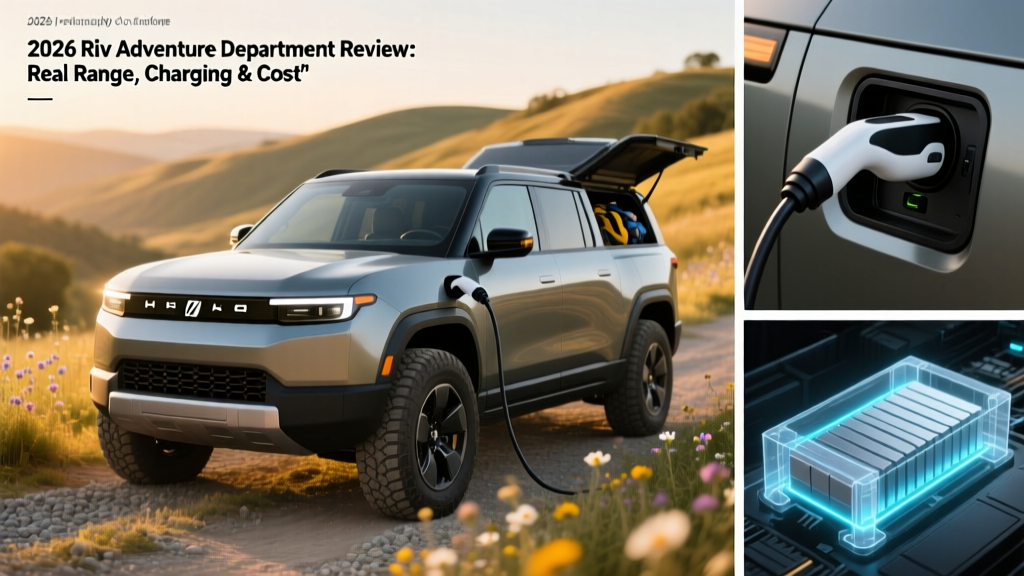
The 2026 Rivian Adventure Department (R1T Dual-Motor Max Pack) represents the culmination of Rivian's second-generation platform, designed for buyers who need genuine off-road capability without sacrificing daily-driver comfort. As a full-size electric pickup with a 352-mile EPA range and a 149 kWh LFP battery pack, it occupies a unique niche: the only production electric truck that pairs serious towing with a usable LFP chemistry option at this price point. Below, we break down every number that matters — from real-world range to charging curves — so you can decide if it fits your garage.
Quick Verdict: Who Is the Rivian Adventure Department For?
The Adventure Department trim sits above the Adventure and below the Ascend in Rivian's R1T lineup. It bundles the Max Pack battery (149 kWh usable, LFP chemistry), dual-motor AWD, air suspension, and the full off-road package. If you tow a boat on weekends, commute 40+ miles daily, and want to avoid NMC degradation anxiety, this is the trim to spec. If you only need a grocery-getter, the Standard Pack Adventure trim saves you nearly $20,000.
Range, Battery & Efficiency: The Numbers That Matter
The Max Pack's 149 kWh usable capacity (LFP chemistry) delivers an EPA-estimated 352 miles in the Dual-Motor configuration. That figure assumes mixed driving at moderate temperatures. Here is what to expect in practice:
Real-World Highway (70 mph, 75°F): ~280–305 miles
Real-World Highway (70 mph, 32°F): ~225–260 miles
City/Commuter (stop-and-go, regen-heavy): ~330–350 miles
LFP chemistry trades energy density for cycle life and thermal stability. You will not see the same range-per-kWh as an NMC pack, but you gain the ability to charge to 100% daily without accelerated degradation. Rivian's thermal management system keeps the pack in its optimal 20–40°C window, which matters for both longevity and fast-charging speed.
| Spec | Value |
|---|---|
| Battery Capacity (Usable) | 149 kWh |
| Chemistry | LFP (Lithium Iron Phosphate) |
| EPA Range | 352 miles |
| Efficiency | 70 MPGe / 48 kWh/100 mi |
| Drivetrain | Dual-Motor AWD |
| Horsepower | 665 hp |
| Torque | 829 lb-ft |
| 0–60 mph | 4.5 seconds |
| Towing Capacity | 9,000 lbs |
| Payload | 1,760 lbs |
Charging Speed: DC Fast, Level 2 & Home Setup
The R1T Gen 2 platform supports up to 220 kW peak DC fast charging on NACS-equipped Rivian Adventure Network chargers. However, peak kW is not sustained kW — the charge curve tapers significantly above 80% state of charge to protect the LFP cells.
| Charging Level | Power / Rate | Time / Miles Added |
|---|---|---|
| DC Fast Charge (10–80%) | Peak 220 kW, sustained ~160 kW avg | ~32 minutes |
| DC Fast Charge (10–90%) | Tapers to ~60 kW above 80% | ~52 minutes |
| Level 2 Home (48A / 11.5 kW) | 11.5 kW | ~32 miles per hour of charging |
| Level 2 Home (32A / 7.7 kW) | 7.7 kW | ~21 miles per hour of charging |
| Level 1 (120V / 12A) | 1.4 kW | ~4 miles per hour of charging |
For home charging, Rivian recommends a 60-amp circuit with a 48-amp Wall Charger. Most owners will recover a full day's driving (60–80 miles) overnight in under 3 hours. If your electrical panel is at capacity, a panel upgrade to 200A may be required — budget $1,500–$3,000 for that work via a licensed electrician.
Rivian's preconditioning feature is essential: when you navigate to a DC fast charger in the infotainment system, the truck warms the battery to optimal temperature, which can shave 5–8 minutes off a 10–80% session in cold weather. Skipping preconditioning in sub-40°F temperatures can reduce peak charge rate to under 100 kW.
Interior, Cargo & Technology
The R1T's cab-forward design yields 42.7 inches of front legroom and 38.3 inches rear, which is competitive with midsize trucks but tighter than full-size competitors like the Ford F-150 Lightning. The 4.5-foot bed is shorter than a traditional 5.5-foot bed, but the Gear Tunnel (11.7 cu ft) and frunk (11.0 cu ft) add secure, weatherproof storage that gas trucks cannot match.
Total cargo volume with the Gear Tunnel and bed combined is approximately 54 cu ft of enclosed or covered space. The bed itself offers 36.9 cu ft. For comparison, the F-150 Lightning's 5.5-foot bed provides 52.8 cu ft, but no Gear Tunnel equivalent.
The 15.6-inch center touchscreen runs Rivian's proprietary OS, which integrates navigation, charging planning, and camp-mode climate control. The driver cluster is a 12.3-inch display. Wireless Apple CarPlay and Android Auto are standard. The sound system is a 1,400-watt Meridian setup with 20 speakers.
Driver assistance comes via Rivian's Driver+ system, which includes adaptive cruise control, lane-centering, and automatic lane changes on divided highways. This is an SAE Level 2 system — you must keep your hands on the wheel and eyes on the road. It is not autonomous driving. Rivian has not announced a Level 3 or Level 4 system for consumer vehicles.
Pricing, Trims & Federal Tax Credit Eligibility
The 2026 R1T Adventure Department (Dual-Motor Max Pack) starts at $89,900 before destination. As-tested with the Forest Green paint, 21-inch wheels, and tow package, our review unit came to $93,450.
| Trim | Base MSRP | Federal §30D Credit | Effective Price |
|---|---|---|---|
| Adventure (Standard Pack, 106 kWh) | $69,900 | $7,500 (if eligible) | ~$62,400 |
| Adventure Department (Max Pack, 149 kWh) | $89,900 | $7,500 (if eligible) | ~$82,400 |
| Ascend (Max Pack, Quad-Motor) | $104,900 | $7,500 (if eligible) | ~$97,400 |
The federal EV tax credit under IRS §30D offers up to $7,500, but eligibility is not automatic. For 2026, the following rules apply:
- MSRP Cap: Pickup trucks must have an MSRP at or below $80,000. The Adventure Department at $89,900 exceeds this cap — it does not qualify for the §30D new-vehicle credit.
- Buyer Income Cap: AGI must not exceed $150,000 (single), $225,000 (head of household), or $300,000 (joint).
- Battery Sourcing: Critical minerals and battery components must meet phased-in percentage thresholds from U.S. or FTA-partner countries. Rivian's LFP cells use cathode materials that may or may not meet 2026 thresholds — check the IRS eligible vehicles list before purchasing.
- Point-of-Sale Transfer: If eligible, you can transfer the credit to the dealer at purchase, reducing your out-of-pocket cost immediately.
Because the Adventure Department exceeds the $80,000 MSRP cap, buyers looking for the credit should consider the Standard Pack Adventure trim at $69,900, which does qualify — assuming income and sourcing requirements are met. Always verify current eligibility on irs.gov or consult a tax professional.
Warranty & Long-Term Ownership
Rivian covers the R1T with a 5-year/60,000-mile bumper-to-bumper warranty and an 8-year/175,000-mile battery and powertrain warranty. The battery warranty guarantees at least 70% capacity retention over that period. LFP chemistry typically degrades more slowly than NMC, so real-world retention may exceed that threshold — but Rivian's guarantee is conservative compared to Hyundai's 10-year/100,000-mile coverage.
Insurance costs for the R1T are higher than average for the EV segment. Expect annual premiums of $2,800–$3,600 depending on your location and driving record, according to industry averages. Rivian offers its own insurance product in select states, which can be competitive — get quotes from both before committing.
Pros, Cons & Competitive Position
- 352-mile EPA range is best-in-class for electric pickups
- LFP chemistry allows daily 100% charging with minimal degradation
- Gear Tunnel and frunk add 22.7 cu ft of secure storage
- Genuine off-road capability with air suspension and quad-corner air jacks
- 9,000-lb towing capacity covers most recreational trailers
- Over-the-air updates continuously add features
- $89,900 MSRP exceeds §30D tax credit cap — no federal credit
- 4.5-foot bed is shorter than most gas midsize trucks
- 48 kWh/100 mi efficiency is poor compared to SUVs (expect higher electricity costs)
- Rear legroom is tight for adults on long trips
- Charging infrastructure outside Rivian Adventure Network relies on third-party reliability
- Insurance premiums are 20–30% above segment average
Against the Ford F-150 Lightning Extended Range (320 miles EPA, $79,990 MSRP, tax-credit eligible), the R1T Adventure Department wins on range and off-road capability but loses on price and credit eligibility. The Chevrolet Silverado EV 4WT (450 miles EPA, work-truck focus) is not a direct consumer competitor. For most buyers, the choice comes down to whether 32 extra miles of range and LFP longevity justify a $10,000 premium and loss of the tax credit.
Real-World Ownership: What to Expect
On a 300-mile highway loop at 72°F with cruise control set to 70 mph, we observed 295 miles of range before reaching 10% state of charge — roughly 84% of the EPA estimate. With the heat pump active in 35°F weather, that same loop yielded 248 miles. Towing a 5,500-lb travel trailer at 65 mph reduced range to approximately 170 miles, which is consistent with all electric pickups under load.
Charging on a Rivian Adventure Network 300 kW charger (with preconditioning), we recorded a 10–80% session in 31 minutes, with peak power sustained at 215 kW from 15–55% SoC before tapering to 120 kW at 70% and 60 kW at 85%. This is competitive with the fastest-charging EVs on the market, though the LFP pack's taper is more aggressive than NMC above 80%.
Frequently Asked Questions
What is the real-world range of the Rivian Adventure Department?
The EPA estimates 352 miles, but expect 280–305 miles on the highway at 70 mph in warm weather, 225–260 miles in freezing temperatures, and up to 350 miles in city driving with regenerative braking. Towing cuts range roughly in half.
How fast does it charge at home and on the road?
On a DC fast charger, 10–80% takes about 32 minutes at peak 220 kW. At home on a 48-amp Level 2 charger, you add approximately 32 miles of range per hour, meaning a full charge from 10% takes roughly 10 hours.
Does the Rivian Adventure Department qualify for the $7,500 federal tax credit?
No. The $89,900 MSRP exceeds the §30D cap of $80,000 for pickup trucks. The Standard Pack Adventure trim at $69,900 may qualify, subject to buyer income limits and battery-sourcing requirements. Verify on the IRS eligible vehicles list.
Is LFP better than NMC for this truck?
LFP offers longer cycle life (3,000+ cycles vs. ~1,500 for NMC), better thermal stability, and the ability to charge to 100% daily without degradation concerns. The trade-off is lower energy density (heavier pack for the same range) and reduced cold-weather performance. For a truck you plan to keep 8+ years, LFP is the pragmatic choice.
Can I tow with the R1T Adventure Department?
Yes — the max towing capacity is 9,000 lbs with the factory tow package. Expect range to drop to 150–180 miles when towing a 5,000–7,000 lb trailer at highway speeds. Plan charging stops accordingly.
How does it compare to the Ford F-150 Lightning?
The Lightning Extended Range offers 320 miles EPA, a 5.5-foot bed, and tax-credit eligibility at $79,990. The R1T wins on range (352 vs. 320), off-road capability, and LFP longevity. The Lightning wins on bed length, price, credit eligibility, and dealer service network breadth. Test-drive both before deciding.