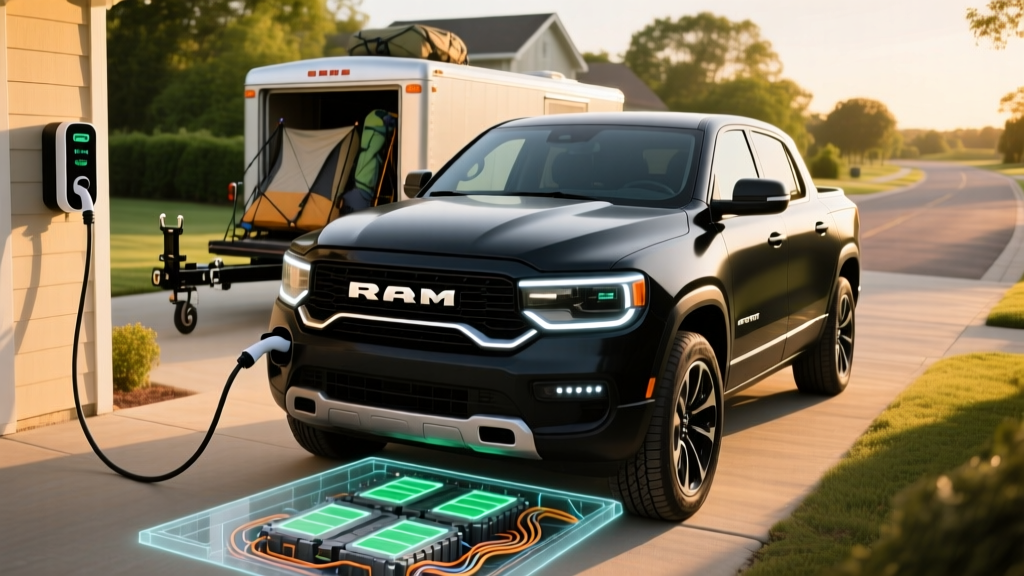
The Ram EREV (extended-range electric vehicle) is not a pure battery-electric truck, and it's not a traditional plug-in hybrid. It occupies a specific niche: a series-hybrid architecture where the wheels are always driven by electric motors, while an onboard gasoline generator recharges the battery when needed. For 2026, Ram enters the EREV truck segment with a clear target — buyers who want daily electric commuting but refuse to sacrifice towing range or deal with charging-desert anxiety on long hauls.
This review examines the 2026 Ram EREV lineup with a focus on what actually matters to truck buyers: real-world electric range, DC fast-charging behavior under load, towing implications of the series-hybrid system, and whether the math works after federal tax credits. All figures below reflect the most recent manufacturer data and EPA estimates available for the 2026 model year.
A BEV (battery-electric vehicle) runs solely on battery power and must be plugged in. A PHEV (plug-in hybrid) can drive on electricity or gas, with the engine sometimes directly turning the wheels. An EREV (extended-range EV) always drives on electric motors — the gas engine never connects to the drivetrain. It exists only as a generator to recharge the battery, extending total range far beyond what the battery alone provides. Think of it as an EV with a built-in backup power plant.
2026 Ram EREV Spec Sheet at a Glance
| Specification | Ram 1500 EREV |
|---|---|
| Battery (usable) | 92 kWh, NMC lithium-ion |
| EPA Electric-Only Range | 145 miles |
| Total Range (EREV mode) | ~690 miles (est.) |
| Generator Engine | 3.6L Pentastar V6 (series generator only) |
| Drivetrain | Dual-motor AWD |
| Horsepower | ~650 hp (combined) |
| 0–60 mph | ~5.2 seconds |
| Max DC Fast Charge | 145 kW peak |
| 10–80% DC Charge Time | ~32 minutes |
| Level 2 Home Charging | 11.5 kW (~38 mi/hr electric) |
| MPGe (electric mode) | 74 MPGe combined (est.) |
| Generator Mode MPG | ~22 MPG combined (est.) |
| Max Towing Capacity | ~10,500 lbs (est.) |
| Bed Length | 5'7" (standard) / 6'4" (available) |
| Battery/Powertrain Warranty | 8 years / 100,000 miles |
| Base MSRP | $62,995 |
Real-World Electric Range: Beyond the EPA Sticker
EPA Electric-Only Range: 145 miles
Expected Real-World (city/mixed): ~125–140 miles
Expected Real-World (sustained 70+ mph highway): ~100–115 miles
Cold-Weather (below 32°F): ~85–105 miles (25–35% reduction)
While Towing (5,000+ lb trailer): ~45–60 miles electric-only before generator kicks in
The 145-mile EPA electric range figure assumes mixed driving at moderate temperatures. In practice, the Ram EREV's boxy aerodynamic profile and 6,000+ lb curb weight penalize highway efficiency more than a sedan-shaped EV would. At sustained 70–75 mph speeds on flat terrain, expect to use roughly 35–40 kWh per 100 miles, which reduces effective electric range to around 100–115 miles before the V6 generator activates.
This isn't necessarily a problem — it's how the EREV system is designed to work. The generator seamlessly extends range, and most daily commutes fall well within the battery-only envelope. But if your one-way commute exceeds 60 miles at highway speeds, you'll regularly dip into generator mode. That's still far cheaper than running a gas-only truck, but it changes the economics.
Cold weather is the bigger concern for northern-climate buyers. The 92 kWh NMC battery loses capacity in freezing temperatures, and cabin heating draws significant power without a dedicated heat pump on the base trim. Below 32°F, budget for a 25–35% range reduction. Preconditioning the battery while plugged in mitigates some of this loss.
Charging Speeds: DC Fast Charge and Home Level 2
| Charging Level | Power | Speed (mi/hr added) | Notes |
|---|---|---|---|
| Level 1 (120V) | ~1.4 kW | ~4 mi/hr | Emergency/trickle; ~36 hours for full charge |
| Level 2 (240V) | 11.5 kW | ~38 mi/hr | ~8 hours for full battery (overnight) |
| DC Fast Charge | 145 kW peak | ~190 mi/hr at peak | 10–80% in ~32 min; tapers sharply above 80% |
The 145 kW peak DC fast-charge rate is modest compared to the 250–350 kW peaks seen on the Hyundai Ioniq 5 or Tesla Cybertruck. Ram's 92 kWh battery has a peak C-rate of roughly 1.6C, meaning charging slows noticeably once you pass 60% state of charge. The 10–80% time of approximately 32 minutes is competitive for the EREV segment, but don't expect to add 200 miles of electric range in a 15-minute stop.
Here's the practical framing: since the EREV has a gas generator, DC fast charging is a convenience, not a necessity. On a road trip, you can simply let the generator run. DC fast charging makes sense when you want to maximize electric-only driving at your destination or when gas prices in your area are particularly high. At home, the 11.5 kW Level 2 rate is the workhorse — a standard overnight charge fully replenishes the battery in about 8 hours, which is ideal for daily commuting.
For Level 2 home installation, expect to budget $800–$1,500 for a quality 48-amp charger (such as a ChargePoint Home Flex or Emporia Vue) plus $500–$2,000 for electrician labor, depending on whether your panel needs a 240V circuit added. If your home has a 100-amp panel already near capacity, a panel upgrade to 200 amps can add $1,500–$3,000. Always get a quote from a licensed electrician before purchasing equipment.
Performance and Towing: The EREV Advantage
Dual electric motors producing an estimated 650 horsepower give the Ram EREV a 0–60 mph time around 5.2 seconds — quick for a full-size truck, though not in Rivian R1T tri-motor territory. The instant torque delivery from the electric motors is the real story: there's no transmission shift lag when merging onto a highway or pulling away from a stop with a loaded bed.
Towing capacity is estimated at approximately 10,500 lbs, which trails the Ram 1500 gas V8 (up to 12,750 lbs) and the Ford F-150 Lightning (up to 10,000–13,000 lbs depending on configuration). The EREV's towing limitation is partly thermal — sustained heavy towing generates significant heat in the electric motors and battery, requiring the generator to run continuously and reducing overall efficiency.
When towing above 5,000 lbs, expect electric-only range to drop to 45–60 miles before the generator engages. In generator mode while towing, fuel economy drops to roughly 12–15 MPG combined depending on trailer weight and terrain. That's comparable to a gas-only Ram 1500 EcoDiesel under similar conditions. The advantage is that you never have to stop to charge on a long tow — you simply refuel the gas tank like any conventional truck.
The dual-motor AWD system provides torque vectoring to individual wheels, which helps with traction on boat ramps and in mud. Ram includes an integrated trailer brake controller and a trailer-reverse-steering assist on higher trims, reducing the skill required for backing a trailer into a tight spot.
Pricing, Trims, and Federal Tax Credit Eligibility
| Trim Level | Base MSRP | Est. After §30D Credit | Key Features |
|---|---|---|---|
| Tradesman EREV | $62,995 | $55,495* | Base work truck, 12" infotainment, tow hooks |
| Laramie EREV | $72,995 | $65,495* | Leather, heated/ventilated seats, 14.9" screen |
| Limited EREV | $85,995 | $78,495* | Air suspension, premium audio, hands-free driving assist |
| Tungsten EREV | $92,995 | $85,495* | Top luxury, massaging seats, 23-speaker audio |
*Price after credit assumes full $7,500 §30D eligibility and point-of-sale transfer. Actual credit amount depends on battery sourcing, buyer income, and MSRP caps. Verify with a tax professional and consult IRS §30D guidelines.
- MSRP Cap: Trucks/vans/SUVs must have an MSRP at or below $80,000. The Tradesman and Laramie trims qualify; the Limited and Tungsten trims may exceed the cap depending on options.
- Buyer Income Cap: Modified adjusted gross income must not exceed $150,000 (single), $225,000 (head of household), or $300,000 (joint filing).
- Battery Sourcing: The $7,500 credit splits into two halves — $3,750 for critical-minerals sourcing and $3,750 for battery-component manufacturing, both requiring North American or FTA-partner supply chains. Ram's NMC battery sourcing determines the exact credit amount; check the latest fueleconomy.gov listing for the specific model year.
- Point-of-Sale Transfer: As of 2024, eligible buyers can transfer the credit to the dealer at purchase, reducing the purchase price upfront rather than waiting for a tax refund.
- One Credit Per VIN: The vehicle must be new, purchased for personal use, and primarily driven in the United States.
The Ram EREV's MSRP positions it against the Ford F-150 Lightning (starting ~$55,000 for the Pro trim, up to ~$97,000 for the Platinum) and the Chevrolet Silverado EV (starting ~$57,000 for the Work Truck, up to ~$90,000 for the RST). The key pricing advantage is the EREV's total range — you're paying a premium over base BEV trucks but gaining unlimited range via the generator, which eliminates the need for route-planning around chargers on long hauls.
Interior, Cargo, and Technology
The Ram EREV shares its cabin architecture with the redesigned Ram 1500, which means class-leading interior materials and a focus on screen real estate. The base Tradesman gets a 12-inch touchscreen running Uconnect 5, while Laramie and above move to a 14.9-inch portrait display with native navigation, over-the-air updates, and wireless Apple CarPlay/Android Auto.
Cargo dimensions are largely unchanged from the standard Ram 1500 crew cab:
- Bed volume (5'7" box): ~61.5 cu ft
- Bed volume (6'4" box): ~71.7 cu ft
- Rear-seat legroom: 45.2 inches
- Front headroom: 40.9 inches
- Rear cargo (behind second row, cabin): Class-leading at 19.3 cu ft of interior storage with RamBox (where equipped)
Notably, the EREV does not have a front trunk (frunk). The space under the hood is occupied by the 3.6L V6 generator, its associated electronics, and cooling systems. This is a meaningful difference from the F-150 Lightning and Silverado EV, both of which offer substantial frunk storage. If you rely on a frunk for secure, weatherproof gear storage, the Ram EREV won't provide it.
Driver-assistance technology includes adaptive cruise control with stop-and-go, lane-centering steering assist, and automatic emergency braking across all trims. The top Tungsten trim adds Ram's Active Driving Assist, a Level 2 hands-on system (per SAE Level 2 classification) that manages steering and speed on divided highways but requires the driver to remain attentive with hands on the wheel. This is not autonomous driving — it is a driver-assist system comparable to Ford BlueCruise or GM Super Cruise, though Ram's implementation does not yet support hands-off operation on mapped highways as those competitors do.
Pros, Cons, and the Bottom Line
- 145 miles of electric-only range covers most daily commutes without gas
- Unlimited total range via V6 generator — no charging-desert anxiety on long hauls
- 650 hp dual-motor AWD with instant electric torque
- Class-leading interior quality and infotainment
- Seamless transition between electric and generator mode
- 8-year/100,000-mile battery warranty
- Point-of-sale tax credit transfer reduces upfront cost
- 145 kW peak DC charge rate is slow vs. 250+ kW BEV competitors
- No frunk — generator occupies under-hood space
- Towing capacity (~10,500 lbs) trails gas V8 Ram 1500
- Cold-weather electric range drops 25–35%
- High-trim MSRPs exceed the $80,000 §30D tax credit cap
- Generator-mode MPG while towing drops to ~12–15 MPG
- Heavier curb weight reduces payload vs. gas-only Ram
Who Should Buy the Ram EREV?
- Your daily commute is under 100 miles round-trip and you want to drive electric most days
- You tow a boat, camper, or horse trailer on weekends and can't risk being stranded between chargers
- You live in a rural area or region with sparse DC fast-charging infrastructure
- You want a full-size truck interior with premium materials but don't want a pure BEV's range limitations
- You have home Level 2 charging access to maximize daily electric driving
- You want the lowest possible operating cost — a pure BEV like the F-150 Lightning eliminates gas entirely
- You need a frunk for secure gear storage on job sites
- Your daily driving exceeds 140 miles and you want to avoid running the generator regularly
- You need maximum towing capacity (12,000+ lbs) — a gas V8 Ram 1500 or heavy-duty 2500/3500 is better suited
The Ram EREV solves a specific problem that neither pure BEVs nor conventional hybrids address well: the need for daily electric efficiency combined with unlimited long-distance range and towing capability. It won't be the cheapest truck to operate if you regularly exceed the battery's range, and the lack of a frunk is a genuine trade-off. But for the buyer who commutes 40 miles each way on weekdays and tows a 7,000-lb travel trailer 300 miles on Saturdays, the EREV architecture makes more practical sense than either a gas truck or a battery-electric one.
Frequently Asked Questions
What is the real-world electric range of the Ram EREV?
The EPA rates the Ram EREV at 145 miles of electric-only range. In real-world mixed driving, expect 125–140 miles. Sustained highway speeds (70+ mph) reduce this to roughly 100–115 miles. In freezing temperatures, plan for 85–105 miles. When towing a trailer over 5,000 lbs, electric-only range drops to approximately 45–60 miles before the V6 generator activates.
How fast does the Ram EREV charge at home and on DC fast chargers?
On a Level 2 home charger at 11.5 kW, the 92 kWh battery charges from empty to full in approximately 8 hours, adding about 38 miles of electric range per hour. On a DC fast charger, it peaks at 145 kW and charges from 10–80% in roughly 32 minutes. Charging slows significantly above 80% state of charge, as is standard for NMC batteries to protect long-term health.
How much does the Ram EREV cost after federal tax credits?
The base Tradesman EREV starts at $62,995. With full $7,500 §30D eligibility (meeting income caps, MSRP cap, and battery-sourcing requirements), the effective price drops to approximately $55,495. Higher trims like the Limited ($85,995) and Tungsten ($92,995) may exceed the $80,000 MSRP cap for trucks, making them ineligible for the federal credit. Always verify current eligibility on fueleconomy.gov and consult a tax professional.
Is the Ram EREV worth buying vs. the F-150 Lightning or Silverado EV?
It depends on your use case. If you have reliable home charging and rarely tow more than 400 miles in a day, the F-150 Lightning offers lower operating costs (no gas at all), a useful frunk, and faster DC charging. If you regularly tow long distances or live in an area with poor charging infrastructure, the Ram EREV's unlimited total range via the gas generator is a genuine advantage that neither the Lightning nor Silverado EV can match. The EREV is a compromise — it sacrifices some electric efficiency and frunk space for total range security.
Does the Ram EREV qualify for the $7,500 federal EV tax credit?
Potentially, with conditions. Under IRS §30D rules, the Ram EREV qualifies as a plug-in electric vehicle with sufficient battery capacity. However, eligibility depends on three factors: (1) the trim's MSRP must not exceed $80,000 for trucks — this limits the credit to Tradesman and Laramie trims in most configurations; (2) buyer modified AGI must fall within income caps ($150K single / $300K joint); (3) the battery's critical minerals and components must meet North American sourcing thresholds, which determine whether you receive the full $7,500 or a partial $3,750 credit. The credit can be transferred to the dealer at point of sale to reduce your purchase price directly.
What happens when the battery runs out — does the truck stop?
No. When the battery depletes to its minimum state of charge (the system maintains a buffer to protect battery health), the 3.6L V6 generator automatically starts and produces electricity to power the drive motors. You refuel the gas tank at any station, just like a conventional truck. The total range in combined battery + generator mode is estimated at approximately 690 miles, limited only by the size of the fuel tank and your willingness to stop for gas.
How long will the Ram EREV battery last?
Ram backs the EREV battery with an 8-year/100,000-mile warranty, which is the federal minimum for plug-in vehicles and standard across the industry. The warranty guarantees the battery will retain at least 70% of its original capacity during the coverage period. NMC batteries in similar applications typically degrade 1–2% per year under normal use, meaning you can expect roughly 85–90% capacity retention at 100,000 miles. Replacement cost for a 92 kWh NMC pack, if needed out of warranty, is estimated at $12,000–$18,000 based on current battery pricing trends, though this figure is expected to decline as battery costs continue to fall.