The Short Answer on the 2026 Outlander Electric
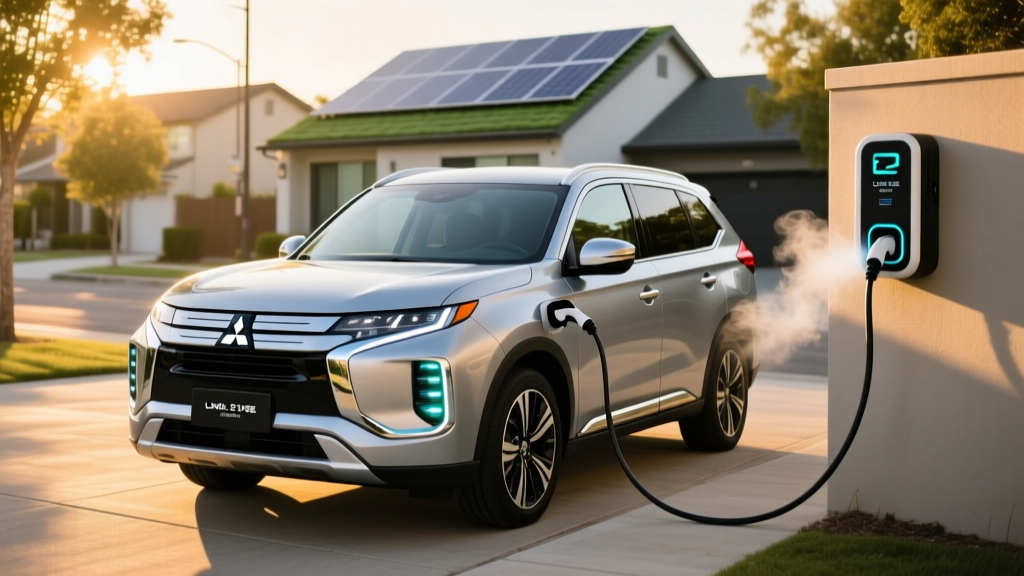
The 2026 Mitsubishi Outlander Electric is Mitsubishi's first fully battery-electric SUV for the North American market, built on the Renault-Nissan-Mitsubishi Alliance's CMF-EV platform (shared with the Nissan Ariya). It targets buyers who want a compact-to-midsize electric crossover with three-row seating, all-wheel drive, and a realistic ~280–300 mile EPA range. Base pricing is expected in the $42,000–$45,000 range before incentives, positioning it against the Hyundai Ioniq 5, Kia EV6, Volkswagen ID.4, and its own stablemate, the Outlander PHEV. If you need a family-sized EV with moderate towing capability and access to a growing dealer-installed DC fast-charging ecosystem, it's worth a close look — but if you frequently drive beyond 250 miles between charges in cold weather, the PHEV variant may still be the pragmatic choice.
What the 2026 Outlander Electric Actually Is
Mitsubishi has sold the Outlander PHEV (plug-in hybrid) in the U.S. since 2017, but the fully electric variant has been a long-anticipated addition. The 2026 Outlander Electric (also referred to in some markets as the Outlander BEV) leverages the Alliance's CMF-EV dedicated EV architecture, which underpins the Nissan Ariya. This is not a converted gas platform — it's a ground-up electric vehicle with a flat battery pack, low center of gravity, and optimized thermal management.
Key specifications based on Mitsubishi's preliminary announcements and platform-sharing data:
| Specification | 2026 Outlander Electric (AWD, Preliminary) |
|---|---|
| Battery Capacity (usable) | ~87 kWh (NMC lithium-ion) |
| EPA Range (est.) | ~280–300 miles |
| Real-World Highway Range | ~240–265 miles (cold weather: ~210–230 mi) |
| Motor Output | Dual motor AWD, ~300+ hp combined |
| 0–60 mph (est.) | ~6.5 seconds |
| Peak DC Fast Charge Rate | ~130 kW (CCS/NACS adapter) |
| 10–80% DC Fast Charge Time | ~35–40 minutes |
| Level 2 AC Charging (240V) | ~7.2 kW onboard charger (~12 hrs 0–100%) |
| Seating | 3 rows / 7 passengers (tight third row) |
| Cargo Volume (est.) | ~12 cu ft (all rows up) / ~60 cu ft (folded) |
| Towing Capacity (est.) | ~1,500 lbs |
| Base MSRP (est.) | $42,000–$45,000 (ES trim); $48,000–$52,000 (SEL Touring) |
| Battery/Powertrain Warranty | 10 years / 100,000 miles (Mitsubishi standard) |
Note: Specs marked as preliminary are based on Alliance platform data and Mitsubishi announcements. Final EPA certification figures may differ. Always verify at fueleconomy.gov when the vehicle is certified.
Outlander Electric vs. Outlander PHEV: The Numbers Side by Side
Many shoppers cross-shop these two without understanding the fundamental trade-offs. Here's how they stack up with concrete data:
| Metric | 2026 Outlander Electric (BEV) | 2026 Outlander PHEV |
|---|---|---|
| Powertrain | Dual-motor AWD, battery only | 2.4L 4-cyl + dual motors, 20 kWh battery |
| Electric-Only Range | ~280–300 miles (full battery) | ~38 miles (EPA est.) |
| Total Range (with gas) | ~280–300 miles | ~420+ miles (gas + electric) |
| Fuel Cost per Mile (est.) | ~$0.04–0.06 (home charging at $0.14/kWh) | ~$0.06–0.10 (blended gas + electric) |
| Base MSRP | $42,000–$45,000 | $40,000–$43,000 |
| Federal Tax Credit (§30D) | Up to $7,500 (if sourcing/income rules met) | Up to $7,500 (if sourcing/income rules met) |
| Maintenance (5-yr est.) | ~$1,500–$2,000 | ~$3,000–$3,500 (engine oil, filters, spark plugs) |
| Cold-Weather Range Loss | ~20–30% (no gas backup) | ~15–20% electric range loss, gas engine compensates |
| Refueling/Recharging Time | 10–80% in ~35–40 min (DC fast) | Gas fill: 5 min; 0–100% L2 charge: ~4 hrs |
The core trade-off: The BEV wins on operating cost, simplicity, and zero tailpipe emissions. The PHEV wins on total range flexibility, cold-weather resilience, and slightly lower entry price. If 90% of your driving is under 60 miles round-trip and you can charge at home, the BEV's daily experience is superior. If you regularly road-trip 300+ miles or live where DC fast chargers are sparse, the PHEV's gas backup is genuine insurance.
Charging Reality: What You'll Actually Experience
The Outlander Electric's ~130 kW peak DC fast-charging rate is the single biggest spec to understand — because it's modest by 2026 standards. For context, the Hyundai Ioniq 5 peaks at 240 kW and the Tesla Model Y at 250 kW on V3 Superchargers. Here's what Mitsubishi's charge rate means in practice:
| Charging Level | Power | Miles Added per Hour | Typical Use Case |
|---|---|---|---|
| Level 1 (120V household) | ~1.4 kW | ~4–5 mi/hr | Emergency / overnight top-up only |
| Level 2 (240V home, 32A) | ~7.2 kW | ~22–25 mi/hr | Daily home charging (full overnight) |
| DC Fast (public, 130 kW peak) | Up to 130 kW | ~150+ mi in first 30 min (tapering) | Road trips; expect 10–80% in ~35–40 min |
Charge-curve reality check: Like all NMC batteries, the Outlander Electric will sustain its peak ~130 kW rate only through roughly 40–50% state of charge, then taper progressively. A 10–80% session will take ~35–40 minutes, but an 80–100% top-off could add another 25–30 minutes. Plan road-trip stops around the 10–80% window to minimize time at the charger.
Home charging prerequisite: A Level 2 home charger (240V, 30–40A circuit) is strongly recommended for daily ownership. Installation costs typically range from $800–$2,500 depending on panel capacity and run length. If your home has a 200-amp electrical panel with spare breaker slots, expect the lower end. Homes with 100-amp panels may need a $2,000–$4,000 panel upgrade. Always get a quote from a licensed electrician before committing to a BEV purchase.
Real Costs: 5-Year Ownership Breakdown
Here's a concrete cost comparison assuming 15,000 miles/year, $0.14/kWh home electricity, $3.50/gallon gas, and no major repairs:
| Cost Category (5 Years / 75,000 mi) | Outlander Electric (BEV) | Outlander PHEV | Gas-Only Compact SUV (baseline) |
|---|---|---|---|
| Purchase Price (base MSRP) | $43,500 | $41,500 | $34,000 |
| Federal Tax Credit (§30D) | –$7,500 (if eligible) | –$7,500 (if eligible) | $0 |
| Net Purchase | $36,000 | $34,000 | $34,000 |
| Fuel / Energy (5 yrs) | $3,900 (home charging) | $5,200 (blended) | $9,800 |
| Maintenance (5 yrs) | $1,800 | $3,200 | $4,500 |
| Insurance (5 yrs, avg.) | $8,500 | $7,800 | $7,200 |
| Home Charger Install | $1,500 | $1,200 | $0 |
| Estimated Depreciation | $16,000 | $14,500 | $13,000 |
| Total 5-Year Cost | ~$67,700 | ~$65,900 | ~$68,500 |
Key takeaways: With the full $7,500 federal credit, the Outlander Electric's 5-year total cost is competitive with a gas-only SUV and only marginally higher than the PHEV. Without the credit (due to income caps, MSRP caps, or battery-sourcing rules), the BEV costs roughly $7,500 more over 5 years. Insurance is typically 10–15% higher for BEVs due to repair costs and battery replacement exposure — get quotes before buying.
Federal §30D tax credit eligibility for 2026 depends on buyer income limits ($150K single / $300K joint MAGI), vehicle MSRP caps ($80K for SUVs), and critical-mineral/battery-component sourcing requirements. Verify current rules at IRS.gov or consult a tax professional. Point-of-sale transfer is available through participating dealers.
Common Misconceptions — Myth vs. Fact
| Myth | Fact |
|---|---|
| "The Outlander Electric has the same range as the gas Outlander." | The BEV offers ~280–300 miles EPA — comparable to a gas tank, but with no 5-minute refill option. The PHEV offers 420+ total miles. |
| "I can charge it as fast as a Tesla." | At ~130 kW peak, the Outlander Electric charges roughly 50% slower than a Tesla Model Y on a V3 Supercharger (250 kW). Plan for longer stops. |
| "The battery will need replacing in 5 years." | NMC batteries with modern thermal management typically retain 85–90% capacity after 100,000 miles. Mitsubishi's 10-year/100,000-mile battery warranty covers capacity loss below ~70%. |
| "I'll save money no matter what." | Savings depend on: (1) qualifying for the $7,500 credit, (2) having affordable home charging, (3) your local electricity vs. gas price ratio. Without all three, the PHEV or a gas SUV may cost less. |
| "The third row is usable for adults." | Like most compact/midsize three-row crossovers, the third row fits children or short trips for adults under 5'6". Cargo space with all rows up is limited (~12 cu ft). |
| "It qualifies for the full $7,500 tax credit automatically." | Credit eligibility depends on battery sourcing, your income, and the vehicle's MSRP. Check the IRS qualified vehicle list and your tax situation before assuming eligibility. |
Decision Framework: Is the 2026 Outlander Electric Right for You?
Choose the Outlander Electric (BEV) if:
- You can install a Level 2 home charger (240V, 30–40A circuit)
- Your daily driving is under 80 miles round-trip (covers ~95% of U.S. commutes)
- You take road trips fewer than 4–5 times per year and can plan DC fast-charger stops
- You qualify for the full or partial §30D federal tax credit
- You want the lowest per-mile operating cost and minimal maintenance
- You live in a mild-to-moderate climate (cold-weather range loss is manageable with preconditioning)
Choose the Outlander PHEV instead if:
- You cannot install home charging (apartment, street parking, no 240V access)
- You regularly drive 250+ miles between stops in areas with sparse DC charging
- You live in a cold climate (below 20°F winters) and need gas-engine range insurance
- You tow more than 1,500 lbs frequently
- You don't qualify for the federal tax credit due to income or sourcing rules
Choose a gas-only SUV if:
- Your budget is under $35,000 and you need maximum upfront affordability
- You drive fewer than 8,000 miles per year (fuel savings won't offset EV premium)
- You have no home or workplace charging access and public infrastructure is limited in your area
What First-Time EV Buyers Must Know Before Signing
If the Outlander Electric is your first EV, here are the ownership realities that no brochure will tell you:
1. Preconditioning matters. The Outlander Electric's thermal management system can warm the battery before a DC fast-charging stop, improving charge speed. Use the navigation system to route to a charger — this triggers preconditioning automatically. Arriving at a fast charger with a cold battery can cut your charge rate by 40–50%.
2. Highway efficiency drops significantly above 70 mph. Expect ~10–15% less range at sustained 75–80 mph highway speeds versus the EPA combined estimate. If your road trip involves mountain passes or sustained high speeds, plan charging stops with a 20% buffer below the rated range.
3. The NACS adapter question. Mitsubishi has committed to NACS (Tesla-style) charging port adoption across its lineup, but early 2026 models may ship with CCS1 ports and a NACS adapter for Supercharger access. Confirm the port type and included adapters with your dealer before purchase.
4. Insurance costs more — shop early. EV insurance premiums are typically 10–20% higher than equivalent gas vehicles. Get quotes from at least three insurers before finalizing your purchase to avoid surprises.
5. Depreciation is the hidden cost. EVs have historically depreciated faster than gas vehicles, partly due to rapid technology improvement and battery-health concerns in the used market. Mitsubishi's strong 10-year warranty helps, but plan for ~35–40% depreciation over 5 years based on current market trends.
Frequently Asked Questions
Does the 2026 Outlander Electric qualify for the $7,500 federal tax credit?
Potentially, but eligibility depends on multiple factors: your modified adjusted gross income must be under $150,000 (single) or $300,000 (joint), the vehicle MSRP must be under $80,000 (SUV threshold), and the battery must meet critical-mineral and component-sourcing requirements set by the IRS. The point-of-sale transfer option lets you apply the credit at purchase through a participating dealer. Always verify current eligibility at IRS.gov before relying on the credit.
How long does it take to charge the Outlander Electric at home?
On a 240V Level 2 charger at 7.2 kW (32 amps), a full 0–100% charge takes approximately 12 hours. Most owners charge from 20–80% overnight, which takes roughly 7–8 hours. On a standard 120V household outlet (Level 1), expect only ~4–5 miles of range per hour of charging — adequate only for emergency top-ups or very low daily mileage.
What is the real-world range in winter?
Expect a 20–30% range reduction in sustained below-freezing temperatures. The ~290-mile EPA estimate could drop to ~210–230 miles in harsh winter conditions. Using seat heaters and steering-wheel heat instead of cabin air heating, and preconditioning while plugged in, can recover 5–10% of that loss. The Outlander Electric's heat pump (if equipped on your trim) significantly reduces winter HVAC energy draw compared to resistive heating.
Can I tow with the Outlander Electric?
Yes, but modestly. The estimated towing capacity is ~1,500 lbs — enough for a small utility trailer or a pair of dirt bikes, but not a boat or camper. Towing also dramatically reduces range (expect 30–40% less range when towing near max capacity). If towing is a priority, the Outlander PHEV or a body-on-frame SUV is a better fit.
How does the Outlander Electric compare to the Hyundai Ioniq 5 or Kia EV6?
The Ioniq 5 and EV6 charge significantly faster (up to 240 kW peak, 10–80% in ~18 minutes vs. the Outlander's ~35–40 minutes) and offer similar or slightly better range. However, neither offers three-row seating. The Outlander Electric's key differentiator is its 7-passenger layout and Mitsubishi's 10-year/100,000-mile powertrain warranty — one of the longest in the industry. If you don't need the third row, the Ioniq 5 and EV6 are more efficient choices with faster charging.
What happens if the battery degrades?
Mitsubishi covers the battery for 10 years or 100,000 miles against capacity loss below approximately 70% of original capacity (check your warranty booklet for the exact threshold). Based on NMC battery degradation data from similar Alliance vehicles, expect roughly 8–12% capacity loss over the first 100,000 miles under normal use. A full battery replacement outside warranty, if ever needed, would likely cost $12,000–$18,000 based on current market pricing for packs of this size.