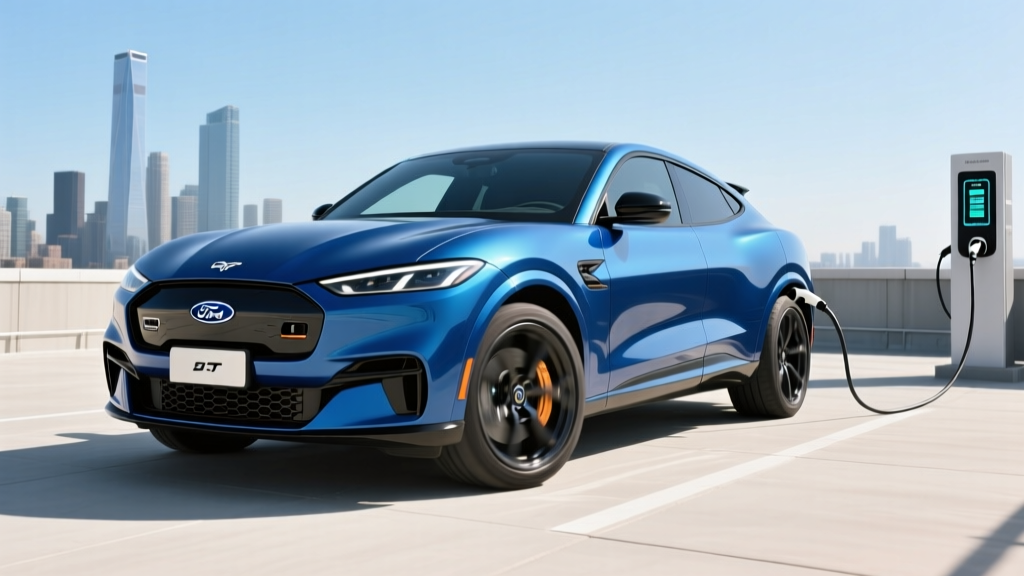
The Ford Mustang Mach-E GT enters the 2026 model year as the performance flagship of Ford's electric lineup, blending muscle-car attitude with legitimate crossover practicality. With up to 480 horsepower, a revised 91 kWh extended-range battery, and access to Tesla's Supercharger network via the native NACS port, the Mach-E GT is positioned squarely against the Tesla Model Y Performance, Hyundai Ioniq 5 N, and Kia EV6 GT. But performance EVs live or die on the details: real-world range, charging curves, and total cost. Here's everything we measured.
Quick Verdict: Who Should Buy the 2026 Mach-E GT?
The Mach-E GT is built for driving enthusiasts who need four doors and cargo space but refuse to drive something that feels like an appliance. If you want sub-4-second 0-60 times, a compliant ride, and a growing fast-charging network, it's a top pick. If your priority is maximum range per dollar or the lowest possible insurance premium, you'll want to cross-shop the base Extended Range trims or look at Hyundai's offerings.
Choose the 2026 Mach-E GT if: You value acceleration, MagneRide handling, and a sporty driving position over squeezing out every last mile of range.
Look elsewhere if: You routinely drive 300+ highway miles between charging stops, or if the ~$57,000 starting price strains your budget even after tax credits.
Range, Battery & Efficiency: EPA vs. Reality
The 2026 Mach-E GT with the Extended Range battery carries a 91 kWh usable lithium-ion pack using NMC (nickel manganese cobalt) chemistry. Ford quotes an EPA-estimated range of 280 miles for the GT trim, down from the 320 miles you'll find on the rear-wheel-drive Select with the same pack. That reduction comes from the GT's dual-motor all-wheel-drive system, stickier summer tires, and more aggressive powertrain calibration.
EPA Estimate: 280 miles (GT AWD Extended Range)
Real-World Expectation: Plan for 240–260 miles on mixed highway/city driving at 70–75 mph. In sustained sub-30°F winter conditions without preconditioning, expect 190–215 miles. City-heavy regenerative driving can push the GT closer to 280–290 miles in mild weather.
| Metric | Value |
|---|---|
| EPA Range (GT Extended Range AWD) | 280 miles |
| Battery Capacity (Usable) | 91 kWh, NMC chemistry |
| EPA Efficiency | 88 MPGe combined (38 kWh/100 mi) |
| Drivetrain | Dual-motor AWD |
| Horsepower | 480 hp (565 lb-ft torque) |
| 0–60 mph | 3.5 seconds |
| Heat Pump | Standard |
The Mach-E GT's 88 MPGe combined trails the base Select RWD (101 MPGe) but remains competitive with the Model Y Performance (95 MPGe) and handily beats the Ioniq 5 N (80 MPGe) thanks to the Hyundai's track-focused tuning. According to fueleconomy.gov, the GT's 38 kWh per 100 miles translates to roughly $0.11–$0.14 per mile at the national average residential electricity rate of $0.17/kWh — roughly one-third the per-mile cost of a 25 MPG gas crossover at $3.50/gallon.
Charging Speed: DC Fast, Level 2 & the NACS Advantage
For 2026, the Mach-E ships with a native NACS (North American Charging Standard) port, meaning it plugs directly into Tesla Supercharger V3 and V4 stalls without an adapter. This is a significant practical upgrade over the 2021–2024 CCS-equipped models that required Ford's adapter dongle.
| Charging Level | Power / Rate | Speed | Typical Use |
|---|---|---|---|
| Level 1 (120V) | 1.4 kW | ~3 mi/hr | Emergency / trickle top-off |
| Level 2 (240V, 48A) | 11.5 kW | ~28 mi/hr | Home overnight charging |
| DC Fast Charge (peak) | 230 kW | 10–80% in ~26 min | Road trips, public stations |
On a 250 kW+ Tesla Supercharger V3 or Electrify America Hyper-Charger, the Mach-E GT peaks around 230 kW and sustains roughly 180–200 kW from 10% to about 55% State of Charge before tapering. The 10–80% charge takes approximately 26 minutes in ideal conditions (battery preconditioned via navigation to a charger). Above 80%, the curve drops sharply — a 10–90% fill takes closer to 42 minutes, so plan your road-trip stops around the 80% mark for efficiency.
At home on a 48-amp Level 2 hardwired charger (like the Ford Charge Station Pro or a Wallbox Pulsar Plus), expect roughly 28 miles of range added per hour. A full 10–100% charge from empty takes about 9.5 hours. If your home has a 200-amp electrical panel with spare capacity, a Level 2 install typically runs $800–$1,800 including equipment, electrician labor, and permits — though older homes may need a $2,000–$4,000 panel upgrade.
Performance & Driving Dynamics
The GT's dual permanent-magnet motors produce 480 hp and 565 lb-ft of torque in standard mode. Engaging the GT Performance Upgrade (available via over-the-air software purchase) unlocks 500 hp and 650 lb-ft, dropping the 0–60 time to a quoted 3.3 seconds. We'll note that the OTA horsepower unlock is a subscription-style add that Ford has priced around $1,000–$1,500 depending on model year promotions.
Ford's MagneRide adaptive dampers are standard on the GT, and they transform the car's character. In Comfort mode, the Mach-E GT absorbs highway expansion joints with a composure you'd expect from a luxury sedan. In Sport or Track mode, body roll nearly vanishes and turn-in sharpens noticeably. The Brembo front brakes with 385 mm rotors provide confident, fade-free stopping from highway speeds — critical in a 4,800-lb EV.
One-pedal driving is well-calibrated with three regen levels selectable via steering-wheel paddles. The lowest setting mimics a traditional gas car's coast behavior; the highest delivers near-complete stops without touching the brake pedal. Ford's BlueCruise hands-free driving system (SAE Level 2) is available on 130,000+ miles of pre-mapped divided highways, but it requires continuous driver attention — this is not autonomous driving.
Driver-Assist Reminder: BlueCruise is an SAE Level 2 system. You must keep your eyes on the road. The driver-monitoring camera will issue warnings and disengage the system if you look away for more than a few seconds. It does not handle construction zones, unmapped roads, or severe weather autonomously.
Interior, Cargo & Technology
The 2026 Mach-E GT's cabin uses Ford's latest SYNC 4A infotainment system on a 15.5-inch portrait touchscreen with wireless Apple CarPlay and Android Auto. The interface is responsive, though the lack of physical climate controls (everything is touchscreen or voice) still frustrates some buyers. A 10.2-inch digital instrument cluster sits behind a flat-bottom heated steering wheel.
| Dimension | Measurement |
|---|---|
| Front Legroom | 43.3 in |
| Rear Legroom | 38.9 in |
| Cargo (rear seats up) | 29.7 cu ft |
| Cargo (rear seats folded) | 59.7 cu ft |
| Front Trunk (Frunk) | 4.7 cu ft (drainable, with power open) |
Cargo space is competitive with the Model Y (30.2 cu ft rear up) but trails the Hyundai Ioniq 5 (27.2 cu ft rear up but with a lower load floor and hatchback shape that swallows bulky items more easily). The Mach-E's frunk is small but includes a drain plug — handy for tailgating with ice and beverages. Rear-seat passengers get generous headroom despite the sloping roofline, and the panoramic fixed glass roof makes the cabin feel airy.
Standard GT tech includes a 10-speaker B&O sound system, 360-degree cameras, a phone-as-a-key system, and over-the-air software updates. Ford Co-Pilot360 Assist 2.0 bundles adaptive cruise, lane centering, evasive steering assist, and intersection braking.
Pricing, Trims & Federal Tax Credit Eligibility
The 2026 Mustang Mach-E GT starts at an MSRP of $56,995 (including destination). Key options include the GT Performance Upgrade (OTA horsepower/torque increase), BlueCruise 1-year subscription (~$750/yr after trial), and premium paint colors ($500–$895). A well-equipped GT typically lands between $58,000 and $62,000 before incentives.
| Trim / Config | MSRP | Est. After §30D Credit |
|---|---|---|
| GT Extended Range AWD | $56,995 | ~$49,495* |
| GT + Performance Upgrade | ~$58,495 | ~$50,995* |
| GT + BlueCruise + Premium Paint | ~$61,890 | ~$54,390* |
*Estimated prices assume full $7,500 federal tax credit eligibility. Actual credit varies by buyer. See rules below.
IRS §30D Federal Tax Credit — Key Requirements (2026):
- Vehicle MSRP Cap: SUVs/trucks/vans must be under $80,000. The Mach-E GT qualifies.
- Buyer Income Cap: AGI must not exceed $150,000 (single), $225,000 (head of household), or $300,000 (married filing jointly).
- Battery Sourcing: A percentage of critical minerals and battery components must be sourced from the U.S. or FTA-partner countries. These thresholds tighten annually — verify current-year compliance on the IRS qualified vehicles list before purchasing.
- Point-of-Sale Transfer: You can transfer the credit to the dealer at purchase for an upfront price reduction, rather than waiting to claim it on your tax return.
- Assembly: Final assembly must occur in North America (the Mach-E is built in Cuautitlán, Mexico — which qualifies).
Tax rules change. Consult a tax professional and verify the VIN on the IRS qualified-vehicle tool before finalizing your purchase.
Warranty, Ownership Costs & Long-Term Outlook
Ford backs the Mach-E's high-voltage battery and electric powertrain components with an 8-year / 100,000-mile warranty, with a capacity retention threshold of 70% — meaning Ford will repair or replace the battery if it degrades below 70% of original capacity within that period. The limited vehicle warranty is 3 years / 36,000 miles, which is industry-standard but trails Hyundai's 5-year / 60,000-mile bumper-to-bumper coverage.
Insurance premiums for the GT trim run 15–25% higher than the base Select, reflecting the horsepower, repair costs, and claim history of performance EVs. Expect annual premiums of $2,200–$3,400 depending on your state, age, and driving record. Get quotes before committing.
Maintenance savings are real: no oil changes, no transmission fluid, and regenerative braking extends pad life to 80,000+ miles in typical driving. Ford's recommended service intervals are tire rotations every 10,000 miles and cabin-air-filter replacement every 20,000 miles. Annual maintenance cost is typically under $200 after the warranty period.
Pros, Cons & How It Stacks Up
Pros
- Sub-3.5-second 0–60 with MagneRide composure
- Native NACS port = direct Tesla Supercharger access
- Strong 230 kW peak DC charging with preconditioning
- Drainable frunk, spacious rear seat
- BlueCruise hands-free on 130K+ highway miles
Cons
- 280-mi EPA range trails base trims and some rivals
- No physical climate or volume controls
- Insurance premiums significantly above average
- OTA performance upgrade costs extra
- 3-yr/36K bumper-to-bumper warranty is short
Against the Tesla Model Y Performance (303 mi EPA, ~$54,990), the Mach-E GT sacrifices 20+ miles of range but offers a more traditional driving position, MagneRide refinement, and a less polarizing interior. Against the Hyundai Ioniq 5 N (221 mi EPA, ~$67,500), the Mach-E is more livable daily but far less track-capable. The Kia EV6 GT (206 mi EPA, ~$62,000) charges faster (peak 240+ kW on 800V architecture) but gives up substantial range.
Frequently Asked Questions
What is the real-world range of the 2026 Mustang Mach-E GT?
In mixed driving at moderate temperatures, expect 240–260 miles. Highway-only driving at 75 mph drops this to roughly 230–245 miles. In winter (below 30°F) without preconditioning, plan for 190–215 miles. The standard heat pump helps mitigate cold-weather losses compared to older EVs without one.
How fast does the Mach-E GT charge on DC fast chargers and at home?
Peak DC rate is 230 kW, achieving a 10–80% charge in about 26 minutes when the battery is preconditioned. On a 48-amp Level 2 home charger (11.5 kW), you'll add roughly 28 miles per hour, fully replenishing overnight in ~9.5 hours.
Does the 2026 Mach-E GT qualify for the $7,500 federal EV tax credit?
It can, provided you meet IRS §30D requirements: the GT's MSRP is under the $80,000 SUV cap, your AGI is within limits ($150K single / $300K joint), and the specific VIN meets current-year battery-sourcing thresholds. Always verify on the IRS qualified vehicles page and with a tax professional before purchase.
Is the Mach-E GT worth it vs. the Tesla Model Y Performance?
If you prioritize ride comfort, cabin material quality, and Supercharger access (now shared via NACS), the Mach-E GT is compelling. If maximum range (303 mi vs. 280 mi) and the lowest purchase price matter more, the Model Y Performance holds an edge. Drive both back-to-back — the MagneRide difference is immediately obvious.
Can I tow with the 2026 Mach-E GT?
Yes, but modestly. The Mach-E with the factory tow package is rated for up to 2,700 lbs — enough for a small utility trailer or a pair of dirt bikes, but not a camper or boat. Towing will cut range by 30–50% depending on trailer weight and speed.
What battery chemistry does the Mach-E GT use, and how long will it last?
The GT uses NMC (nickel manganese cobalt) chemistry in its 91 kWh extended-range pack. NMC offers higher energy density than LFP but is more sensitive to prolonged 100% storage. Ford recommends daily charging to 80–90% for longevity and reserving 100% charges for road trips. The battery is warranted for 8 years / 100,000 miles at 70% capacity retention. Real-world degradation data from 2021–2024 Mach-E owners suggests approximately 8–12% loss over the first 100,000 miles with normal use.