Quick Verdict: Luxury Electric Utility With a Caveat
The 2026 Mercedes EQS SUV remains the brand's flagship electric family hauler — a three-row, air-suspended cruiser built for quiet miles and premium tech. For 2026, Mercedes-Benz has refined the lineup with updated battery management software and standard heat-pump conditioning across all trims, nudging efficiency upward. The result is an SUV that delivers genuine 300-mile capability in fair weather, charges at a competitive 200 kW peak, and offers the most opulent EV interior in its class. The caveat? A six-figure starting price, steep depreciation curves, and a federal tax credit situation that demands careful homework before you sign.
If you're cross-shopping against the BMW iX, Audi Q8 e-tron, or Tesla Model X, the EQS SUV wins on cabin luxury and ride comfort but concedes ground on charging speed and sporty dynamics. Here's every number that matters.
Range and Efficiency: What the EPA Says vs. What You'll Actually Get
The 2026 EQS SUV carries a 118 kWh usable battery pack (NMC lithium-ion chemistry), one of the largest in any production electric vehicle. Mercedes uses a slightly larger gross pack (~120 kWh) with a buffer to protect long-term cell health. According to fueleconomy.gov, the EPA rates the trims as follows:
| Trim | Drivetrain | EPA Range | MPGe (Combined) | kWh/100 mi |
|---|---|---|---|---|
| EQS 450+ SUV | RWD (single motor) | 305 mi | 83 MPGe | 40 |
| EQS 450 4MATIC SUV | AWD (dual motor) | 292 mi | 79 MPGe | 42 |
| EQS 580 4MATIC SUV | AWD (dual motor) | 285 mi | 77 MPGe | 44 |
Real-World Range Expectations
EPA sticker: 285–305 miles depending on trim.
Highway driving (70–75 mph, fair weather): Expect 250–275 miles. The EQS SUV's aerodynamic drag profile — it's a tall three-row vehicle — hurts efficiency at sustained speed more than a sedan like the EQS 580.
Cold weather (below 32°F): Plan for 200–230 miles. The standard heat pump for 2026 reduces the penalty compared to earlier model years, but NMC chemistry still loses 20–30% range in deep cold, especially on short trips where the cabin and battery are repeatedly reheated.
City/commuter driving: You'll see numbers close to or slightly above EPA thanks to regenerative braking and lower average speeds.
The EQS SUV's efficiency (40–44 kWh/100 mi) trails rivals like the BMW iX xDrive50 (~43 kWh/100 mi with a smaller, lighter platform). The mass is the tax you pay for three rows and sound-deadened luxury.
Charging Speed: DC Fast, Level 2, and the Curve Reality
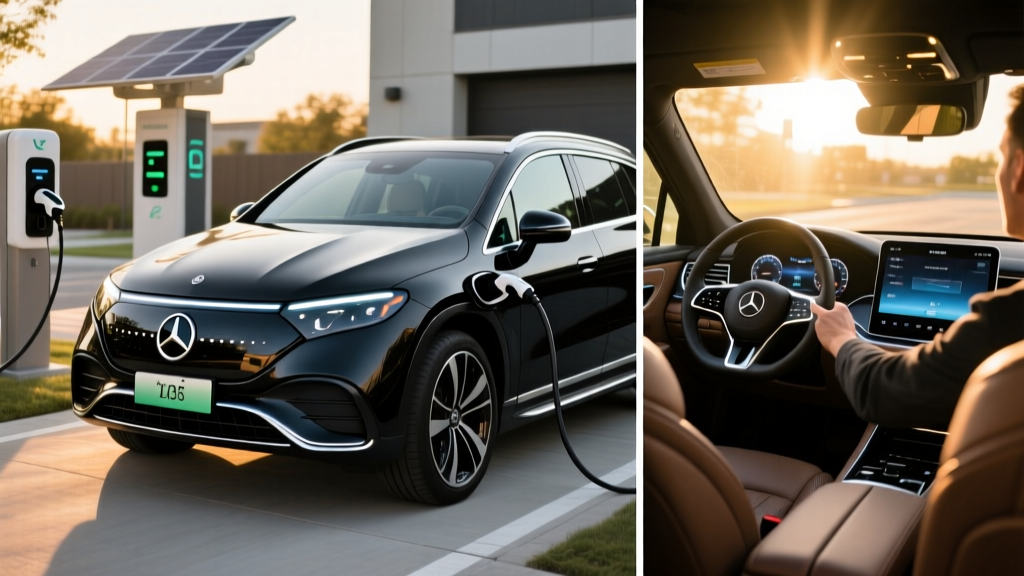
The 2026 EQS SUV supports a peak DC fast-charge rate of 200 kW via its CCS1 port (a NACS adapter is available for Tesla Supercharger access). Mercedes quotes a 10–80% charge time of approximately 31 minutes under ideal conditions — battery preconditioned, ambient temperature moderate, charger capable.
| Level | Max Power | Charge Time / Rate | Notes |
|---|---|---|---|
| Level 1 (120V) | ~1.4 kW | ~2–3 mi/hr | Emergency trickle only; full charge takes days |
| Level 2 (240V, 48A) | 11.5 kW (onboard charger) | ~24 mi/hr; 0–100% in ~12 hr | Standard home solution; overnight-ready |
| DC Fast Charge | 200 kW peak | 10–80% in ~31 min | Sustained rate tapers significantly above 60% SoC |
Charging-curve reality check: The 200 kW peak is achievable roughly between 10–40% state of charge. Beyond 60%, the curve tapers sharply — you'll see 100 kW or less past 70%, and sub-50 kW above 85%. This is typical for large NMC packs but means the last 20% takes nearly as long as the first 50%. For road trips, plan stops around the 15–75% window for the fastest throughput.
For home Level 2 charging, the 11.5 kW onboard charger is a strong point. A full overnight charge from near-empty is realistic with a standard 48-amp hardwired wallbox. Expect roughly $1,500–$3,000 for a quality Level 2 home installation (equipment + licensed electrician + permit), depending on your panel capacity and run distance.
Performance and Drivetrain
| Trim | Motor Config | Horsepower | Torque (lb-ft) | 0–60 mph | Top Speed |
|---|---|---|---|---|---|
| EQS 450+ SUV | Single motor (RWD) | 355 hp | 419 | 6.5 sec | 130 mph |
| EQS 450 4MATIC | Dual motor (AWD) | 355 hp | 590 | 5.3 sec | 130 mph |
| EQS 580 4MATIC | Dual motor (AWD) | 536 hp | 633 | 4.3 sec | 130 mph |
The 450 4MATIC is the sweet spot for most buyers — you gain all-weather traction and meaningful torque without the efficiency penalty of the 580's higher-output motors. The 580 is thrilling for a vehicle this size but shaves range and adds cost. All trims use Mercedes' adaptive air suspension with automatic level control, which delivers a genuinely plush ride quality that outclasses the firmer BMW iX.
Towing capacity is rated at 3,500 pounds across the lineup when properly equipped — adequate for a small boat or utility trailer but not a large camper. If you need serious towing, look at the Rivian R1S or Tesla Model X.
Interior, Cargo, and Technology
The EQS SUV's cabin is where the six-figure price tag earns its keep. Standard equipment includes the MBUX Hyperscreen — a 56-inch curved glass panel spanning the full dashboard width — combining a 12.3-inch instrument cluster, 17.7-inch central OLED, and 12.3-inch passenger display. The system runs Mercedes' latest MBUX generation with wireless Apple CarPlay and Android Auto, over-the-air updates, and a reasonably responsive voice assistant ("Hey Mercedes").
Passenger space:
- Front headroom: 40.4 in | legroom: 39.5 in
- Second-row headroom: 38.8 in | legroom: 40.9 in
- Third-row headroom: 37.5 in | legroom: 28.5 in (best for children or short trips)
Cargo volume:
- Behind third row: 14.4 cu ft
- Behind second row (third row folded): 44.2 cu ft
- Max (both rear rows folded): 74.2 cu ft
The third row is genuinely usable for adults on short drives — an advantage over the two-row BMW iX and Audi Q8 e-tron. However, the Rivian R1S offers more third-row space and significantly more cargo volume. The EQS SUV does not have a frunk; the under-hood area houses HVAC and electronics components.
Driver assistance: All 2026 EQS SUVs come standard with Mercedes' Driver Assistance Package, which includes adaptive cruise control with stop-and-go, active lane-keeping, blind-spot assist, and evasive steering assist. The optional Drive Pilot system is SAE Level 3 (conditional automation) in approved conditions — currently limited to specific highways in Nevada and California at speeds up to 40 mph in heavy traffic. This is genuine hands-off, eyes-off driving in traffic jams, but it's a narrow use case, not a full self-driving system.
SAE Automation Level: What Drive Pilot Actually Does
Mercedes Drive Pilot is SAE Level 3 — the vehicle handles all driving tasks in approved conditions (mapped divided highways, under 40 mph, clear weather), and the driver can disengage attention. Outside those conditions, the system defaults to Level 2 (hands-on, eyes-on supervision required). This is not a robotaxi — it's a traffic-jam companion with strict operational limits. Mercedes assumes liability when Level 3 is active and conditions are met.
Pricing, Trims, and Federal Tax Credit Eligibility
| Trim | Base MSRP | Destination | As-Tested (Typical Options) | Federal §30D Credit Eligible? |
|---|---|---|---|---|
| EQS 450+ SUV | $104,400 | $1,150 | $112,000–$118,000 | No — exceeds $80,000 SUV MSRP cap |
| EQS 450 4MATIC SUV | $107,400 | $1,150 | $115,000–$125,000 | No — exceeds $80,000 SUV MSRP cap |
| EQS 580 4MATIC SUV | $125,950 | $1,150 | $135,000–$148,000 | No — exceeds $80,000 SUV MSRP cap |
Federal tax credit reality: Under IRS §30D rules, SUVs must have a base MSRP of $80,000 or less to qualify for the up-to-$7,500 new clean vehicle credit. Every 2026 EQS SUV trim exceeds this cap. Additionally, buyer income limits apply ($300,000 joint / $150,000 single filer modified AGI), and the vehicle must meet critical-mineral and battery-component sourcing requirements. The EQS SUV does not qualify for the federal credit in any configuration.
Some buyers may find relief through state-level incentives (check your local DMV or energy office — these vary by jurisdiction and change frequently) or through Mercedes-Benz's occasional loyalty/lease incentives, which effectively reduce monthly cost without relying on federal credits. Consult a tax professional for your specific situation.
Warranty and Long-Term Ownership
Mercedes backs the 2026 EQS SUV with:
- New-vehicle limited warranty: 4 years / 50,000 miles
- High-voltage battery warranty: 8 years / 100,000 miles (guarantees minimum 70% state-of-health retention)
- Powertrain (e-motors, reduction gear): Covered under 4-year/50,000-mile new-vehicle warranty
- Roadside assistance: 4 years / 50,000 miles
The 8-year/100,000-mile battery warranty is industry-standard, matching Tesla, BMW, and Hyundai/Kia. The 70% SoH threshold means Mercedes will repair or replace the pack if it degrades below that capacity within the warranty period. Based on NMC degradation data from similar Mercedes packs (the EQS sedan), owners can expect approximately 85–90% SoH at 100,000 miles under normal use — well above the warranty floor. Avoid repeated DC fast-charging to 100% and prolonged storage at extreme SoC levels to maximize longevity.
Out-of-warranty battery replacement for a pack this size is estimated at $20,000–$30,000+ at current pricing — a factor for second- and third-owners. Depreciation on the EQS SUV is steep: expect 45–55% value loss within three years, which hurts original purchasers but creates compelling used-market opportunities.
Who the 2026 EQS SUV Is For — and Who Should Look Elsewhere
Choose the 2026 EQS SUV If:
- You prioritize ride comfort and cabin quietness over sporty handling
- You need a usable third row in an electric SUV
- Most of your driving is suburban/commuter with occasional 250-mile road trips
- You have reliable home Level 2 charging and don't rely on public DC infrastructure daily
- Budget is secondary to luxury execution
Look Elsewhere If:
- You want the fastest DC charging in the segment — the Hyundai Ioniq 9 and Kia EV9 charge faster at ~350 kW
- You need serious towing capacity (Rivian R1S: 7,700 lb)
- You want a federal tax credit — no EQS SUV trim qualifies
- Driving dynamics matter — the BMW iX M60 is sharper on back roads
- You're budget-conscious — the Genesis Electrified GV70 or Cadillac Lyriq deliver luxury at $20,000–$40,000 less
Pros
- Class-leading ride quality with standard air suspension
- Genuinely usable third row for a luxury EV SUV
- Massive 118 kWh battery delivers confident 280+ mile real-world range
- MBUX Hyperscreen is visually stunning and increasingly responsive
- Drive Pilot Level 3 is a real differentiator in approved conditions
- Excellent cabin isolation — among the quietest EVs on the market
Cons
- No federal tax credit eligibility (MSRP cap exceeded)
- 200 kW peak DC charging trails newer 800V competitors
- Heavy depreciation — painful for original purchasers
- No front trunk (frunk) despite the vehicle's size
- Third-row cargo space is tight at 14.4 cu ft
- Touch-sensitive controls on steering wheel frustrate some drivers
Frequently Asked Questions
What is the real-world range of the 2026 Mercedes EQS SUV?
In mixed driving at moderate temperatures, expect 250–280 miles from the 450+ RWD trim and 240–265 miles from the 580 4MATIC. Highway-only driving at 75 mph drops that to roughly 240–260 miles (450+) or 220–245 miles (580). In sustained cold below freezing, plan for 200–230 miles. The EPA rates these trims at 305 and 285 miles respectively, but real-world conditions rarely match the test cycle perfectly.
How fast does the 2026 EQS SUV charge at home and on the road?
On a DC fast charger, it peaks at 200 kW and reaches 10–80% in approximately 31 minutes with a preconditioned battery. At home on a Level 2 (240V, 48A) charger, the 11.5 kW onboard charger adds about 24 miles of range per hour, meaning a full overnight charge from near-empty takes roughly 12 hours. Level 1 (120V) is a trickle at ~2–3 miles per hour and only practical for topping off.
Does the 2026 EQS SUV qualify for the $7,500 federal EV tax credit?
No. Under current IRS §30D rules, SUVs must have a manufacturer's suggested retail price at or below $80,000 to be eligible. The least expensive EQS SUV trim starts at $104,400, disqualifying the entire lineup. Buyer income limits and battery-sourcing requirements are additional barriers, but the MSRP cap alone is the disqualifier here. Check your state's incentive programs for possible local credits.
Is the 2026 EQS SUV worth buying over the BMW iX or Tesla Model X?
It depends on your priorities. The EQS SUV wins on ride comfort, cabin quietness, and third-row usability. The BMW iX xDrive50 offers sportier handling, faster charging (up to ~200 kW but on a lighter, more efficient platform), and starts around $87,000 — still above the credit cap but meaningfully less expensive. The Tesla Model X offers the fastest acceleration, access to the Supercharger network natively, and gull-wing rear doors, but its interior quality and ride comfort don't match the Mercedes. If luxury execution is paramount, the EQS SUV earns its price. If value or driving dynamics lead your list, the iX is the stronger pick.
What's the biggest drawback of owning the 2026 EQS SUV?
Depreciation is the most painful ownership cost. Luxury EVs in this price tier lose 45–55% of their value within three years, meaning a $120,000 purchase could be worth $55,000–$65,000 at trade-in time. Combined with no federal tax credit offset, the total cost of ownership is steep for first owners. Second- and third-owners benefit enormously from this depreciation curve, getting a nearly-new luxury EV at a fraction of the original cost.
Can I use Tesla Superchargers with the 2026 EQS SUV?
Yes, with a NACS adapter. The EQS SUV ships with a CCS1 inlet, but Mercedes offers a CCS-to-NACS adapter that enables access to Tesla's Supercharger network (V3 and V4 stalls). Charging speed will be limited by the EQS SUV's 200 kW peak and the adapter's throughput, but it dramatically expands your road-trip charging options, especially in regions where Electrify America or EVgo coverage is sparse.