Quick Verdict: The Performance EV That Still Makes Daily Sense
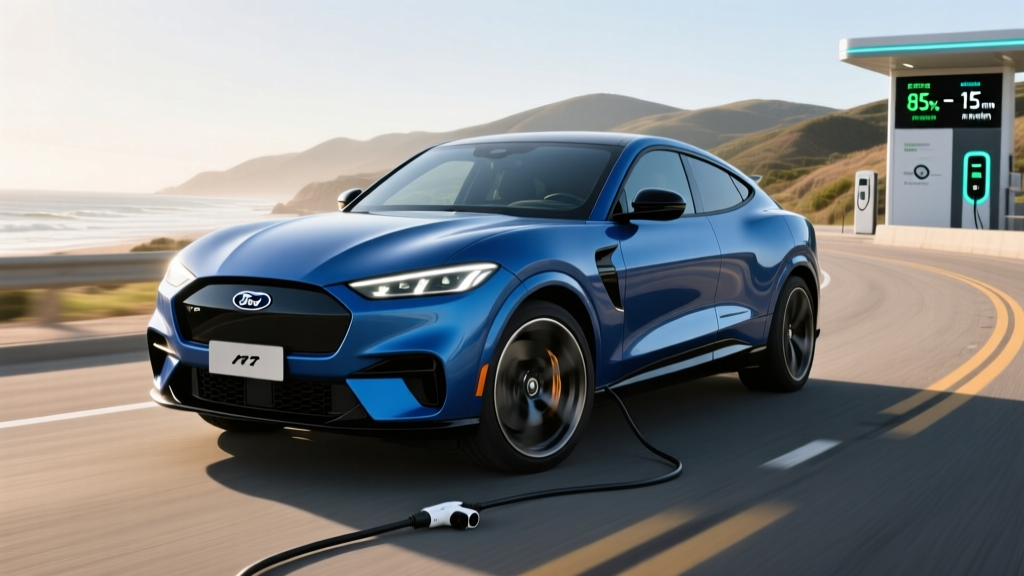
The 2026 Ford Mustang Mach-E GT occupies a rare position in the electric crossover market: it delivers genuine sports-sedan acceleration while maintaining the cargo space, charging convenience, and price point that actual buyers need. With 480 horsepower, a 280-mile EPA range estimate, and DC fast charging that peaks at 150 kW, the GT trim answers the question of whether you can have a thrill machine that also handles school runs and road trips. After spending time with the 2026 model, the answer is yes — with a few caveats around real-world highway range and charging-curve taper that every buyer should understand before signing.
Range and Efficiency: What the EPA Sticker Doesn't Tell You
The 2026 Mach-E GT carries a 91 kWh usable lithium-ion battery pack (NMC chemistry) and earns an EPA-estimated range of 280 miles on the extended-range AWD configuration. That figure drops to approximately 265 miles for the GT Performance Edition, which adds stickier summer tires and more aggressive tuning that increase rolling resistance.
EPA Estimate: 280 miles (GT AWD Extended Range)
Highway Driving (70-80 mph): Expect 230-250 miles. The GT's dual-motor AWD system and performance-oriented drivetrain consume more energy at sustained high speeds than single-motor competitors.
Cold Weather (below 32°F): Plan for 190-220 miles. The Mach-E GT lacks a standard heat pump in all trims (resistance heating is standard), which increases cabin-heating energy draw in winter. Battery preconditioning helps but doesn't eliminate cold-weather losses.
Mixed Commuting (city/suburban): 260-280 miles is achievable, with regenerative braking recovering energy in stop-and-go traffic.
Efficiency ratings land at 84 MPGe combined (city/highway) according to fueleconomy.gov, which translates to approximately 34 kWh per 100 miles. That's competitive with the Tesla Model Y Performance (90 MPGe) but trails the Hyundai Ioniq 5's single-motor variants (114 MPGe). The GT prioritizes power over efficiency, and the numbers reflect that trade-off.
Charging Speed: DC Fast, Level 2, and the 80% Taper
The 2026 Mach-E GT supports DC fast charging at a peak rate of 150 kW via its CCS1 connector (Ford has not adopted NACS for the 2026 model year, though a NACS adapter is available for Supercharger access). On a 150 kW or higher charger, the GT can add approximately 60 miles of range in 10 minutes under optimal conditions — meaning a warm battery, low state of charge, and a charger that can sustain peak power delivery.
| Charging Level | Power (kW) | Charging Speed | Time to Full |
|---|---|---|---|
| Level 1 (120V household) | 1.4 kW | ~3 miles per hour | ~90 hours (10-100%) |
| Level 2 (240V home, 32A) | 7.7 kW | ~21 miles per hour | ~12 hours (10-100%) |
| Level 2 (240V home, 48A) | 11.5 kW | ~31 miles per hour | ~8.5 hours (10-100%) |
| DC Fast (150 kW peak) | 150 kW (peak) | ~60 miles in 10 min | ~45 min (10-80%) |
The 10-80% DC fast-charge time of approximately 45 minutes reflects the GT's charging curve reality: peak 150 kW is only sustained between roughly 10-40% state of charge. Above 60%, the charge rate tapers significantly to protect battery longevity, dropping to 50-70 kW by the time you reach 80%. This is standard behavior for NMC chemistry batteries, but it means that the final 20% of charging takes nearly as long as the first 60%. For road trips, plan to charge to 80% and drive rather than waiting for a full battery.
Home Level 2 charging requires a 240-volt circuit. The Ford Mobile Power Cord (included) delivers 7.7 kW on a 32-amp circuit, adding about 21 miles of range per hour. For faster overnight charging, the Ford Connected Charge Station (48-amp, $599 plus installation) delivers 11.5 kW and 31 miles per hour. Expect to pay $500-$1,500 for professional Level 2 installation depending on your electrical panel capacity and distance from the panel to your parking spot — and potentially $2,000-$4,000 more if your home requires a 200-amp service upgrade.
Performance: 480 Horsepower, 3.5-Second 0-60, and AWD Grip
The 2026 Mach-E GT's dual-motor all-wheel-drive powertrain produces 480 horsepower and 634 lb-ft of torque in standard GT trim. The GT Performance Edition bumps torque to 634 lb-ft (horsepower remains 480) and adds a Performance Braking Package with larger front rotors and Brembo calipers. The result is a 0-60 mph time of 3.5 seconds for the GT and 3.3 seconds for the GT Performance Edition, according to Ford's testing.
| Specification | 2026 Mach-E GT | 2026 Mach-E GT Performance Edition |
|---|---|---|
| Powertrain | Dual-motor AWD | Dual-motor AWD |
| Horsepower | 480 hp | 480 hp |
| Torque | 634 lb-ft | 634 lb-ft |
| 0-60 mph | 3.5 seconds | 3.3 seconds |
| Battery (usable) | 91 kWh NMC | 91 kWh NMC |
| EPA Range | 280 miles | 265 miles |
| MPGe (combined) | 84 MPGe | 81 MPGe |
| Top Speed | 124 mph | 130 mph |
| Towing Capacity | Not rated | Not rated |
On the road, the GT's acceleration is immediate and relentless — the kind of torque delivery that makes merging onto highways effortless and passing maneuvers instantaneous. The AWD system provides confident grip in wet and light snow conditions, though the GT's performance-tuned suspension (stiffer than standard Mach-E trims) trades some ride comfort for cornering composure. The GT Performance Edition's MagneRide adaptive dampers (standard on that trim, optional on base GT) help mitigate this by allowing adjustable firmness, but the GT is never as plush over rough pavement as a Hyundai Ioniq 5 or Tesla Model Y.
One-pedal driving is available and effective, with regenerative braking strong enough to bring the GT to a complete stop without touching the friction brakes in most city driving. The brake pedal feel is firm and predictable — a common weak point in EVs that Ford has addressed well here.
Interior, Cargo, and Technology
The 2026 Mach-E GT's cabin is driver-focused with a 10.2-inch digital instrument cluster and a massive 15.5-inch vertically oriented touchscreen running Ford's SYNC 4A infotainment system. Wireless Apple CarPlay and Android Auto are standard, as is wireless phone charging. The GT trim adds ActiveX synthetic leather seating surfaces (heated and ventilated front seats), a panoramic fixed glass roof, and a 10-speaker B&O sound system.
Passenger space is generous for a performance crossover: front legroom measures 43.3 inches, rear legroom is 38.9 inches, and rear headroom is 38.1 inches despite the sloping roofline. Two adults in the rear seats will be comfortable on long trips; three across is tight for adults but workable for children.
Cargo capacity behind the rear seats is 29.7 cubic feet, expanding to 59.7 cubic feet with the rear seats folded (60/40 split). The front trunk (frunk) adds 4.7 cubic feet of lockable storage — useful for charging cables, gym bags, or groceries you want to keep separate from the main cargo area. The frunk includes a drain plug, making it suitable for ice and beverages on tailgating outings.
Driver-assistance technology includes Ford Co-Pilot360 2.0 as standard: automatic emergency braking with pedestrian detection, blind-spot monitoring with cross-traffic alert, lane-keeping assist, and rear parking sensors. The available BlueCruise hands-free driving system (SAE Level 2 — not self-driving; the driver must remain attentive and ready to take over) allows hands-off operation on pre-mapped divided highways. BlueCruise works well on long interstate drives but requires the driver to keep eyes on the road, with a driver-monitoring camera that will issue warnings and eventually disengage the system if attention drifts. BlueCruise requires a subscription after the initial trial period (currently $75/month or $800/year after the first 90 days free).
Pricing, Trims, and Federal Tax Credit Eligibility
The 2026 Ford Mustang Mach-E GT starts at an MSRP of $59,995 (including destination charge). The GT Performance Edition lists at $65,995. These prices place the GT above the federal tax credit MSRP cap for SUVs ($80,000), meaning the GT does qualify for the full $7,500 §30D federal tax credit — assuming the buyer meets income requirements and the vehicle's battery components satisfy critical-mineral and battery-sourcing rules.
| Trim | Base MSRP | As-Tested Price* | After $7,500 Credit |
|---|---|---|---|
| GT AWD Extended Range | $59,995 | $62,590 (with BlueCruise, Red Metallic paint) | $55,090 |
| GT Performance Edition | $65,995 | $67,490 (with Elixir Red brake calipers, panoramic roof) | $59,990 |
*As-tested pricing reflects typical option packages; your configuration may vary.
- Vehicle MSRP Cap: Must be $80,000 or less for SUVs/crossovers (Mach-E GT qualifies)
- Buyer Income Cap: Modified adjusted gross income must not exceed $300,000 (married filing jointly), $225,000 (head of household), or $150,000 (single filer)
- Battery Sourcing: Minimum percentage of battery critical minerals must be extracted or processed in the U.S. or a free-trade-agreement country; battery components must be manufactured or assembled in North America (percentage thresholds increase annually through 2029)
- Point-of-Sale Transfer: Buyers can transfer the credit to the dealer at purchase, reducing the purchase price by $7,500 upfront rather than waiting to claim it on tax returns
- Final Assembly: Vehicle must undergo final assembly in North America (Mach-E is assembled in Cuautitlán, Mexico — verify VIN eligibility at irs.gov before purchase)
Critical note: The Mach-E is built in Mexico, not the U.S. Under current §30D rules, final assembly in North America (including Mexico) satisfies the assembly requirement, but battery component and critical mineral sourcing rules are strict and change annually. As of early 2026, Ford has confirmed that the Mach-E GT with the extended-range battery qualifies for the full $7,500 credit, but buyers should verify their specific VIN's eligibility using the IRS's online tool at fueleconomy.gov before finalizing a purchase. Tax professionals can provide guidance on individual eligibility.
Warranty and Long-Term Ownership
Ford backs the 2026 Mach-E GT with a 3-year/36,000-mile bumper-to-bumper limited warranty and an 8-year/100,000-mile battery and powertrain warranty. The battery warranty guarantees that the high-voltage pack will retain at least 70% of its original capacity during the coverage period; if degradation exceeds 30%, Ford will repair or replace the battery at no cost. This is industry-standard and matches Tesla, Hyundai, and Chevrolet's EV battery coverage.
Real-world battery degradation data for the Mach-E (which launched for the 2021 model year) suggests that most owners see 5-8% capacity loss over the first 100,000 miles, with NMC chemistry batteries stabilizing after the initial break-in period. Proper charging habits — avoiding frequent 100% charges, using DC fast charging sparingly, and leveraging the battery preconditioning feature before fast charging — can minimize long-term degradation.
Insurance costs for the Mach-E GT are higher than average for the EV segment. Expect to pay $2,200-$2,800 annually depending on your location, driving record, and coverage levels. The GT's performance classification and $60,000+ MSRP contribute to elevated premiums compared to a base Mach-E Select or a Tesla Model Y.
Pros, Cons, and Who Should Buy the 2026 Mach-E GT
- 3.5-second 0-60 mph acceleration with dual-motor AWD grip
- 280-mile EPA range is practical for road trips and commuting
- 150 kW DC fast charging adds 60 miles in 10 minutes
- Generous cargo space (29.7 cu ft rear, 4.7 cu ft frunk)
- BlueCruise hands-free driving is effective on highways
- Qualifies for $7,500 federal tax credit (verify VIN eligibility)
- Comfortable, well-insulated cabin with quality materials
- Real-world highway range drops to 230-250 miles at 75+ mph
- Cold-weather range loss is significant without a heat pump
- Performance-tuned suspension is firm over rough roads
- BlueCruise requires ongoing subscription ($75/month after trial)
- Insurance premiums are elevated for the GT trim
- Charging curve tapers heavily above 60% state of charge
- CCS1 connector (no native NACS; adapter required for Superchargers)
Who the 2026 Mach-E GT suits best: Performance-oriented drivers who want sports-sedan acceleration in a practical crossover package. The GT is ideal for enthusiasts who commute daily, take occasional road trips (280-mile range handles most routes with one DC fast-charge stop), and need cargo space for family gear or weekend projects. It's less ideal for buyers in extreme cold climates (where range loss is steep) or those who prioritize ride comfort over handling precision. If you want maximum efficiency over performance, the single-motor Mach-E Select or a Hyundai Ioniq 5 will deliver more miles per kWh.
Competitive Comparison: Mach-E GT vs. Model Y Performance vs. Ioniq 5 N
The Mach-E GT's direct competitors include the Tesla Model Y Performance (303-mile EPA range, 3.5-second 0-60, ~$54,990 base) and the Hyundai Ioniq 5 N (280-mile range, 3.25-second 0-60, ~$67,500 base). The Model Y offers slightly better range and access to the Supercharger network (though Mach-E owners can use Superchargers with a NACS adapter). The Ioniq 5 N is more track-focused with simulated gear shifts and launch control, but it sacrifices range and daily usability. The Mach-E GT splits the difference: it's more comfortable than the Ioniq 5 N on daily commutes and more engaging to drive than the Model Y on back roads, while offering comparable performance numbers.
FAQ: 2026 Ford Mustang Mach-E GT
What is the real-world range of the 2026 Mach-E GT?
The EPA estimates 280 miles for the GT AWD Extended Range, but real-world highway driving at 70-80 mph yields 230-250 miles. Cold weather (below freezing) can reduce range to 190-220 miles due to battery chemistry limitations and cabin heating demands. City and suburban driving with regenerative braking can approach the EPA sticker.
How fast does the Mach-E GT charge at home and on DC fast chargers?
DC fast charging peaks at 150 kW, adding approximately 60 miles in 10 minutes and reaching 80% in about 45 minutes. Home Level 2 charging on a 48-amp, 240-volt circuit delivers 11.5 kW and adds 31 miles per hour, fully charging the 91 kWh battery in roughly 8.5 hours. Level 1 (120V) charging is too slow for daily use, adding only 3 miles per hour.
Does the 2026 Mach-E GT qualify for the $7,500 federal EV tax credit?
Yes, the Mach-E GT qualifies under current §30D rules, provided the buyer's income is below the cap ($150,000 single / $300,000 joint), the vehicle's MSRP is under $80,000 (it is), and the battery meets critical-mineral and component-sourcing requirements. The credit can be transferred to the dealer at point of sale, reducing your purchase price by $7,500 upfront. Verify your VIN's eligibility at fueleconomy.gov before purchase.
Is the Mach-E GT worth buying over the Tesla Model Y Performance?
Choose the Mach-E GT if you prefer Ford's build quality, want BlueCruise hands-free driving, and value the frunk and cargo versatility. Choose the Model Y if you prioritize maximum range (303 vs. 280 miles), want native Supercharger access without an adapter, or prefer Tesla's over-the-air update ecosystem. Both deliver 3.5-second 0-60 performance; the decision comes down to brand preference, charging network priorities, and interior design taste.
Does the Mach-E GT have a heat pump for cold-weather efficiency?
No. The 2026 Mach-E GT uses resistance heating for cabin warmth, which consumes more battery energy in cold weather than a heat pump system would. This contributes to the GT's significant cold-weather range loss (30-40% below EPA estimates in sub-freezing temperatures). Competitors like the Hyundai Ioniq 5 and Tesla Model Y include heat pumps as standard.
What is the warranty coverage on the Mach-E GT's battery?
Ford provides an 8-year/100,000-mile warranty on the high-voltage battery pack and electric powertrain components. The warranty guarantees the battery will retain at least 70% of its original capacity; if degradation exceeds 30%, Ford will repair or replace the battery. This is standard for the EV industry and matches Tesla, Hyundai, and Chevrolet's coverage.