Quick Verdict: The 2026 Mach-E Gets Smarter Storage
The 2026 Ford Mustang Mach-E arrives with a meaningful update that crossover shoppers have been requesting: a redesigned front trunk (frunk) with improved capacity, a standard drain plug, and an available weatherproof cargo organizer. The 2026 Mach-E frunk option transforms what was already a practical 4.7-cubic-foot compartment into a more versatile storage zone — ideal for wet gear, groceries, or charging cables. But the frunk is just one piece of the puzzle. The Mach-E continues to offer competitive EPA range, strong DC fast-charging speeds, and a refined driving experience that keeps it relevant against the Tesla Model Y, Hyundai Ioniq 5, and Chevrolet Blazer EV.
Below, we break down every number that matters — from real-world range and charging curves to pricing and tax credit eligibility — so you can decide if the 2026 Mach-E earns a spot in your driveway.
Range, Battery, and Real-World Efficiency
The 2026 Mustang Mach-E carries over the two battery pack sizes introduced in recent model years. The Standard Range pack uses a 75.7 kWh (usable) lithium-ion NMC (nickel manganese cobalt) battery, while the Extended Range pack bumps capacity to 91 kWh usable, also NMC chemistry. Ford has not adopted LFP (lithium iron phosphate) for the Mach-E as of this model year, meaning you get higher energy density but should follow the typical 20-80% daily charge recommendation to maximize long-term battery health.
| Spec | Standard Range | Extended Range | GT (Extended Range) |
|---|---|---|---|
| EPA Range | 250 mi | 320 mi | 290 mi |
| Battery (usable) | 75.7 kWh (NMC) | 91 kWh (NMC) | 91 kWh (NMC) |
| Drivetrain | RWD or eAWD | RWD or eAWD | eAWD (Dual-Motor) |
| Horsepower | 266 hp (RWD) / 312 hp (eAWD) | 290 hp (RWD) / 346 hp (eAWD) | 480 hp |
| 0-60 mph | 6.1s (RWD) / 5.2s (eAWD) | 5.8s (RWD) / 5.0s (eAWD) | 3.5s |
| MPGe (combined) | 101 MPGe | 101 MPGe | 84 MPGe |
| Efficiency | 33 kWh/100mi | 33 kWh/100mi | 40 kWh/100mi |
| Max DC Fast Charge | 150 kW | 150 kW | 150 kW |
| 10-80% DC Charge | ~36 min | ~41 min | ~41 min |
| Level 2 Home Charge | 10.5 kW (~30 mi/hr) | 10.5 kW (~30 mi/hr) | 10.5 kW (~30 mi/hr) |
The EPA rates the Extended Range RWD at 320 miles, but expect ~265-285 miles on sustained highway driving at 70-75 mph. In cold weather (below 30°F), range can drop 20-30%, bringing a fully charged Extended Range model down to roughly 220-250 miles. City driving with regenerative braking recovers closer to the sticker number. The Standard Range eAWD typically delivers 210-230 miles in mixed driving. Plan road trips around 200-mile legs for comfort.
According to fueleconomy.gov, the Mach-E Extended Range RWD achieves 101 MPGe combined, translating to 33 kWh per 100 miles — competitive with the segment but trailing the Hyundai Ioniq 5's superior efficiency.
Charging Speed: DC Fast and Home Level 2
The Mach-E peaks at 150 kW on DC fast chargers via its CCS connector (Ford has confirmed NACS adapter compatibility for Tesla Supercharger access). At 150 kW, the charge curve is strongest between 10-50% SoC, then tapers progressively. The 10-80% charge takes approximately 36-41 minutes depending on battery size and ambient temperature. Preconditioning — enabled automatically when you navigate to a charger via the infotainment system — warms the battery to optimize charge acceptance and can shave several minutes off your stop.
| Charge Level | Power (kW) | Miles Added per Hour | Full Charge Time |
|---|---|---|---|
| Level 1 (120V household) | ~1.4 kW | ~3 mi/hr | ~65 hr (Extended Range) |
| Level 2 (240V, 48A) | 10.5 kW | ~30 mi/hr | ~9 hr (Extended Range) |
| DC Fast Charge | Up to 150 kW | ~210 mi/hr (peak) | 10-80% in ~36-41 min |
At home on a Level 2 charger, the Mach-E's 10.5 kW onboard charger replenishes the Extended Range pack in roughly 9 hours — adequate for overnight charging. Ford's Mobile Power Cord comes with the vehicle and supports both 120V and 240V outlets, though a dedicated wall-mounted Level 2 station (like the Ford Charge Station Pro or a third-party unit) is strongly recommended for daily use. Budget $500-$1,500 for a quality Level 2 home charger and $800-$2,500 for professional installation depending on your electrical panel's capacity.
The 2026 Mach-E Frunk Option: What's New
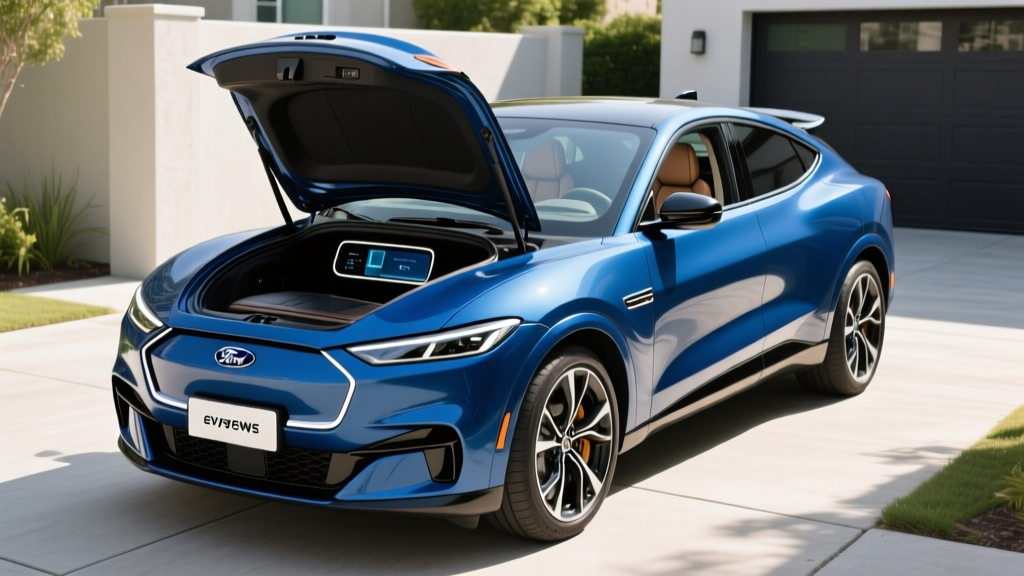
The headline update for 2026 is the available frunk cargo organizer and all-weather liner package. The Mach-E's front trunk has always offered 4.7 cubic feet of space — enough for a charging cable bag, a small cooler, or a couple of backpacks — but the 2026 option adds:
- Molded all-weather liner with integrated drain plug (wash out mud, sand, or melted ice)
- Divided cargo organizer with removable partitions for groceries, tools, or gym gear
- LED cargo light upgrade for nighttime visibility
- 12V power outlet in the frunk (available with the Convenience Package) for powering accessories or a small cooler
The frunk itself is power-operated via the key fob, FordPass app, or interior button — a feature that continues to set the Mach-E apart from competitors like the Tesla Model Y (which has no power frunk latch on most trims). The drain plug makes the frunk genuinely useful as an ice chest for tailgating, a wet-gear bin for kayaking trips, or simply a hose-out zone after messy errands.
The frunk option package is available across all trims for approximately $295 as a dealer-installed accessory, while the 12V outlet requires the Convenience Package ($495). Total frunk cargo dimensions remain 4.7 cu ft with a flat load floor roughly 22 inches deep.
Cargo Space, Interior, and Tech
Beyond the frunk, the Mach-E offers 29.7 cubic feet of rear cargo space behind the second row and 59.7 cu ft with the rear seats folded — competitive with midsize electric crossovers. Rear legroom measures 38.9 inches, and front headroom is a generous 40.4 inches thanks to the panoramic glass roof (standard on Premium and GT trims).
The centerpiece of the interior remains the 15.5-inch vertical touchscreen running Ford's SYNC 4A system with wireless Apple CarPlay and Android Auto. The interface is responsive, and the physical volume knob at the bottom of the screen is a welcome ergonomic touch. Available features include:
- Ford Co-Pilot360 Active 2.0 (BlueCruise) — hands-free highway driving on pre-mapped divided highways (SAE Level 2 — driver must remain attentive)
- Phone-as-a-Key via Bluetooth on your smartphone
- Over-the-air (OTA) updates for software and feature additions
- Available B&O 10-speaker sound system
- Heated and ventilated front seats (Premium and GT)
Ford's BlueCruise is an SAE Level 2 driver-assistance system. It allows hands-free operation on approved highway sections, but the driver must remain alert, monitor the road, and be ready to take over instantly. A driver-facing camera monitors your attention. This is not Level 4 autonomy — you are always responsible for the vehicle.
Pricing, Trims, and Federal Tax Credit
The 2026 Mustang Mach-E lineup starts at $42,995 for the Select trim with Standard Range RWD and climbs to $62,995 for the GT with Extended Range eAWD. Here's the full trim breakdown:
| Trim | Battery / Drivetrain | Base MSRP | Est. §30D Credit* | Effective Price |
|---|---|---|---|---|
| Select | Std Range / RWD | $42,995 | Up to $3,750 | ~$39,245 |
| Premium | Ext Range / RWD | $48,995 | Up to $3,750 | ~$45,245 |
| Premium | Ext Range / eAWD | $51,995 | Up to $3,750 | ~$48,245 |
| GT | Ext Range / eAWD | $62,995 | Up to $3,750 | ~$59,245 |
*Federal tax credit amounts shown are estimates based on the IRS §30D rules current for 2026. The full $7,500 credit requires meeting both critical-mineral and battery-component sourcing thresholds; the Mach-E has historically qualified for a partial credit ($3,750) due to battery sourcing. Credit eligibility also depends on buyer income caps ($150,000 single / $300,000 joint) and the vehicle's MSRP being under $80,000 for SUVs/crossovers. The credit can be transferred to the dealer as a point-of-sale discount. Always verify current eligibility on IRS.gov and consult a tax professional.
All Mach-E trims fall under the $80,000 MSRP cap for SUVs/crossovers, making them eligible in principle. The point-of-sale transfer option means you can apply the credit as an immediate price reduction at the dealership rather than waiting to claim it on your tax return.
Warranty and Ownership Costs
Ford backs the Mach-E with the following warranty coverage:
- Battery: 8 years / 100,000 miles (covers capacity below 70% of original)
- Electric powertrain components: 8 years / 100,000 miles
- Bumper-to-bumper: 3 years / 36,000 miles
- Corrosion perforation: 5 years / unlimited miles
The 70% battery capacity retention threshold is industry-standard, matching Hyundai and Tesla. In practice, NMC batteries in liquid-cooled packs like the Mach-E's have demonstrated 8-12% degradation over 100,000 miles based on owner-reported data, well within warranty limits. Ford covers roadside assistance for 5 years / 60,000 miles.
Insurance costs for the Mach-E average 15-25% higher than comparable gas-powered crossovers, driven by EV repair costs and parts pricing. Get quotes before purchasing. Maintenance savings are significant — no oil changes, fewer brake replacements (thanks to regenerative braking), and reduced drivetrain complexity.
Pros, Cons, and Competitor Comparison
- Power-operated frunk with new all-weather liner option
- Strong handling and ride quality for the segment
- BlueCruise hands-free highway capability
- Spacious rear seat (38.9" legroom)
- Competitive 320-mile EPA range (Extended Range RWD)
- NACS adapter enables Tesla Supercharger access
- 150 kW peak DC charge rate trails 350 kW rivals (Ioniq 5, EV6)
- 10-80% charge time of ~40 minutes is middling
- Partial federal tax credit ($3,750) due to battery sourcing
- GT trim's 84 MPGe hurts efficiency
- No LFP battery option for daily 100% charging flexibility
Vs. Tesla Model Y: The Model Y offers slightly more cargo space (30.2 cu ft rear), faster 250 kW DC charging, and a broader Supercharger network — but the Mach-E counters with a more conventional interior, physical controls, and a power frunk.
Vs. Hyundai Ioniq 5: The Ioniq 5 charges at up to 350 kW (10-80% in ~18 minutes on a capable charger) and offers an 800V architecture the Mach-E lacks. However, the Mach-E delivers a more car-like driving feel and BlueCruise availability.
Vs. Chevrolet Blazer EV: The Blazer EV undercuts on price but has faced software reliability issues. The Mach-E's SYNC 4A platform is more mature and its dealer network more EV-experienced.
- Choose the Mach-E if: You want a polished electric crossover with a power frunk, BlueCruise, and don't need the fastest DC charging in the segment.
- Look at the Ioniq 5 if: Road-trip charging speed is your top priority and you want 800V architecture.
- Look at the Model Y if: Maximum Supercharger access and cargo space matter most, and you're comfortable with Tesla's minimalist interior.
Frequently Asked Questions
What is the real-world range of the 2026 Mach-E?
The Extended Range RWD is EPA-rated at 320 miles, but expect 265-285 miles in real-world highway driving and as low as 220-250 miles in cold weather below 30°F. The Standard Range eAWD delivers roughly 210-230 miles in mixed use.
How fast does the 2026 Mach-E charge?
On DC fast chargers, the Mach-E peaks at 150 kW and charges from 10-80% in approximately 36-41 minutes. At home on Level 2 (10.5 kW), a full charge takes about 9 hours for the Extended Range battery. Level 1 (120V) adds only ~3 miles per hour.
Does the 2026 Mach-E qualify for the federal EV tax credit?
The Mach-E qualifies for a partial §30D federal credit — typically $3,750 — because it meets one of the two sourcing thresholds (critical minerals or battery components) but not both. Buyer income caps ($150K single / $300K joint) and the $80K SUV MSRP cap apply. Verify current rules at IRS.gov. The credit can be applied as a point-of-sale discount.
What's new about the 2026 Mach-E frunk option?
The 2026 frunk option adds an all-weather molded liner with a drain plug, a divided cargo organizer with removable partitions, and an available 12V power outlet. The frunk remains 4.7 cu ft and is power-operated via key fob, app, or interior button.
Is the 2026 Mach-E worth buying over the Tesla Model Y?
It depends on priorities. The Mach-E wins on interior quality, BlueCruise availability, and the power frunk. The Model Y wins on DC charging speed (250 kW vs. 150 kW), cargo volume, and Supercharger network breadth. Both are strong choices — test-drive both before deciding.
What is the Mach-E's battery warranty?
Ford covers the high-voltage battery for 8 years or 100,000 miles, guaranteeing at least 70% of original capacity retention. Electric powertrain components are covered on the same 8-year/100,000-mile term.