Quick Verdict: The 3-Row EV Benchmark for 2026
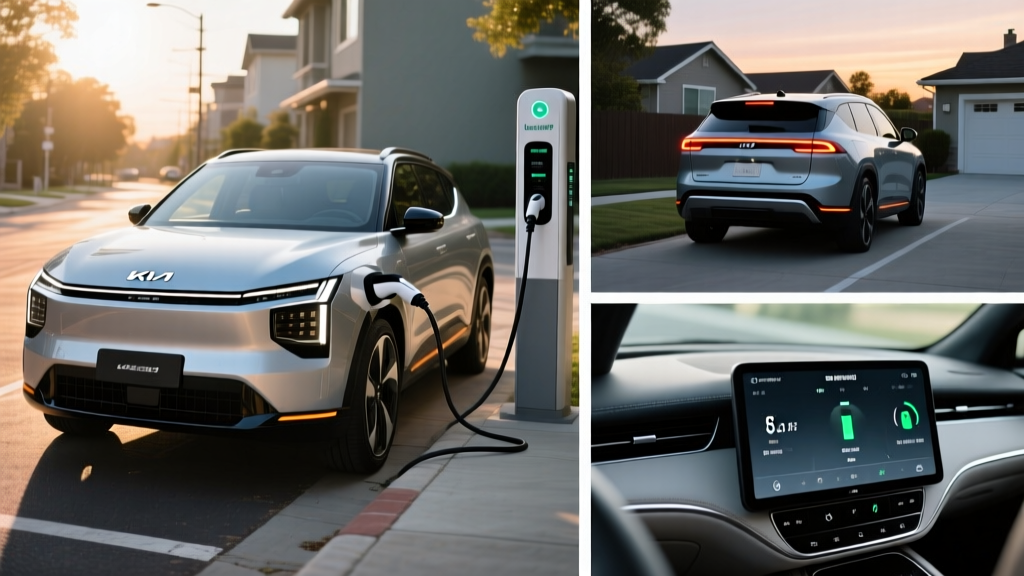
The 2026 Kia EV9 remains the only mainstream, purpose-built three-row electric SUV priced under $60,000 that doesn't force you into a luxury badge. Built on Hyundai Motor Group's E-GMP platform with an 800-volt electrical architecture, it delivers class-leading DC fast-charging speeds, usable third-row seating, and a real-world range profile that makes 300-mile road trips practical with one brief stop. After two model years on the market, Kia has refined the EV9's software and expanded the Light Long Range trim, making the entry point more compelling for buyers who prioritize range over all-wheel-drive traction.
The EV9 isn't perfect. Its efficiency drops noticeably at sustained highway speeds above 75 mph, the ride on 21-inch wheels can be firm over broken pavement, and second-row captain's chairs eliminate the six-seat bench option found in some competitors. But for families transitioning from a midsize gas SUV like the Toyota Highlander or Kia Telluride, the EV9 offers the lowest friction path to electrification without sacrificing passenger or cargo utility.
Range, Battery, and Real-World Efficiency
The 2026 EV9 is offered with two battery configurations. The Light RWD trim uses a 76.1 kWh usable lithium-ion NMC (nickel-manganese-cobalt) pack, while all Long Range trims step up to a 99.8 kWh usable NMC battery. Kia has not adopted LFP (lithium iron phosphate) chemistry for the EV9, prioritizing the higher energy density that NMC provides to keep curb weight manageable in a vehicle this size.
| Trim | Battery (kWh usable) | Chemistry | Drivetrain | EPA Range (mi) | MPGe (combined) | kWh/100 mi |
|---|---|---|---|---|---|---|
| Light RWD | 76.1 | NMC | RWD | 230 | 142 | 31 |
| Light Long Range RWD | 99.8 | NMC | RWD | 304 | 134 | 33 |
| Wind / Land / GT-Line AWD | 99.8 | NMC | AWD (dual-motor) | 280 | 122 | 37 |
The EPA rates the Long Range RWD at 304 miles, but expect ~250–270 miles at sustained 70–80 mph highway speeds in moderate temperatures. In cold weather (below 30°F), plan for 20–30% range reduction, bringing the usable highway range to approximately 200–220 miles before you'll want to find a charger. The AWD trims at 280 EPA miles realistically deliver 230–250 highway miles in fair conditions. This is physics, not a Kia flaw — large, boxy SUVs push significant air at highway speed.
Efficiency, measured in kWh per 100 miles, tells the real story. The Long Range RWD at 33 kWh/100 mi is competitive with the Rivian R1S and slightly better than the Cadillac Escalade IQ, but it trails the more aerodynamic Tesla Model X (30 kWh/100 mi). Around town at 35–45 mph with regenerative braking engaged, you'll routinely beat the EPA combined figure and see 28–30 kWh/100 mi, which stretches the 99.8 kWh battery close to its 304-mile sticker.
Charging Speeds: 800V Architecture Pays Off
The EV9's 800-volt electrical architecture is its single biggest technical advantage over competitors like the Volkswagen ID.4 or Ford Explorer EV, which use 400V systems. Higher voltage allows faster charging at compatible DC fast chargers without requiring excessive current that generates heat and degrades the battery.
| Charging Method | Max Rate | Time / Delivery | Connector |
|---|---|---|---|
| DC Fast Charge (10–80%) | 236 kW peak | ~24 minutes (10–80%) | NACS (native Tesla Supercharger compatible) |
| DC Fast Charge (sustained avg 10–80%) | ~175 kW avg | Adds ~150 mi in 15 min | NACS |
| Level 2 Home Charging | 10.9 kW | ~33 mi/hr of range; full charge in ~9.5 hrs | NACS (J1772 adapter included) |
| Level 1 (120V outlet) | 1.4 kW | ~4 mi/hr of range | Standard household |
A critical note on the charge curve: the EV9 peaks near 236 kW only between roughly 10–30% state of charge. From 30–60%, it sustains around 180–200 kW, then tapers progressively. Above 80%, charging slows to under 60 kW to protect battery longevity. This is why the 10–80% time is the meaningful metric — charging from 80–100% at a DC fast charger is painfully slow and expensive. Plan your road trips around 10–80% sessions and move on.
For the 2026 model year, the EV9 comes equipped with the native NACS (North American Charging Standard) port, meaning it plugs directly into Tesla Superchargers without an adapter. This unlocks access to over 20,000 Supercharger stalls nationwide — the most reliable and widespread DC fast-charging network in North America. A CCS adapter is available for Electrify America and other non-Tesla networks, though most EV9 owners will find the Supercharger network sufficient.
Home Level 2 charging at 10.9 kW requires a 48-amp hardwired wall connector on a 60-amp dedicated circuit. Expect a full overnight charge to replenish the 99.8 kWh battery in about 9.5 hours — adequate for daily use if you charge nightly. Installation costs typically range from $500 to $2,500 depending on your electrical panel capacity and the distance from panel to garage. If your home has a 100-amp main panel, budget for a potential $1,500–$3,000 panel upgrade to 200 amps.
Performance and Driving Dynamics
| Trim | Horsepower | Torque (lb-ft) | 0–60 mph | Drivetrain | Towing (lbs) |
|---|---|---|---|---|---|
| Light RWD | 215 | 258 | 7.3 sec | RWD | 2,000 |
| Light Long Range RWD | 201 | 258 | 8.2 sec | RWD | 2,000 |
| Wind / Land AWD | 379 | 516 | 4.5 sec | AWD (dual-motor) | 4,500 |
| GT-Line AWD | 379 (boost: 400) | 516 (boost: 516) | 4.3 sec | AWD (dual-motor) | 4,500 |
The RWD models are adequate for commuting and school runs but feel their weight — the EV9 tips the scales at over 5,500 pounds in Long Range AWD form. The dual-motor AWD trims transform the character entirely: 379 hp and a 4.5-second 0–60 time in a three-row SUV is genuinely quick, and the instant torque makes highway merging effortless. The GT-Line's boost mode adds a brief 21-hp bump for passing maneuvers.
Ride quality is composed on smooth highways, but the EV9's firm suspension tuning — necessary to control its mass — transmits sharp impacts on rough roads, especially with the available 21-inch wheels on the GT-Line. The 20-inch wheels on the Wind and Land trims offer a noticeably better ride compromise. Brake feel is progressive, and the four-level regenerative braking system (adjustable via steering wheel paddles) allows genuine one-pedal driving in its strongest setting.
Interior Space, Cargo, and Technology
The EV9's boxy, upright design isn't just aesthetic — it maximizes interior volume. With a 122.8-inch wheelbase (longer than a Kia Telluride), the EV9 offers legitimate third-row space for adults on shorter trips, not just children.
| Measurement | Specification |
|---|---|
| First-row legroom | 41.5 in |
| Second-row legroom | 42.8 in (bench) / 42.8 in (captain's chairs) |
| Third-row legroom | 32.0 in |
| Cargo (behind 3rd row) | 20.2 cu ft |
| Cargo (3rd row folded) | 43.5 cu ft |
| Cargo (2nd + 3rd folded) | 81.7 cu ft |
| Front trunk (frunk) | 1.8 cu ft (AWD) / 3.2 cu ft (RWD) |
The second row is where the EV9 shines for family duty. Available captain's chairs slide and recline, and on certain trims they offer "relaxation" mode with powered leg rests — a genuine differentiator for airport runs or waiting at soccer practice. However, choosing captain's chairs reduces seating from seven to six, and there's no bench-and-captain's-chair middle ground.
Technology centers on dual 12.3-inch displays (instrument cluster and infotainment) running Kia's latest ccNC operating system. Wireless Apple CarPlay and Android Auto are standard. The available head-up display with augmented-reality navigation overlays turn directions onto the windshield. Over-the-air updates continue to refine the system post-purchase.
Driver assistance falls under Kia's Highway Driving Assist 2 (HDA2), a SAE Level 2 system that provides adaptive cruise control with stop-and-go, lane-centering, and lane-change assist. It is not autonomous — the driver must remain engaged with hands on the wheel at all times. HDA2 is competent on divided highways but does not match the hands-free capability of GM's Super Cruise or Ford's BlueCruise on mapped roads.
Pricing, Trims, and Federal Tax Credit Eligibility
| Trim | Drivetrain | Base MSRP | Est. Federal Credit | Effective Price* |
|---|---|---|---|---|
| Light RWD | RWD | $54,900 | Up to $7,500 | ~$47,400 |
| Light Long Range RWD | RWD | $57,500 | Up to $7,500 | ~$50,000 |
| Wind AWD | AWD | $63,900 | Up to $7,500 | ~$56,400 |
| Land AWD | AWD | $69,900 | Up to $7,500 | ~$62,400 |
| GT-Line AWD | AWD | $73,900 | Up to $7,500 | ~$66,400 |
*Effective price assumes full §30D credit eligibility. Actual credit depends on battery sourcing, buyer income, and MSRP cap compliance. See eligibility details below.
The 2026 EV9 qualifies as an SUV under IRS §30D rules, which sets the MSRP cap at $80,000 for SUVs — meaning all trims clear the price ceiling. However, full $7,500 credit eligibility depends on two additional hurdles:
- Buyer income caps: Modified adjusted gross income (MAGI) must not exceed $300,000 for joint filers, $225,000 for heads of household, or $150,000 for single filers.
- Battery component and critical mineral sourcing: The credit splits into two halves ($3,750 each). One half requires battery components manufactured or assembled in North America; the other requires critical minerals sourced from the U.S. or free-trade-agreement partners. Kia has been progressively shifting EV9 battery supply chains to meet these requirements through its Georgia manufacturing operations and SK On battery partnership, but the exact credit amount ($3,750 or $7,500) can vary by production batch. Confirm with your dealer and consult a tax professional before relying on the full $7,500.
As of the 2026 model year, the §30D credit can be transferred to the dealer at point of sale, reducing your purchase price directly rather than waiting for a tax refund. This is a significant cash-flow advantage.
Ownership Costs, Warranty, and Longevity
Kia backs the EV9 with one of the strongest warranty packages in the segment:
- Battery: 10 years / 100,000 miles (capacity retention threshold: 70% of original capacity)
- Powertrain: 10 years / 100,000 miles
- Bumper-to-bumper: 5 years / 60,000 miles
- Roadside assistance: 5 years / 60,000 miles
The 10-year battery warranty exceeds the federal minimum of 8 years/100,000 miles and provides meaningful peace of mind for a vehicle in this price range. Kia's NMC cells have shown modest degradation in early EV9 and EV6 data — typically 5–8% capacity loss over the first 50,000 miles, well within the 70% warranty threshold. Real-world battery replacement costs for the 99.8 kWh pack, if needed out of warranty, are estimated at $15,000–$22,000 including labor, though this figure is expected to decline as battery costs continue to fall.
Charging costs at home average $0.13–$0.18 per kWh nationally, meaning a full charge of the 99.8 kWh battery costs roughly $13–$18. At 33 kWh/100 mi (Long Range RWD), that translates to approximately $4.30–$5.90 per 100 miles — roughly one-third the fuel cost of a comparable gas SUV getting 22 MPG at $3.50/gallon. DC fast charging on the road runs $0.35–$0.55 per kWh depending on the network, raising the per-mile cost but still below gasoline for most drivers.
Pros, Cons, and Who Should Buy the 2026 EV9
Pros
- Fastest DC charging in the 3-row EV segment (800V, ~24 min 10–80%)
- Native NACS port — direct Tesla Supercharger access, no adapter
- Genuinely usable third row with adult-capable legroom
- Up to 4,500-lb towing capacity (AWD trims)
- Industry-leading 10-year/100,000-mi battery warranty
- Relaxation-mode second-row seats on select trims
- All trims under $80K MSRP cap for §30D tax credit
Cons
- Highway efficiency drops significantly above 75 mph
- Firm ride quality, especially on 21-inch GT-Line wheels
- Cold-weather range loss of 20–30% is substantial on the 230-mi Light RWD
- HDA2 is competent but not hands-free — lags behind Super Cruise/BlueCruise
- Frunk is tiny on AWD trims (1.8 cu ft)
- No six-passenger bench option with captain's chairs
- RWD trims limited to 2,000-lb towing
- Families upgrading from a Telluride, Highlander, or Atlas who want three rows, home charging, and lower running costs.
- Road-trip-capable households who value 800V fast charging and Supercharger access for 300-mile weekend trips.
- Light towers who need 4,500-lb capacity for a small boat or utility trailer (AWD trims only).
- Not ideal for: Solo commuters (it's too large and inefficient for one person), apartment dwellers without home charging access, or buyers in extreme-cold climates where the 230-mi Light RWD becomes impractical in winter.
2026 Kia EV9 vs. Key Competitors
| Spec | Kia EV9 (Land AWD) | Rivian R1S (Dual-Motor) | Tesla Model X (Long Range) |
|---|---|---|---|
| EPA Range | 280 mi | 352 mi | 335 mi |
| Battery (kWh) | 99.8 | 149 (Max Pack) | ~100 |
| DC Fast Charge (10–80%) | ~24 min (236 kW peak) | ~29 min (220 kW peak) | ~30 min (250 kW peak) |
| 0–60 mph | 4.5 sec | 5.0 sec | 3.8 sec |
| 3rd-Row Legroom | 32.0 in | 30.4 in | 33.2 in (tight with falcon doors) |
| Towing Capacity | 4,500 lbs | 7,700 lbs | 5,000 lbs |
| Base MSRP | $69,900 | $83,900 | $81,630 |
The EV9's advantage is value: it undercuts the R1S and Model X by $12,000–$14,000 while delivering 90% of the utility. The Rivian wins on range (with the Max Pack), towing, and off-road capability. The Model X wins on performance and Supercharger-native convenience, though its falcon-wing doors and aging interior are polarizing. If budget is the primary constraint and you need three rows, the EV9 is the clear choice. If you need maximum range or serious towing, look to the R1S.
Frequently Asked Questions
What is the real-world range of the 2026 Kia EV9?
The Long Range RWD is EPA-rated at 304 miles, but real-world highway driving at 70–80 mph yields approximately 250–270 miles. In cold weather below 30°F, expect 200–220 miles. The AWD trims at 280 EPA miles deliver roughly 230–250 highway miles in moderate temperatures. City driving with regenerative braking can exceed EPA estimates.
How fast does the EV9 charge at home and on the road?
On a DC fast charger, the EV9 peaks at 236 kW and charges from 10–80% in approximately 24 minutes, adding roughly 150 miles of range in 15 minutes. At home on a Level 2 charger (10.9 kW), it adds about 33 miles of range per hour, fully charging the 99.8 kWh battery overnight in about 9.5 hours.
Does the 2026 Kia EV9 qualify for the $7,500 federal tax credit?
All EV9 trims fall under the $80,000 SUV MSRP cap for the IRS §30D credit. However, full $7,500 eligibility depends on buyer income limits ($150K single / $300K joint), battery critical-mineral sourcing, and component manufacturing requirements. Kia's Georgia-built EV9s with SK On batteries are increasingly compliant, but the exact credit may be $3,750 or $7,500 depending on production date. Verify with your dealer and consult IRS guidance before purchase.
Is the EV9 worth buying over the Rivian R1S or Tesla Model X?
If your priority is value, the EV9 wins decisively — it's $12,000–$14,000 less than either competitor while offering comparable three-row space, faster DC charging, and a longer warranty. The R1S is the better choice if you need 350+ miles of range, 7,700-lb towing, or off-road capability. The Model X suits performance-focused buyers who prioritize 0–60 times and the Tesla ecosystem. For most families, the EV9 is the rational pick.
How is the EV9's third row for adults?
With 32.0 inches of legroom, the third row accommodates adults comfortably on trips under two hours. For longer journeys, it's better suited to children or teenagers. The second-row captain's chairs can slide forward to provide additional third-row space when needed. Entry and exit are straightforward thanks to the EV9's tall roofline and wide-opening rear doors.
What is the battery warranty and expected degradation?
Kia covers the EV9 battery for 10 years or 100,000 miles, guaranteeing at least 70% of original capacity retention. Early data from the E-GMP platform (shared with the EV6 and Ioniq 5) suggests typical degradation of 5–8% over the first 50,000 miles — well within the warranty threshold. Following best practices (avoiding frequent 100% charges, minimizing DC fast charging when Level 2 is available, preconditioning in cold weather) will further preserve battery health.