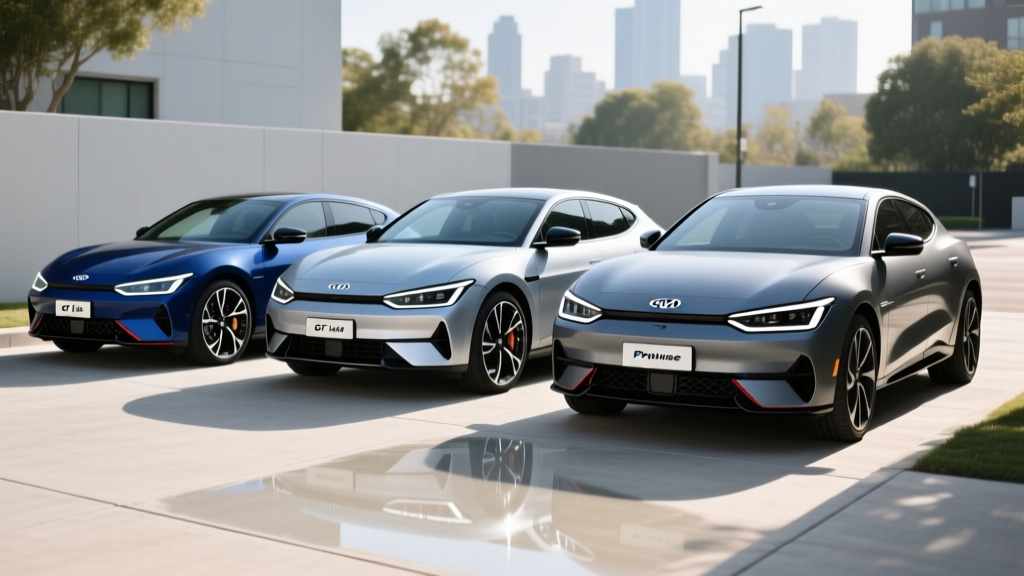
The Kia EV6 entered its second generation for the 2025 model year with a larger battery, refreshed styling, and Tesla Supercharger access via the NACS port. For 2026, Kia carries that formula forward with minor equipment shuffles, making the EV6 one of the most well-rounded midsize electric crossovers on the market. But with four distinct trims spanning roughly $43,000 to $63,000, the real question for buyers is which configuration delivers the best value. This guide dissects every 2026 Kia EV6 trim, pairing hard specs with real-world ownership context so you can match the right version to your driving needs.
2026 Kia EV6 Trim Lineup at a Glance
Kia offers the EV6 in four trims for 2026: Light (base RWD), Wind (RWD or AWD), GT-Line (AWD), and the performance-focused GT (AWD). All trims share the updated 84.0 kWh usable battery pack (NMC chemistry), an 800-volt electrical architecture, and the NACS charge port that provides native access to Tesla's Supercharger network without an adapter.
| Spec | Light RWD | Wind RWD | Wind AWD | GT-Line AWD | GT AWD |
|---|---|---|---|---|---|
| EPA Range | 310 mi | 310 mi | 290 mi | 290 mi | 265 mi |
| Battery (usable) | 84.0 kWh, NMC | ||||
| Horsepower | 167 hp | 167 hp | 320 hp | 320 hp | 601 hp |
| Torque | 258 lb-ft | 258 lb-ft | 446 lb-ft | 446 lb-ft | 568 lb-ft |
| 0-60 mph | 7.3 sec | 7.3 sec | 4.5 sec | 4.5 sec | 3.4 sec |
| Drivetrain | RWD | RWD | Dual-motor AWD | Dual-motor AWD | Dual-motor AWD |
| Max DC Charge Rate | ~240 kW (peak) | ||||
| 10-80% DCFC Time | ~18 min (ideal conditions) | ||||
| Level 2 Rate | 10.9 kW (~37 mi/hr) | ||||
| MPGe (combined) | 134 | 134 | 117 | 117 | 88 |
| kWh/100 mi | 25 | 25 | 29 | 29 | 38 |
| Base MSRP | $43,200 | $47,200 | $51,200 | $55,500 | $63,200 |
Source: fueleconomy.gov and Kia America specifications. MSRP excludes destination charge (~$1,395).
Real-World Range: What the EPA Number Doesn't Tell You
Light/Wind RWD: EPA 310 mi → Expect ~260-280 mi highway, ~200-220 mi in sub-30°F cold.
Wind AWD / GT-Line: EPA 290 mi → Expect ~245-265 mi highway, ~190-210 mi in sub-30°F cold.
GT: EPA 265 mi → Expect ~220-240 mi highway, ~170-190 mi in sub-30°F cold.
The EV6's 800-volt platform and heat pump (standard on all trims) help it manage cold-weather range loss better than many competitors, but physics is physics. In our experience with the E-GMP platform, highway driving at 75+ mph cuts range by roughly 12-16% versus the EPA combined figure, and freezing temperatures compound that loss with another 15-25% reduction depending on cabin heat usage. The heat pump recovers some efficiency by scavenging waste heat from the powertrain, but resistive heating still dominates below about 20°F.
If your typical commute is under 60 miles round-trip, even the GT's real-world range will feel effortless. For road-trippers who regularly cover 250+ miles in a single stretch, the RWD trims offer a meaningful buffer — and the charging network access to back it up.
Charging Speed: The EV6's Strongest Selling Point
The 800-volt architecture remains the EV6's trump card. While many competitors peak at 150-180 kW on DC fast chargers, the EV6 can pull up to roughly 240 kW at a compatible 350 kW station. The charge curve is aggressive in the 10-55% window, then tapers progressively through 80% and above — typical for NMC chemistry.
| Charging Level | Power | Speed / Time | Notes |
|---|---|---|---|
| Level 1 (120V) | ~1.4 kW | ~4 mi/hr | Emergency/trickle only |
| Level 2 (240V, 48A) | 10.9 kW | ~37 mi/hr; full charge ~9 hr | Home/workplace standard |
| DC Fast (350 kW station) | Peak ~240 kW | 10-80% in ~18 min | Requires 800V-capable station |
| DC Fast (150 kW station) | ~150 kW | 10-80% in ~28 min | More common infrastructure |
| Tesla Supercharger (V3/V4) | Up to ~250 kW | 10-80% in ~20 min | Native NACS port, no adapter |
A critical detail many buyers miss: that 18-minute 10-80% claim assumes you arrive at a low state of charge with battery preconditioning active. The EV6 will precondition the pack automatically when a DC fast charger is set as your navigation destination — this warms the battery to its optimal charging temperature. Skip preconditioning on a cold morning and your peak rate might drop to 150 kW or lower, stretching that stop to 30+ minutes. Always navigate to your charger.
The switch to NACS for 2025+ model years means 2026 EV6 owners can use Tesla Superchargers natively, dramatically expanding the practical fast-charging network. This is a significant advantage over CCS-only vehicles that still require adapters for Supercharger access.
Performance by Trim: From Efficient Commuter to 601-hp Rocket
The Light and Wind RWD trims use a single rear motor producing 167 hp and 258 lb-ft of torque. The 7.3-second 0-60 time isn't thrilling, but it's perfectly adequate for merging and city driving, and the instant electric torque makes it feel punchier than the number suggests. These are the efficiency champions of the lineup.
Step up to the Wind AWD or GT-Line, and the dual-motor setup delivers 320 hp and 446 lb-ft, dropping the 0-60 to 4.5 seconds. This is the sweet spot for most buyers — genuinely quick, all-weather capable, and only a modest hit to range and efficiency.
The GT is in a different universe entirely. With 601 hp and 568 lb-ft, it hits 60 mph in 3.4 seconds — territory occupied by sports cars costing twice as much. The tradeoff is efficiency: 88 MPGe and 38 kWh/100 mi means you'll charge more often and pay more per mile. Kia also equips the GT with an electronic limited-slip differential, enhanced brake regen, and a dedicated GT drive mode with launch control.
Pricing, Trims, and Federal Tax Credit Eligibility
Here's where the rubber meets the road for most buyers. The 2026 EV6 is manufactured in West Point, Georgia, which is a critical factor for federal tax credit eligibility under IRS §30D rules. Because it's domestically assembled, buyers can claim the credit as a point-of-sale reduction at the dealer — effectively lowering your out-of-pocket cost on day one.
| Trim | MSRP | + Destination | Est. After $7,500 Credit | Credit Eligible? |
|---|---|---|---|---|
| Light RWD | $43,200 | $44,595 | ~$37,095 | Yes (meets MSRP cap) |
| Wind RWD | $47,200 | $48,595 | ~$41,095 | Yes (meets MSRP cap) |
| Wind AWD | $51,200 | $52,595 | ~$45,095 | Yes (meets MSRP cap) |
| GT-Line AWD | $55,500 | $56,895 | ~$49,395 | Yes (meets MSRP cap) |
| GT AWD | $63,200 | $64,595 | ~$57,095 | Yes (SUV/crossover MSRP cap: $80,000) |
Key §30D eligibility requirements (verify at irs.gov before purchasing):
- MSRP cap: $55,000 for sedans; $80,000 for SUVs/crossovers/vans. The EV6 is classified as a small SUV/crossover, so all trims fall under the $80,000 cap.
- Buyer income limits: Modified AGI must not exceed $300,000 (joint filers), $225,000 (head of household), or $150,000 (single). Your dealer will collect a tax consent form at sale.
- Battery sourcing: A percentage of critical minerals and battery components must be sourced from the U.S. or free-trade-agreement partners. Kia's Georgia-built EV6 currently meets these thresholds, but rules tighten annually — confirm with your dealer at time of purchase.
- Point-of-sale transfer: You can elect to transfer the credit to the dealer, reducing your purchase price directly rather than waiting to claim it on your tax return.
Interior, Cargo, and Daily-Use Practicality
The EV6's crossover profile yields surprisingly good interior space. Rear legroom measures 39.5 inches — enough for adults on longer trips without complaint. Cargo volume behind the second row is 24.4 cubic feet, expanding to approximately 54.3 cubic feet with the 60/40 rear seats folded. The front trunk (frunk) adds 1.8 cubic feet on AWD models and 3.2 cubic feet on RWD trims — enough for charging cables and a small bag.
All trims feature dual 12.3-inch curved displays running Kia's latest infotainment software with wireless Apple CarPlay and Android Auto. Physical buttons for climate control remain, which is a practical win over touch-only interfaces. The GT-Line and GT trims add a head-up display with augmented-reality navigation overlays, a Meridian premium audio system, and ventilated front seats.
Driver assistance comes via Kia's Highway Driving Assist 2 (HDA2), a Level 2 system that combines adaptive cruise control with lane-centering and lane-change assist. It's competent on interstates but requires hands-on-wheel attention at all times — this is not an eyes-off system. All trims include forward collision-avoidance assist, blind-spot monitoring, rear cross-traffic alert, and safe exit assist.
Warranty and Long-Term Ownership
Kia backs the EV6 with one of the strongest warranty packages in the segment:
- Battery & Drive Unit: 10 years / 100,000 miles (whichever comes first)
- Limited Vehicle Warranty: 5 years / 60,000 miles
- Powertrain: 10 years / 100,000 miles
- Roadside Assistance: 5 years / 60,000 miles
The battery warranty guarantees that the pack will retain at least 70% of its original capacity during the coverage period. Based on data from first-generation E-GMP vehicles (2022-2024 EV6 and Ioniq 5), real-world degradation has been modest — typically 5-8% loss over the first 60,000 miles when DC fast charging is used moderately. The NMC chemistry in the 84.0 kWh pack offers strong energy density, though it requires more careful charge management than LFP (lithium iron phosphate) batteries. Kia recommends daily charging to 80% for routine use and 100% only when you need the full range for a trip.
EV6 vs. Key Competitors: Where It Stands
✓ Pros
- 800V architecture: 10-80% in ~18 min at 350 kW stations
- Native NACS port — Tesla Supercharger access without an adapter
- Georgia-built: all trims eligible for $7,500 federal credit (subject to buyer eligibility)
- Strong warranty: 10yr/100k-mi battery and powertrain
- Heat pump standard across all trims
- Physical climate controls alongside modern infotainment
- GT trim offers supercar-level acceleration in a practical crossover
✗ Cons
- Light trim is sparsely equipped — many features locked to Wind and above
- GT's 265-mi EPA range and 88 MPGe are thirstier than rivals
- Rear visibility is compromised by the sloping roofline and thick C-pillars
- No front wiper on the rear window (controversial design choice)
- RWD trims feel underpowered versus the dual-motor options
- Cargo space (24.4 cu ft) trails the Hyundai Ioniq 5 and Ford Mustang Mach-E
Against the Hyundai Ioniq 5 (its E-GMP sibling), the EV6 trades a bit of rear headroom and cargo volume for sportier styling and slightly firmer ride tuning. The Ioniq 5 offers a bit more interior space and a standard rear wiper. Against the Tesla Model Y, the EV6 wins on build quality, ride comfort, and warranty, but loses on Supercharger network breadth (though NACS access narrows this gap) and software ecosystem. The Ford Mustang Mach-E offers a sportier drive in its GT variant but trails on charging speed and has a smaller battery.
Which 2026 Kia EV6 Trim Should You Buy?
Choose the Light RWD if: You want the lowest entry price (~$37k after credit), mostly drive in fair weather, and don't need AWD or advanced features.
Choose the Wind RWD if: You want maximum range (310 mi EPA), heated seats, and a power liftgate without paying for AWD you won't use.
Choose the Wind AWD if: You need all-weather traction, want the 4.5-second 0-60 dual-motor performance, and consider this the best value in the lineup.
Choose the GT-Line AWD if: You want the sport-tuned suspension, premium interior upgrades (HUD, Meridian audio), and the visual distinction without stepping to the GT's efficiency penalty.
Choose the GT if: Acceleration is a priority, you accept the range and efficiency tradeoff, and you want a daily-driver that can embarrass sports cars at stoplights.
For most buyers, the Wind AWD at ~$45,095 after the federal credit represents the best balance of range (290 mi EPA), performance (4.5 seconds to 60), all-weather capability, and feature content. It's the trim we'd put our own money on.
Frequently Asked Questions
What is the real-world range of the 2026 Kia EV6?
The RWD trims (Light, Wind) carry a 310-mile EPA rating, but expect roughly 260-280 miles on the highway at 75 mph and 200-220 miles in sustained sub-30°F weather. AWD trims (290 mi EPA) typically deliver 245-265 highway miles. The GT (265 mi EPA) averages 220-240 in real-world highway driving.
How fast does the EV6 charge at home and on the road?
On a home Level 2 charger (240V, 48A), the EV6 charges at 10.9 kW, adding roughly 37 miles of range per hour — a full charge takes about 9 hours overnight. At a 350 kW DC fast charger, it peaks near 240 kW and reaches 10-80% in approximately 18 minutes with battery preconditioning active.
Does the 2026 Kia EV6 qualify for the $7,500 federal EV tax credit?
Yes — all trims currently qualify. The EV6 is assembled in Georgia and meets the MSRP cap (under $80,000 for crossovers). However, buyer eligibility depends on your modified adjusted gross income (≤$300k joint, ≤$150k single) and battery-sourcing requirements that tighten annually. Verify at irs.gov and consult a tax professional.
Is the Kia EV6 worth buying over the Hyundai Ioniq 5 or Tesla Model Y?
The EV6 wins on charging speed, warranty coverage, and ride refinement. The Ioniq 5 offers slightly more interior volume and a rear wiper. The Model Y has a broader software ecosystem and the largest Supercharger network (though NACS access narrows this gap for the EV6). If fast-charging capability and long-term warranty peace of mind are priorities, the EV6 is an excellent choice.
What is the biggest drawback of the EV6 GT?
Efficiency. At 88 MPGe and 38 kWh/100 mi, the GT consumes significantly more energy per mile than other trims. Its 265-mile EPA range drops to roughly 220 miles on the highway, meaning more frequent charging stops on road trips. You're paying for 601 hp with both range and wallet.
Can I use Tesla Superchargers with the 2026 EV6?
Yes. The 2026 EV6 comes equipped with a native NACS charge port, meaning you can plug directly into any Tesla Supercharger V3 or V4 stall without an adapter. This adds thousands of fast-charging locations to your network.