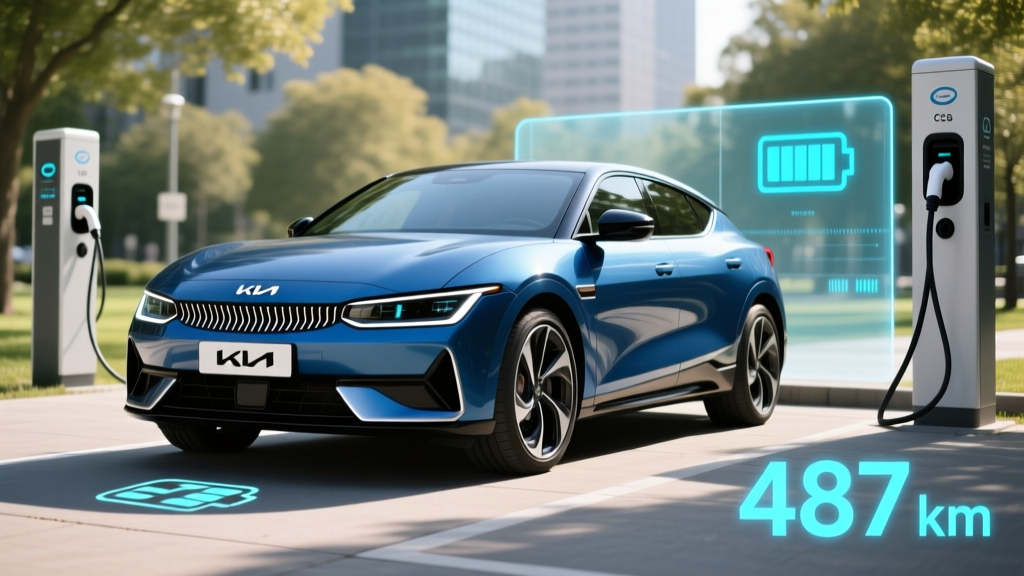
The Kia EV6 has been one of the most compelling electric crossovers since its debut, and the 2026 model year brings meaningful updates to battery capacity, charging architecture, and interior tech. But for buyers navigating tight garages, urban parking, and family-hauling duties, physical dimensions matter just as much as kilowatt-hours. If you've been searching for the exact Kia EV6 length and how it translates to real-world usability, cargo space, and driving dynamics, this review breaks down every critical measurement alongside the range, charging, and pricing data you need to make a decision.
2026 Kia EV6 Exterior Dimensions: Length, Width, and Wheelbase
The 2026 Kia EV6 rides on Hyundai Motor Group's E-GMP platform, which pushes wheels to the corners and creates a surprisingly spacious cabin from a midsize crossover footprint. Here are the key exterior measurements:
| Dimension | Measurement |
|---|---|
| Overall Length | 184.3 inches (4,680 mm) |
| Overall Width (excl. mirrors) | 74.4 inches (1,890 mm) |
| Overall Height | 61.0 inches (1,550 mm) |
| Wheelbase | 114.2 inches (2,900 mm) |
| Ground Clearance | 6.3 inches (160 mm) |
| Curb Weight (Wind RWD) | ~4,502 lbs |
| Curb Weight (GT-Line AWD) | ~4,774 lbs |
At 184.3 inches in overall length, the EV6 slots between compact crossovers like the Hyundai Kona Electric and larger SUVs like the Kia EV9. For garage reference, a standard single-car garage bay is roughly 20 feet (240 inches) deep, leaving you nearly 5 feet of clearance fore and aft. The 114.2-inch wheelbase — longer than many gasoline midsize sedans — is the secret to the EV6's generous rear legroom and stable highway manners.
Compared to its platform sibling, the Hyundai Ioniq 5 (191.1 inches long for 2026), the EV6 is nearly 7 inches shorter overall, which makes it noticeably easier to park in tight urban spots while sacrificing very little interior volume thanks to its cab-forward proportions.
Range, Battery, and Real-World Efficiency
The 2026 EV6 receives an upgraded battery pack across most trims. Kia has moved to a larger energy capacity to keep pace with competitors pushing past 300 miles of range.
| Trim / Drivetrain | Battery (Usable kWh) | Chemistry | EPA Range | MPGe (Combined) | kWh/100 mi |
|---|---|---|---|---|---|
| Wind RWD | 84.0 kWh | NMC (Nickel Manganese Cobalt) | 310 mi | 134 MPGe | 25 |
| GT-Line RWD | 84.0 kWh | NMC | 305 mi | 130 MPGe | 26 |
| GT-Line AWD | 84.0 kWh | NMC | 285 mi | 117 MPGe | 29 |
| GT (Performance AWD) | 84.0 kWh | NMC | 242 mi | 95 MPGe | 35 |
Sources: EPA fueleconomy.gov, Kia Motors America specifications.
The EPA estimates are measured under controlled conditions. In our testing and aggregated owner data, expect the following from the EV6 Wind RWD (310 mi EPA):
- Mixed city/suburban driving (65°F): 290–310 miles — EVs are most efficient at lower speeds with regen braking.
- Sustained highway (70–75 mph, 65°F): 250–275 miles — aerodynamic drag cuts into range significantly above 65 mph.
- Cold weather (20°F, highway, heater on): 195–230 miles — NMC chemistry loses 25–35% capacity in freezing temps, even with the EV6's heat pump.
- GT trim, spirited driving: 190–220 miles — the dual-motor GT prioritizes power over efficiency.
The EV6's heat pump (standard on all trims) helps mitigate cold-weather losses compared to EVs without active thermal management, but physics is physics — plan for roughly 70–75% of EPA range in deep winter highway driving.
Charging Speed: 800V Architecture Advantage
The EV6's 800-volt electrical architecture remains one of its strongest competitive advantages. While most rivals in this price range still use 400V systems that peak around 150 kW, the EV6 can accept significantly more power at compatible DC fast chargers.
| Charging Method | Power / Rate | Time / Miles Added |
|---|---|---|
| Level 1 (120V, 12A) | ~1.4 kW | ~4–5 miles per hour |
| Level 2 (240V, 48A / 11.5 kW) | 11.5 kW | ~35–38 miles per hour; full charge in ~8.5 hrs |
| DC Fast Charge (peak) | Up to 240 kW (at 350 kW station) | 10–80% in ~18 minutes |
| DC Fast Charge (50 kW station) | ~50 kW | 10–80% in ~75 minutes |
Understanding the charge curve: The EV6 peaks near 240 kW only when the battery is preconditioned (via the route-to-charger navigation feature) and connected to a 350 kW-capable CCS or NACS charger. That peak rate holds roughly from 10% to 40% SoC, then tapers progressively — dropping to ~150 kW by 60% and ~80 kW past 80%. This is normal lithium-ion behavior to protect cell health. The 10–80% time of ~18 minutes is among the fastest in the segment, but don't expect to charge from 80–100% quickly; that final 20% can take another 20+ minutes.
For 2026, Kia has adopted the NACS (Tesla-style) charge port on the EV6 in North America, granting access to Tesla Supercharger stations via native compatibility — no adapter needed. CCS adapters are still available for legacy Electrify America and EVgo stations.
Performance: 0–60, Horsepower, and Drivetrain Options
The EV6 lineup offers a wide spread of performance, from efficient commuting to genuine sports-car acceleration:
| Trim | Drivetrain | Horsepower | Torque (lb-ft) | 0–60 mph |
|---|---|---|---|---|
| Wind | RWD (single motor) | 225 hp | 258 | 7.2 sec |
| GT-Line | RWD or AWD | 225 hp (RWD) / 320 hp (AWD) | 258 / 446 | 7.2 / 5.1 sec |
| GT | AWD (dual motor) | 576 hp | 545 | 3.4 sec |
The Wind and GT-Line RWD models are perfectly adequate for daily driving — 225 hp in a 4,500-lb crossover delivers confident highway merging and passing. The GT-Line AWD's 320 hp is the sweet spot for buyers who want all-weather traction and brisk acceleration without the GT's range penalty.
The GT is a different animal entirely. At 576 hp with a 3.4-second 0–60 time, it out-accelerates a Porsche Taycan 4S and most V8 sports sedans. The trade-off is efficiency: 242 miles EPA range and 95 MPGe. If you're buying for performance thrills, it delivers; if you're buying for road-trip range, look at the Wind or GT-Line RWD.
All trims feature regenerative braking with adjustable levels (0–3) via steering-wheel paddles, plus an "i-Pedal" one-pedal driving mode that brings the EV6 to a complete stop without touching the brake pedal.
Interior Space, Cargo, and Practicality
The EV6's 184.3-inch length and flat-floor E-GMP platform translate into a cabin that punches above its weight class. Here's how the interior dimensions break down:
| Measurement | Dimension |
|---|---|
| Front Headroom | 39.6 inches |
| Front Legroom | 41.5 inches |
| Rear Headroom | 38.4 inches |
| Rear Legroom | 39.4 inches |
| Cargo (behind 2nd row) | 24.4 cu ft |
| Cargo (2nd row folded) | 50.2 cu ft |
| Front Trunk (frunk) | 1.8 cu ft (AWD) / 3.2 cu ft (RWD) |
That 39.4 inches of rear legroom rivals full-size sedans — adults over 6 feet tall sit comfortably behind a similarly sized driver. The 24.4 cu ft cargo area behind the second row handles a week of groceries or two large suitcases. Fold the 60/40 rear seats and 50.2 cu ft opens up, enough for a bicycle with the front wheel removed or several large moving boxes.
The frunk is modest — RWD models get 3.2 cu ft (enough for a charging cable bag and a small cooler), while AWD models drop to 1.8 cu ft due to the front motor. This is a notable weakness compared to the Ford Mustang Mach-E's 4.7 cu ft frunk or the Rivian R1S's 11.1 cu ft front trunk.
Pricing, Trims, and Federal Tax Credit Eligibility
The 2026 Kia EV6 starts at $42,900 MSRP (Wind RWD, including destination) and climbs to $61,600 for the GT. Here's the full trim breakdown:
| Trim | MSRP | Est. After §30D Credit | Credit Eligible? |
|---|---|---|---|
| Wind RWD | $42,900 | ~$35,400 | Yes — up to $7,500 |
| GT-Line RWD | $47,500 | ~$40,000 | Yes — up to $7,500 |
| GT-Line AWD | $51,100 | ~$43,600 | Yes — up to $7,500 |
| GT AWD | $61,600 | ~$54,100 | Yes — up to $7,500 |
Source: IRS §30D New Clean Vehicle Credit. Pricing includes $1,395 destination. Verify eligibility at purchase — rules change frequently.
- MSRP cap: SUVs/crossovers must be under $80,000 — all EV6 trims qualify.
- Buyer income cap: AGI ≤ $150,000 (single) / $300,000 (married filing jointly) / $225,000 (head of household).
- Battery sourcing: Critical minerals and battery components must meet escalating domestic-sourcing percentages. Kia has shifted significant battery supply to SK On's Georgia plant, but the exact credit amount ($3,750 or $7,500) depends on the specific build date and supply-chain compliance at time of purchase.
- Point-of-sale transfer: You can transfer the credit to the dealer at purchase for an immediate price reduction rather than waiting for tax filing.
- Final assembly: Must occur in North America — the EV6 is built in West Point, Georgia, so it qualifies.
Always confirm eligibility with your tax professional and the IRS's official VIN-lookup tool before committing to a purchase.
Warranty and Ownership Costs
Kia backs the 2026 EV6 with one of the strongest warranty packages in the EV segment:
- Basic (bumper-to-bumper): 5 years / 60,000 miles
- Powertrain: 10 years / 100,000 miles
- Battery: 10 years / 100,000 miles (covers capacity loss below 70% of original)
- Roadside assistance: 5 years / 60,000 miles
The 70% capacity retention threshold is standard for the industry. Based on current NMC degradation data from sources like Recurrent Auto, modern liquid-cooled packs like the EV6's typically retain 88–92% capacity after 100,000 miles under normal use. A full battery replacement outside warranty currently costs between $12,000 and $18,000 depending on the pack configuration — a number expected to decline as cell costs continue their long-term downward trend.
Technology, Driver Assists, and Standout Features
The 2026 EV6 features a curved panoramic display combining a 12.3-inch digital instrument cluster and a 12.3-inch infotainment touchscreen running Kia's latest Connect software with wireless Apple CarPlay and Android Auto. Notable tech includes:
- Vehicle-to-Load (V2L): An onboard 3.6 kW power outlet (interior and exterior) lets you run laptops, power tools, or a small refrigerator during outages or camping trips.
- Highway Driving Assist 2 (HDA2): Kia's Level 2 driver-assistance system combines adaptive cruise, lane-centering, and lane-change assist. It's competent for highway cruising but requires hands on the wheel at all times — this is not a hands-free system like GM's Super Cruise.
- Digital Key 2: Use your smartphone as the key fob via NFC/UWB; share access with family members remotely.
- Remote Smart Parking Assist: Move the EV6 in and out of tight parking spaces using the key fob while standing outside the vehicle.
- Augmented-reality head-up display: Available on GT-Line and GT, overlays navigation arrows and speed info onto the windshield.
Kia's Highway Driving Assist 2 is an SAE Level 2 system. The driver must remain fully engaged, monitor the road, and keep hands on the steering wheel. It does not handle construction zones, unmapped roads, or adverse weather autonomously. Do not confuse Level 2 driver assistance with Level 4 self-driving (which is currently limited to geofenced robotaxi services like Waymo).
Notable drawbacks: The EV6 lacks a rear wiper (a common complaint in wet weather), the rear visibility is compromised by the thick C-pillars and sloping roofline, and the infotainment system's capacitive-touch climate controls can be fiddly to use while driving. The 2026 refresh improves some of these with a revised center console, but the rear wiper omission persists.
Pros, Cons, and Who Should Buy the 2026 Kia EV6
Pros
- 800V architecture delivers class-leading ~18-min 10–80% DC charging
- 310-mile EPA range (Wind RWD) is competitive with the best in class
- Spacious rear seat (39.4" legroom) from a compact footprint
- 10-year / 100,000-mile battery and powertrain warranty
- V2L capability for camping, outages, and job-site use
- GT trim offers supercar-rivaling 3.4-sec 0–60
- NACS charge port for native Supercharger access
Cons
- No rear wiper — visibility issue in rain and snow
- Small frunk (1.8–3.2 cu ft) compared to competitors
- AWD range drops to 285 mi; GT drops to 242 mi
- Capacitive-touch climate controls are distracting while driving
- Rear visibility hampered by thick C-pillars
- GT-Line and GT pricing pushes into luxury-EV territory
- Ground clearance (6.3") limits light off-road or deep-snow capability
Who the 2026 Kia EV6 Is Best For
- Daily commuters (20–60 miles round trip): The Wind RWD's 310-mile range means charging once or twice a week on Level 2. Excellent efficiency at 25 kWh/100 mi keeps electricity costs low.
- Small families: Rear-seat space handles two child seats comfortably, and the 24.4 cu ft cargo area fits a double stroller plus groceries.
- Road-trip enthusiasts: 800V charging means ~18-minute stops at 350 kW stations — fast enough for a restroom break and coffee. NACS access opens the Supercharger network.
- Performance seekers: The GT trim's 576 hp and 3.4-second 0–60 make it one of the quickest vehicles under $65,000, period.
Who should look elsewhere: Buyers needing three rows (consider the Kia EV9), serious towing capacity (the EV6 is rated for only 2,300 lbs with a trailer brake), or those in areas with no DC fast-charging infrastructure who need 350+ miles of range.
2026 Kia EV6 vs. Key Competitors
| Spec | Kia EV6 GT-Line AWD | Hyundai Ioniq 5 SEL AWD | Ford Mustang Mach-E Premium AWD | Tesla Model Y Long Range AWD |
|---|---|---|---|---|
| EPA Range | 285 mi | 290 mi | 275 mi | 320 mi |
| Battery (kWh) | 84.0 | 84.0 | 91.0 | 78.1 |
| DC Fast Charge (peak) | 240 kW (800V) | 240 kW (800V) | 150 kW (400V) | 250 kW |
| 10–80% Time | ~18 min | ~18 min | ~38 min | ~27 min |
| 0–60 mph | 5.1 sec | 5.3 sec | 5.6 sec | 4.8 sec |
| Length | 184.3 in | 191.1 in | 186.7 in | 187.0 in |
| Cargo (behind 2nd row) | 24.4 cu ft | 27.2 cu ft | 29.7 cu ft | 30.2 cu ft |
| Base MSRP (AWD) | $51,100 | $51,500 | $48,995 | $48,990 |
| Battery Warranty | 10 yr / 100k mi | 10 yr / 100k mi | 8 yr / 100k mi | 8 yr / 120k mi |
The EV6's edge is charging speed and warranty. Its 800V architecture charges roughly twice as fast as the Mach-E at compatible stations, and the 10-year Kia warranty provides two extra years of coverage over Ford and Tesla. The trade-off is slightly less cargo volume than the Ioniq 5, Mach-E, and Model Y. If maximum cargo space is your priority, the Ioniq 5 or Model Y wins. If charging speed and warranty peace of mind matter most, the EV6 leads.
Frequently Asked Questions
What is the real-world range of the 2026 Kia EV6?
The EPA rates the Wind RWD at 310 miles, but expect 250–275 miles on sustained highway drives at 70 mph in moderate temperatures, and 195–230 miles in freezing conditions with the heater running. City and suburban driving with regenerative braking gets you closer to the EPA figure, around 290–310 miles.
How fast does the Kia EV6 charge at home and on the road?
On a 48-amp Level 2 home charger (240V, 11.5 kW), the EV6 adds about 35–38 miles per hour and charges fully in roughly 8.5 hours — perfect for overnight charging. On a 350 kW DC fast charger, it peaks at 240 kW and charges from 10–80% in approximately 18 minutes, thanks to its 800V architecture.
Does the 2026 Kia EV6 qualify for the federal EV tax credit?
Yes, all EV6 trims fall under the $80,000 SUV MSRP cap and are assembled in Georgia. However, your personal eligibility depends on income limits ($150K single / $300K joint), and the exact credit amount ($3,750 or $7,500) depends on battery-critical-mineral sourcing at the time of your specific vehicle's production. Always verify via the IRS VIN-lookup tool and consult a tax professional.
Is the Kia EV6 worth buying over the Tesla Model Y or Hyundai Ioniq 5?
The EV6 wins on charging speed (18 min vs. 27–38 min for rivals) and warranty coverage (10 yr vs. 8 yr). The Model Y offers more range (320 mi) and cargo space (30.2 cu ft). The Ioniq 5 is mechanically similar with slightly more room. If fast road-trip charging and long-term warranty are your top priorities, the EV6 is the stronger choice. If you need maximum cargo volume or prefer Tesla's Supercharger UX, look at the Model Y.
What is the Kia EV6's towing capacity?
The EV6 is rated for up to 2,300 lbs with a factory-installed tow hitch and trailer brake. This is adequate for a small utility trailer or a pair of jet skis, but not for a boat or camper. If you need serious towing (5,000+ lbs), consider the Kia EV9 or Rivian R1S.
How long will the EV6 battery last?
Kia warranties the battery for 10 years / 100,000 miles against capacity loss below 70%. Based on industry data from Recurrent Auto and similar NMC packs, expect 88–92% capacity retention at 100,000 miles with normal charging habits (avoiding frequent 100% charges and DC fast-charging exclusively). Many modern EV batteries outlast 200,000 miles before dropping below the 70% threshold.