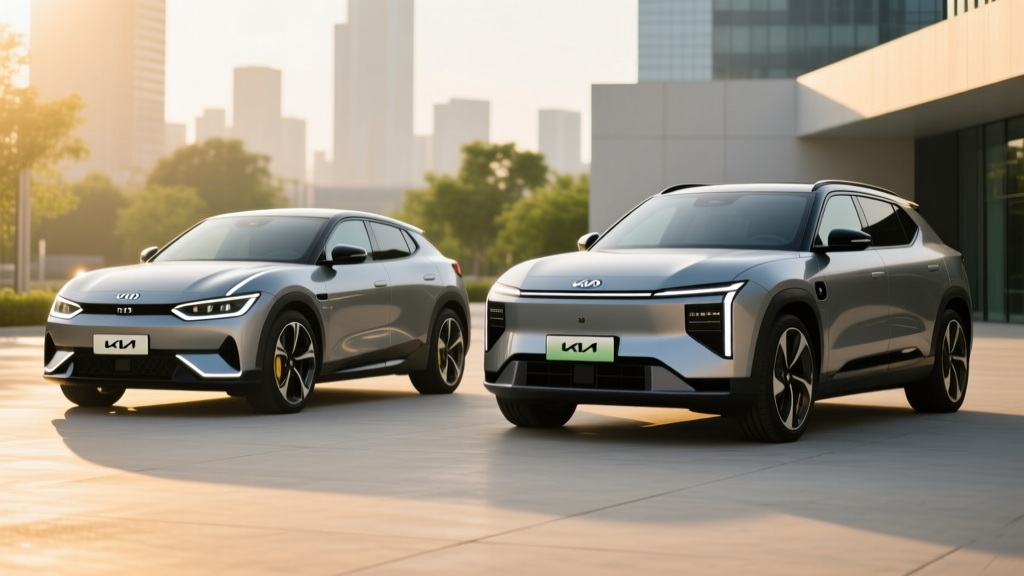
If you're researching Kia EV offers in 2026, the decision narrows quickly to two very different electric vehicles: the sleek, performance-oriented Kia EV6 crossover and the three-row, family-hauling Kia EV9 SUV. Both ride on Hyundai Motor Group's E-GMP platform with 800V architecture, but they serve distinct buyers. This profile breaks down every number that matters — EPA range, real-world efficiency, DC fast-charging curves, installed pricing, and federal tax credit eligibility — so you can choose the right Kia EV for your driveway.
2026 Kia EV Lineup at a Glance
Kia's US electric lineup currently centers on two E-GMP-based models. The EV6 received a significant refresh for the 2025 model year with a larger battery and updated styling, and carries into 2026 largely unchanged. The EV9, introduced for 2024, enters its third model year with minor trim and package adjustments. A third model, the compact EV5, has been announced for global markets but is not yet confirmed for US sale.
| Spec | 2026 Kia EV6 (Long Range RWD) | 2026 Kia EV9 (Long Range RWD) |
|---|---|---|
| EPA Range | 310 miles | 304 miles |
| Usable Battery | 84.0 kWh (NMC) | 100.0 kWh (NMC) |
| Peak DC Fast Charge | 240 kW | 210 kW |
| 10–80% DCFC Time | ~18 minutes | ~24 minutes |
| Level 2 Charge Rate | 10.9 kW (~36 mi/hr) | 10.9 kW (~30 mi/hr) |
| Horsepower | 225 hp (RWD) / 320 hp (AWD) | 201 hp (RWD) / 379 hp (AWD) |
| 0–60 mph | 7.2s (RWD) / 5.1s (AWD) | 8.2s (RWD) / 5.3s (AWD) |
| MPGe (Combined) | 134 MPGe | 97 MPGe |
| EPA Efficiency | 25 kWh/100 mi | 35 kWh/100 mi |
| Cargo (behind 2nd row) | 24.4 cu ft | 43.5 cu ft |
| Seating | 5 passengers | 6 or 7 passengers |
| Base MSRP | $44,300 (Light LR RWD) | $56,900 (Light RWD) |
| Battery Warranty | 10 yr / 100,000 mi | 10 yr / 100,000 mi |
Sources: EPA fueleconomy.gov, Kia EV6 specs, Kia EV9 specs.
Real-World Range: What the EPA Sticker Doesn't Tell You
EPA vs. Reality — EV6 Long Range RWD: The sticker says 310 miles. In mixed highway driving at 70–75 mph in moderate temperatures (60–75°F), expect 265–285 miles. In sub-freezing winter conditions (20–35°F), plan for 220–250 miles due to cabin heating load and reduced battery efficiency. The EV6's heat pump (standard on most trims) helps mitigate cold-weather losses compared to EVs without one.
EPA vs. Reality — EV9 Long Range RWD: Rated at 304 miles, the EV9's boxy aerodynamics and 4,800+ lb curb weight hit efficiency hard on the highway. Expect 250–275 miles in temperate mixed driving and as low as 200–230 miles in winter highway conditions. City and suburban driving with regen braking gets closer to the EPA figure.
The efficiency gap between these two models is significant: the EV6 consumes roughly 25 kWh per 100 miles (combined), while the EV9 needs 35 kWh for the same distance. That 40% difference compounds on road trips — you'll stop to charge the EV9 noticeably more often on a long drive, even with its larger battery.
Charging Speed and the 800V Advantage
Both the EV6 and EV9 use Hyundai Motor Group's 800V electrical architecture, which enables some of the fastest DC fast-charging speeds available in any mainstream EV. Here's what that means in practice:
| Level | Power | EV6 Miles Added/Hr | EV9 Miles Added/Hr |
|---|---|---|---|
| Level 1 (120V / 12A) | ~1.4 kW | ~4 mi/hr | ~3 mi/hr |
| Level 2 (240V / 48A) | 10.9 kW | ~36 mi/hr | ~30 mi/hr |
| DC Fast Charge (peak) | 240 kW (EV6) / 210 kW (EV9) | ~700+ mi/hr* | ~550+ mi/hr* |
*Peak rate during the early portion of the charge curve; actual rate tapers significantly above 60–70% SoC.
The charge curve reality: The EV6 peaks near 240 kW from roughly 10–45% state of charge, then tapers to ~150 kW through 65%, and drops further to ~80 kW past 80%. The 18-minute 10–80% time assumes a 350 kW-capable CCS or NACS station with proper battery preconditioning. On a 150 kW station, expect 10–80% in roughly 28–32 minutes for the EV6 and 35–40 minutes for the EV9.
Kia's navigation system includes battery preconditioning — when you set a DC fast charger as your destination, the thermal management system warms the battery to optimize charge speed. This is essential in cold weather; without preconditioning, peak charge rates can drop 40–60%.
For home charging, both vehicles accept 10.9 kW on Level 2 (240V, 48A). That translates to a full overnight charge from near-empty in roughly 8–10 hours. Most owners charging from 20–80% daily will need only 5–6 hours on a home Level 2 unit.
Performance, Ride, and Drivetrain
The EV6 GT-Line AWD delivers 320 hp and a 5.1-second 0–60 mph time, making it genuinely quick without being a dedicated performance model. The EV6 GT variant (576 hp, 3.4-second 0–60) remains available for enthusiasts, though its 265-mile EPA range and higher price ($62,000+) narrow its audience.
The EV9's performance story is different. The RWD model's 201 hp and 8.2-second 0–60 feel adequate but unhurried for a vehicle this large. The AWD model's 379 hp drops that to 5.3 seconds — plenty for highway merging and passing. Neither model is tuned for sporty handling; the EV9 rides comfortably but exhibits noticeable body roll in corners.
Towing is where the EV9 distinguishes itself: it's rated for 5,000 lbs (AWD) or 2,000 lbs (RWD). The EV6 is rated for 2,700 lbs (AWD). If you need to tow a small trailer or boat, the EV9 AWD is the clear choice — but expect a severe range penalty while towing, often 40–50%.
Pricing, Trims, and Federal Tax Credit Eligibility
| Model / Trim | MSRP | Est. §30D Credit | Effective Price* |
|---|---|---|---|
| EV6 Light Long Range RWD | $44,300 | Up to $7,500 | ~$36,800 |
| EV6 Wind AWD | $50,600 | Up to $7,500 | ~$43,100 |
| EV6 GT-Line AWD | $55,300 | Up to $7,500 | ~$47,800 |
| EV9 Light RWD | $56,900 | Up to $7,500 | ~$49,400 |
| EV9 Wind AWD | $61,900 | Up to $7,500 | ~$54,400 |
| EV9 GT-Line AWD | $68,400 | Up to $7,500 | ~$60,900 |
*Effective price assumes full $7,500 federal credit. Actual eligibility depends on income, battery sourcing, and MSRP caps. Destination charges (~$1,300–$1,400) not included.
Federal tax credit rules (IRS §30D) for 2026: The full $7,500 credit requires meeting two $3,750 sub-requirements — one for critical minerals sourcing and one for battery component manufacturing, both with escalating domestic-content thresholds. As of early 2026, Kia's US-built EV9 (assembled at the Kia Georgia plant) generally qualifies for the full credit. The EV6, built in South Korea, has faced partial credit eligibility that varies by model year and battery batch. Kia's US assembly of the EV6 is expected to begin for the 2026 model year, potentially restoring full credit eligibility.
§30D Federal EV Tax Credit Requirements (2026):
- MSRP Cap: SUVs/vans/pickups must be under $80,000; sedans/wagons/crossovers under $55,000. The EV6 qualifies (crossover, $55K cap). The EV9 qualifies (SUV, $80K cap).
- Buyer Income Cap: AGI must not exceed $150,000 (single), $225,000 (head of household), or $300,000 (joint filers).
- Battery Sourcing: Critical minerals and battery components must meet escalating North American/domestic thresholds. Check the specific VIN at fueleconomy.gov.
- Point-of-Sale Transfer: You can transfer the credit to the dealer at purchase for an immediate price reduction, or claim it on your tax return.
- New Vehicle Only: Must be purchased new; different rules apply to used EVs (§25E, up to $4,000).
Always verify eligibility with the IRS §30D guidance and your tax professional before purchasing.
Interior Space, Tech, and Daily Livability
The EV6's interior is driver-focused with a curved dual 12.3-inch display panel, ambient lighting, and a flat floor that creates generous front legroom (41.7 inches). Rear legroom is 39.0 inches — comfortable for adults. Cargo space is 24.4 cu ft behind the rear seats and 54.3 cu ft with seats folded. The front trunk (frunk) adds a modest 0.7 cu ft on AWD models — enough for charging cables.
The EV9 is a genuinely large vehicle, and the interior reflects it. Front legroom is 41.6 inches, second row offers 42.8 inches (class-leading), and the third row provides 32.0 inches — usable for children or short-trip adults. Cargo behind the third row is 20.2 cu ft; fold the third row for 43.5 cu ft; fold both rear rows for 81.7 cu ft. The EV9 also offers vehicle-to-load (V2L) capability, allowing you to power devices or appliances from the traction battery via an interior or exterior outlet — useful for camping or emergency backup.
Driver assistance: Both models come with Kia's Highway Driving Assist 2 (HDA2), a Level 2 SAE driver-assist system combining adaptive cruise control, lane-centering, and lane-change assist. This is a hands-on, eyes-on system — not self-driving. It works well on divided highways but requires active driver supervision. The EV9 GT-Line adds Remote Smart Parking Assist, which can move the vehicle in and out of tight spaces via the key fob.
Infotainment: Both use Kia's latest ccNC (Connected Car Navigation Cocktail) system with wireless Apple CarPlay and Android Auto, over-the-air updates, and Digital Key 2 (phone-as-key via NFC/UWB). The system is responsive and logically organized, though the touch-capacitive climate controls on the EV6 can be finicky while driving.
Warranty Coverage and Long-Term Ownership
Kia's warranty remains one of the strongest in the industry:
- Battery: 10 years / 100,000 miles (capacity retention threshold: 70%)
- Powertrain: 10 years / 100,000 miles
- Bumper-to-Bumper: 5 years / 60,000 miles
- Roadside Assistance: 5 years / 60,000 miles
The 70% capacity retention threshold is standard for the industry — if your battery drops below 70% of its original capacity within the warranty period, Kia will repair or replace it. Real-world degradation data from E-GMP vehicles (EV6, Ioniq 5) suggests most owners retain 90–95% capacity after 3 years and 40,000–50,000 miles, well above the warranty threshold. The NMC chemistry in both models favors energy density over the extreme cycle life of LFP batteries, but Kia's thermal management system appears to manage degradation effectively.
Pros, Cons, and Which Kia EV Suits You
2026 Kia EV6 — Pros
- Class-leading 18-minute DC fast charging (10–80%)
- 310-mile EPA range (best in Kia lineup)
- 134 MPGe combined — highly efficient
- Sporty design with engaging driving dynamics
- Competitive pricing after tax credit
2026 Kia EV6 — Cons
- Modest 24.4 cu ft cargo space
- Small frunk on AWD models
- Touch-capacitive climate controls are distracting
- Rear visibility limited by sloping roofline
2026 Kia EV9 — Pros
- True three-row seating for 6–7 passengers
- Massive cargo capacity (up to 81.7 cu ft)
- 5,000-lb towing (AWD)
- V2L power output for devices/appliances
- US-built — strong tax credit eligibility
2026 Kia EV9 — Cons
- 304-mile range drops sharply in winter/highway use
- 35 kWh/100 mi — expensive to charge on road trips
- 8.2s 0–60 on RWD feels sluggish for the price
- $57K+ base price before incentives
Choose the EV6 if: You're a commuter or couple who prioritizes efficiency, fast charging, and lower cost. Its 134 MPGe and 18-minute DCFC stops make it the better road-trip EV despite slightly less cargo room.
Choose the EV9 if: You need three rows, tow regularly, or want V2L capability for outdoor use. Accept the efficiency penalty and plan road trips around 350 kW chargers to minimize downtime.
Competitor Check: How Kia EV Offers Stack Up
The EV6 competes directly with the Hyundai Ioniq 5 (its E-GMP sibling), Tesla Model Y, Ford Mustang Mach-E, and Volkswagen ID.4. Its key advantages are charge speed (18 min vs. 20–26 min for most rivals) and the EV6's standard heat pump. The Ioniq 5 offers more cargo space and a similar platform at a comparable price. The Model Y wins on Supercharger network access (though Kia now supports NACS adapters for Tesla Supercharger access as of 2025).
The EV9 has far fewer direct competitors. The Rivian R1S is more capable off-road but starts above $75,000. The Tesla Model X offers falcon-wing doors and more range but costs $20,000+ more. The Mazda CX-90 PHEV is a plug-in hybrid alternative if you're not ready for full electric. In the three-row electric SUV segment, the EV9 is currently the value leader.
Frequently Asked Questions
What is the real-world range of the 2026 Kia EV6?
The EPA rates the EV6 Long Range RWD at 310 miles. In real-world highway driving at 70–75 mph, expect 265–285 miles in moderate temperatures and 220–250 miles in freezing conditions. The AWD model rates at 282 miles EPA and delivers roughly 240–260 miles on the highway.
How fast does the Kia EV9 charge at home and on the road?
On a home Level 2 charger (240V, 48A), the EV9 adds about 30 miles per hour and fully charges overnight in roughly 9–10 hours. On a 350 kW DC fast charger, it peaks at 210 kW and charges 10–80% in approximately 24 minutes with battery preconditioning active.
Does the 2026 Kia EV6 or EV9 qualify for the $7,500 federal tax credit?
The EV9, built in Georgia, generally qualifies for the full $7,500 credit under §30D, subject to buyer income caps ($150K single / $300K joint) and battery sourcing rules. The EV6, previously imported from South Korea, has had partial eligibility; Kia's planned US production for 2026 may restore full credit. Always verify your specific VIN at fueleconomy.gov and consult a tax professional.
Is the Kia EV6 worth buying over the Tesla Model Y?
The EV6 offers faster DC charging, a more distinctive design, and a lower starting price after credits. The Model Y provides access to the native Supercharger network (though Kia now supports NACS adapters), more cargo space, and broader software features. If charging speed and design matter most, the EV6 wins. If cargo volume and software ecosystem are priorities, the Model Y remains strong.
How long will the Kia EV battery last?
Kia warranties the battery for 10 years / 100,000 miles with a 70% capacity retention guarantee. Real-world data from E-GMP vehicles suggests most batteries retain 90%+ capacity at 50,000 miles. With proper care (avoiding frequent 100% charges, minimizing DC fast charging in extreme heat), the battery should outlast the typical ownership period.
Can I use Tesla Superchargers with a Kia EV6 or EV9?
Yes. Starting in 2025, Kia EVs with the native NACS charge port (or using Kia's approved CCS-to-NACS adapter) can access Tesla Supercharger stalls. Kia includes access via the Kia Access app for payment and routing. This significantly expands the available DC fast-charging network for road trips.