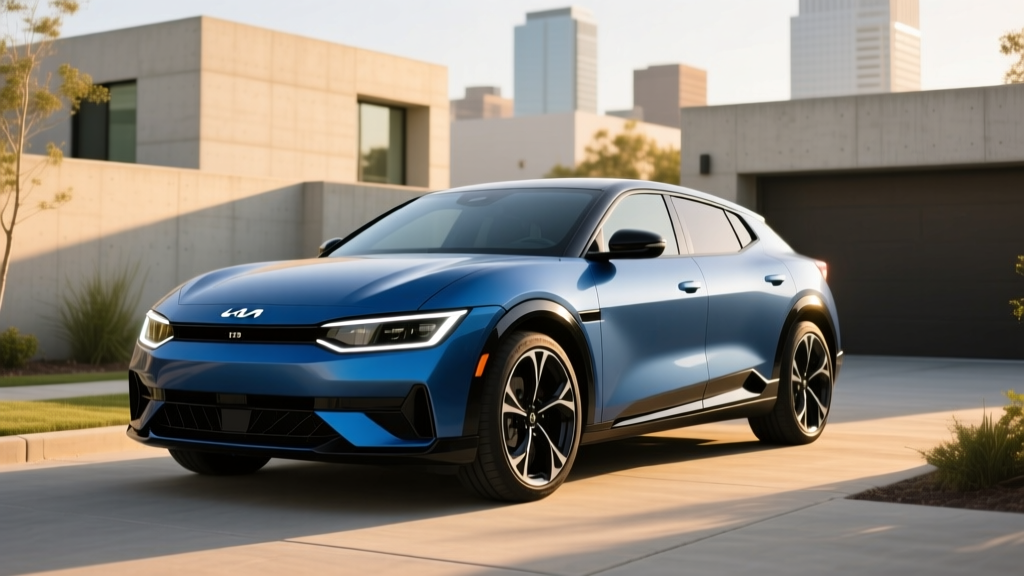
The Kia EV6 has carved out a distinct niche in the midsize electric crossover segment by pairing sports-sedan performance with practical SUV proportions. For 2026, Kia continues to refine the EV6 with updated battery packs, a refreshed interior, and expanded driver-assist features. But beyond the marketing gloss, buyers need hard numbers: exactly how much room does this thing offer, what's the real-world range, and how fast does it actually charge when you're on a road trip?
This review breaks down every critical spec — from EV6 dimensions and cargo volume to DC fast-charge curves and federal tax credit eligibility — so you can make an informed decision without cross-referencing a dozen tabs.
2026 Kia EV6 Dimensions and Interior Space
The EV6 rides on Hyundai Motor Group's E-GMP (Electric Global Modular Platform), which uses a flat skateboard-style battery pack to maximize cabin volume relative to its footprint. Here's how the numbers stack up:
| Measurement | Specification |
|---|---|
| Wheelbase | 114.2 in |
| Overall Length | 184.8 in |
| Overall Width | 74.4 in |
| Overall Height | 61.0 in |
| Front Headroom | 39.0 in |
| Rear Headroom | 38.0 in |
| Front Legroom | 41.7 in |
| Rear Legroom | 39.4 in |
| Cargo (rear seats up) | 24.4 cu ft |
| Cargo (rear seats folded) | 50.2 cu ft |
| Front Trunk (Frunk) | 1.8 cu ft (RWD) / 0.7 cu ft (AWD) |
| Curb Weight | 4,502–4,817 lbs (varies by trim) |
The 114.2-inch wheelbase is the key to the EV6's interior generosity. It's actually longer than the Tesla Model Y's wheelbase (113.8 in), and that translates directly to rear-seat comfort. Adults over six feet tall will find the rear seats genuinely accommodating — the 39.4 inches of rear legroom outpaces the Ford Mustang Mach-E (38.9 in) and is close to the Hyundai Ioniq 5 (39.4 in, its platform sibling).
The cargo area is where the EV6's fastback roofline imposes a trade-off. At 24.4 cubic feet behind the second row, it trails the Model Y (30.2 cu ft) and the Ioniq 5 (27.2 cu ft). The sloping roofline cuts into vertical space for taller items like dog crates or stacked luggage. Fold the rear seats and you get 50.2 cu ft — usable for flat-load hauling but again, not class-leading.
The frunk is modest. On AWD models, it's a shallow 0.7 cu ft — enough for a charging cable and a small bag, not a proper storage compartment. RWD models offer slightly more at 1.8 cu ft. If frunk utility matters to you, the Ford F-150 Lightning or Rivian R1S are in a different league here.
Range, Efficiency, and Real-World Expectations
The 2026 EV6 is offered with two battery configurations. The standard-range Light trim uses a smaller pack, while the Wind, GT-Line, and GT trims use the extended-range pack.
| Trim | Battery (usable kWh) | Chemistry | Drivetrain | EPA Range | MPGe (combined) | kWh/100 mi |
|---|---|---|---|---|---|---|
| Light RWD | 58.0 kWh | NMC | RWD | 232 mi | 117 MPGe | 29 |
| Wind RWD | 77.4 kWh | NMC | RWD | 310 mi | 117 MPGe | 29 |
| GT-Line AWD | 77.4 kWh | NMC | AWD | 282 mi | 106 MPGe | 32 |
| GT AWD | 77.4 kWh | NMC | AWD | 231 mi | 85 MPGe | 39 |
The EPA-rated 310 miles on the Wind RWD is achievable in mild-weather city and suburban driving at moderate speeds. On sustained highway trips at 70–75 mph, expect 260–280 miles before needing to charge. In cold weather (below 32°F), range drops 15–25% depending on cabin heating use — plan for 230–260 miles in winter highway conditions. The GT trim, with its higher-output dual motors and stickier tires, sacrifices significant efficiency; real-world highway range often lands around 190–210 miles.
All EV6 models use NMC (nickel manganese cobalt) lithium-ion chemistry, which prioritizes energy density over the cycle-life longevity of LFP (lithium iron phosphate). NMC packs offer more range per kilogram but are more sensitive to sustained high-state-of-charge storage. Kia recommends charging to 80% for daily use and reserving 100% for long trips — a practice that meaningfully extends pack life over a decade of ownership.
The EV6's heat pump (standard on all trims) recovers waste heat from the powertrain to warm the cabin, reducing the winter range penalty compared to EVs without one. In our experience, the heat pump buys back roughly 5–8% of range in sub-freezing conditions versus resistive heating alone.
Charging Speed: 800V Architecture That Delivers
The EV6's 800-volt electrical architecture remains one of its strongest competitive advantages. While most rivals in this price range still use 400V systems, the EV6 can accept significantly higher charge power when paired with a capable DC fast charger.
| Charging Level | Power | Time / Rate |
|---|---|---|
| Level 1 (120V household) | ~1.4 kW | ~3–4 mi/hr added |
| Level 2 (240V, 48A home charger) | 11.5 kW | ~32 mi/hr; full charge in ~7.5 hr (77.4 kWh pack) |
| DC Fast Charge (peak) | 240 kW (extended-range) | 10–80% in ~18 minutes on a 350 kW charger |
| DC Fast Charge (standard-range) | ~180 kW | 10–80% in ~20 minutes |
| Charge Port | NACS (Tesla Supercharger compatible via native port on 2025+ models; CCS via adapter on earlier builds) | |
That 10–80% time of 18 minutes is real — but with an important caveat. The 240 kW peak rate only holds between roughly 10% and 35% state of charge. From 35–60%, the rate tapers to approximately 180 kW, and from 60–80%, it drops further to around 110–130 kW. This is normal charge-curve behavior for NMC packs, but it means the average charge rate during a 10–80% session is closer to 160 kW, not the 240 kW headline figure.
For road-trip planning, budget roughly 25–30 minutes per stop (including plugging in, authentication, and getting back to the car). At a 350 kW Electrify America or Tesla Supercharger V4 station, you'll add approximately 180–200 miles of range in that window.
At home, the 11.5 kW onboard charger is competitive. A 48-amp Level 2 wallbox on a dedicated 60-amp circuit will replenish the 77.4 kWh pack from empty to full overnight. According to fueleconomy.gov, the EV6's onboard charger and thermal management work together to precondition the battery during navigation-routed charging sessions — a feature that's critical for achieving those peak DC charge rates in cold weather.
Performance and Driving Dynamics
| Trim | Horsepower | Torque (lb-ft) | Drivetrain | 0–60 mph |
|---|---|---|---|---|
| Light RWD | 167 hp | 258 | RWD (single motor) | 7.3 sec |
| Wind RWD | 225 hp | 258 | RWD (single motor) | 6.2 sec |
| GT-Line AWD | 320 hp | 446 | AWD (dual motor) | 4.5 sec |
| GT AWD | 576 hp | 545 | AWD (dual motor) | 3.4 sec |
The EV6 GT-Line AWD is the sweet spot for most buyers — 320 hp and a 4.5-second 0–60 time deliver genuinely quick acceleration without the GT's range and price penalties. The dual-motor AWD system provides confident traction in rain and light snow, with torque vectoring that makes the car feel planted through corners despite its 4,700+ lb curb weight.
The GT is a legitimate performance machine — 576 hp and a 3.4-second sprint puts it in Porsche Taycan territory off the line. But the trade-off is significant: 231 miles of EPA range, a firmer ride, and a $61,600 starting price that pushes it into luxury-EV territory where buyers might cross-shop the BMW i4 M50 or Tesla Model 3 Performance.
All trims feature one-pedal driving via adjustable regenerative braking (four levels, including i-PEDAL for full stop), paddle-shift regen controls, and a low center of gravity from the floor-mounted battery pack that gives the EV6 surprisingly flat cornering manners for a crossover.
Pricing, Trims, and Federal Tax Credit Eligibility
| Trim | Base MSRP | As-Tested (typical) | Est. Federal Credit (§30D) |
|---|---|---|---|
| Light RWD | $44,100 | $45,500 | Up to $7,500* |
| Wind RWD | $48,500 | $50,800 | Up to $7,500* |
| GT-Line AWD | $54,200 | $57,500 | Up to $7,500* |
| GT AWD | $61,600 | $64,000 | Up to $7,500* |
*Federal tax credit eligibility is subject to IRS §30D rules. As of 2026, the full $7,500 credit requires the vehicle to meet critical-mineral sourcing and battery-component manufacturing thresholds that shift annually. Buyer income caps also apply: modified AGI must not exceed $150,000 (single), $225,000 (head of household), or $300,000 (joint). The EV6 qualifies as an SUV for the $80,000 MSRP cap. Point-of-sale transfer to the dealer is available, effectively reducing the purchase price at signing. Always verify current eligibility on IRS.gov or consult a tax professional before relying on credit amounts.
Kia also offers the EV6 through a point-of-sale credit transfer, meaning the dealer applies the credit as a price reduction at purchase rather than waiting for a tax refund at filing. This makes the effective starting price of the Light RWD potentially as low as ~$36,600 for eligible buyers — a compelling entry point for a 232-mile EV with 800V charging.
Tech, Driver Assists, and Standout Features
The 2026 EV6 comes equipped with Kia's latest infotainment and ADAS suite:
- Dual 12.3-inch displays: A curved panoramic setup combining the digital instrument cluster and infotainment touchscreen, running Kia's latest Connect interface with wireless Apple CarPlay and Android Auto.
- Highway Driving Assist 2 (HDA-2): A Level 2 driver-assist system combining adaptive cruise control, lane-centering, and lane-change assist. Per SAE International definitions, this is Level 2 automation — the driver must remain fully engaged and cannot delegate driving responsibility.
- Remote Smart Parking Assist: The EV6 can park or unpark itself in tight spaces while the driver stands outside using the key fob.
- V2L (Vehicle-to-Load): The EV6 can output up to 3.6 kW of AC power through an interior outlet and an external adapter, enough to run a laptop, power tools at a job site, or a small refrigerator during an outage.
- Digital Key 2: Use your smartphone as a key via NFC and UWB, with the ability to share access with family members.
- Augmented-reality head-up display: Available on GT-Line and GT trims, projecting navigation arrows and speed onto the windshield in your line of sight.
Highway Driving Assist 2 is a Level 2 driver-assist system, not a self-driving feature. The driver must keep hands on or near the wheel, monitor the road at all times, and be prepared to take over instantly. The system will issue escalating warnings and eventually bring the vehicle to a stop if it detects driver inattention. Do not confuse HDA-2 with Level 4 autonomous services like Waymo.
Notable drawbacks include the EV6's lack of a traditional rear wiper (the fastback design relies on aerodynamic airflow to clear the glass, which doesn't always work in heavy rain) and the touch-sensitive climate control strip that replaces physical buttons — a usability frustration when you're trying to adjust temperature while driving.
Warranty Coverage
Kia's warranty remains one of the strongest in the EV segment:
- Battery pack: 10 years / 100,000 miles (capacity retention above 70% of original)
- Electric powertrain (motors, inverter, reducer): 10 years / 100,000 miles
- Bumper-to-bumper: 5 years / 60,000 miles
- Roadside assistance: 5 years / 60,000 miles
The 10-year/100,000-mile battery warranty is a significant advantage over competitors like the Tesla Model Y (8 years / 120,000 miles) and the Ford Mustang Mach-E (8 years / 100,000 miles). The 70% capacity retention threshold is standard for the industry. In practice, NMC packs in the E-GMP platform have shown degradation of roughly 8–12% over the first 100,000 miles based on owner-reported data, meaning most owners will never approach the warranty claim threshold.
Pros and Cons
- 800V architecture enables 10–80% DC charging in ~18 min
- Spacious rear seat with 39.4 in legroom
- Class-leading 10-yr/100,000-mi battery warranty
- V2L capability (3.6 kW output)
- GT trim offers supercar-level 3.4-sec 0–60
- Heat pump standard on all trims
- NACS port for native Tesla Supercharger access
- Cargo space (24.4 cu ft) trails Model Y and Ioniq 5
- Frunk is nearly useless on AWD models (0.7 cu ft)
- GT trim range drops to 231 mi EPA
- No rear wiper on fastback hatch
- Touch-sensitive HVAC controls frustrate while driving
- Standard-range Light trim limited to 232 mi range
- Base price above $44K before options
Who Is the 2026 Kia EV6 Best For?
- Choose the EV6 Wind RWD if: You want maximum range (310 mi EPA), fast DC charging, and don't need AWD. Best for commuters and road-trippers in moderate climates.
- Choose the EV6 GT-Line AWD if: You need all-weather traction, want quick 4.5-sec acceleration, and can accept 282 mi of range. Best for families in four-season climates.
- Choose the EV6 GT if: Performance is the priority and you have reliable home charging to offset the 231-mi range. Best for enthusiasts who also daily-drive.
- Look elsewhere if: Maximum cargo volume is critical (consider the Model Y or Ioniq 5), you need three rows (Kia EV9), or your budget is under $40K (consider the Chevy Equinox EV or Hyundai Kona Electric).
The EV6 excels as a daily commuter and weekend road-tripper for households of two to four people. Its rear-seat dimensions accommodate child seats and adult passengers comfortably, and the 800V charging architecture means road-trip stops are measured in minutes, not half-hours. It's less ideal for buyers who regularly haul bulky cargo or need the frunk utility that competitors like the Mustang Mach-E (4.7 cu ft frunk) or Rivian R1S offer.
Frequently Asked Questions
What is the real-world range of the 2026 Kia EV6?
The Wind RWD's EPA rating is 310 miles, but expect 260–280 miles on highway trips at 70+ mph, and 230–260 miles in cold weather below freezing. The GT-Line AWD delivers roughly 240–260 miles real-world highway, while the GT averages 190–210 miles in spirited driving.
How fast does the EV6 charge at home and on DC fast chargers?
At home on a 48-amp Level 2 charger (11.5 kW), the 77.4 kWh pack charges fully in about 7.5 hours. On a 350 kW DC fast charger, the EV6 peaks at 240 kW and reaches 10–80% in approximately 18 minutes, though the average charge rate across the session is closer to 160 kW due to tapering above 35% SoC.
Does the 2026 Kia EV6 qualify for the federal EV tax credit?
The EV6 has qualified for up to $7,500 under IRS §30D, but eligibility depends on battery-sourcing requirements that tighten annually, buyer income caps ($150K single / $300K joint), and the $80K MSRP cap for SUVs. Point-of-sale transfer is available. Verify current-year rules at IRS.gov before purchasing.
Is the EV6 worth buying over the Tesla Model Y or Hyundai Ioniq 5?
The EV6 wins on charging speed (800V vs. 400V on the Ioniq 5), warranty length (10 years vs. 8 for Tesla and Hyundai), and rear-seat comfort. The Model Y wins on cargo volume (30.2 vs. 24.4 cu ft) and Supercharger network seamlessness. The Ioniq 5 offers more cargo space and a boxier design. If fast DC charging and long warranty matter most, the EV6 is the stronger pick.
What are the EV6's biggest drawbacks?
Cargo volume is below segment average, the frunk is negligible on AWD trims, the GT sacrifices too much range for its performance gains, and the touch-sensitive HVAC panel is a usability downgrade. There's also no rear wiper, which is a safety concern in heavy rain.
Can the EV6 tow, and does it have V2L?
The EV6 is rated to tow up to 2,700 lbs (braked) on AWD trims — sufficient for a small utility trailer or a pair of dirt bikes, but not a camper. V2L (Vehicle-to-Load) is standard, providing up to 3.6 kW of AC power through an interior outlet or the external charge-port adapter.