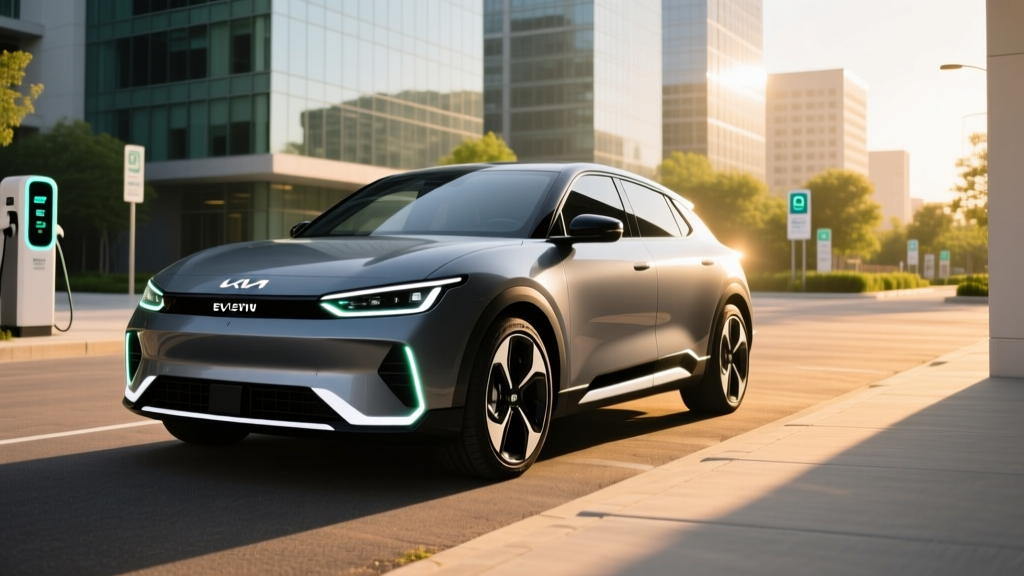
Kia's electric portfolio has expanded rapidly, and the 2026 Kia EV10 slots in as the brand's entry-level electric crossover, positioned below the EV6 and EV9 in both size and price. Built on a dedicated EV platform with Kia's latest battery and thermal-management technology, the EV10 targets urban commuters and small families who want a practical, affordable EV without stepping up to mid-size pricing. We've compiled the full spec sheet, real-world efficiency data, charging benchmarks, and tax-credit eligibility to help you decide if the EV10 earns a spot on your shortlist.
Quick Verdict: Who the Kia EV10 Is For
The 2026 Kia EV10 is best suited for city-dwelling commuters and small households who prioritize low running costs, compact dimensions for tight parking, and quick DC fast charging over maximum range or towing capability. With an EPA-estimated range up to 290 miles on the Long Range trim, 800V-class fast charging, and a starting MSRP near $30,000, it competes directly with the Chevrolet Equinox EV, Hyundai Kona Electric, and Nissan Ariana. If you need a third row, heavy towing, or 350+ miles of range, look to the EV9 or a larger platform. For daily driving under 60 miles with occasional road trips, the EV10 is a strong value proposition.
Range, Efficiency, and Real-World Expectations
Kia offers the 2026 EV10 in two battery configurations: a Standard Range model and a Long Range model. The EPA-estimated range figures set the baseline, but real-world results depend heavily on driving style, temperature, and terrain.
Standard Range (RWD): EPA 220 miles — Expect ~185-200 mi highway, ~165-180 mi in freezing temps
Long Range (RWD): EPA 290 miles — Expect ~245-265 mi highway, ~215-235 mi in freezing temps
Long Range (AWD): EPA 265 miles — Expect ~220-240 mi highway, ~195-215 mi in freezing temps
Highway driving at 75+ mph reduces range 10-15% vs. EPA combined. Cold weather (below 32°F) with cabin heating can cut range 20-30%. Preconditioning the battery while plugged in recovers some of this loss.
Efficiency ratings from fueleconomy.gov place the Long Range RWD at approximately 113 MPGe combined (30 kWh/100 mi), which is competitive for the segment. The Standard Range model achieves slightly higher MPGe due to its lighter curb weight, but the smaller battery means more frequent charging stops on longer trips.
Battery, Chemistry, and Platform Details
The 2026 EV10 uses Kia's latest-generation battery packs with cell-to-module architecture for improved energy density and thermal management. Here's what we know about the chemistry and capacity:
| Specification | Standard Range | Long Range |
|---|---|---|
| Usable Battery Capacity | 58.3 kWh | 77.4 kWh |
| Chemistry | LFP (Lithium Iron Phosphate) | NMC (Nickel Manganese Cobalt) |
| Voltage Architecture | 800V nominal | 800V nominal |
| Thermal Management | Liquid-cooled with heat pump | Liquid-cooled with heat pump |
| Estimated Weight | ~3,850 lbs | ~4,200 lbs |
LFP vs. NMC — what it means for you: The Standard Range's LFP battery offers superior cycle life (often 3,000+ cycles before significant degradation) and can be charged to 100% daily without accelerating wear — ideal for commuters who always want a full charge. The trade-off is lower energy density and reduced cold-weather performance. The Long Range's NMC pack delivers more miles per charge and better cold-weather range retention, but Kia recommends charging to 80% for daily use and only going to 100% before long trips to preserve long-term health.
Charging Speed: DC Fast, Level 2, and Level 1
Charging speed is where the EV10's 800V architecture pays dividends. Unlike 400V competitors that peak around 100-150 kW, the EV10 can accept significantly higher power at compatible DC fast chargers, cutting road-trip downtime.
| Charging Level | Max Power | 10-80% Time (Long Range) | Miles Added per Hour |
|---|---|---|---|
| Level 1 (120V household) | 1.4 kW | ~48+ hours | ~4-5 mi/hr |
| Level 2 (240V, 48A home charger) | 11.5 kW | ~6.5 hours | ~35-38 mi/hr |
| DC Fast Charge (350 kW station) | Peak 239 kW | ~18 minutes | N/A (session-based) |
| DC Fast Charge (150 kW station) | Peak 148 kW | ~28 minutes | N/A (session-based) |
Charging curve reality check: The 239 kW peak rate is not sustained for the entire session. Like all EVs, the EV10's charge rate tapers as the battery fills — you'll see peak speeds between 10-50% State of Charge, then a gradual reduction. The 10-80% time of ~18 minutes on a 350 kW charger is excellent and matches class leaders. Above 80%, charging slows significantly to protect the battery; plan to charge only to 80% on road trips unless you need the extra miles to reach your next stop.
The EV10 comes equipped with a NACS (North American Charging Standard) port, granting access to Tesla Supercharger stations via Kia's charging partnership, alongside CCS-compatible networks like Electrify America and EVgo. For home charging, a 48-amp Level 2 wallbox on a 60-amp circuit delivers a full overnight charge in roughly 6-7 hours — sufficient for any daily commute.
Performance and Drivetrain
The EV10 isn't positioned as a performance EV, but it delivers adequate acceleration for merging and passing. Here are the powertrain specs by trim:
- Standard Range RWD: 168 hp, 0-60 mph in ~7.8 seconds
- Long Range RWD: 225 hp, 0-60 mph in ~6.5 seconds
- Long Range AWD (dual-motor): 320 hp, 0-60 mph in ~5.1 seconds
The single-motor RWD models use a rear-mounted permanent-magnet synchronous motor, giving the EV10 a balanced weight distribution and a tight turning radius suited to city driving. The AWD variant adds a front induction motor for all-weather traction and a meaningful power bump, though the extra weight and drivetrain losses reduce EPA range by roughly 25 miles.
Regenerative braking is adjustable through four levels via steering-wheel paddles, with Level 3 enabling near-one-pedal driving in city traffic. The system doesn't quite bring the car to a complete stop at the lowest speeds, so you'll still use the brake pedal occasionally.
Interior Space, Cargo, and Technology
As a compact crossover, the EV10 prioritizes efficient packaging over cavernous space. Kia's flat-floor EV architecture maximizes interior room relative to the exterior footprint.
- Front legroom: 41.7 inches
- Rear legroom: 37.8 inches
- Cargo behind rear seats: 25.4 cu ft
- Cargo with rear seats folded: 58.1 cu ft
- Front trunk (frunk): 1.8 cu ft (enough for a charging cable bag or small backpack)
The rear seat fits two adults comfortably for longer trips, though a third middle passenger will find the seat narrow. Child-seat installation via LATCH anchors is straightforward, and the rear doors open wide for easy loading.
Infotainment: A 12.3-inch touchscreen runs Kia's latest ccNC (Connected Car Navigation Cockpit) software with wireless Apple CarPlay and Android Auto, over-the-air updates, and integrated EV-specific features like route-based battery preconditioning. The system preheats or precools the battery when a DC fast-charger is set as your navigation destination, ensuring you hit peak charge rates on arrival.
Driver assistance: The EV10 comes standard with Kia's Highway Driving Assist 2 (HDA2), which includes adaptive cruise control with stop-and-go, lane-centering steering, and automated lane changes when you activate the turn signal. This is an SAE Level 2 system — you must keep your hands on the wheel and eyes on the road at all times. It does not make the EV10 a self-driving vehicle.
Pricing, Trims, and Federal Tax Credit Eligibility
The 2026 Kia EV10 is offered in three main trims with the following MSRP pricing (destination included):
| Trim | Drivetrain | MSRP | Est. After §30D Credit |
|---|---|---|---|
| Light (Standard Range) | RWD | $29,990 | ~$22,490* |
| Wind (Long Range) | RWD | $35,490 | ~$27,990* |
| GT-Line (Long Range) | AWD | $42,490 | ~$34,990* |
*Tax credit estimates assume full $7,500 eligibility under IRS §30D. Actual credit depends on your individual tax situation, income, and vehicle sourcing compliance. Credit can be applied as a point-of-sale rebate through a registered dealer.
- Buyer income caps: AGI ≤ $150,000 (single), $225,000 (head of household), $300,000 (joint)
- MSRP cap: Vehicle MSRP must not exceed $55,000 for SUVs/crossovers — all EV10 trims qualify
- Battery sourcing: Increasing percentages of critical minerals and battery components must be sourced from the U.S. or free-trade-agreement countries. Verify current-year compliance on irs.gov or with your dealer before purchase.
- Point-of-sale transfer: You can elect to transfer the credit to the dealer at purchase, reducing your out-of-pocket cost immediately rather than waiting to claim it on your tax return.
Warranty and Long-Term Ownership
Kia backs the EV10 with one of the strongest warranty packages in the segment:
- Battery warranty: 10 years / 100,000 miles (capacity retention guaranteed above 70% of original)
- Powertrain warranty: 10 years / 100,000 miles
- Bumper-to-bumper: 5 years / 60,000 miles
- Roadside assistance: 5 years / 60,000 miles
The 70% capacity retention threshold is standard for the industry, though some competitors guarantee 70% over 8 years rather than 10. Based on degradation data from similar Kia/Hyundai 800V battery packs, owners can expect approximately 5-8% capacity loss over the first 100,000 miles under normal charging habits — meaning a Long Range EV10 that started at 290 miles EPA would still deliver roughly 265-275 miles after a decade of use.
Insurance costs for the EV10 are expected to align with segment averages, roughly $1,400-$1,800 annually depending on your profile and state. Always get a personalized quote before purchase, as EV insurance premiums can be 10-20% higher than comparable gas vehicles due to repair-cost differentials.
Pros, Cons, and How It Compares
- Sub-$30,000 starting price before tax credits
- 800V architecture with ~18-min 10-80% DC charging
- 10-year/100,000-mi battery warranty
- LFP option for worry-free daily 100% charging
- NACS port for Supercharger access
- Compact dimensions with surprisingly usable cargo space
- HDA2 standard on all trims
- Standard Range model's 220-mi EPA range is modest for road trips
- Small frunk (1.8 cu ft) limits front storage
- Rear middle seat is narrow for three-across seating
- LFP battery loses more range in extreme cold vs. NMC
- No towing package available (not rated for towing)
- AWD only available on top GT-Line trim
Look elsewhere if: You need 350+ miles of range, three rows of seating, towing capability, or a large frunk. Consider the Kia EV6 for more range and power, the EV9 for three rows, or the Chevrolet Equinox EV for a larger cargo area at a similar price.
Frequently Asked Questions
What is the real-world range of the 2026 Kia EV10?
The Long Range RWD achieves an EPA-estimated 290 miles, but expect 245-265 miles on highway trips at 75 mph, and 215-235 miles in freezing weather with cabin heating active. The Standard Range model delivers roughly 185-200 real-world highway miles.
How fast does the Kia EV10 charge at home and on the road?
On a 350 kW DC fast charger, the EV10 peaks at 239 kW and charges from 10-80% in approximately 18 minutes. At home on a 48-amp Level 2 charger (11.5 kW), a full charge takes about 6.5 hours for the Long Range battery.
Does the 2026 Kia EV10 qualify for the $7,500 federal EV tax credit?
All EV10 trims fall under the $55,000 MSRP cap for SUVs. Eligibility depends on your adjusted gross income (≤$150K single / $300K joint) and the vehicle's battery-sourcing compliance with current-year IRS rules. Verify at irs.gov and with your dealer before purchasing.
Is the Kia EV10 worth buying over the Chevrolet Equinox EV or Hyundai Kona Electric?
The EV10's 800V fast-charging advantage is significant — it charges roughly 30-40% faster than 400V competitors at high-power stations. If DC charging speed matters for your road trips, the EV10 has a clear edge. The Equinox EV offers slightly more cargo space; the Kona Electric shares corporate DNA but lacks 800V architecture.
What charger connector does the Kia EV10 use?
The 2026 EV10 uses the NACS (North American Charging Standard) connector, providing native access to Tesla Supercharger stations. It is also compatible with CCS-equipped public chargers through the broader Kia charging network partnerships.
Can I charge the LFP battery to 100% every day?
Yes. LFP (lithium iron phosphate) batteries tolerate daily 100% charging without the accelerated degradation concerns of NMC chemistry. This makes the Standard Range EV10 ideal for owners who always want a full battery in the morning.