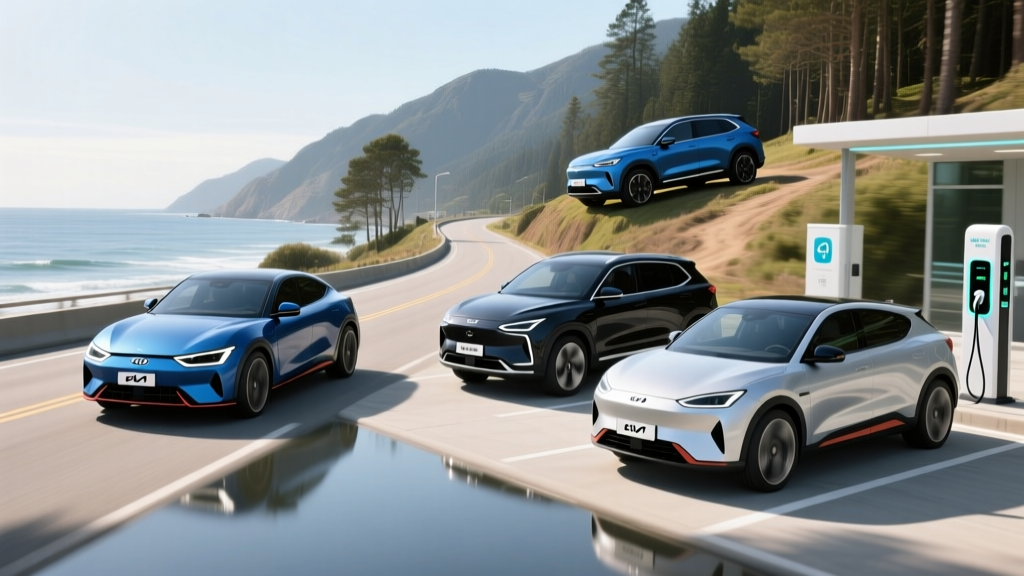
Kia has quietly built one of the most complete electric vehicle lineups in the mainstream market. Rather than betting on a single halo car, the automaker now offers three distinct Kia EV models spanning a compact crossover, a midsize performance SUV, and a three-row family hauler. For 2026, the lineup consists of the redesigned Niro EV, the refreshed EV6, and the flagship EV9 — each targeting a different buyer with different priorities and budgets.
This guide cuts through the marketing to give you the exact numbers that matter: real EPA range, actual charging speeds (not just peak kW), battery chemistry, federal tax credit eligibility under current IRS §30D rules, and the real-world ownership trade-offs Kia's spec sheets don't highlight. Whether you're cross-shopping the EV6 against a Tesla Model Y or wondering if the EV9 can actually replace your three-row gas SUV, the data below will help you decide.
2026 Kia EV Lineup at a Glance
Before diving into each model, here's how Kia's three EVs stack up on the specs that drive purchase decisions. All figures reflect 2026 model-year data from fueleconomy.gov and Kia's official specifications.
| Spec | Niro EV | EV6 (Long Range RWD) | EV9 (LR RWD) |
|---|---|---|---|
| Base MSRP | $39,600 | $42,900 | $54,900 |
| EPA Range | 239 mi | 310 mi | 304 mi |
| Battery (usable) | 64.8 kWh | 84.0 kWh | 100.0 kWh |
| Chemistry | NMC | NMC (4th-gen) | NMC (4th-gen) |
| Max DC Fast Charge | 85 kW | 240 kW | 210 kW |
| 10–80% DCFC Time | ~43 min | ~18 min | ~20 min |
| Level 2 Rate | 10.9 kW | 10.9 kW | 11.5 kW |
| 0–60 mph | 7.8 sec | 7.2 sec (RWD) / 4.5 sec (GT-Line AWD) | 8.2 sec (RWD) / 5.0 sec (AWD) |
| Horsepower | 201 hp | 225 hp (RWD) / 320 hp (AWD) | 215 hp (RWD) / 379 hp (AWD) |
| Combined MPGe | 113 MPGe | 134 MPGe | 88 MPGe |
| Cargo (behind 2nd row) | 23.7 cu ft | 24.4 cu ft | 20.2 cu ft (43.5 cu ft 2-row) |
| Battery Warranty | 10 yr / 100,000 mi | 10 yr / 100,000 mi | 10 yr / 100,000 mi |
2026 Kia Niro EV: The Budget-Conscious Daily Driver
The Niro EV is Kia's entry point into electric ownership — a compact crossover that prioritizes affordability and everyday practicality over headline-grabbing range or charging speed. For 2026, it carries over with the 64.8 kWh NMC battery pack and a single front-mounted motor producing 201 hp and 291 lb-ft of torque.
Range, Efficiency, and Real-World Expectations
Real-World Expectation: Expect 200–220 miles in mixed highway driving at 70 mph. In cold weather (below 30°F), plan for 170–190 miles due to cabin heating demands and increased battery resistance. City driving with regenerative braking can push closer to the 239-mile sticker. The Niro EV does not come with a heat pump in the U.S. market — a notable efficiency gap versus competitors like the Hyundai Kona Electric, which uses one to reduce cold-weather range loss.
At 113 MPGe combined (30 kWh/100 mi), the Niro EV is efficient but not class-leading. Its relatively small battery and lighter curb weight help in city commuting, but highway efficiency drops noticeably above 70 mph. If your daily commute is under 60 miles round-trip and you have reliable home charging, the Niro's range is more than adequate — but road-trippers will find themselves stopping more often than they'd like.
Charging Speed: The Niro's Biggest Limitation
Here's where the Niro EV shows its budget positioning most clearly. With a peak DC fast-charge rate of just 85 kW, a 10–80% session takes roughly 43 minutes at a compatible station. That's nearly double the time you'd spend at a Supercharger with a Tesla Model Y or at a 350-kW Electrify America station with the EV6.
| Charging Level | Power | Speed / Time |
|---|---|---|
| Level 1 (120V outlet) | ~1.4 kW | ~4 mi/hr added |
| Level 2 (240V home) | 10.9 kW | ~35 mi/hr; full charge in ~7 hr |
| DC Fast Charge | Peak 85 kW | 10–80% in ~43 min |
For daily ownership, Level 2 home charging is perfectly adequate — you'll wake up to a full battery every morning. But if you plan regular road trips exceeding 200 miles, the Niro's slow DC charging will be a recurring frustration. The 85 kW peak also means you won't benefit from newer 350 kW charging stations; the car simply can't accept that much power.
Pricing and Federal Tax Credit
The 2026 Niro EV starts at $39,600 for the Wind trim, with the SX Touring coming in at $44,100. Under current IRS §30D rules, the Niro EV may qualify for up to $7,500 in federal tax credits, but eligibility depends on several factors:
- Buyer income caps: AGI must not exceed $150,000 (single), $225,000 (head of household), or $300,000 (joint)
- MSRP cap: The Niro EV's price falls well under the $55,000 SUV/crossover cap
- Battery sourcing: The credit phases based on critical mineral and battery component sourcing requirements that tighten annually — verify current-year eligibility at purchase
- Point-of-sale transfer: Eligible buyers can apply the credit as a down-payment reduction at the dealer rather than waiting for tax filing
With the full $7,500 credit, the effective starting price drops to approximately $32,100 — making the Niro EV one of the most affordable new EVs available. However, battery-sourcing rules change annually, so confirm eligibility with your dealer and a tax professional before finalizing your purchase.
Who Should Buy the Niro EV?
The Niro EV is best for urban and suburban commuters who charge at home, drive fewer than 50 miles daily, and want the lowest entry price into Kia's EV lineup. It's not a road-trip car, and it's not fast — but it's a practical, well-equipped daily driver with Kia's excellent 10-year/100,000-mile battery warranty.
2026 Kia EV6: The Performance and Charging Champion
The EV6 remains Kia's technological showcase — built on the Hyundai Motor Group's E-GMP platform with 800V electrical architecture that enables some of the fastest DC charging in the mainstream market. For 2026, the EV6 continues with the updated 84.0 kWh fourth-generation NMC battery, offering improved energy density and a slightly revised charge curve.
Range and Efficiency That Deliver
Real-World Expectation: Highway cruising at 75 mph yields approximately 260–280 miles in moderate temperatures. In cold weather (20°F), expect 220–245 miles. The EV6 includes a standard heat pump on all U.S. trims, which significantly reduces winter range loss compared to the Niro EV. In city driving with regen, you can approach or even exceed the EPA figure.
At 134 MPGe combined (25 kWh/100 mi) in the Long Range RWD configuration, the EV6 is one of the most efficient midsize electric crossovers available. The GT-Line AWD variant drops to 282 miles EPA and 116 MPGe, a meaningful trade-off if you don't need all-wheel drive.
Charging Speed: Where the EV6 Earns Its Keep
The EV6's 800V architecture is the defining feature of this car. At a 350 kW DC fast charger, it peaks at 240 kW and sustains strong charging rates through the critical 10–80% window.
| Charging Level | Power | Speed / Time |
|---|---|---|
| Level 1 (120V outlet) | ~1.4 kW | ~4 mi/hr added |
| Level 2 (240V home) | 10.9 kW | ~35 mi/hr; full charge in ~8.5 hr |
| DC Fast Charge | Peak 240 kW | 10–80% in ~18 min |
The 18-minute 10–80% time is real, but with a critical caveat: you need a CCS-equipped charger capable of delivering 350 kW. At a 150 kW station (still common on many networks), expect 10–80% in roughly 28–32 minutes. The charge curve also tapers significantly above 80% — charging from 80–100% can add another 20+ minutes, so plan your stops to leave at 80% unless you absolutely need a full battery.
One practical note: Kia includes a Vehicle-to-Load (V2L) adapter with the EV6, allowing you to power external devices — camping gear, tailgate equipment, or emergency home appliances — at up to 3.6 kW from the charge port. It's a genuinely useful feature that most competitors still don't offer.
Performance and Driving Dynamics
The Long Range RWD model delivers 225 hp and a 7.2-second 0–60 time — brisk but not thrilling. The GT-Line AWD bumps output to 320 hp and drops 0–60 to 4.5 seconds, which is genuinely quick for a family crossover. The GT variant (576 hp, 3.4-second 0–60) continues for 2026 at $61,600, though its 206-mile EPA range makes it a niche choice for enthusiasts who prioritize acceleration over efficiency.
Ride quality is firm but well-damped, and the EV6's low center of gravity keeps body roll controlled through corners. Road noise is well-suppressed at highway speeds. The steering is precise if slightly numb — typical of electric power steering systems, but better calibrated than many competitors.
Interior, Tech, and Cargo
The EV6's interior is modern and well-built, anchored by a curved dual-12.3-inch display panel. Wireless Apple CarPlay and Android Auto are standard on all trims. The center console features a mix of physical buttons and touch-sensitive controls — the climate controls require a mode switch that toggles between HVAC and media, which is a recurring annoyance for some owners.
Cargo space measures 24.4 cubic feet behind the rear seats and 50.2 cubic feet with the rear seats folded. The rear-seat legroom of 39.4 inches is generous. A small front trunk (frunk) adds 0.7 cubic feet of storage — enough for charging cables but not much else.
Pricing and Tax Credit Eligibility
| Trim | MSRP | Est. After §30D Credit* |
|---|---|---|
| Light Long Range RWD | $42,900 | $35,400 |
| Wind RWD | $47,500 | $40,000 |
| GT-Line AWD | $53,200 | $45,700 |
| GT AWD | $61,600 | $54,100 |
*Credit eligibility depends on buyer income, battery-sourcing compliance, and MSRP caps per IRS §30D. The EV6's MSRP falls under the $80,000 SUV cap. Consult a tax professional and verify sourcing compliance at time of purchase.
2026 Kia EV9: The Three-Row Electric Family Hauler
The EV9 is Kia's largest and most expensive electric vehicle — and one of the very few three-row electric SUVs available in the mainstream market. It competes directly with the Rivian R1S (at a significantly lower price point) and the Tesla Model X (which is far more expensive). For families that need six or seven seats and are ready to go electric, the EV9 is currently the default choice in its price bracket.
Range and the Three-Row Trade-Off
Real-World Expectation: Highway driving at 75 mph yields approximately 255–275 miles in the RWD model and 230–250 miles in AWD. Cold weather drops these figures by roughly 15–20%. The EV9 includes a heat pump standard. With a 100.0 kWh usable battery, you have substantial energy reserves, but the EV9's 5,000+ lb curb weight and boxy aerodynamics work against highway efficiency. Plan conservatively on long trips.
At 88 MPGe combined (38 kWh/100 mi), the EV9 is less efficient than the EV6 — the unavoidable physics of a larger, heavier, less aerodynamic vehicle. That translates to roughly $0.05–0.07 per mile in electricity costs at national average residential rates ($0.16/kWh), still far cheaper than a comparable gas-powered three-row SUV at $0.14–0.18 per mile.
Charging the Big Battery
The EV9's 100.0 kWh battery is large, and Kia rates its peak DC fast-charge speed at 210 kW. Here's what that looks like in practice:
| Charging Level | Power | Speed / Time |
|---|---|---|
| Level 1 (120V outlet) | ~1.4 kW | ~3 mi/hr added |
| Level 2 (240V home) | 11.5 kW | ~30 mi/hr; full charge in ~10 hr |
| DC Fast Charge | Peak 210 kW | 10–80% in ~20 min |
The 20-minute 10–80% time is impressive for a vehicle this size, but again requires a 350 kW-capable station. At 150 kW chargers, expect 28–35 minutes. Home Level 2 charging at 11.5 kW will fully replenish the battery overnight, which is the primary use case for most EV9 owners. Budget for a 48-amp Level 2 home charger installation — the EV9's larger battery benefits from the faster Level 2 rate compared to a standard 32-amp unit.
Space, Comfort, and Family Practicality
The EV9 offers three rows with seating for six (captain's chairs) or seven (bench second row). Third-row legroom is 32.0 inches — adequate for children and shorter adults on trips under an hour, but tight for taller passengers on longer drives. Cargo space behind the third row is 20.2 cubic feet, expanding to 43.5 cubic feet behind the second row and 81.7 cubic feet with both rear rows folded.
The second row is where the EV9 shines: captain's chairs offer generous legroom (42.8 inches), and available power-reclining and relaxation features make it a comfortable space for long trips. Available second-row sunshades and USB-C ports on every row round out the family-friendly features.
Pricing and Value Proposition
The 2026 EV9 starts at $54,900 for the Light RWD trim and climbs to $73,900 for the GT-Line AWD Prestige. Under §30D rules, the EV9 qualifies for the credit category for SUVs/vans with an $80,000 MSRP cap — all trims fall under this limit. Buyer income caps still apply ($150K/$225K/$300K), and battery-sourcing requirements must be met.
Even without the federal credit, the EV9 undercuts the Rivian R1S by roughly $15,000 and the Tesla Model X by over $30,000, making it the most affordable new three-row EV available. Kia also offers the EV9 through its Kia Access subscription program in select markets, which may appeal to families who want to try electric without a long-term commitment.
Federal Tax Credit: What You Actually Need to Know
The federal EV tax credit under IRS §30D is not a guaranteed $7,500 for every buyer. Here's a precise checklist of what determines eligibility for Kia EV models in 2026:
- Vehicle MSRP cap: Must be ≤ $55,000 for sedans/wagons or ≤ $80,000 for SUVs/vans/pickups. All three Kia EV models fall under their respective caps.
- Buyer AGI limits: $150,000 (single filer), $225,000 (head of household), $300,000 (married filing jointly). If your modified AGI exceeds these thresholds in either the purchase year or the prior year, you are ineligible.
- Critical minerals requirement: A percentage of critical minerals in the battery must be sourced from the U.S. or a free-trade-agreement country. This threshold increases annually.
- Battery components requirement: A percentage of battery components must be manufactured or assembled in North America. This threshold also tightens annually.
- Foreign entity of concern (FEOC) restriction: Vehicles with battery components or critical minerals from a FEOC are disqualified entirely.
- Point-of-sale transfer: You can elect to transfer the credit to the dealer at purchase, reducing your down payment or monthly payment. The dealer must be IRS-registered.
Kia's battery sourcing has historically aligned with §30D requirements for most trims, but the specific credit amount (full $7,500, partial $3,750, or $0) can vary by model year and production batch. Always confirm the exact credit amount with your dealer and verify against the DOE's fueleconomy.gov tax credit tracker before signing.
Kia EV Models vs. Key Competitors
Each Kia EV model faces distinct competition. Here's how they compare on the metrics that matter most:
Niro EV vs. Hyundai Kona Electric vs. Chevrolet Bolt EUV
The Niro EV competes primarily with the Hyundai Kona Electric (261 mi EPA, 100+ kW DCFC) and the Chevrolet Bolt EUV (discontinued after 2025, but available used). The Niro's 85 kW charge rate is its weakest competitive point — the Kona Electric charges significantly faster. If road trips are part of your routine, the Kona is the stronger pick. If you prioritize interior space and Kia's warranty, the Niro holds up well.
EV6 vs. Tesla Model Y vs. Ford Mustang Mach-E vs. Hyundai Ioniq 5
The EV6's closest rivals are the Tesla Model Y (310 mi, Supercharger access), the Ford Mustang Mach-E (312 mi Extended Range), and the Hyundai Ioniq 5 (303 mi, same E-GMP platform). The EV6's charging speed is a genuine advantage over the Mach-E. Against the Model Y, Tesla's Supercharger network remains more reliable than third-party CCS networks, though Kia EVs now have access to Tesla Superchargers via the NACS adapter — a significant improvement in road-trip practicality. The Ioniq 5 shares most of the EV6's hardware but with a more retro design and slightly different packaging.
EV9 vs. Rivian R1S vs. Tesla Model X
The EV9 occupies a near-monopoly in the affordable three-row EV segment. The Rivian R1S offers superior off-road capability and a more premium interior but starts above $70,000. The Tesla Model X starts above $85,000. For families who simply need three rows and electric propulsion under $60,000, the EV9 is currently the only answer.
Pros Across the Kia EV Lineup
- Industry-leading 10-year/100,000-mile battery and powertrain warranty
- EV6 and EV9 offer best-in-class DC fast-charge speeds
- Heat pump standard on EV6 and EV9 for cold-weather efficiency
- Competitive pricing, especially after federal tax credits
- NACS adapter compatibility unlocks Tesla Supercharger network
- V2L capability on EV6 and EV9 for external power
- Well-equipped interiors with standard wireless phone integration
Cons Across the Kia EV Lineup
- Niro EV's 85 kW DC charging is painfully slow for road trips
- No heat pump on the Niro EV — significant cold-weather range loss
- EV9 third row is tight for adults on longer drives
- CCS public charging reliability still lags behind Tesla Superchargers
- Touch-sensitive climate/media toggle on EV6 is frustrating
- EV9 efficiency (88 MPGe) means higher per-mile electricity costs
- No frunk worth mentioning on any Kia EV model
Which Kia EV Model Is Right for You?
Choose the Niro EV if: You're a commuter driving under 50 miles daily, you charge at home every night, you want the lowest possible entry price into a new EV, and road trips are rare. The effective ~$32,000 price after tax credits is hard to beat.
Choose the EV6 if: You want a do-it-all electric crossover that handles daily commuting and road trips equally well. The 310-mile range and 18-minute fast-charging make it genuinely practical for long-distance travel, and the efficiency keeps running costs low. This is Kia's best all-around EV.
Choose the EV9 if: You need three rows of seating and refuse to compromise on going electric. The 304-mile range and 20-minute charging make it viable for family road trips, and nothing else in its price range offers the same combination of space, range, and charging speed.
Ownership Costs and Long-Term Value
Kia's 10-year/100,000-mile battery and powertrain warranty is among the best in the industry and applies to all three EV models. The warranty covers battery capacity below 70% of original — a reasonable threshold, though some competitors (like Hyundai) use the same figure. Real-world data from E-GMP platform vehicles (EV6, Ioniq 5) suggests degradation of approximately 5–8% over the first 60,000 miles under normal use, well within warranty coverage.
Insurance costs vary significantly by model and region. The EV6 GT-Line AWD and EV9 typically carry higher premiums than the Niro EV due to higher repair costs and vehicle values. Get quotes from your insurer before purchasing — in some cases, EV insurance premiums can be 15–25% higher than comparable gas vehicles.
Maintenance costs are minimal: no oil changes, no spark plugs, no transmission fluid. Expect to replace cabin air filters, brake fluid (every 2–3 years), and tires (EVs wear tires faster due to weight and instant torque). Budget approximately $0.02–0.03 per mile for maintenance, compared to $0.08–0.12 per mile for a gas equivalent.
Frequently Asked Questions
What is the real-world range of Kia EV models?
The Niro EV delivers approximately 200–220 miles in real-world highway driving (EPA 239). The EV6 Long Range RWD achieves 260–280 miles highway (EPA 310). The EV9 RWD manages 255–275 miles highway (EPA 304). Cold weather reduces these figures by 10–20% depending on severity. All three include regenerative braking that helps recover range in city driving.
How fast do Kia EVs charge at home and on the road?
At home on Level 2 (240V), all three Kia EV models charge at 10.9–11.5 kW, adding 30–35 miles of range per hour — enough for a full overnight charge. On DC fast chargers, the EV6 is the fastest at 18 minutes (10–80%), the EV9 takes about 20 minutes, and the Niro EV takes roughly 43 minutes due to its 85 kW peak rate.
Do Kia EV models qualify for the $7,500 federal tax credit?
All three models fall under the applicable MSRP caps and can qualify for up to $7,500 under IRS §30D, but eligibility depends on your income, the battery's critical-mineral and component sourcing, and current-year phase-in thresholds. The credit can be transferred at the point of sale to reduce your purchase price. Always verify eligibility at irs.gov and with your tax professional.
Can Kia EVs use Tesla Superchargers?
Yes. Starting in 2025, Kia EVs gained access to Tesla's Supercharger network via a NACS adapter (included or available from Kia). This significantly improves road-trip charging options, particularly in areas where CCS infrastructure is sparse. Future Kia EV models will be built with native NACS ports.
How long will the battery last in a Kia EV?
Kia warranties its EV batteries for 10 years or 100,000 miles against capacity loss below 70%. Based on data from E-GMP platform vehicles now in their third and fourth model years, typical degradation is 5–8% over 60,000 miles. With proper care (avoiding frequent 100% charges on NMC batteries, using DC fast charging judiciously), these batteries should retain 80%+ capacity well past 150,000 miles. Full battery replacement costs, if ever needed, are estimated at $10,000–$18,000 depending on the model.
Is the Kia EV9 worth it over a gas three-row SUV?
If you can charge at home and your driving is mostly within 250 miles, the EV9 offers dramatically lower fuel costs (roughly $0.05–0.07/mile vs. $0.14–0.18/mile for a gas equivalent), minimal maintenance, and a quiet, smooth driving experience. The trade-offs are higher upfront cost, longer refueling time on road trips, and reduced third-row space versus a Kia Telluride. For families who drive under 300 miles daily and charge at home, the total cost of ownership over five years can be lower than a comparable gas SUV, especially after the federal tax credit.