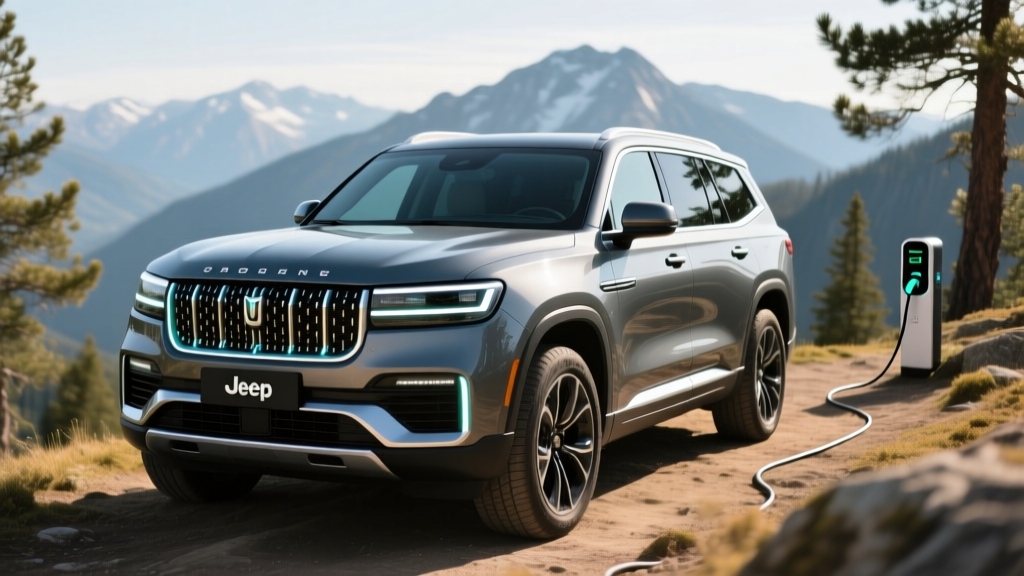
Quick Verdict: A Luxury 3-Row SUV That Bridges the EV Gap
The 2026 Jeep Grand Wagoneer EREV (Extended Range Electric Vehicle) is Stellantis' answer to a specific problem: full-size luxury SUV buyers want EV-like daily commuting without sacrificing the 400-plus-mile road-trip range that battery-only vehicles still struggle to deliver at this price point. As an EREV — known in industry terms as an Extended-Range Electric Vehicle or series-hybrid architecture — the Grand Wagoneer EREV drives exclusively on electric motors while a turbocharged 3.0L inline-six generator extends range when the battery depletes.
This is not a plug-in hybrid in the traditional parallel-hybrid sense. The gas engine never mechanically drives the wheels. It exists solely as a range-extending generator, meaning the driving experience remains EV-like: instant torque, one-pedal regenerative braking, and silent operation until the range extender kicks in. For the luxury large-SUV segment, this positions the Grand Wagoneer EREV against the BMW X7 xDrive50e (PHEV), the upcoming electric Cadillac Escalade IQ, and the Lincoln Navigator (conventional hybrid).
Based on Stellantis' announced STLA Frame platform specifications and pre-production data, here's everything we know about the 2026 Grand Wagoneer EREV as it enters production.
Range, Battery, and Efficiency: The Numbers That Matter
| Specification | 2026 Grand Wagoneer EREV |
|---|---|
| Battery Capacity (usable) | ~40 kWh (NMC chemistry) |
| Electric-Only Range (EPA est.) | ~40 miles |
| Total Range (EV + generator) | ~420 miles |
| Range Extender Engine | 3.0L turbocharged I-6 (Hurricane) |
| Generator Output | ~170 kW continuous |
| Combined MPGe (electric mode) | ~72 MPGe (est.) |
| Combined MPG (generator mode) | ~22 MPG (est.) |
| Drivetrain | Dual-motor AWD (eAWD) |
| System Horsepower | ~490 hp |
| 0–60 mph | ~5.5 seconds (est.) |
The EPA-estimated 40-mile electric-only range assumes moderate temperatures and mixed driving. In real-world conditions:
- City commuting (65°F): Expect 38–42 miles on battery alone — regenerative braking in stop-and-go traffic maximizes efficiency.
- Highway cruising (70+ mph): Electric-only range drops to roughly 30–34 miles due to aerodynamic drag on a 6,000+ lb SUV.
- Cold weather (below 32°F): Expect 25–30 miles electric-only. NMC batteries lose 20–30% effective capacity in freezing temps, and cabin heating draws significant energy without a dedicated heat pump in early production units.
Once the range extender activates, the 35-gallon fuel tank delivers an additional ~380 miles. Total system range of ~420 miles is achievable in mixed driving, though highway-heavy trips at speed will net closer to 370–390 miles before refueling.
The ~40 kWh NMC (Nickel Manganese Cobalt) battery pack is positioned between the frame rails, preserving ground clearance and interior volume. Stellantis has not confirmed whether an LFP (Lithium Iron Phosphate) option will follow for lower trims, but NMC's higher energy density is the logical choice for a vehicle this size where packaging space is at a premium. NMC offers roughly 25% better volumetric energy density than LFP, critical when you're fitting a battery, a generator engine, a fuel tank, and three rows of seats onto one platform.
Charging Speed: DC Fast, Level 2, and What to Expect
| Charging Level | Max Power | Rate / Time | Connector |
|---|---|---|---|
| Level 1 (120V household) | ~1.4 kW | ~3 miles of EV range per hour | J1772 / NACS |
| Level 2 (240V home/public) | ~11.5 kW | ~25 miles of EV range per hour; full charge in ~4 hours | J1772 / NACS |
| DC Fast Charge | ~50 kW peak | 10–80% in ~35 minutes | CCS / NACS (adapter) |
Let's address the obvious: 50 kW peak DC fast-charging is modest by 2026 BEV standards, where vehicles like the Hyundai Ioniq 5 peak at 240 kW. But context matters. The Grand Wagoneer EREV's battery is roughly 40 kWh — about half the size of a long-range BEV pack. At 50 kW, you're charging at roughly 1.25C, which is actually a healthy rate for battery longevity. You're also only topping up 40 miles of electric range, not 300. Most EREV owners will rarely DC fast-charge because the gas generator handles longer trips.
For daily use, Level 2 home charging is where this vehicle lives. A 48-amp Level 2 wall connector delivering 11.5 kW will fully replenish the 40 kWh pack in approximately 4 hours. That means you plug in when you get home from work, and by bedtime the battery is full for tomorrow's 40-mile electric commute. Most EREV owners report using gasoline only on road trips — daily fuel consumption can approach zero if your round-trip commute stays under ~35 miles.
Home charging installation note: A 48-amp Level 2 charger requires a dedicated 60-amp circuit. Expect installation costs of $800–$2,500 depending on your electrical panel's capacity and distance from the panel to your garage or driveway. If your home has a 100-amp main panel, a panel upgrade to 200 amps may be necessary ($1,500–$3,500 additional). Always consult a licensed electrician for final specifications.
Performance, Drivetrain, and Capability
The Grand Wagoneer EREV uses Stellantis' dual-motor eAWD system, with one electric motor on each axle. Combined system output targets approximately 490 horsepower, placing it in the same performance bracket as the Grand Wagoneer's twin-turbo Hurricane I-6 (510 hp in Series III). The 0–60 mph estimate of ~5.5 seconds is respectable for a three-row luxury SUV weighing over 6,000 pounds.
Because the electric motors provide 100% of the wheel torque, the driving character is distinctly EV: immediate off-the-line response, smooth acceleration without transmission shifts, and strong regenerative braking that enables one-pedal driving in most scenarios. The range-extender engine starts seamlessly — Stellantis has engineered acoustic isolation to minimize the transition, though you will hear a subtle hum under heavy load when the generator spools up to meet demand.
Towing and payload: The STLA Frame platform is engineered for body-on-frame capability. Preliminary specs suggest a towing capacity of ~7,500 pounds when properly equipped — competitive with the conventional Grand Wagoneer but lower than a dedicated heavy-duty truck platform. For towing long distances, expect the generator to run continuously, and fuel economy while towing will drop to approximately 12–14 MPG. The electric-only range effectively disappears when towing at capacity.
Pricing, Trims, and Federal Tax Credit Eligibility
| Trim | Base MSRP (est.) | §30D Credit Potential | Effective Price |
|---|---|---|---|
| Grand Wagoneer EREV (base) | $89,995 | Up to $7,500* | ~$82,495 |
| Grand Wagoneer EREV Obsidian | $99,995 | Up to $7,500* | ~$92,495 |
| Grand Wagoneer EREV Series III | $112,995 | Up to $7,500* | ~$105,495 |
*Federal tax credit eligibility under IRS §30D is subject to multiple requirements. This is not guaranteed.
- MSRP cap: SUVs/vans/pickups must have an MSRP at or below $80,000. The Grand Wagoneer EREV base price of ~$89,995 exceeds this cap, which means it likely does NOT qualify for the full new-vehicle §30D credit. Higher trims are further above the threshold.
- Buyer income limits: AGI must not exceed $300,000 (joint), $225,000 (head of household), or $150,000 (individual).
- Battery sourcing: Critical minerals and battery components must meet escalating domestic-content percentages per IRS guidance.
- Point-of-sale transfer: If eligible, the credit can be applied at purchase to reduce the out-of-pocket price rather than waiting for tax filing.
Because the Grand Wagoneer EREV's MSRP exceeds the $80,000 SUV cap, buyers should not count on the $7,500 federal credit. Consult IRS.gov §30D guidance and a tax professional before factoring incentives into your purchase decision. Some state-level incentives (e.g., California's CVRP, New York's Charge Ready) may still apply — check your local programs.
Interior, Cargo, and Technology
The Grand Wagoneer EREV carries forward the interior that has defined the nameplate's luxury positioning. The STLA Frame platform's skateboard-style battery placement preserves the interior dimensions of the conventional Grand Wagoneer:
- Cargo volume: ~27 cu ft behind the third row, ~71 cu ft behind the second row, ~97 cu ft with both rear rows folded (estimates based on conventional Grand Wagoneer, pending final EREV confirmation)
- Third-row legroom: ~37 inches — genuinely usable for adults on shorter trips
- Second-row legroom: ~42 inches with captain's chairs
- Seating capacity: 7 passengers (captain's chairs) or 8 (bench second row)
Infotainment and tech: The Grand Wagoneer EREV features Stellantis' Uconnect 5 system with a 12.3-inch digital cluster, a 12.1-inch central touchscreen, and an available 10.3-inch passenger display. Wireless Apple CarPlay and Android Auto are standard. The available McIntosh 19-speaker audio system remains one of the best in the segment. A head-up display, digital rearview mirror, and wireless charging pad round out the tech suite.
Driver assistance (SAE Level 2): The Grand Wagoneer EREV includes Stellantis' Active Driving Assist, which provides adaptive cruise control with stop-and-go, lane centering, and traffic sign recognition. This is an SAE Level 2 system — the driver must remain fully engaged with hands on the wheel and eyes on the road. It is not autonomous driving. Available Hands-Free Active Driving Assist on higher trims allows hands-off operation on pre-mapped divided highways, but the driver must still monitor the road at all times. This is comparable to GM's Super Cruise or Ford's BlueCruise in capability and limitation.
Warranty and Long-Term Ownership
Stellantis provides the following warranty coverage for the Grand Wagoneer EREV (based on current brand-wide EV/PHEV warranty structure):
- Basic vehicle warranty: 3 years / 36,000 miles
- Powertrain warranty: 5 years / 60,000 miles
- High-voltage battery warranty: 8 years / 100,000 miles (covers capacity retention below 70% of original)
- Range-extender engine: Covered under powertrain warranty (5 yr / 60,000 mi)
The 8-year/100,000-mile battery warranty is federally mandated minimum for emissions-related components in many states, and Stellantis matches this standard. The 70% capacity retention threshold is typical — if your 40 kWh pack degrades below ~28 kWh usable within the warranty period, Stellantis will repair or replace it. In practice, NMC batteries in liquid-cooled systems with moderate cycle depths (you're only cycling 40 kWh, not 100+) tend to retain 85–90% capacity at 100,000 miles. Long-term degradation is unlikely to be a concern for most owners.
Battery replacement cost (out of warranty): Based on current NMC pack pricing trends of $130–$160/kWh at the cell level plus integration, a full 40 kWh pack replacement could cost $7,000–$11,000 at a dealership. This figure should decrease as battery costs continue their long-term decline.
Pros, Cons, and Who Should Buy
- 40 miles electric-only covers most daily commutes with zero gasoline
- 420+ mile total range eliminates road-trip range anxiety
- True body-on-frame capability: ~7,500-lb towing, off-road hardware
- EV-like driving dynamics with instant torque and regen braking
- Luxury 3-row interior with genuine adult-sized third row
- No dependence on public charging infrastructure for long trips
- Quieter daily operation than conventional Grand Wagoneer
- Base MSRP ~$90,000 likely exceeds the §30D federal tax credit MSRP cap
- DC fast-charging limited to ~50 kW (slow by BEV standards)
- Electric-only range drops significantly in cold weather and while towing
- 6,000+ lb curb weight impacts tire wear and braking distances
- Complexity: two powertrains (electric + generator) mean more systems to maintain long-term
- Fuel economy in generator mode (~22 MPG) is modest for the segment
- Insurance premiums for high-MSRP luxury SUVs with advanced tech are elevated
- Choose it if: You want a luxury 3-row SUV with daily electric commuting (under 40 miles round-trip), need body-on-frame towing capability, regularly take road trips beyond 300 miles, and don't want to plan around DC fast-charging stops. This is the bridge vehicle for luxury SUV buyers not yet ready for a full BEV.
- Look elsewhere if: Your priority is maximum electric-only range (consider the Rivian R1S with its 350+ mile BEV range), you want to qualify for the full $7,500 federal tax credit (most trims exceed the $80K MSRP cap), or you need the lowest possible operating cost (a BEV eliminates gasoline entirely).
Competitor Comparison: EREV vs. PHEV vs. BEV
| Spec | 2026 Grand Wagoneer EREV | BMW X7 xDrive50e (PHEV) | Rivian R1S (Dual-Motor BEV) | Cadillac Escalade IQ (BEV) |
|---|---|---|---|---|
| Architecture | EREV (series hybrid) | PHEV (parallel) | BEV | BEV |
| Electric Range | ~40 mi | ~35 mi | ~350 mi | ~300+ mi |
| Total Range | ~420 mi | ~400 mi | ~350 mi | ~300+ mi |
| 0–60 mph | ~5.5 sec | ~5.5 sec | ~4.5 sec | ~4.5 sec |
| DC Fast Charge | ~50 kW | ~7.4 kW (L2 only) | ~200 kW | ~200+ kW |
| Base MSRP | ~$89,995 | ~$83,000 | ~$79,900 | ~$130,000+ |
| Towing Capacity | ~7,500 lb | ~5,900 lb | ~7,700 lb | ~8,000 lb |
The Grand Wagoneer EREV occupies a unique niche. It offers more electric-only range than the BMW X7 PHEV, far more total range than the Rivian R1S or Escalade IQ, and genuine body-on-frame capability that unibody competitors can't match. The trade-off is price (likely no federal tax credit), modest DC charging speed, and the mechanical complexity of carrying two complete powertrains.
Frequently Asked Questions
What is the real-world electric range of the 2026 Grand Wagoneer EREV?
The EPA-estimated electric-only range is approximately 40 miles. In real-world city driving at moderate temperatures, expect 38–42 miles. Highway driving at 70+ mph reduces this to roughly 30–34 miles, and freezing temperatures can drop it to 25–30 miles. Once the battery depletes, the 3.0L turbo I-6 generator extends total range to approximately 420 miles combined.
How fast does the Grand Wagoneer EREV charge?
On DC fast charging, the ~40 kWh battery peaks at approximately 50 kW, reaching 10–80% in about 35 minutes. At home on a Level 2 (240V, 48-amp) charger delivering 11.5 kW, a full charge takes roughly 4 hours, adding about 25 miles of EV range per hour. Level 1 (120V) trickle charging adds roughly 3 miles per hour — adequate only for occasional top-ups.
Does the 2026 Grand Wagoneer EREV qualify for the federal EV tax credit?
Likely not. Under current IRS §30D rules, SUVs must have an MSRP at or below $80,000 to qualify. The Grand Wagoneer EREV's estimated base MSRP of ~$89,995 exceeds this cap. Even if it met the price requirement, buyers must also satisfy income limits ($300K joint / $150K individual AGI) and battery-sourcing requirements. Consult a tax professional before making purchase decisions based on incentives.
Is the EREV better than a full BEV for a large SUV?
It depends on your use case. If your daily commute is under 40 miles round-trip and you regularly tow or take 400+ mile road trips, the EREV offers the best of both worlds: zero-emission daily driving with no range anxiety on long hauls. If you primarily drive in cities, have reliable home charging, and rarely exceed 300 miles in a day, a BEV like the Rivian R1S offers lower operating costs, faster charging, and fewer mechanical systems to maintain.
What happens when the battery runs out on a road trip?
The 3.0L turbocharged inline-six range extender starts automatically and generates electricity to power the drive motors. The transition is designed to be seamless — you'll hear a subtle engine note under load, but the vehicle continues to drive on electric motors. You refuel at any gas station and keep driving. There is no "stranded" scenario as long as you have gasoline.
How does the Grand Wagoneer EREV compare to the Wagoneer EREV?
The standard Wagoneer EREV shares the STLA Frame platform and EREV powertrain but at a lower price point (estimated starting ~$65,000–$70,000) with fewer luxury features. The Wagoneer EREV may fall under the $80,000 MSRP cap, potentially qualifying for the §30D federal tax credit — making it a more value-oriented option for buyers who don't need the Grand Wagoneer's premium interior and McIntosh audio system.
What is the warranty on the battery and powertrain?
The high-voltage battery is covered for 8 years / 100,000 miles against capacity loss below 70% of original. The powertrain warranty (including the range-extender engine) covers 5 years / 60,000 miles. The basic vehicle warranty is 3 years / 36,000 miles. These align with Stellantis' brand-wide EV and PHEV coverage and meet federal minimums for emissions-related components.
Note: Specifications in this review are based on Stellantis' announced STLA Frame platform data and pre-production information available as of early 2026. Final EPA certification figures, MSRP, and feature availability may differ at time of sale. Always verify with your dealer and consult fueleconomy.gov for official EPA ratings once published.