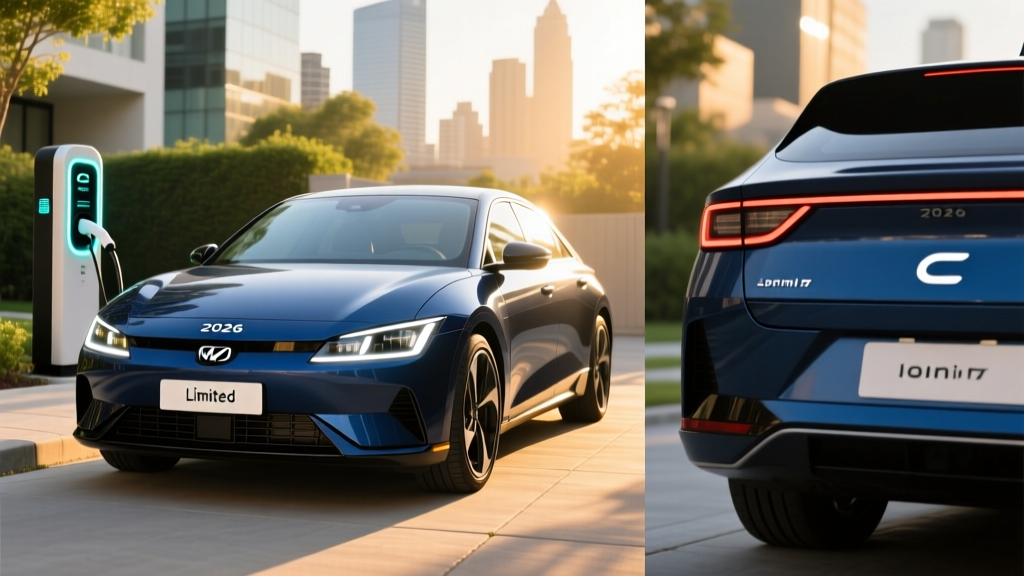
The Hyundai Ioniq 5 has been a cornerstone of the mainstream EV market since its debut, and the 2026 model year brings meaningful refinements to an already compelling package. The top-tier 2026 Ioniq 5 Limited trim bundles dual-motor all-wheel drive, an 84.0 kWh NMC battery, and Hyundai's full suite of tech and luxury features into a crossover that undercuts rivals on price while matching or exceeding them on charging speed. This review breaks down every number that matters — from EPA range and real-world highway efficiency to DC fast-charging curves and federal tax credit eligibility — so you can decide whether the Limited trim is the right EV for your garage.
2026 Ioniq 5 Limited: Quick Verdict
The 2026 Ioniq 5 Limited is the best all-around version of Hyundai's electric crossover. You get dual-motor AWD with 320 horsepower, an EPA-estimated 290 miles of range, and access to 800V DC fast-charging architecture that peaks at roughly 240 kW — meaning a 10–80% charge in approximately 18 minutes on a capable station. The Limited trim adds premium features like a panoramic sunroof, ventilated front seats, a head-up display with augmented reality navigation, and Hyundai's Highway Driving Assist 2 (HDA 2). At an MSRP starting around $54,600, it competes directly with the Tesla Model Y Long Range AWD, Ford Mustang Mach-E Premium AWD, and Volkswagen ID.4 Pro S AWD. For buyers who prioritize rapid road-trip charging and a comfortable, tech-forward cabin over brand cachet, the Ioniq 5 Limited is one of the strongest choices in the segment.
Range, Efficiency, and Real-World Expectations
The 2026 Ioniq 5 Limited AWD carries an EPA-estimated range of 290 miles. Efficiency is rated at approximately 98 MPGe combined, which translates to about 34 kWh per 100 miles — respectable for a dual-motor crossover of this size and weight.
- EPA sticker: 290 miles (AWD Limited, 19-inch wheels)
- Real-world highway (70–75 mph, moderate temps): ~245–265 miles
- Real-world mixed city/highway (spring/fall): ~260–280 miles
- Cold weather (below 32°F, highway): ~200–230 miles — a 20–30% reduction is typical for NMC batteries without aggressive preconditioning
On a 300-mile road trip at sustained highway speeds in summer conditions, plan for one 15–20 minute DC fast-charge stop. In winter, plan for two stops or a more conservative driving pace. The Ioniq 5's heat pump (standard on the Limited) helps mitigate cold-weather losses compared to EVs without one, but physics still applies.
Hyundai's battery thermal management system is active, meaning the car preconditions the pack when you navigate to a DC fast charger — a critical feature for achieving peak charge rates. Without preconditioning, cold-soaked batteries can charge at a fraction of the rated speed.
Battery Chemistry, Capacity, and Longevity
The 2026 Ioniq 5 Limited uses an 84.0 kWh usable lithium-ion battery pack with NMC (nickel-manganese-cobalt) chemistry. NMC offers higher energy density than LFP (lithium iron phosphate), which is why Hyundai can package 290 miles of range in a relatively compact crossover footprint. The trade-off: NMC batteries generally prefer not to sit at 100% state of charge for extended periods, and they experience slightly faster long-term degradation than LFP — though Hyundai's warranty provides strong coverage.
| Specification | Value |
|---|---|
| Battery chemistry | NMC (Nickel-Manganese-Cobalt) |
| Usable capacity | 84.0 kWh |
| Voltage architecture | 800V nominal |
| Drivetrain | Dual-motor AWD |
| Horsepower | 320 hp |
| Torque | 446 lb-ft |
| 0–60 mph | 4.5 seconds |
| EPA range (AWD Limited) | 290 miles |
| MPGe (city / hwy / combined) | 103 / 92 / 98 |
| Efficiency | ~34 kWh/100 mi |
Hyundai covers the battery and powertrain with a 10-year / 100,000-mile warranty, one of the longest in the industry. The warranty guarantees the battery will retain at least 70% of its original capacity during that period. Based on data from earlier Ioniq 5 model years, real-world degradation has been modest — most owners report 95%+ state of health after the first two years of typical use. For detailed degradation tracking, owners can pull State of Health (SoH) data through the Hyundai app or third-party OBD-II tools.
Charging Speed: DC Fast, Level 2, and Level 1
The Ioniq 5's 800V architecture is its standout technical advantage. While most rivals in this price range use 400V systems that peak between 130–170 kW, the Ioniq 5 can accept up to ~240 kW on a compatible 350 kW DC fast charger. Here's what that looks like across charging levels:
| Charging Level | Power (kW) | Speed (mi/hr added) | Notes |
|---|---|---|---|
| Level 1 (120V household) | ~1.4 kW | ~4–5 mi/hr | Emergency/trickle only; ~60+ hrs for full charge |
| Level 2 (240V, 48A home charger) | ~10.9 kW | ~33 mi/hr | Full charge in ~8.5 hours (0–100%) |
| DC Fast (350 kW station) | Peak ~240 kW | ~150+ mi/hr (at peak) | 10–80% in ~18 min; tapers significantly above 80% |
| DC Fast (150 kW station) | Peak ~150 kW | ~90 mi/hr (at peak) | 10–80% in ~25 min |
Charging curve reality check: The "240 kW peak" figure is just that — a peak. The Ioniq 5 sustains roughly 200–240 kW from about 10% to 55% state of charge, then tapers to ~150 kW through 70%, and drops further above 80%. This is normal behavior for NMC packs protecting cell longevity. On a road trip, charging from 10–80% is the practical window; the last 20% takes disproportionately longer and is best reserved for overnight Level 2 sessions.
For home charging, Hyundai includes a portable Level 2 cord with the vehicle. A dedicated 48-amp home wall connector on a 60-amp circuit is the recommended setup — expect to pay $600–$1,500 for equipment and professional installation depending on your electrical panel's proximity to the garage. Homes with older 100-amp panels may need a $1,500–$3,000 panel upgrade. Always consult a licensed electrician for a site-specific quote.
The 2026 Ioniq 5 comes equipped with the NACS (North American Charging Standard) port, giving it native access to Tesla's Supercharger network — the most extensive and reliable DC fast-charging network in the US. This eliminates the need for a CCS-to-NACS adapter and is a significant practical advantage over CCS-only vehicles for road-trip charging.
Performance and Driving Dynamics
The dual-motor AWD powertrain produces 320 horsepower and 446 lb-ft of torque, delivering a 0–60 mph time of 4.5 seconds. That puts the Ioniq 5 Limited ahead of the Volkswagen ID.4 Pro S AWD (5.7 seconds) and roughly even with the Ford Mustang Mach-E Premium AWD (4.8 seconds), though it trails the Tesla Model Y Long Range AWD's brisk 4.1-second sprint.
Instant electric torque makes the Ioniq 5 feel quicker in daily driving than the 0–60 number alone suggests. The steering is well-weighted, the ride quality is composed over rough pavement, and regenerative braking offers four levels of intensity — adjustable via steering-wheel paddles — including a full one-pedal driving mode (i-PEDAL) that can bring the car to a complete stop without touching the brake pedal.
The Limited trim includes an adaptive suspension that smooths out highway imperfections, and the low center of gravity from the under-floor battery pack keeps body roll minimal through corners. Towing capacity is rated at 2,300 pounds with the factory tow hitch — adequate for a small utility trailer or a pair of dirt bikes, but not for a camper.
Interior, Tech, and Cargo Space
The 2026 Ioniq 5's cabin is one of its strongest selling points. The Limited trim features:
- Dual 12.3-inch displays — one for the instrument cluster, one for infotainment — housed under a single curved glass panel
- Augmented reality head-up display (AR HUD) that overlays navigation arrows onto the road ahead
- Ventilated front seats with leather upholstery and 8-way power adjustment
- Panoramic sunroof with power shade
- Highway Driving Assist 2 (HDA 2) — Hyundai's Level 2 driver-assistance suite including adaptive cruise with stop-and-go, lane centering, and lane-change assist
- Digital Key 2 — use your smartphone as the key fob via NFC/UWB
- Vehicle-to-Load (V2L) — power external devices (laptops, camping gear, tailgate equipment) at up to 3.6 kW via the interior and exterior V2L adapters
Cargo space: The Ioniq 5 offers 27.2 cubic feet behind the rear seats and 59.3 cubic feet with the rear seats folded flat. Rear-seat legroom is a generous 39.4 inches, enough for adults on long trips. The front trunk (frunk) adds 0.85 cubic feet — small but useful for storing charging cables. Compared to the Tesla Model Y (30.2 cu ft rear / 76.2 cu ft folded), the Ioniq 5 gives up some cargo volume, but its interior materials and ride comfort are generally rated higher by owners and reviewers.
Pricing, Trims, and Federal Tax Credit Eligibility
The 2026 Hyundai Ioniq 5 is offered in three trims. Pricing (MSRP, before destination):
| Trim | Drivetrain | EPA Range | MSRP |
|---|---|---|---|
| SE | RWD / AWD | 303 mi (RWD) / 290 mi (AWD) | ~$42,600 (RWD) / ~$46,100 (AWD) |
| SEL | AWD | 290 mi | ~$49,100 |
| Limited | AWD | 290 mi | ~$54,600 |
The Limited trim at ~$54,600 falls under the IRS §30D federal EV tax credit's $80,000 MSRP cap for SUVs/crossovers, so it is not disqualified on price. However, full credit eligibility depends on several factors that change periodically:
- Buyer income caps: Modified adjusted gross income (MAGI) must not exceed $150,000 (single), $225,000 (head of household), or $300,000 (joint filers) — per current IRS rules
- MSRP cap: Vehicle MSRP must be ≤ $80,000 for SUVs/crossovers (Ioniq 5 qualifies)
- Battery sourcing requirements: A percentage of critical minerals and battery components must be sourced from the US or free-trade-agreement countries — this requirement tightens annually and can reduce or eliminate the credit for some models
- Point-of-sale transfer: Eligible buyers can transfer the credit to the dealer at purchase, reducing the upfront cost rather than waiting for a tax refund
- Assembly: The Ioniq 5 sold in the US is assembled at Hyundai's Metaplant in Ellabell, Georgia, satisfying the North American final assembly requirement
Important: Battery-sourcing rules are the wildcard. Some model years and production batches of the Ioniq 5 have qualified for the full $7,500 credit, while others have qualified for $3,750 or none, depending on when they were built and where battery components were sourced. Always verify current eligibility on IRS.gov or via the dealer's point-of-sale credit system before finalizing your purchase.
| Item | Amount |
|---|---|
| MSRP (Limited AWD) | ~$54,600 |
| Destination charge | ~$1,395 |
| Federal tax credit (if fully eligible) | –$7,500 |
| Effective price after credit | ~$48,495 |
State and local incentives may reduce the cost further — check fueleconomy.gov and your state energy office for details.
2026 Ioniq 5 Limited vs. Key Competitors
| Spec | Hyundai Ioniq 5 Limited AWD | Tesla Model Y LR AWD | Ford Mach-E Premium AWD | VW ID.4 Pro S AWD |
|---|---|---|---|---|
| EPA Range | 290 mi | ~311 mi | ~290 mi | ~275 mi |
| Battery (usable kWh) | 84.0 kWh (NMC) | ~75 kWh (NMC) | ~91 kWh (NMC) | ~82 kWh (NMC) |
| Peak DC Fast Charge | ~240 kW | ~250 kW | ~150 kW | ~175 kW |
| 10–80% DC Fast Time | ~18 min | ~20 min | ~35 min | ~28 min |
| 0–60 mph | 4.5 sec | 4.1 sec | 4.8 sec | 5.7 sec |
| Horsepower | 320 hp | 384 hp | 312 hp | 295 hp |
| MSRP (top AWD trim) | ~$54,600 | ~$52,490 | ~$53,875 | ~$51,490 |
| NACS Port (native) | Yes | Yes | No (adapter) | No (adapter) |
| Battery Warranty | 10 yr / 100k mi | 8 yr / 120k mi | 8 yr / 100k mi | 8 yr / 100k mi |
Where the Ioniq 5 Limited wins: Fastest practical DC charging in its class (the Mach-E and ID.4 are significantly slower), the longest battery warranty, V2L capability, and a premium interior that punches above its price point. The native NACS port is a major road-trip advantage over Ford and VW.
Where rivals have an edge: The Model Y offers more range (311 mi), more cargo space, and Tesla's Supercharger network reliability (though the gap is closing as other brands gain NACS access). The Mach-E has a sportier driving feel and a larger battery. The ID.4 is the most affordable entry point for AWD electric SUV buyers.
Pros and Cons
- Class-leading DC fast-charging speed (~240 kW, 18 min 10–80%)
- Native NACS port — full Tesla Supercharger access without adapter
- 10-year / 100,000-mile battery and powertrain warranty
- Premium interior with AR head-up display and ventilated seats
- V2L capability for camping, tailgating, and emergency power
- Composed ride quality with adaptive suspension
- US-assembled (Georgia), simplifying §30D assembly requirement
- Real-world highway range drops to ~245–265 mi — plan road trips accordingly
- Less cargo space than Model Y (59.3 vs 76.2 cu ft max)
- Frunk is tiny (0.85 cu ft) — mostly useful for cables only
- Towing limited to 2,300 lbs — not suitable for most campers
- Federal tax credit eligibility can vary by production batch (battery sourcing)
- Infotainment learning curve for first-time Hyundai EV owners
- Rear wiper absent on earlier builds (check build date for 2026 inclusion)
Who Should Buy the 2026 Ioniq 5 Limited?
Ideal for: Daily commuters with home Level 2 charging who take 2–4 road trips per year and want the shortest possible DC fast-charge stops. The Limited trim's premium features justify the price for buyers who value interior quality and tech. Families of 3–4 will find the rear seat and cargo space more than adequate. The V2L feature is a genuine differentiator for outdoor enthusiasts.
Consider alternatives if: You regularly drive 300+ miles between charging stops (the Model Y's 311-mile range offers more buffer). You need maximum cargo volume for hauling gear or large dogs. You want the absolute lowest purchase price and are willing to sacrifice charging speed (the ID.4 Pro S saves ~$3,000). You tow frequently and need more than 2,300 lbs of capacity.
Frequently Asked Questions
What is the real-world range of the 2026 Ioniq 5 Limited?
The EPA rates it at 290 miles, but real-world highway driving at 70–75 mph typically yields 245–265 miles in moderate weather. In cold conditions (below 32°F), expect 200–230 miles. City driving with regenerative braking can approach or even slightly exceed the EPA figure.
How fast does the 2026 Ioniq 5 Limited charge at home and on the road?
On a 350 kW DC fast charger, it peaks at ~240 kW and charges from 10–80% in approximately 18 minutes. At home on a 48-amp Level 2 charger (240V), it adds about 33 miles of range per hour, fully charging in roughly 8.5 hours. Level 1 (120V) trickle charging adds only 4–5 miles per hour.
Does the 2026 Ioniq 5 Limited qualify for the $7,500 federal EV tax credit?
It meets the MSRP cap ($80,000 for SUVs), the North American assembly requirement (built in Georgia), and — depending on your income — the buyer income caps. However, battery critical-mineral and component sourcing requirements change annually and can affect eligibility. Verify current status on IRS.gov or through your dealer's point-of-sale credit system before purchasing.
Is the 2026 Ioniq 5 Limited worth buying over the Tesla Model Y?
The Ioniq 5 Limited offers faster DC charging, a longer warranty, a more premium interior, and V2L capability at a similar price. The Model Y counters with more range (311 mi), more cargo space, and the Tesla software/Supercharger ecosystem. If charging speed and interior quality are priorities, the Ioniq 5 is the stronger pick. If range and cargo volume matter most, the Model Y wins. Both are excellent vehicles — the choice comes down to your specific needs.
What connector does the 2026 Ioniq 5 use?
The 2026 Ioniq 5 is equipped with the NACS (North American Charging Standard) connector, providing native access to Tesla Superchargers and a growing number of NACS-equipped public chargers. For Level 2 home and public AC charging, NACS also handles AC charging natively, eliminating the need for adapters that CCS-ported EVs require at Superchargers.
How long will the Ioniq 5 battery last?
Hyundai warranties the battery for 10 years or 100,000 miles (whichever comes first) with a minimum 70% capacity retention guarantee. Based on data from 2022–2025 Ioniq 5 owners, degradation has been modest — most report 93–97% state of health after 2–3 years of typical use. With proper charging habits (avoiding frequent 100% charges, using preconditioning for DC fast charging), the pack should provide reliable service well beyond the warranty period.
Specifications and pricing reflect 2026 model-year data available at time of publication. Federal tax credit rules under IRS §30D are subject to change. Always confirm current eligibility at IRS.gov and verify exact pricing with your local Hyundai dealer. Range and efficiency figures sourced from fueleconomy.gov. Safety ratings available at NHTSA.gov and IIHS.org.