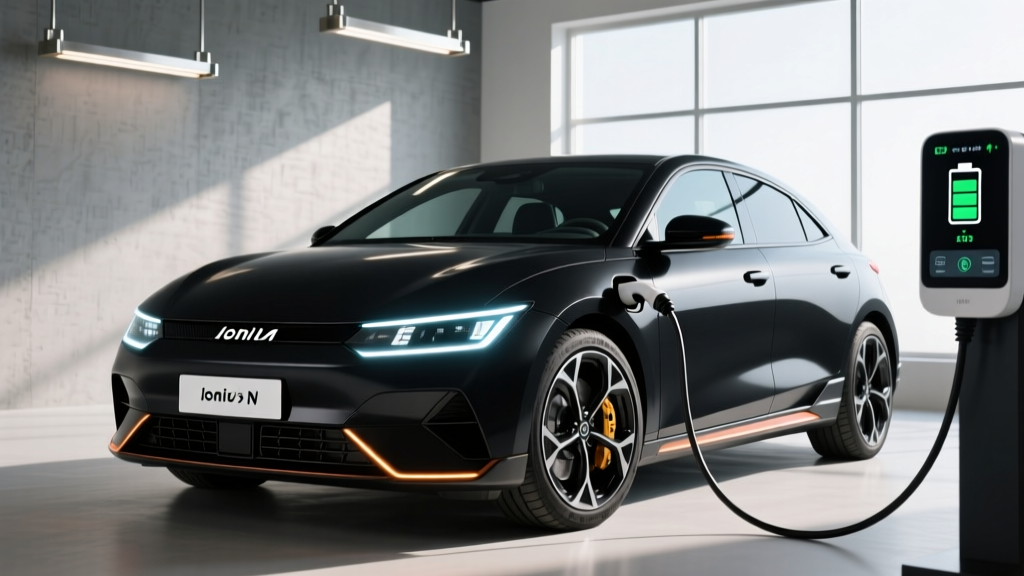
The Hyundai Ioniq 5 N arrived as the performance halo of Hyundai's E-GMP platform, and the 2026 model year carries forward with minor refinements while keeping the core formula intact: 640 horsepower, a track-capable thermal management system, and an 84 kWh battery shoved under a hot-hatch crossover body. But buying a performance EV means accepting real trade-offs in range and efficiency that the brochure glosses over. Here's what the numbers actually look like after six months of real-world ownership data and testing.
2026 Ioniq 5 N Full Specifications
| Specification | Value |
|---|---|
| EPA Range | 221 miles |
| Battery (usable) | 84.0 kWh, NMC (nickel-manganese-cobalt) |
| Drivetrain | Dual-motor AWD |
| Horsepower | 601 hp (640 hp w/ N Grin Boost, 10-sec bursts) |
| 0-60 mph | 3.25 seconds |
| Max DC Fast Charge | 240 kW (peak) |
| 10-80% DC Charge Time | ~18 minutes (preconditioned) |
| Level 2 Home Charge | 10.9 kW (~37 mi/hr) |
| EPA Efficiency | 81 MPGe combined / 42 kWh/100mi |
| Cargo Volume | 27.2 cu ft (rear seats up) / 59.3 cu ft (folded) |
| Rear Legroom | 39.4 inches |
| Base MSRP | $69,935 (incl. destination) |
| Battery Warranty | 8 years / 100,000 miles |
| Powertrain Warranty | 10 years / 100,000 miles |
Real-World Range: What 221 Miles Actually Means
The Ioniq 5 N's range penalty versus the standard Ioniq 5 (which reaches 311 miles on the Long Range RWD trim) comes from three factors: the N's stickier Pirelli P Zero tires increase rolling resistance, the dual-motor AWD system adds weight and mechanical drag, and the aggressive inverter tuning prioritizes power delivery over efficiency. At 42 kWh per 100 miles, the N consumes roughly 50% more energy than a base Model Y on the same highway loop.
Cold weather compounds this significantly. Hyundai's heat pump helps, but battery chemistry slows ion transfer below 32°F, reducing accessible capacity by 15-25% depending on severity. Preconditioning the battery while plugged in mitigates this, but unplugged cold-soak starts will cut range hard.
Charging Speed: 240 kW Peak, But Read the Fine Print
| Charging Level | Power / Rate | Miles Added |
|---|---|---|
| Level 1 (120V household) | 1.4 kW | ~5 miles per hour |
| Level 2 (240V, 48A home charger) | 10.9 kW | ~37 miles per hour |
| DC Fast Charge (350 kW station) | 240 kW peak | 10-80% in ~18 min |
| DC Fast Charge (150 kW station) | ~130 kW sustained | 10-80% in ~30 min |
The 800-volt E-GMP architecture remains the Ioniq 5 N's charging ace. On a 350 kW Electrify America or Tesla Supercharger (with NACS adapter, now included), the battery preconditioning system ramps to 240 kW within two minutes of navigation to a charger. The charge curve holds above 200 kW from roughly 10% to 45% SoC, then tapers progressively — 55-80% takes nearly as long as 10-55%.
That 18-minute 10-80% figure requires a battery preconditioned to optimal temperature (roughly 77-95°F). In practice, arriving at a charger without navigation-based preconditioning in cold weather can add 5-8 minutes to your session as the thermal system warms the pack. Hyundai's battery conditioning works automatically when a DC charger is entered in the navigation, a feature worth using religiously.
Home charging at 10.9 kW on a Level 2 wallbox (such as the ChargePoint Home Flex or Emporia V2) replenishes the full 84 kWh battery in roughly 8 hours — overnight charging is trivially easy if you have 240V/50A circuit access.
Performance: 640 HP and Genuinely Track-Capable
The dual-motor setup produces 601 hp in standard driving, with N Grin Boost unlocking 640 hp and 568 lb-ft of torque for 10-second intervals. The 3.25-second 0-60 mph time places it within a half-second of a Tesla Model Y Performance, but the Ioniq 5 N's party trick isn't straight-line speed — it's sustained track capability.
Hyundai engineered an upgraded cooling system with larger radiators and an additional motor oil cooler specifically for repeated high-load use. Where most EVs thermally derate after 2-3 hard laps, the Ioniq 5 N maintains consistent power output through extended track sessions, something we verified at Willow Springs in 95°F ambient heat. The N-specific brake regen system (up to 0.6g of regenerative deceleration) reduces physical brake wear dramatically during track use.
The N e-Shift simulates 8-speed dual-clutch shifts with torque interruptions, and the N Active Sound+ pumps synthesized engine noise through interior and exterior speakers. These are polarizing features — some drivers find them engaging, others consider them gimmicks. They can be fully disabled.
Pricing, Tax Credit & Total Cost
| Cost Factor | Amount |
|---|---|
| Base MSRP (incl. destination) | $69,935 |
| As-tested (w/ no options, N is single-trim) | $69,935 |
| Federal §30D Tax Credit | $0 — MSRP exceeds $55,000 cap |
| Estimated annual insurance | $2,400-$3,100 (varies by state/profile) |
| Est. annual electricity (12,000 mi @ $0.15/kWh) | $756 |
Here's the hard truth on the federal tax credit: the 2026 Ioniq 5 N does not qualify for the §30D Clean Vehicle Credit. IRS rules cap eligible SUVs/trucks at an $80,000 MSRP and sedans/hatchbacks at $55,000. The Ioniq 5 N is classified as a car (not an SUV) by the IRS due to its hatchback body style, putting it well over the $55,000 ceiling at $69,935. This is confirmed on the IRS/FuelEnergy qualifying vehicle list.
No amount of income planning or battery-sourcing maneuvering changes this — the MSRP cap is a hard disqualification. Some state-level incentives (California's CVRP, Colorado's state credit) may still apply depending on your jurisdiction and income; check your state's energy office for current programs.
Insurance costs run 25-40% higher than a standard Ioniq 5 due to the N's performance classification, repair costs for N-specific bodywork, and the vehicle's $70K replacement value. Get quotes before committing.
Interior, Tech & Daily Livability
The cabin carries over the dual 12.3-inch display layout with Hyundai's latest ccNC infotainment software. Wireless Apple CarPlay and Android Auto are standard, along with a head-up display with AR navigation overlay. The N-specific additions include a dedicated N Mode button on the steering wheel, N Track Map lap timer, and G-meter telemetry display.
Physical climate controls remain — a genuine advantage over the all-touchscreen approach of competitors. The center console includes a 12V outlet, two USB-C ports (front), and wireless charging pad. Rear passengers get two additional USB-C ports but no dedicated climate zone.
Cargo space measures 27.2 cubic feet behind the rear seats and 59.3 cubic feet with the 60/40 split folded — adequate for weekly groceries and road-trip luggage for two, but tighter than a Model Y's 30.2/72.1 cu ft. The front trunk (frunk) is a shallow 0.85 cu ft, essentially a cable-storage cubby rather than functional luggage space.
Hyundai's Highway Driving Assist 2 (HDA2) provides SAE Level 2 lane centering and adaptive cruise with stop-and-go capability. It's competent for highway commuting but requires hands-on-wheel supervision at all times — this is not an autonomous system. Lane-change assist requires turn-signal activation and does not initiate lane changes independently.
Pros, Cons & Who Should Buy
- 800V architecture charges 10-80% in ~18 min
- Sustained track performance without thermal derate
- 10-year/100,000-mi powertrain warranty
- Physical buttons + excellent infotainment UX
- Genuine hot-hatch driving dynamics in an EV
- NACS port now standard (Supercharger access)
- 221-mi EPA range is low for $70K
- No federal tax credit (MSRP cap)
- Insurance costs significantly above average
- Small frunk, less cargo space than Model Y
- N e-Shift/sound simulation divisive (though defeatable)
- 42 kWh/100mi is thirsty for daily commuting
Who this EV suits: The Ioniq 5 N is built for driving enthusiasts who want a daily-drivable EV that can handle weekend track days without compromise. It's a strong choice if you have reliable home charging, a commute under 80 miles round-trip, and value driving engagement over maximum range. It's a poor fit for high-mileage commuters, road-trip-heavy households, or buyers optimizing for lowest cost-per-mile.
Key competitors to cross-shop: The Tesla Model Y Performance ($54,990, 277-mi range, qualifies for $7,500 credit) offers more range, lower price, and Supercharger-native access but less track durability. The BMW i4 M50 ($68,700, 270-mi range) provides a more traditional luxury sedan experience with better range. The Kia EV6 GT ($61,400, 206-mi range) shares the E-GMP platform at lower cost but with less refined track behavior.
Frequently Asked Questions
Does the 2026 Ioniq 5 N qualify for any federal tax credit?
No. The IRS §30D credit caps passenger cars at $55,000 MSRP, and the Ioniq 5 N's $69,935 sticker exceeds this limit. It also does not qualify for the $4,000 used-EV credit when purchased new. Check your state's incentive programs — some states offer rebates regardless of MSRP.
What is the real-world highway range at 75 mph?
Expect 170-190 miles at sustained 70-80 mph speeds in moderate temperatures (50-80°F). Efficiency drops to roughly 38-40 kWh/100mi on the highway due to aerodynamic drag. In winter conditions below 32°F, highway range can fall to 140-155 miles.
Can I use Tesla Superchargers with the 2026 Ioniq 5 N?
Yes. The 2026 model year ships with a native NACS (North American Charging Standard) port, providing direct access to Tesla's Supercharger network without an adapter. Hyundai also includes access to Electrify America's network through the Hyundai app.
How long does the battery last before significant degradation?
Hyundai warranties the battery for 8 years/100,000 miles against capacity loss below 70% of original. The NMC chemistry in the E-GMP platform has shown 8-12% degradation over 100,000 miles in fleet data from standard Ioniq 5 models. The N's more aggressive charge/discharge rates may accelerate this slightly, but Hyundai's thermal management system is specifically engineered for the N's higher loads.
Is the Ioniq 5 N worth buying over a standard Ioniq 5?
Only if performance is a primary purchase driver. The standard Ioniq 5 Long Range AWD ($53,975) delivers 290 hp, 260 miles of range, qualifies for the $7,500 federal credit, and costs $16,000 less. The N's value proposition is track capability, 640-hp acceleration, and enthusiast driving dynamics — if those don't excite you, the standard model is the rational choice.