Quick Verdict: An Electric Supertruck SUV With Real Trade-Offs
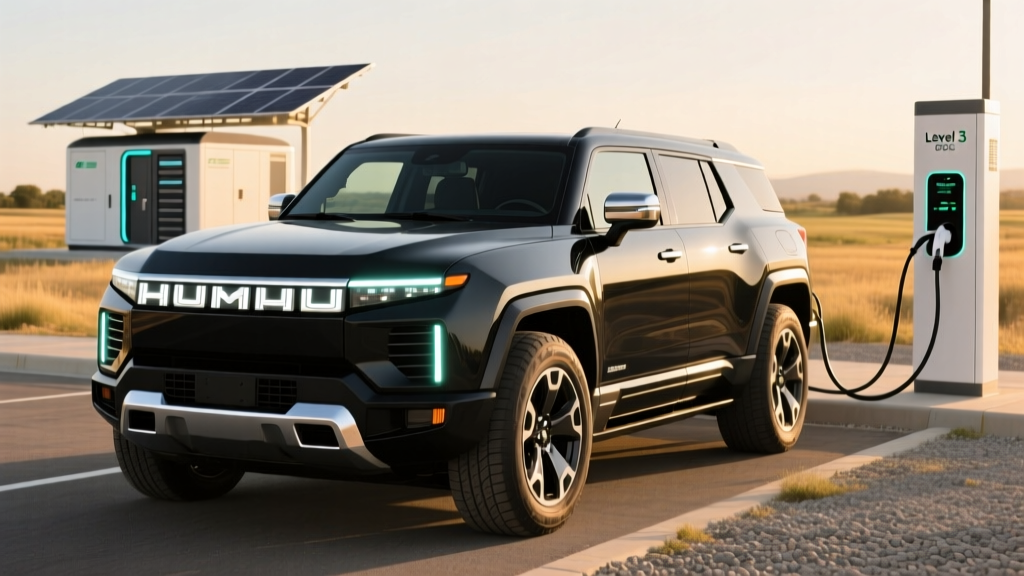
The 2026 Hummer EV SUV is a 9,000-pound statement piece that happens to be electric. With up to 830 horsepower in its top 3X trim, a Watts to Freedom launch mode, and GMC's UltraVision camera suite, it is unlike anything else on the road. But beneath the spectacle lies a capable, genuinely practical luxury EV SUV with over 300 miles of EPA range and 300 kW DC fast-charging capability. The question isn't whether it's impressive — it's whether the efficiency penalty, sheer size, and six-figure price tag make sense for your driveway.
This review covers every number that matters: real-world range expectations, charging-curve behavior, §30D tax credit eligibility under current IRS rules, and how it stacks up against the Rivian R1S, Tesla Model X, and Cadillac Escalade IQ.
Range, Efficiency, and the Real-World Reality Check
The 2026 Hummer EV SUV is available in two primary configurations that affect range. The dual-motor 2X trim carries an EPA-estimated 314 miles of range, while the tri-motor 3X drops to approximately 298 miles due to added weight and power draw. Both trims use a 212.7 kWh (gross) / ~205 kWh usable Ultium battery pack with NMC (nickel manganese cobalt) chemistry — one of the largest battery packs in any production passenger vehicle.
- EPA sticker (2X): 314 miles
- Highway driving (70-80 mph): Expect ~245–270 miles. The Hummer's brick-like aerodynamics (estimated 0.35+ Cd) punish efficiency at speed.
- Cold weather (below 32°F): Range can drop 20–30%, yielding as little as ~210–230 miles in freezing conditions despite the heat pump.
- City/stop-and-go: Closest to EPA thanks to aggressive regenerative braking — 290+ miles achievable.
Bottom line: Plan road trips around ~250 miles of usable range per charge to keep a safe buffer.
Efficiency is where the Hummer's mass shows. The EPA rates the 2X at approximately 47 MPGe combined, translating to roughly 70–73 kWh per 100 miles. For context, the Rivian R1S achieves about 69 MPGe and the Tesla Model X around 102 MPGe. You are moving nearly five tons of vehicle, and physics collects its tax at every charging session.
Charging Speed: DC Fast, Level 2, and the Curve
The Hummer EV SUV supports a peak DC fast-charging rate of 300 kW on 800-volt-capable chargers (350 kW stations). However, the enormous battery means that even at peak power, a full 10–80% charge takes roughly 35–40 minutes. The charge curve is relatively flat between 10–50% SoC, then tapers progressively above 60%, and drops sharply past 85%.
| Charging Level | Power / Rate | Time / Speed | Notes |
|---|---|---|---|
| Level 1 (120V) | ~1.4 kW | ~3–4 miles per hour | Emergency/trickle only — full charge takes days |
| Level 2 (240V, 48A) | 11.5 kW (onboard charger) | ~31 miles per hour / ~7 hours (10–100%) | Standard home charging; requires 60A circuit |
| Level 2 (240V, 80A) | 19.2 kW | ~52 miles per hour / ~4.5 hours (10–100%) | Requires upgraded home charger + 100A circuit |
| DC Fast Charge | Up to 300 kW peak | 10–80% in ~35–40 min | Sustained ~200–250 kW through 50% SoC |
For home charging, the Hummer's 11.5 kW onboard charger (standard) is adequate for overnight replenishment if your daily driving is under 100 miles. Owners who regularly deplete the battery will want the available 19.2 kW onboard charger and a hardwired Level 2 unit on a dedicated 100-amp circuit — budget $2,000–$4,000 for the electrical work, including a possible panel upgrade if your home has a 100-amp service panel.
Performance: 0-60, Horsepower, and Drivetrain
The 2026 Hummer EV SUV is offered in two powertrain configurations:
| Spec | 2X (Dual Motor) | 3X (Tri Motor) |
|---|---|---|
| Drivetrain | AWD (dual motor) | AWD (tri motor, e4WD) |
| Horsepower | 625 hp | 830 hp |
| Torque | 7,400 lb-ft (wheel) | 10,000+ lb-ft (wheel) |
| 0–60 mph | ~4.5 seconds | ~3.5 seconds (WTF mode) |
| Towing Capacity | 7,500 lbs | 7,500 lbs |
| Ground Clearance | 10.1 in (standard) | 15.9 in (Extract Mode) |
The 3X's Watts to Freedom (WTF) launch mode drops the air suspension, haptics pulse through the seat, and the Hummer sprints to 60 mph in roughly 3.5 seconds — absurd for a vehicle with the footprint of a small studio apartment. The adaptive air suspension with Extract Mode raises the body nearly 6 inches for off-road obstacles, and the available four-wheel steering (CrabWalk) lets the SUV move diagonally at low speeds — genuinely useful on tight trails.
Pricing, Trims, and Federal Tax Credit Eligibility
The 2026 Hummer EV SUV lineup starts at $99,995 (including destination) for the 2X and climbs to $119,995 for the 3X. Fully optioned 3X models with the Extreme Off-Road Package and Infinity Roof can exceed $135,000.
| Trim | Base MSRP | Federal §30D Credit | Effective Price |
|---|---|---|---|
| 2X | $99,995 | Up to $7,500* | ~$92,495 |
| 3X | $119,995 | Up to $7,500* | ~$112,495 |
| 3X Extreme Off-Road | $135,000+ | Up to $7,500* | ~$127,500+ |
- MSRP cap for SUVs: $80,000 — the Hummer EV SUV exceeds this threshold on all trims, meaning it does NOT qualify for the new-vehicle §30D credit.
- Income caps: $150K single / $300K married filing jointly (adjusted gross income).
- Battery sourcing & critical minerals: Must meet escalating domestic-content thresholds.
- Point-of-sale transfer: Available for qualifying vehicles — but only if the vehicle itself qualifies first.
Source: IRS §30D Clean Vehicle Credit. Consult a tax professional for your specific situation. The Hummer EV SUV's MSRP disqualifies it from the new-vehicle credit. Buyers may explore the used EV credit (§25E) if purchasing a qualifying pre-owned unit under $80,000, subject to separate income and sourcing rules.
Interior Space, Cargo, and Daily Livability
The Hummer EV SUV seats five adults across two rows. Interior dimensions are generous, though the vehicle's width (86.7 inches without mirrors) makes it challenging in tight parking structures and narrow urban lanes.
- Front legroom: 42.5 inches
- Rear legroom: 38.9 inches
- Cargo behind rear seats: ~35.9 cu ft
- Cargo with rear seats folded: ~81.8 cu ft
- Front trunk (frunk): ~11.3 cu ft — includes a drain plug for use as a cooler
- Infinity Roof: Removable transparent panels stow in the frunk
The frunk's eTrunk is genuinely practical — the drain plug means you can fill it with ice for tailgating. The Infinity Roof panels are a party trick that actually works, transforming the cabin into an open-air experience. However, the sheer height of the vehicle (over 71 inches) means most parking garages with 6'8" clearances will be a tight squeeze or outright impossible.
Tech, Driver Assistance, and Standout Features
The 2026 Hummer EV SUV rides on GM's Ultifi software platform with a 13.4-inch infotainment touchscreen and a 12.3-inch driver display. Standard and notable tech includes:
- UltraVision: Up to 18 camera views, including underbody cameras for off-road trail visibility
- Super Cruise: GM's Level 2 hands-free driver-assistance system, operational on over 750,000 miles of mapped roads in North America
- CrabWalk: Four-wheel steering for diagonal movement at low speeds (3X standard)
- Adaptive Air Suspension: With Extract Mode for 15.9 inches of ground clearance
- One-Pedal Driving: Aggressive regen allows near-complete stops without the brake pedal
- Power Station Pro: Available V2L (vehicle-to-load) capability to power tools or camp equipment
Super Cruise allows hands-free operation on compatible highways, but per NHTSA SAE definitions, it remains a Level 2 system. The driver must remain attentive, and the infrared camera monitors eye gaze. You are legally and practically responsible for the vehicle at all times.
Warranty Coverage and Battery Longevity
GMC backs the 2026 Hummer EV SUV with the following warranty structure:
- Bumper-to-bumper: 3 years / 36,000 miles
- Powertrain: 5 years / 60,000 miles
- Battery pack: 8 years / 100,000 miles (minimum 70% capacity retention)
The Ultium NMC battery is liquid-cooled with an active thermal management system. Based on data from earlier Ultium-platform vehicles, expect degradation of roughly 8–12% over the first 100,000 miles under normal use. The 205 kWh usable capacity means even at 70% retention (the warranty threshold), you'd still have ~143 kWh — enough for over 200 miles of range. Battery replacement cost, should it ever be needed out of warranty, is estimated at $25,000–$35,000+ for a pack of this size, though prices are expected to decline as Ultium production scales.
Pros, Cons, and Who Should Buy the 2026 Hummer EV SUV
- 314 miles EPA range (2X) is strong for a vehicle this size
- 300 kW DC fast-charging minimizes road-trip downtime
- 830 hp tri-motor 3X delivers supercar acceleration in a 9,000-lb SUV
- CrabWalk and Extract Mode provide genuine off-road capability
- Super Cruise hands-free driving reduces highway fatigue
- Massive frunk with drain plug is uniquely practical
- 7,500-lb towing capacity covers most boats and campers
- 47 MPGe efficiency is poor — charging costs add up vs. more efficient EVs
- MSRP exceeds $80K on all trims — no federal §30D new-vehicle tax credit
- 212 kWh battery means long home-charge times and high electrical-install costs
- 86.7-inch width and 71+ inch height limit parking-garage and lane usability
- Real-world highway range drops to ~250 miles, limiting between-stop distance
- No third-row seating — five-passenger only in a segment where rivals offer seven
- Six-figure pricing competes with established luxury marques
- Choose it if: You want maximum presence, genuine off-road capability, and don't mind the efficiency penalty. Ideal for outdoor enthusiasts who tow, trail, and road-trip — and have a garage that fits it.
- Look elsewhere if: You prioritize efficiency, urban maneuverability, third-row seating, or federal tax credit savings. The Rivian R1S offers similar off-road chops with better efficiency and a lower starting price; the Tesla Model X delivers far superior MPGe and Falcon Wing doors for family duty.
Frequently Asked Questions
What is the real-world range of the 2026 Hummer EV SUV?
The EPA rates the dual-motor 2X at 314 miles and the tri-motor 3X at ~298 miles. In real-world highway driving at 70–80 mph, expect 245–270 miles. In freezing temperatures, range can drop to 210–230 miles. City driving with regenerative braking gets closest to the EPA sticker.
How fast does the Hummer EV SUV charge at home and on the road?
On a Level 2 home charger at 11.5 kW, it adds ~31 miles per hour (full charge in ~7 hours). At a 300+ kW DC fast charger, 10–80% takes approximately 35–40 minutes, with sustained rates of 200–250 kW through 50% state of charge.
Does the 2026 Hummer EV SUV qualify for the federal EV tax credit?
No. Under current IRS §30D rules, the new-vehicle credit caps SUV MSRP at $80,000. The Hummer EV SUV starts at $99,995 and exceeds this limit on every trim. Buyers may qualify for the used-EV credit (§25E, up to $4,000) if purchasing a qualifying pre-owned unit under $80,000.
Is the Hummer EV SUV worth buying over the Rivian R1S or Tesla Model X?
It depends on priorities. The R1S starts lower, offers three rows, and has better efficiency (~69 MPGe). The Model X delivers 102 MPGe and strong Supercharger access. The Hummer wins on sheer presence, CrabWalk off-road uniqueness, and raw 830-hp performance — but costs more to buy and charge.
What are the biggest drawbacks of the Hummer EV SUV?
Poor efficiency (47 MPGe), no federal tax credit eligibility, long home-charge times due to the massive 212 kWh battery, extreme width limiting urban usability, and no third-row seating despite its size.
How long will the Hummer EV SUV battery last?
GMC warrants the Ultium battery for 8 years / 100,000 miles with a minimum 70% capacity retention threshold. Real-world degradation for NMC chemistry with active thermal management typically runs 8–12% over 100,000 miles. At 70% retention, the pack still holds ~143 kWh — sufficient for 200+ miles of range.