The GMC Hummer EV is less a vehicle and more a rolling statement: 1,000 horsepower, a 24-module Ultium battery, and the kind of interior space that makes full-size pickups feel cozy. For 2026, GMC has refined the cabin materials, expanded the Super Cruise coverage map, and standardized features that were previously locked behind the Edition 1 trim. But at over 9,000 pounds and a starting price well into six figures, the Hummer EV demands a hard look at whether its interior quality, real-world range, and charging logistics justify the cost.
This review focuses on what the 2026 Hummer EV interior actually delivers to the driver and passengers — and pairs that with the exact range, charging, and ownership numbers you need before signing a purchase order.
2026 Hummer EV Interior: Space, Materials, and the Infinity Roof
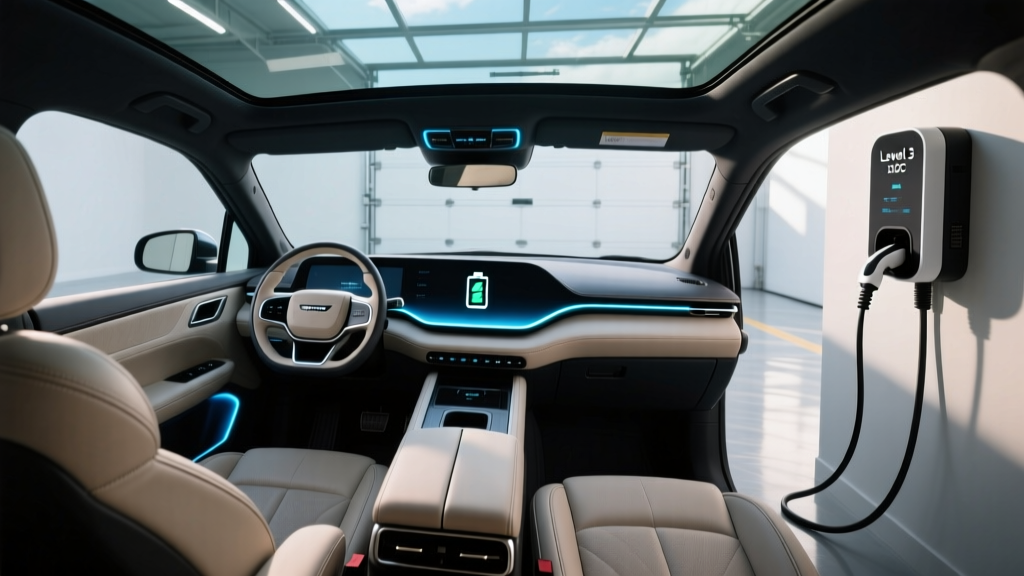
The first thing you notice climbing into the Hummer EV is the sheer verticality. The removable Infinity Roof panels (standard on all trims) stow in the frunk, and with them off, the cabin feels more like an open-air command center than a traditional SUV or pickup. GMC has carried over the 13.4-inch diagonal infotainment touchscreen and 12.3-inch driver cluster from the prior generation, but for 2026 the dashboard trim receives upgraded soft-touch materials on the EV3x and up, replacing the harder plastics that drew criticism on early 2022–2024 build vehicles.
The seating position is commanding — the driver sits high above most traffic, with excellent forward visibility aided by the upright windshield and thin A-pillars. The available 18-way power front seats with massage (standard on EV3x) are a meaningful upgrade for long highway stints. Rear-seat passengers get 38.9 inches of legroom in the SUV variant, which is competitive with the Rivian R1S and superior to the Tesla Model X's third row, though the Hummer's rear seats don't slide or recline as much as some competitors offer.
Cargo volume is where the Hummer EV Pickup and SUV diverge. The Pickup offers a 5-foot bed with a MultiPro tailgate (six configurations), while the SUV provides 81.8 cubic feet of cargo space behind the front seats — enough for serious gear hauling but less than a Chevy Suburban. The front trunk (frunk) adds roughly 11.4 cubic feet of lockable, drainable storage, which is practical for muddy off-road gear or wet wetsuits.
| Spec | Hummer EV Pickup (2X) | Hummer EV SUV (2X) |
|---|---|---|
| EPA Range | 314 miles (20-module) | 314 miles (20-module) |
| Usable Battery | ~212 kWh (24-module) / ~170 kWh (20-module) | ~212 kWh (24-module) / ~170 kWh (20-module) |
| Battery Chemistry | NCMA (nickel-cobalt-manganese-aluminum) | NCMA |
| Max DC Fast Charge | 350 kW (800V architecture) | 350 kW (800V architecture) |
| 10–80% DC Charge Time | ~35 minutes (est.) | ~35 minutes (est.) |
| Level 2 Home Charging | 11.5 kW (~28 mi/hr) | 11.5 kW (~28 mi/hr) |
| 0–60 mph | ~3.0 sec (Watts to Freedom mode, 24-module) | ~3.5 sec (Watts to Freedom mode, 24-module) |
| Horsepower | Up to 1,000 hp (24-module tri-motor) | Up to 830 hp (24-module tri-motor) |
| Drivetrain | Tri-motor AWD (e4WD) | Tri-motor AWD (e4WD) |
| Efficiency | 47 MPGe combined (EPA est.) | 47 MPGe combined (EPA est.) |
| Base MSRP | $98,845 (2X) | $100,445 (2X) |
| Battery/Powertrain Warranty | 8 years / 100,000 miles | 8 years / 100,000 miles |
Real-World Range: What the EPA Sticker Doesn't Tell You
Real-World Expectation: ~240–270 miles highway at 70 mph; ~200–230 miles in freezing temperatures with cabin heat; ~280–300 miles in mixed city driving with regenerative braking engaged.
The Hummer EV's efficiency is its Achilles' heel. At roughly 4.5 kWh per mile in mixed driving, this is one of the least efficient EVs on the market — a direct consequence of its 9,000+ pound curb weight and brick-like aerodynamics. For context, the Rivian R1T Dual-Motor achieves around 2.5–2.8 kWh/mile, and the Tesla Cybertruck AWD sits near 2.9 kWh/mile.
In practice, this means highway road trips at sustained 75–80 mph will see the range drop noticeably. Cold weather compounds the problem: without a standard heat pump (GMC uses resistive cabin heating), winter range loss of 25–35% is realistic in sub-freezing climates. If you live in the upper Midwest or Northeast and plan to use the Hummer EV as a daily driver year-round, budget for real-world range closer to 220 miles in January.
The 24-module battery variant (available on EV3x and Edition 1 trims) offers an EPA estimate of approximately 329 miles, but this comes with a significant weight and price penalty. For most buyers, the 20-module pack in the 2X trim represents the better value proposition, provided you can charge at home nightly.
Charging: 350 kW Peak, But Mind the Curve
The Hummer EV uses GM's Ultium 800-volt architecture, enabling DC fast charging at up to 350 kW at compatible stations (such as Electrify America's newest 350 kW stalls or Tesla Superchargers via the NACS adapter, which GM now includes standard for 2026). At peak rate, GMC estimates a 10–80% charge in roughly 35 minutes.
However, the charging curve tells a more nuanced story. The massive battery pack sustains high charge rates longer than smaller-pack EVs, but the sheer capacity means that even at 350 kW, you're adding roughly 100 miles of range in 15 minutes — not the 200 miles a lighter, more efficient EV might recover in the same window. Above 80% SoC, the charge rate tapers aggressively to protect cell longevity, and an 80–100% top-off can add another 25–30 minutes.
| Charging Level | Power | Miles of Range Added Per Hour | Typical Use Case |
|---|---|---|---|
| Level 1 (120V outlet) | ~1.4 kW | ~3 miles/hr | Emergency trickle only |
| Level 2 (240V, 48A) | 11.5 kW | ~28 miles/hr | Overnight home charging (~11 hours for full charge) |
| DC Fast Charge (peak) | Up to 350 kW | ~400 miles/hr (at peak) | Road-trip stops; 10–80% in ~35 min |
Home charging is straightforward but requires a 240V/48A+ circuit to achieve the full 11.5 kW rate. With a battery this large, expect a full Level 2 charge from near-empty to take 18+ hours on the 24-module pack. Most owners will plug in nightly and rarely see a full 0–100% cycle, which actually benefits long-term battery health.
Performance: Watts to Freedom and the Physics of 9,000 Pounds
Activate Watts to Freedom (WTF) mode, and the Hummer EV drops its air suspension, stiffens the dampers, preconditions the battery for maximum discharge, and unleashes the full tri-motor output. The Pickup hits 60 mph in approximately 3.0 seconds with the 24-module battery — a number that seems physically absurd for a vehicle weighing over 9,000 pounds. The 20-module 2X variant is slightly slower, in the 3.5-second range, but still firmly in sports-car territory off the line.
The dual-motor 2X trim (two motors instead of three) produces up to 625 horsepower and still manages a sub-5-second 0–60 time, which is more than adequate for any real-world driving scenario. The tri-motor setup's primary advantage beyond straight-line speed is the rear torque-vectoring capability, which enables features like CrabWalk (diagonal movement at low speeds) and Tank Turns (360-degree pivots on loose surfaces).
The air suspension provides up to 15.9 inches of ground clearance in Extract Mode — enough to clear serious off-road obstacles — and automatically lowers at highway speeds for improved aerodynamics. Ride quality on pavement is surprisingly composed, though the sheer mass means you feel weight transfers in aggressive cornering. This is not a canyon carver; it's a luxury off-road bruiser.
Pricing, Trims, and Federal Tax Credit Reality
The 2026 Hummer EV lineup starts at $98,845 for the Pickup 2X and $100,445 for the SUV 2X. The tri-motor EV3x trims climb to approximately $118,000, while the limited-run Edition 1 (fully loaded, 24-module battery) pushes past $125,000.
| Trim | Base MSRP | §30D Federal Credit Eligible? | Effective Price (if eligible) |
|---|---|---|---|
| Pickup 2X (dual-motor) | $98,845 | No — exceeds $80,000 MSRP cap for pickups/vans | $98,845 |
| Pickup EV3x (tri-motor) | ~$118,000 | No — exceeds MSRP cap | ~$118,000 |
| SUV 2X (dual-motor) | $100,445 | No — exceeds $80,000 MSRP cap for SUVs | $100,445 |
| SUV EV3x (tri-motor) | ~$120,000 | No — exceeds MSRP cap | ~$120,000 |
Under current IRS §30D rules, new clean vehicle credits are capped at $80,000 MSRP for SUVs, pickups, and vans. Every Hummer EV trim exceeds this threshold, making the vehicle ineligible for the federal purchase credit regardless of buyer income. State-level incentives (such as Colorado's $5,000 EV credit or California's CVRP for income-qualified buyers) may still apply — check your state's energy office for current programs.
The Hummer EV does qualify for the used clean vehicle credit (§25E) if you purchase a qualifying pre-owned model for $25,000 or less — though finding a used Hummer EV at that price point is unlikely in the near term.
Technology, Driver Assists, and Standout Features
The 2026 Hummer EV ships with GM's Super Cruise hands-free driving system, which now covers over 750,000 miles of compatible roads in the US and Canada. Super Cruise is an SAE Level 2 system — the driver must remain attentive and keep eyes on the road (monitored by an infrared camera on the steering column). It handles lane-keeping, adaptive cruise, and automatic lane changes on divided highways, and is one of the most capable Level 2 systems available, alongside Ford's BlueCruise.
The infotainment system runs GM's latest Ultifi software platform with Google Built-In (Maps, Assistant, Play Store), wireless Apple CarPlay and Android Auto, and over-the-air update capability. The 13.4-inch center screen is responsive, though the sheer number of off-road-specific menus (pitch/roll angles, tire pressure per corner, suspension height, torque distribution) adds complexity that new owners will need time to learn.
Unique features that set the Hummer EV apart:
- CrabWalk: Rear wheels turn up to 10 degrees in the same direction as the front wheels, allowing diagonal movement for obstacle avoidance at low speeds.
- Extract Mode: Air suspension raises the vehicle nearly 6 inches for maximum ground clearance (15.9 inches total).
- Underbody armor: Steel skid plates protect the battery pack and drivetrain during serious rock-crawling.
- MultiPro Tailgate (Pickup): Six-position tailgate with integrated steps and load-stop functionality.
- Power station capability: Available ProGrade onboard power system provides up to 7.2 kW of 120V/240V output for tools, camping, or emergency backup.
Notable drawbacks include the lack of a standard heat pump (resistive heating increases winter energy consumption), limited rear-seat recline adjustment, and the sheer physical size that makes urban parking and narrow trail navigation challenging despite the rear-steer assist.
Who the Hummer EV Is Actually For
- You need a serious off-road-capable electric vehicle with ground clearance, armor, and torque-vectoring for trails, sand, or snow.
- You want a statement vehicle with unmatched presence and conversation-starting features like CrabWalk and the removable Infinity Roof.
- You can charge at home nightly (Level 2) and accept 200–270 miles of real-world range as sufficient for your daily driving and weekend trips.
- You value the 7.2 kW onboard power capability for job-site use, overlanding, or home backup power.
- Efficiency and maximum range are priorities — the Rivian R1T/R1S or Tesla Cybertruck deliver more miles per kWh.
- You need federal tax credit eligibility to make the math work — no Hummer EV trim qualifies under current §30D rules.
- You primarily drive in dense urban environments where the Hummer's 81-inch width and 20+ foot length become a daily hassle.
- You want third-row seating — the Hummer EV SUV is a two-row vehicle; consider the Rivian R1S or Kia EV9 for three-row electric options.
Pros
- Unmatched off-road capability in an EV (Extract Mode, CrabWalk, skid plates)
- 350 kW DC fast charging on 800V architecture
- Super Cruise Level 2 system with extensive highway coverage
- 7.2 kW onboard power output for tools and backup
- Removable Infinity Roof for open-air driving
- Massive frunk and practical bed/cargo area
Cons
- Extremely poor efficiency (~4.5 kWh/mile) limits real-world range
- No federal tax credit eligibility (MSRP exceeds §30D cap)
- No heat pump — significant winter range loss
- Sheer size makes urban driving and parking difficult
- High starting price ($98,845+) with no budget-friendly trim
- 18+ hour full Level 2 charge time on 24-module battery
Frequently Asked Questions
What is the real-world range of the 2026 Hummer EV?
The EPA rates the 20-module 2X trim at 314 miles. In real-world highway driving at 70+ mph, expect 240–270 miles. In freezing weather with cabin heat, that drops to 200–230 miles. The Hummer EV's efficiency penalty is significant — plan trips around charging stops more carefully than you would in a more efficient EV.
How fast does the Hummer EV charge at home and on the road?
At home on a 240V/48A Level 2 charger, the Hummer EV charges at 11.5 kW, adding roughly 28 miles of range per hour. A full charge from near-empty takes 11–18 hours depending on battery size. On DC fast chargers, it peaks at 350 kW and can charge from 10–80% in approximately 35 minutes, though the large battery means total road-trip stop times are longer than in smaller-pack EVs.
Does the 2026 Hummer EV qualify for the federal EV tax credit?
No. Under current IRS §30D rules, pickups, SUVs, and vans must have an MSRP at or below $80,000 to qualify for the new vehicle credit. Every Hummer EV trim exceeds this cap. State incentives may still apply depending on your location and income.
Is the Hummer EV worth buying over the Rivian R1T or Tesla Cybertruck?
It depends on your priorities. The Hummer EV wins on raw off-road capability (Extract Mode, CrabWalk, underbody armor), onboard power output, and sheer presence. The Rivian R1T is significantly more efficient, offers a more refined on-road ride, and has a more usable quad-motor torque-vectoring system. The Cybertruck offers similar off-road chops at a lower starting price with better efficiency. If maximum off-road capability and the open-air Infinity Roof experience matter most, the Hummer EV is unique. If daily usability and efficiency rank higher, the R1T is the stronger all-around choice.
What is the battery warranty on the Hummer EV?
GMC covers the Ultium battery pack and electric powertrain components for 8 years or 100,000 miles, whichever comes first. The warranty guarantees the battery will retain a minimum percentage of its original capacity (typically 70% or above, per GM's standard Ultium warranty terms). This is competitive with the industry standard and matches Rivian, Ford, and Tesla's battery coverage periods.
Can the Hummer EV power my home or tools?
Yes, with the available ProGrade onboard power system, the Hummer EV can output up to 7.2 kW through 120V and 240V outlets in the bed and frunk. This is sufficient to run power tools, camping equipment, or provide emergency backup power to essential home circuits during an outage (with a proper transfer switch installed by a licensed electrician).