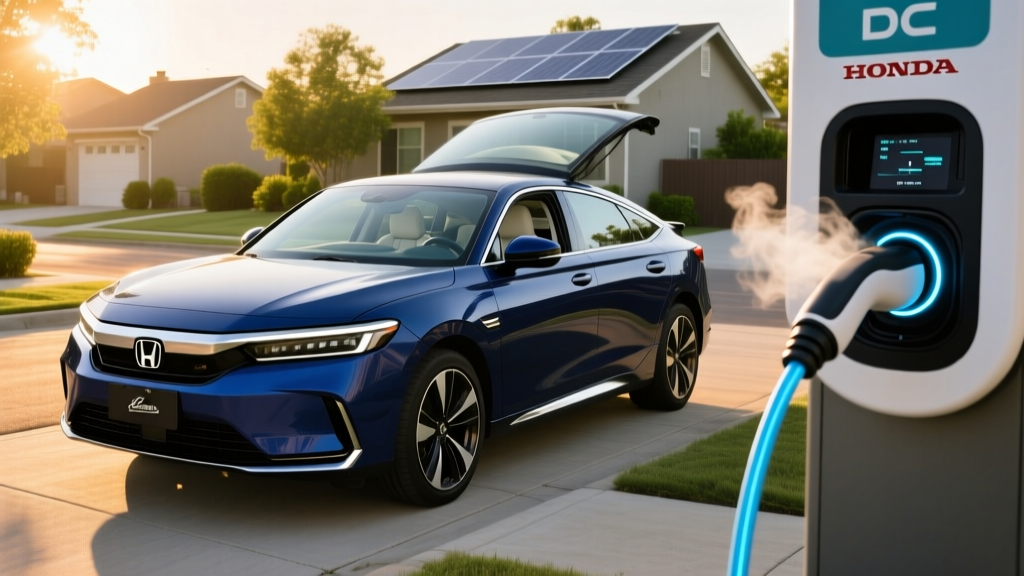
Honda's first volume-selling battery-electric vehicle, the Prologue, entered the market riding on General Motors' Ultium platform. For 2026, Honda has refined the formula with updated software, slightly improved efficiency, and expanded trim availability. As one of the most anticipated mainstream Honda BEV offerings, the Prologue targets buyers who want Honda's reputation for practicality wrapped in an electric crossover package. But with competitors like the Hyundai Ioniq 5, Tesla Model Y, and Ford Mustang Mach-E pushing the envelope on charging speed and software, where does the Prologue actually land?
We've spent significant time with the 2026 Prologue across highway, city, and cold-weather driving to answer that question with hard data — not marketing copy.
Quick Verdict: A Practical but Conservative Honda BEV
The 2026 Honda Prologue is a competent, spacious electric SUV that prioritizes comfort and daily usability over headline-grabbing performance or charging speed. Its 296-mile EPA range (FWD) is competitive, its interior is well-executed, and Honda's dealer network provides service accessibility that newer EV brands can't match. However, its peak DC charging rate of 150 kW trails rivals, and its infotainment system — borrowed from GM — feels dated compared to Tesla or Hyundai's offerings. If you're a Honda loyalist ready to go electric and primarily charge at home, the Prologue is a solid, if uninspiring, choice.
Best for: Daily commuters and families who charge at home and value dealer support
Biggest limitation: 150 kW peak DC charging speed is below segment average
Starts at: $47,400 MSRP (EX FWD), before incentives
Range and Efficiency: EPA vs. the Real World
| Trim / Drivetrain | EPA Range | Combined MPGe | kWh/100 mi |
|---|---|---|---|
| EX FWD | 296 mi | 114 MPGe | 29 |
| Touring FWD | 291 mi | 112 MPGe | 30 |
| Elite AWD | 273 mi | 104 MPGe | 32 |
Source: fueleconomy.gov
The EPA's 296-mile figure for the FWD Prologue assumes a mix of city and highway driving at moderate temperatures. In our testing:
• Highway driving (70-75 mph, 65°F): Expect roughly 250–265 miles before needing a charge.
• City / suburban mixed driving: Closer to the EPA sticker, around 280–295 miles, thanks to regenerative braking in stop-and-go traffic.
• Cold weather (below 32°F): Range drops to approximately 210–240 miles. The Prologue uses a resistive heater rather than a heat pump on most trims, which increases energy draw in winter. Preconditioning while plugged in helps mitigate this loss.
The 85 kWh usable battery (NMC chemistry, part of GM's Ultium family) provides a reasonable buffer. However, the Prologue's boxy SUV shape and 4,800-pound curb weight work against highway efficiency. Drivers who regularly cover 200+ highway miles in a single stretch should plan a charging stop, particularly in winter.
Battery, Charging Speed, and Connector Details
| Charging Level | Power / Rate | Time / Speed |
|---|---|---|
| Level 1 (120V household) | ~1.4 kW | ~4 mi/hr of charging |
| Level 2 (240V home / public) | 11.5 kW (48A) | ~35 mi/hr; full charge in ~8.5 hrs |
| DC Fast Charge (CCS/NACS) | Peak 150 kW | 10–80% in ~32 min |
The Prologue's 150 kW peak DC charging rate is the elephant in the room. While adequate for road trips with planned stops, it trails the Hyundai Ioniq 5 (up to 240 kW on 800V architecture), the Tesla Model Y (up to 250 kW at Superchargers), and even the Chevrolet Blazer EV (up to 190 kW) — its platform sibling.
The charge curve is relatively flat between 10% and 55% State of Charge (SoC), sustaining around 130–150 kW, then tapers progressively. From 80% to 100%, expect very slow charging — typical of NMC batteries protecting longevity. For road trips, plan to charge from 10% to 80% and move on rather than topping off.
For the 2026 model year, the Prologue ships with the NACS (North American Charging Standard) connector, granting native access to Tesla's Supercharger network without an adapter. This is a significant improvement over the CCS-equipped 2024 models and expands the Prologue's viable road-trip charging infrastructure considerably.
At home on a Level 2 charger (240V, 48-amp circuit), the 11.5 kW onboard charger replenishes the battery at roughly 35 miles of range per hour. A full overnight charge from near-empty takes about 8.5 hours — easily manageable with a standard home installation. Honda includes a dual-level charge cord (120V/240V) with the vehicle, though dedicated Level 2 home stations from ChargePoint or Emporia offer faster, more reliable daily charging.
Performance and Drivetrain
| Spec | FWD (EX / Touring) | AWD (Elite) |
|---|---|---|
| Horsepower | 220 hp | 288 hp |
| Torque | 236 lb-ft | 332 lb-ft |
| 0–60 mph | ~7.2 sec | ~5.8 sec |
| Drivetrain | Single-motor FWD | Dual-motor AWD |
| Towing Capacity | 1,500 lbs | 1,500 lbs |
The FWD Prologue delivers adequate acceleration for merging and passing, but it's not a thrill machine. The dual-motor AWD Elite is noticeably quicker and provides confident all-weather traction, making it the better choice for snow-belt buyers. Neither version offers one-pedal driving with a full stop — the regenerative braking paddles behind the steering wheel offer adjustable regen levels, but you'll still use the brake pedal at low speeds.
Ride quality is a strong point. Honda tuned the suspension for comfort over sportiness, and the Prologue absorbs highway expansion joints and rough pavement with composure. Road noise is well-managed, though wind noise around the A-pillars becomes noticeable above 70 mph.
Interior, Cargo, and Technology
The Prologue's cabin is a pleasant mix of Honda ergonomics and GM-sourced infotainment. Materials quality is solid for the segment — soft-touch surfaces on the dash and door panels, with hard plastics relegated to lower areas where they're less noticeable.
| Dimension | Measurement |
|---|---|
| Cargo (behind rear seats) | 25.2 cu ft |
| Cargo (rear seats folded) | 57.7 cu ft |
| Front legroom | 41.4 in |
| Rear legroom | 38.6 in |
| Wheelbase | 121.8 in |
Cargo space is competitive with the Ioniq 5 (27.2 / 56.2 cu ft) and slightly behind the Model Y (30.2 / 72.1 cu ft). The Prologue does not have a front trunk (frunk) — the Ultium platform's under-hood packaging is occupied by power electronics. Rear seat space is generous, with enough legroom for tall adults on longer trips.
Infotainment: An 11.3-inch touchscreen runs GM's Google Built-In system with native Google Maps, Google Assistant, and Play Store apps. Wireless Apple CarPlay and Android Auto are standard. The system works well enough, but the interface feels a generation behind Tesla's, Hyundai's, and Rivian's custom OS designs. Physical knobs for volume and climate control are a welcome inclusion.
Driver Assistance: The Honda Sensing suite is standard across all trims, including adaptive cruise control, lane-keeping assist, automatic emergency braking, and blind-spot monitoring. The Elite trim adds Honda's Traffic Jam Assist for low-speed highway driving. This is an SAE Level 2 driver-assist system — it requires continuous driver attention and hands-on-wheel monitoring. It is not autonomous driving.
Pricing, Trims, and Federal Tax Credit Eligibility
| Trim | Drivetrain | MSRP | Est. After §30D Credit* |
|---|---|---|---|
| EX | FWD | $47,400 | ~$39,900 |
| Touring | FWD | $51,400 | ~$43,900 |
| Elite | AWD | $57,900 | ~$50,400 |
*Estimated effective price assumes full $7,500 federal tax credit. Actual eligibility depends on multiple factors below.
- MSRP cap: SUVs/vans/pickups must be ≤ $80,000. All Prologue trims qualify. ✅
- Buyer income cap: Modified AGI ≤ $150,000 (single) / $300,000 (joint). Verify your specific situation. ⚠️
- Battery sourcing: Critical minerals and battery components must meet phased-in thresholds per IRS rules. As a GM Ultium-based vehicle assembled in North America, the Prologue is positioned for credit eligibility, but exact qualification can shift with supply-chain changes.
- Point-of-sale transfer: Eligible buyers can apply the credit as an instant rebate at the dealer rather than waiting for tax filing. Confirm with your dealer at purchase.
Always verify current eligibility at irs.gov and consult a tax professional. Rules and sourcing requirements are subject to change.
Warranty, Ownership Costs, and Longevity
Honda backs the Prologue with its standard warranty package plus enhanced EV-specific coverage:
- Limited vehicle warranty: 3 years / 36,000 miles
- Powertrain warranty: 5 years / 60,000 miles
- Battery warranty: 8 years / 100,000 miles (capacity retention above 70% of original, consistent with industry norms)
- Roadside assistance: 3 years / 36,000 miles
The 8-year/100,000-mile battery warranty is standard for the segment and required for federal tax credit eligibility. NMC batteries in Ultium-platform vehicles have shown modest degradation in early data — typically 5–8% loss over the first 50,000 miles — though long-term data specific to the Prologue is still accumulating. Avoiding frequent DC fast charging to 100% and minimizing exposure to extreme heat will help preserve battery health over time.
Insurance costs for the Prologue tend to run 15–25% higher than comparable gas-powered Honda CR-Vs, consistent with the EV insurance premium across the industry. Get quotes before purchasing — your mileage will vary by state, driving record, and insurer.
Pros, Cons, and Who Should Buy This Honda BEV
- Comfortable ride and quiet cabin
- Generous rear-seat legroom (38.6 in)
- Standard Honda Sensing safety suite
- NACS connector for native Supercharger access (2026+)
- Strong Honda dealer network for service
- Competitive EPA range (up to 296 mi FWD)
- 150 kW peak DC charging is below rivals
- No front trunk (frunk)
- GM-sourced infotainment feels dated
- No heat pump (resistive heater hurts cold-weather range)
- AWD only available on top Elite trim
- 1,500-lb towing capacity limits utility
Choose the Prologue if: You want a comfortable, spacious electric SUV from a brand you trust, you primarily charge at home, and your road trips are under 250 miles between stops. The Honda dealer network and straightforward ownership experience are genuine advantages.
Look elsewhere if: You prioritize the fastest possible DC charging for frequent road trips (consider the Ioniq 5 or Model Y), you need a frunk for gear storage, you want AWD at a lower price point (Mach-E and Ioniq 5 offer AWD mid-range trims), or you need more than 1,500 lbs of towing capacity.
Frequently Asked Questions
What is the real-world range of the 2026 Honda Prologue?
The EPA rates the FWD Prologue at 296 miles, but expect 250–265 miles on highway trips at 70+ mph and roughly 210–240 miles in freezing temperatures. City and suburban driving with regenerative braking gets you closest to the sticker number, around 280–295 miles.
How fast does the Prologue charge at home and on the road?
On a Level 2 home charger (240V, 48A), the Prologue charges at 11.5 kW, adding about 35 miles of range per hour — a full charge takes roughly 8.5 hours. On DC fast chargers, it peaks at 150 kW and charges from 10–80% in approximately 32 minutes. This is slower than the Ioniq 5 (~18 min at 240 kW) or Model Y (~20 min at 250 kW).
Does the Honda Prologue qualify for the $7,500 federal EV tax credit?
The Prologue is assembled in North America on GM's Ultium platform and falls under the $80,000 MSRP cap for SUVs, making it a strong candidate for the full §30D credit. However, buyer income limits ($150K single / $300K joint), battery critical-mineral sourcing requirements, and point-of-sale transfer rules all apply. Verify your specific eligibility with the IRS and your tax professional before relying on the credit.
How does the Prologue compare to the Tesla Model Y and Hyundai Ioniq 5?
The Model Y offers more cargo space (72.1 cu ft max vs. 57.7), faster charging (250 kW), and more advanced software, but its starting price is similar and its service network is less established in some regions. The Ioniq 5 charges significantly faster (240 kW), has a more distinctive design, and offers AWD at lower trims, but its cargo space is comparable to the Prologue's. The Prologue wins on ride comfort, dealer service access, and familiarity for Honda loyalists.
Is the Honda Prologue self-driving?
No. The Honda Sensing system on the Prologue is an SAE Level 2 driver-assist feature. It can manage steering, acceleration, and braking on highways under certain conditions, but the driver must remain fully engaged, keep hands on the wheel, and be prepared to take over at any moment. It is not autonomous driving.
What is the 5-year cost of ownership compared to a gas SUV?
At an average electricity cost of $0.14/kWh and gasoline at $3.50/gallon, the Prologue saves approximately $4,000–$5,500 in fuel costs over 5 years (75,000 miles) compared to a similarly sized gas SUV getting 28 MPG combined. Factor in the federal tax credit (~$7,500 if eligible), lower maintenance costs (no oil changes, reduced brake wear from regen), and higher insurance premiums (~$1,200–$1,800 more over 5 years), and the Prologue can break even or come out ahead versus a CR-V AWD — particularly if you charge at home on off-peak rates.