Quick Verdict: A Work-Truck EV Built Around Its Midgate
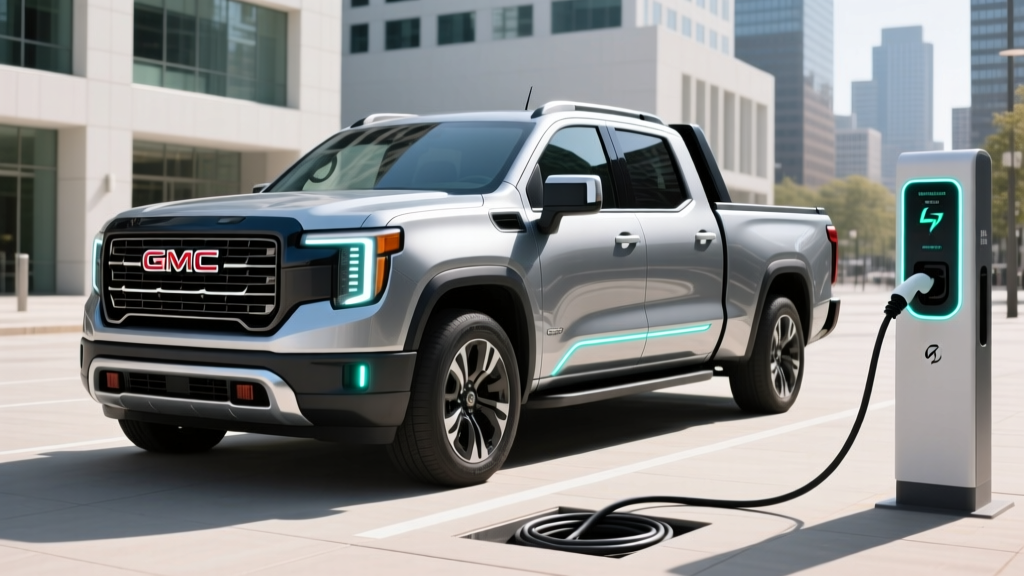
The 2026 GMC Sierra EV isn't trying to be a Tesla Cybertruck or a Rivian R1T. It's a full-size electric pickup aimed squarely at contractors, fleet buyers, and weekend warriors who need an eight-foot bed without sacrificing a crew cab. The headline feature is the MultiPro Midgate — a power-folding partition between the cab and bed that extends usable cargo length from roughly 5'11" to over 10 feet with the tailgate down. Combined with GM's Ultium battery platform, available four-wheel steer (CrabWalk), and up to 754 horsepower in the Denali Edition 1, the Sierra EV occupies a unique niche: a luxury-grade electric work truck with genuine job-site utility.
But with a starting price well above $50,000 for the work-oriented trims and stretching past $90,000 for the Denali, buyers need to know exactly what they're getting in range, charging speed, and real-world usability. Here's the full breakdown.
Range, Battery, and Real-World Efficiency
The 2026 Sierra EV lineup uses GM's Ultium platform with large-format NMC (nickel manganese cobalt) lithium-ion pouch cells. Battery capacity varies significantly by trim:
- Elevation (base/work trim): ~200 kWh usable battery pack
- AT4 / Denali: ~205–215 kWh usable, with slightly different cell module configurations for performance tuning
These are among the largest battery packs in any production passenger vehicle, which explains both the impressive range and the substantial curb weight (estimated 8,900+ lbs for Denali).
EPA Estimated: Up to 390 miles (Elevation trim, RWD-biased AWD)
Denali Edition 1 AWD: ~340–360 miles EPA (heavier, more powerful)
Real-World Highway (70 mph): Expect ~290–320 miles for the max-range pack; ~260–290 for Denali
Cold Weather (below 30°F): Plan for 20–30% range reduction, yielding ~220–260 miles highway in winter conditions
Towing (5,000+ lb trailer): Range roughly halves — expect 150–190 miles depending on speed and terrain
Efficiency lands around 47–50 MPGe combined for the Elevation trim, translating to roughly 68–72 kWh/100 miles. That's expected for a 9,000-lb truck — the Sierra EV prioritizes range through sheer battery mass rather than efficiency optimization. For context, the Rivian R1T Dual-Motor achieves ~73 MPGe combined with a far smaller 149 kWh pack and 352-mile range.
| Spec | Elevation (Base) | Denali Edition 1 |
|---|---|---|
| EPA Range | ~390 mi | ~340–360 mi |
| Battery (Usable) | ~200 kWh, NMC | ~205–215 kWh, NMC |
| Horsepower | ~510 hp | 754 hp (e4WD) |
| 0–60 mph | ~5.5 sec (est.) | ~4.3 sec |
| Drivetrain | Dual-motor AWD | Dual-motor e4WD w/ CrabWalk |
| Max Tow Rating | ~10,000 lbs (est.) | ~10,000 lbs |
| MPGe (Combined) | ~50 MPGe | ~47 MPGe |
| Base MSRP | ~$55,000 (est.) | ~$99,495 |
Charging: 350 kW DC Fast Charging and Home Setup
The Sierra EV supports DC fast charging at up to 350 kW on 800V-capable chargers (GM's Ultium platform uses a native 400V architecture with a parallel-charge capability that approaches 800V charge speeds). On a 350 kW station like Electrify America's latest stalls, GM estimates a 10–80% charge in approximately 30–35 minutes for the largest pack.
Here's what that looks like across charging levels:
| Level | Power | Speed | Notes |
|---|---|---|---|
| Level 1 (120V) | ~1.4 kW | ~2–3 mi/hr | Emergency only; full charge takes 6+ days |
| Level 2 (240V, 48A) | ~11.5 kW | ~17–19 mi/hr | Full charge ~20–22 hours; overnight top-up practical |
| Level 2 (240V, 80A) | ~19.2 kW | ~28–31 mi/hr | Requires hardwired 100A circuit; full charge ~12–14 hours |
| DC Fast (350 kW) | Up to 350 kW | ~100 mi in ~10 min | 10–80% in ~30–35 min; tapers significantly above 80% |
Charging curve reality check: Like all large NMC packs, the Sierra EV won't sustain 350 kW for the full session. Expect peak rates between 10–40% SoC, with a significant taper above 60% and a steep drop past 80%. Plan road-trip stops around the 10–80% window for the fastest turnaround. Preconditioning the battery (via the navigation-routed preconditioning feature) is essential for achieving peak charge rates — arriving at a fast charger without preconditioning can add 10–15 minutes to your session.
Home charging note: With a ~200 kWh battery, a standard 48A Level 2 charger adds roughly 17–19 miles per hour. Most owners will plug in nightly and top off rather than charge from empty. If you regularly deplete the pack (towing, long work days), consider an 80A hardwired Level 2 unit — but consult a licensed electrician, as this requires a 100-amp dedicated circuit and likely a panel upgrade in older homes.
MultiPro Midgate: The Defining Feature
The MultiPro Midgate is what separates the Sierra EV from every other electric pickup on the market. The system includes:
- Power-folding midgate partition between the cab and bed — folds down in seconds via a button on the key fob, touchscreen, or bed-side switch
- MultiPro Tailgate with six configurable positions (load stop, step, work surface, full-open)
- Combined cargo length: ~5'11" with midgate up; over 10 feet with midgate folded and tailgate down
- eTrunk (front trunk): Approximately 10.8 cu ft of lockable, weather-sealed storage under the hood — enough for tools, charging cables, or groceries
For contractors hauling drywall, lumber, or pipe, this is the killer app. You retain full crew-cab seating for five with the midgate up, then transform the truck into a long-bed hauler in seconds. The rear-seat pass-through also allows skis, poles, or ladder-length items to extend into the cabin without folding the midgate entirely.
Cargo dimensions (approximate):
- Bed volume (midgate up): ~55 cu ft
- Bed length (midgate up): ~5'11"
- Bed length (midgate down, tailgate closed): ~8'2"
- Bed length (midgate down, tailgate open): ~10'6"
- Rear legroom: ~43.4 inches
- Front legroom: ~44.5 inches
Performance and Driving Dynamics
The Denali Edition 1's 754 horsepower and 785 lb-ft of torque (in Watts to Freedom launch mode) deliver sports-car acceleration in a truck that weighs nearly five tons. The 0–60 mph time of approximately 4.3 seconds is remarkable for the segment, though you'll feel the mass in corners and during emergency lane changes.
The available Four-Wheel Steer (CrabWalk) lets the rear wheels turn up to 10 degrees in the same or opposite direction as the front wheels. In practice, this shrinks the turning circle by several feet — a genuine advantage on tight job sites or narrow trails — and enables a diagonal "crab" mode that's more useful for obstacle avoidance than it sounds.
Air suspension (standard on Denali, available on AT4) provides up to 2 inches of ride-height adjustment: lower for highway efficiency, raise for off-road clearance or loading. Ride quality is impressively compliant for a body-on-frame-style truck, though the sheer mass means you'll feel sharp impacts more than in a lighter EV.
Towing: The Sierra EV is rated to tow up to approximately 10,000 lbs (final SAE J2807 certification pending for all trims). However, towing at or near max capacity will cut range roughly in half. Plan for 150–190 miles between charges when pulling a heavy trailer at highway speed — and confirm DC fast charger availability along your route before departing.
Pricing, Trims, and Federal Tax Credit Eligibility
The 2026 Sierra EV lineup spans from a work-truck Elevation trim to the ultra-premium Denali Edition 1. Pricing (MSRP, before destination):
| Trim | Est. MSRP | §30D Credit Eligible? | Notes |
|---|---|---|---|
| Elevation (Std Range) | ~$55,000 | Yes (if under $80k cap) | Base work truck; fewer luxury features |
| Elevation (Ext Range) | ~$65,000 | Yes (if under $80k cap) | Max range package for fleet/commercial |
| AT4 | ~$75,000–$80,000 | Borderline — verify MSRP | Off-road oriented; $80k truck cap applies |
| Denali Edition 1 | ~$99,495 | No | Exceeds $80,000 MSRP cap for trucks under §30D |
Federal tax credit rules (IRS §30D, 2026): The Sierra EV qualifies as a truck, so the MSRP cap is $80,000 (vs. $55,000 for sedans). However, eligibility depends on multiple factors:
- MSRP cap: Vehicle MSRP must not exceed $80,000 (trucks/vans/SUVs). The Denali Edition 1 at ~$99,495 does not qualify.
- Buyer income limits: Adjusted gross income must not exceed $150,000 (single), $225,000 (head of household), or $300,000 (joint filing).
- Battery sourcing: A percentage of critical minerals and battery components must be sourced from the U.S. or free-trade-agreement partners. GM's Ultium cells are manufactured in the U.S. (Lansing, MI and Spring Hill, TN plants), which positions lower trims favorably — but verify current-year compliance on the IRS qualified vehicles list before purchasing.
- Point-of-sale transfer: As of 2024, the credit can be transferred to the dealer at purchase, reducing your out-of-pocket cost immediately rather than waiting for tax filing. Confirm with your dealer.
Bottom line: The Elevation trims under $80k are the ones to target if the §30D credit matters to your purchase decision. Always verify on the IRS qualified vehicle list and consult a tax professional for your specific situation.
Tech, Driver Assistance, and Interior
The Sierra EV's cabin is dominated by a 16.8-inch diagonal infotainment touchscreen (portrait orientation) running Google Built-In with native Google Maps, Google Assistant, and Play Store apps. A separate 11-inch digital instrument cluster sits behind the steering wheel. Wireless Apple CarPlay and Android Auto are standard.
Driver assistance (SAE Level 2):
GM's Super Cruise and the Sierra EV's driver-assistance suite are Level 2 systems. The driver must remain attentive, keep hands available, and be prepared to take over at any time. This is not self-driving. Super Cruise enables hands-free operation on pre-mapped divided highways (over 750,000 miles of compatible roads in North America), but you are always the responsible operator.
- Super Cruise: Hands-free driving on compatible highways with driver-attention monitoring via infrared camera. Includes automatic lane changes when turn signal is activated.
- Adaptive Cruise Control: Full stop-and-go with traffic sign recognition
- HD Surround Vision: 360-degree camera system with trailer-rear-view integration
- Trailer integration: ProGrade Trailering System with hitch guidance, trailer tire-pressure monitoring, and blind-zone trailer coverage
- Does not work on unmapped, local, or non-divided roads
- Does not handle construction zones, stopped emergency vehicles, or extreme weather autonomously
- Does not replace an attentive driver — the system will disengage and issue escalating alerts if driver attention lapses
- Not a Level 3 or Level 4 autonomous system
Notable drawbacks:
- Curb weight nearing 9,000 lbs impacts tire wear, braking distances, and efficiency
- The ~200 kWh battery means long Level 2 charge times if you fully deplete the pack
- No LFP option — buyers who prefer LFP's longevity and daily 100% charging flexibility must look elsewhere (e.g., Tesla Cybertruck base, certain Rivian configurations)
- Denali pricing pushes well past $100k as-tested with options, eliminating tax-credit eligibility
- Real-world highway range falls meaningfully below EPA estimates, especially when towing or in cold weather
Warranty and Ownership Costs
GM backs the Sierra EV with:
- Battery & drive unit warranty: 8 years / 100,000 miles (whichever comes first), with a capacity retention threshold of ~70% (typical for GM's Ultium warranty)
- Bumper-to-bumper: 3 years / 36,000 miles
- Powertrain (non-battery): 5 years / 60,000 miles
The 8-year/100,000-mile battery warranty is consistent with federal requirements and industry norms. For a work truck accumulating 20,000+ miles annually, the 100,000-mile cap is worth monitoring — some competitors (like Rivian) offer similar terms, while the Ford F-150 Lightning provides 8 years/100,000 miles on the battery as well.
Estimated 5-year cost of ownership considerations:
- Electricity cost: At $0.15/kWh national average, charging the ~200 kWh pack from 0–100% costs ~$30. With 15,000 miles/year at ~70 kWh/100mi, annual electricity cost is approximately $1,575.
- Comparable gas truck (e.g., Sierra 1500 5.3L V8 at 17 MPG combined, $3.50/gal): ~$3,088/year in fuel
- Annual fuel savings: ~$1,500/year or ~$7,500 over five years
- Insurance: Expect premiums 15–25% higher than a comparable gas Sierra due to repair costs and vehicle value
- Maintenance: Significantly lower than gas — no oil changes, fewer brake replacements (regen braking), but tire costs are higher due to vehicle weight
Who Should Buy the 2026 GMC Sierra EV?
- You need a full-size crew cab and an 8+ foot cargo bed (the Midgate is unmatched)
- You have home Level 2 charging and a daily commute under 200 miles
- You want hands-free highway driving (Super Cruise) for long commutes or road trips
- You're a fleet/commercial buyer targeting the Elevation trim with available commercial incentives
- You value V2L (Vehicle-to-Load) capability for job-site power (up to 9.6 kW export on equipped trims)
- Your budget is under $55,000 — the Sierra EV doesn't reach that price point
- You need a lightweight, efficiency-focused EV truck (look at Rivian R1T or Ford Maverick-based options)
- You regularly tow heavy loads over 200+ miles between charging stops
- You prefer LFP battery chemistry for daily 100% charging without degradation concerns
- The Denali's ~$100k price and tax-credit ineligibility make the value proposition hard to justify vs. a loaded F-150 Lightning Platinum
Frequently Asked Questions
What is the real-world range of the 2026 GMC Sierra EV?
The EPA estimates up to 390 miles for the Elevation extended-range trim and approximately 340–360 miles for the Denali Edition 1. In real-world highway driving at 70 mph, expect roughly 290–320 miles (Elevation) or 260–290 miles (Denali). Cold weather below 30°F can reduce range by 20–30%, and towing a 5,000+ lb trailer will cut range roughly in half.
How fast does the Sierra EV charge at home and on the road?
On a 350 kW DC fast charger, the Sierra EV can add approximately 100 miles of range in about 10 minutes, with a 10–80% session taking roughly 30–35 minutes. At home on a 48A Level 2 charger (11.5 kW), expect about 17–19 miles of range per hour of charging. An 80A hardwired Level 2 unit (19.2 kW) increases that to roughly 28–31 miles per hour.
Does the 2026 GMC Sierra EV qualify for the $7,500 federal EV tax credit?
It depends on the trim. The Elevation trims (priced under the $80,000 truck MSRP cap) are expected to qualify, provided the buyer meets income limits ($150k single / $300k joint) and the vehicle's battery sourcing meets current-year IRS requirements. The Denali Edition 1 at ~$99,495 exceeds the MSRP cap and does not qualify. Always verify on the IRS qualified clean vehicles list before purchasing.
Is the Sierra EV worth buying vs. the Ford F-150 Lightning or Rivian R1T?
The Sierra EV wins on cargo versatility (MultiPro Midgate), available hands-free Super Cruise, and maximum battery size. The Ford F-150 Lightning starts lower (~$50k), has a more established dealer network, and offers similar towing — it's the better value play. The Rivian R1T is lighter, more efficient, more agile off-road, and offers a quad-motor option — better for adventure-oriented buyers who don't need an 8-foot bed. The Sierra EV's Midgate is genuinely unique; if long-cargo hauling in a crew cab is your priority, nothing else matches it.
What are the biggest pros and cons?
- MultiPro Midgate: 10+ ft cargo length in a crew cab
- Up to 390 miles EPA range (class-leading battery size)
- Super Cruise hands-free highway driving
- 754 hp Denali with CrabWalk four-wheel steer
- V2L power export (up to 9.6 kW) for job-site use
- eTrunk provides secure front storage
- Google Built-In infotainment
- Denali pricing near $100k; no tax credit on top trim
- ~9,000-lb curb weight impacts efficiency and tire wear
- Long Level 2 home-charge times due to massive battery
- Real-world highway and cold-weather range significantly below EPA
- No LFP battery option for daily 100% charging
- Towing cuts range roughly in half
- Base Elevation trim availability and delivery timeline uncertain
Can the Sierra EV power my home or job site?
Yes. Equipped trims offer V2L (Vehicle-to-Load) capability with up to 9.6 kW of power export via outlets in the bed and cabin. This can run power tools, lights, and appliances on a job site, or serve as emergency backup power for essential home circuits during an outage (with appropriate transfer switch installation by a licensed electrician). GM has also indicated V2H (Vehicle-to-Home) bidirectional capability on future OTA updates for properly equipped models.
Sources: GMC Sierra EV Official Page, EPA Fuel Economy, IRS §30D Qualified Vehicles. Pricing and specifications are based on manufacturer announcements and preliminary data for the 2026 model year. Verify final specs and credit eligibility with your dealer and tax professional before purchase.