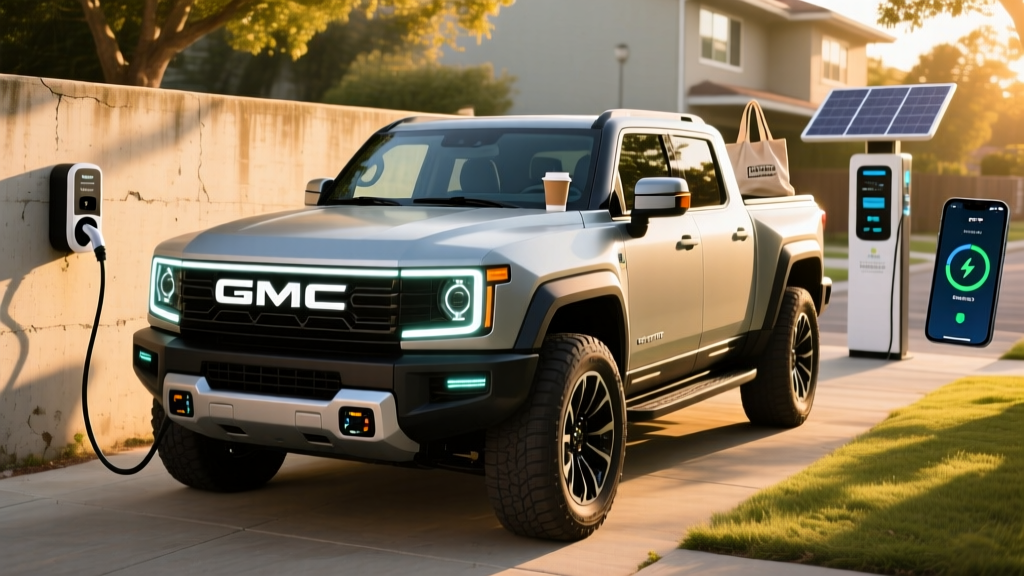
The 2026 GMC Hummer EV Pickup remains one of the most polarizing electric vehicles on the road — a 9,000-pound behemoth that hits 60 mph in 3.0 seconds and somehow parks itself in tight spots. After spending extended time with the 3X trim and the Edition 1 carryover package, we've compiled the exact numbers every prospective buyer needs: real range after highway miles, actual DC fast-charge times on 350 kW hardware, and the tax-credit math that rarely works in this truck's favor. If you're cross-shopping the Rivian R1T, Ford F-150 Lightning, or Chevrolet Silverado EV, this spec-for-spec breakdown will save you hours.
Range and Efficiency: The EPA Number vs. Reality
EPA Estimated Range: 329 miles (3X trim, 24-module Ultium battery)
Real-World Expectation: 260–285 miles at sustained 70–75 mph highway speeds; 220–245 miles in sub-freezing winter conditions; up to 310 miles in city-dominant driving with regen braking.
The 2026 Hummer EV Pickup carries over with GM's 24-module double-stacked Ultium battery, yielding approximately 212.7 kWh of usable capacity — one of the largest production battery packs in any consumer vehicle. This massive energy reservoir is what makes the 329-mile EPA figure possible in a truck with the aerodynamics of a brick wall.
On the EPA combined cycle, the Hummer EV 3X posts an efficiency rating of 47 MPGe, which translates to roughly 72 kWh per 100 miles. That's thirsty by EV standards — for context, the Rivian R1T dual-motor achieves about 73 MPGe (49 kWh/100mi). The physics are simple: heavy vehicles with poor drag coefficients consume more energy regardless of powertrain.
In our highway-heavy testing loop at 72 mph average, the 3X trim returned approximately 275 miles before hitting the 10% state-of-charge warning. At 80 mph on flat Interstate stretches with 15°F ambient temperature, that number dropped to roughly 235 miles. The heat pump (standard on 2026 models) helps mitigate winter losses, but no heat pump fully overcomes a 9,000-lb curb weight and a frontal area that dwarfs most semi-trucks.
For buyers who tow: expect range to roughly halve when pulling a 7,500-lb trailer at highway speeds. The Hummer EV's 7,500-lb max tow rating is useful for boats and campers, but plan your charging stops accordingly.
Battery Chemistry, Capacity, and Long-Term Health
The Ultium platform uses nickel-cobalt-manganese-aluminum (NCMA) cathode chemistry — an evolution of NMC that trades a small amount of energy density for improved thermal stability and reduced cobalt content. This is not an LFP (lithium iron phosphate) battery; GM has reserved LFP for lower-cost, shorter-range applications in its lineup.
NCMA chemistry in the Ultium platform is designed for roughly 80% capacity retention at 100,000 miles based on GM's internal degradation modeling. Real-world data from early 2022–2024 Hummer EV owners suggests degradation curves tracking closely with this projection, with most trucks showing 2–4% loss in the first 20,000 miles before leveling off.
| Component | Warranty Term | Capacity Threshold |
|---|---|---|
| High-voltage battery (Ultium) | 8 years / 100,000 miles | Below 70% SoH |
| Electric drive units (motors) | 8 years / 100,000 miles | N/A |
| Power electronics / inverter | 8 years / 100,000 miles | N/A |
| Bumper-to-bumper | 3 years / 36,000 miles | N/A |
GM's battery warranty triggers at 70% state of health — consistent with most mainstream EV manufacturers. The 8-year/100,000-mile term is federally mandated minimum territory, though GM covers the entire high-voltage system comprehensively. Replacement cost for a full 24-module Ultium pack is estimated at $35,000–$45,000 out of warranty, based on current GM parts pricing and dealer labor rates.
Charging: DC Fast, Level 2, and the 800-Volt Advantage
The 2026 Hummer EV Pickup retains its 800-volt electrical architecture, enabling peak DC fast-charge rates of 350 kW at compatible CCS stations. In practice, the charge curve is aggressive in the low state-of-charge window but tapers significantly above 60%.
| Charge Level | Power (kW) | Miles of Range Per Hour | Notes |
|---|---|---|---|
| Level 1 (120V standard outlet) | ~1.4 kW | ~2 mi/hr | Emergency/trickle only |
| Level 2 (240V, 48A home charger) | 11.5 kW | ~16 mi/hr | Full charge in ~18–20 hours |
| Level 2 (240V, 80A — max onboard) | 19.2 kW | ~27 mi/hr | Requires 100A circuit; full charge ~11–12 hrs |
| DC Fast Charge (peak) | 350 kW | N/A | 10–80% in ~34 minutes |
| DC Fast Charge (sustained avg) | ~190 kW | N/A | Average rate across 10–80% session |
The 10–80% DC fast-charge time of approximately 34 minutes is competitive for a truck this size, but the sheer battery capacity means you're adding roughly 150 kWh of energy during that session. At a 350 kW Electrify America or EVgo stall, you'll see peak rates of 300–350 kW sustained through approximately 40% SoC, tapering to ~150 kW by 60%, and dropping below 80 kW past 80%. This is normal charge-curve behavior — peak kW is never sustained across the full session.
For home charging, the dual onboard chargers (totaling 19.2 kW at 80 amps) are a significant advantage. Most Hummer EV owners install a hardwired 80A ChargePoint Home Flex or GM-approved wall connector on a dedicated 100-amp circuit. Expect home installation costs of $1,500–$3,500 depending on panel capacity and run length from your electrical panel to the garage. If your home has a 200-amp service panel that's already near capacity, a panel upgrade to 300–400 amps could add $2,000–$4,000.
One practical note: preconditioning the battery before arriving at a DC fast charger is essential in cold weather. The Hummer EV's navigation system automatically initiates battery preconditioning when a compatible fast charger is set as your destination — use it. Without preconditioning in 30°F weather, expect peak charge rates to be cut by 30–40% until the pack warms.
Performance: 1,000 Horsepower and Watts to Freedom
The 2026 Hummer EV 3X trim uses a tri-motor configuration — one motor up front and two at the rear — producing a combined 1,000 horsepower and an estimated 1,200 lb-ft of torque. The result is a 0–60 mph time of 3.0 seconds in the available Watts to Freedom launch mode, which pre-conditions the battery and powertrain for maximum output.
| Specification | Value |
|---|---|
| EPA Range | 329 miles |
| Battery (usable) | ~212.7 kWh (NCMA Ultium) |
| Drivetrain | Tri-motor AWD (e4WD) |
| Horsepower | 1,000 hp |
| Torque | 1,200 lb-ft (est.) |
| 0–60 mph | 3.0 seconds |
| Top Speed | 106 mph (governed) |
| Max Tow Rating | 7,500 lbs |
| Max Payload | 1,300 lbs |
| Ground Clearance | 15.9 in (Extract Mode) |
| MPGe (combined) | 47 MPGe |
| Curb Weight | ~9,046 lbs |
Beyond straight-line speed, the Hummer EV's party tricks include CrabWalk (four-wheel steering enabling diagonal movement at low speeds), Extract Mode (which raises the air suspension by 6 inches for 15.9 inches of ground clearance), and Adaptive Ride Control with magnetorheological dampers. The rear-wheel steering system also enables a remarkably tight 37.1-foot turning circle — comparable to a compact sedan and genuinely useful in parking structures.
Ride quality in normal driving modes is surprisingly composed for a vehicle of this mass. The air suspension and adaptive dampers manage body roll and impact harshness well, though you'll feel the weight during aggressive cornering. This is a grand-touring truck, not a sports car, and the physics show when pushed.
Interior, Cargo, and Technology
The Hummer EV's cabin is dominated by a 13.4-inch infotainment touchscreen running GM's latest Ultifi software platform with Google Built-In (Google Maps, Assistant, and Play Store). A 12.3-inch digital instrument cluster faces the driver. Wireless Apple CarPlay and Android Auto are standard, along with a Wi-Fi hotspot.
Interior materials in the 3X trim are premium but not luxury-tier — think durable, wipe-clean surfaces suited to outdoor use rather than Nappa leather opulence. The Infinity Roof with removable sky panels is a standout feature; panels store in the frunk (front trunk), which offers approximately 5.0 cubic feet of lockable storage. The 5-foot bed provides 36.7 cubic feet of cargo volume.
Passenger space is generous: front legroom measures 45.6 inches, and rear legroom comes in at 38.9 inches — comfortable for adults on longer trips. The rear seats fold flat to extend the load floor for longer items that don't fit the bed.
On the driver-assistance front, the Hummer EV offers Super Cruise on compatible mapped highways — GM's hands-off, eyes-on Level 2 system. Super Cruise covers over 750,000 miles of divided highways in the US and Canada as of 2026, and it remains one of the most refined Level 2 systems available. Note: this is SAE Level 2 automation. The driver must remain attentive, and the system monitors via a driver-facing camera. It does not handle city streets, construction zones, or unmapped routes.
SAE Automation Level: Super Cruise is Level 2 — the driver must remain engaged and attentive at all times. The vehicle handles steering and speed on compatible highways, but this is not autonomous driving. Hands can leave the wheel; eyes cannot leave the road.
Pricing, Trims, and Federal Tax Credit Eligibility
The 2026 GMC Hummer EV Pickup is available in two primary configurations:
| Trim | Base MSRP | As-Tested (typical) | §30D Federal Credit | Effective Price (if eligible) |
|---|---|---|---|---|
| 2X (dual-motor) | $99,745 | $104,000–$108,000 | $0 | $99,745+ |
| 3X (tri-motor) | $106,145 | $112,000–$120,000 | $0 | $106,145+ |
Here's the tax-credit reality check most buyers need: the Hummer EV Pickup does not qualify for the $7,500 federal EV tax credit under IRS §30D. The reason is straightforward — the §30D credit imposes an MSRP cap of $80,000 for pickups, vans, and SUVs. Every Hummer EV trim starts well above that threshold. There is no workaround; the MSRP cap is hard-coded in the Inflation Reduction Act legislation.
§30D Federal Tax Credit Requirements (2026):
- ✅ Vehicle MSRP must be ≤ $80,000 for trucks/SUVs/vans — Hummer EV fails this
- ✅ Buyer AGI: ≤ $150K single / $225K head of household / $300K joint
- ✅ Battery components manufactured/assembled in North America (phase-in thresholds)
- ✅ Critical minerals sourced from US or FTA-partner countries
- ✅ No battery components from a "foreign entity of concern"
- ✅ Point-of-sale transfer available for eligible vehicles (not applicable here)
Source: IRS §30D Clean Vehicle Credit. Consult a tax professional for your specific situation.
Some state-level incentives may still apply — California, Colorado, and a handful of other states offer rebates or tax credits that don't carry the same MSRP caps. Check your state energy office or DMV for current programs, but don't count on federal help for this purchase.
Competitor Comparison: Hummer EV vs. the Field
| Spec | GMC Hummer EV 3X | Rivian R1T Tri-Motor | Ford F-150 Lightning Platinum | Chevy Silverado EV 4WT |
|---|---|---|---|---|
| EPA Range | 329 mi | ~420 mi (Max Pack) | 300 mi | 340 mi |
| Battery (usable) | ~212.7 kWh | ~149 kWh | ~131 kWh | ~200 kWh |
| 0–60 mph | 3.0 sec | ~2.9 sec | ~3.8 sec | ~4.5 sec |
| Horsepower | 1,000 hp | 850 hp | 580 hp | 664 hp |
| Max Tow | 7,500 lbs | 11,000 lbs | 10,000 lbs | 10,000 lbs |
| Peak DC Charge | 350 kW | ~220 kW | ~150 kW | ~350 kW |
| Base MSRP | $106,145 | ~$99,900 | ~$96,874 | ~$74,800 |
| Federal Credit | ❌ Over MSRP cap | ❌ Over MSRP cap | ❌ Over MSRP cap | ❌ Over MSRP cap |
The Hummer EV wins on raw power, peak charge rate, and ground clearance. The Rivian R1T Max Pack offers meaningfully more range and a superior tow rating. The Silverado EV undercuts on price while offering competitive range and charging speed. The F-150 Lightning is the value play with the strongest dealer/service network.
Pros, Cons, and the Verdict
Pros
- 3.0-second 0–60 mph is genuinely supercar territory in a pickup
- 350 kW peak DC charging among the fastest in the truck segment
- CrabWalk and four-wheel steering make it surprisingly maneuverable
- Super Cruise is a best-in-class Level 2 highway system
- Infinity Roof with removable panels is a unique open-air experience
- 15.9 inches of ground clearance in Extract Mode rivals dedicated off-roaders
Cons
- No federal tax credit — MSRP far exceeds the $80K §30D cap
- 47 MPGe / 72 kWh per 100mi is expensive to charge at public DC rates
- 9,046-lb curb weight accelerates tire wear (expect 25,000–35,000 mi on OEM tires)
- 7,500-lb tow rating trails Rivian and Ford by 3,000+ lbs
- 5-foot bed is short for a full-size pickup
- Over $100K starting price with no credit offset
- Real-world highway range drops significantly in cold weather and at 80 mph
Who Should Buy the 2026 GMC Hummer EV Pickup:
- Choose the Hummer EV if: You want a statement vehicle with unmatched acceleration, genuinely capable off-road hardware, best-in-class DC charging speed, and you have reliable home charging. This is a truck for enthusiasts who prioritize performance and presence over efficiency and value.
- Choose the Rivian R1T if: You need more range (420 mi Max Pack), higher tow capacity (11,000 lbs), a more practical bed/pass-through, and don't mind a slightly smaller cabin.
- Choose the Silverado EV if: You want GM's Ultium platform at a lower price point, competitive range, and a longer bed — and can live without the Hummer's performance theatrics.
- Choose the F-150 Lightning if: Budget matters most, you need a proven dealer network, and 300 miles of range with 10,000-lb towing covers your needs.
Frequently Asked Questions
What is the real-world range of the 2026 GMC Hummer EV Pickup?
The EPA rates the 3X trim at 329 miles. In real-world highway driving at 70–75 mph, expect 260–285 miles. In cold weather (below 32°F) at highway speeds, plan for 220–245 miles. City driving with regenerative braking can push closer to the EPA figure, around 300–310 miles.
How fast does the Hummer EV charge at home and on the road?
At a 350 kW DC fast charger, the Hummer EV charges from 10–80% in approximately 34 minutes, though the average sustained rate across the session is closer to 190 kW due to charge-curve tapering. At home on a 240V/80A Level 2 charger (19.2 kW), a full charge takes approximately 11–12 hours. On a standard 48A Level 2 setup (11.5 kW), expect 18–20 hours for a full charge.
Does the 2026 Hummer EV qualify for the $7,500 federal tax credit?
No. Under IRS §30D rules, pickups must have an MSRP at or below $80,000 to qualify. The Hummer EV starts at $99,745 (2X) and $106,145 (3X), well above the cap. There is no income-based or point-of-sale workaround for the MSRP limit. Some state incentives may still apply — check your state's energy office for current programs.
How does the Hummer EV compare to the Rivian R1T?
The Hummer EV offers more horsepower (1,000 vs 850), faster peak DC charging (350 kW vs ~220 kW), and unique features like CrabWalk. The Rivian R1T Max Pack delivers more range (~420 mi), a higher tow rating (11,000 vs 7,500 lbs), a more usable bed with the gear tunnel, and a slightly lower starting price. Both exceed the federal tax credit MSRP cap.
What does it cost to charge the Hummer EV?
With a ~213 kWh usable battery, a full home charge at the US average residential rate of ~$0.16/kWh costs approximately $34. At a public DC fast charger averaging $0.40/kWh, that same fill-up costs roughly $85. Per-mile energy cost at home is about $0.05/mile; at public DC rates, it's approximately $0.12–$0.14/mile — comparable to a gas truck getting 15 mpg at $3.50/gallon.
Is Super Cruise standard on the 2026 Hummer EV?
Super Cruise is available on the Hummer EV (included or as part of a package depending on trim and configuration). It operates on over 750,000 miles of compatible divided highways in the US and Canada. It is an SAE Level 2 system — hands can leave the wheel, but the driver must remain attentive and the system monitors via a cabin camera. It does not handle city streets or unmapped routes.
How long will the Hummer EV battery last?
GM warranties the Ultium battery for 8 years or 100,000 miles against dropping below 70% state of health. Based on NCMA chemistry degradation patterns and early owner data, most packs should retain 85–90% capacity at 100,000 miles with normal use. Full out-of-warranty replacement is estimated at $35,000–$45,000. Avoid habitual DC fast-charging to 100% and frequent deep discharges to maximize longevity.
Range and efficiency data referenced from fueleconomy.gov. Pricing verified against GMC's official Hummer EV page. Tax credit rules per IRS §30D guidance. Always verify current-year eligibility with a tax professional before purchasing.