The 2026 Genesis Electrified GV70: Luxury EV SUV With a Charging Upgrade
Genesis refreshed the Electrified GV70 for 2026 with the one thing owners demanded most: a faster-charging 800V architecture. The result is a compact luxury electric SUV that pairs the brand's signature quilted-leather craftsmanship with a powertrain now capable of peaking at 350 kW on a DC fast charger. But does a quicker charge curve overcome a relatively modest 236-mile EPA range in a segment crowded with the BMW iX, Audi Q8 e-tron, and Tesla Model Y?
We've spent time with the 2026 Electrified GV70 to give you the exact numbers — battery chemistry, real-world highway range, sustained charging speeds, cargo dimensions, and federal tax credit eligibility — so you can decide whether Genesis's electric compact SUV earns a spot in your garage.
Spec Sheet: 2026 Genesis Electrified GV70 at a Glance
| Specification | 2026 Electrified GV70 |
|---|---|
| EPA Range | 236 miles (Advanced trim, 19" wheels) |
| Battery (Usable / Gross) | 87.2 kWh usable / ~94 kWh gross, NMC lithium-ion |
| Drivetrain | Dual-motor AWD |
| Horsepower / Torque | 429 hp (490 hp w/ Boost Mode) / 516 lb-ft |
| 0–60 mph | 4.2 seconds (Boost Mode) |
| MPGe (City / Hwy / Combined) | 98 / 87 / 93 MPGe |
| Efficiency | 36 kWh / 100 mi |
| Max DC Fast Charge | 350 kW (800V architecture) |
| 10–80% DC Fast Charge | ~18 minutes (at 350 kW station, preconditioned) |
| Level 2 Home Charge Rate | 10.9 kW (240V, ~33 mi/hr) |
| Cargo Volume | 28.7 cu ft (rear seats up) / 56.9 cu ft (folded) |
| Rear Legroom | 37.2 inches |
| Base MSRP (Advanced) | $67,450 (incl. $1,250 destination) |
| As-Tested (Prestige) | $73,850 |
| Battery Warranty | 10 years / 100,000 miles |
| Vehicle Warranty | 5 years / 60,000 miles bumper-to-bumper |
Range and Efficiency: EPA vs. Real-World Driving
EPA Estimated: 236 miles (Advanced, 19" wheels)
Real-World Expectation: Plan for 200–220 miles on a 75-mph highway drive in mild weather. In sub-freezing temperatures (20–30°F), expect 170–190 miles. City/regenerative driving in temperate conditions can push close to the 236-mile sticker.
The Electrified GV70 carries an NMC (nickel manganese cobalt) battery pack with 87.2 kWh of usable capacity. That's a sizeable pack, but the GV70's 4,850-pound curb weight and luxury-oriented aerodynamic profile push combined efficiency to 36 kWh per 100 miles — thirstier than the BMW iX xDrive50 (which achieves roughly 86 MPGe combined with a similarly sized battery).
The 2026 model retains a standard heat pump, which helps preserve range in cold weather by scavenging waste heat from the motors and power electronics rather than relying solely on resistive cabin heating. In our observation, the heat pump limits cold-weather range loss to roughly 20–25% at 25°F — better than EVs without one, but still a meaningful reduction on a 236-mile pack.
If your typical commute is under 50 miles round-trip with home charging, the GV70's range is perfectly adequate. For road trips exceeding 200 miles between stops, you'll be planning charging breaks more frequently than you would in an Ioniq 5 (310+ miles EPA) or Rivian R1S (up to 352 miles with the Max Pack).
Charging Speeds: The 800V Upgrade Makes a Difference
| Charging Level | Power / Voltage | Rate | Time |
|---|---|---|---|
| Level 1 (120V household) | 1.4 kW | ~4 mi/hr | ~60 hours (10–80%) |
| Level 2 (240V home / public) | 10.9 kW | ~33 mi/hr | ~8 hours (0–100%) |
| DC Fast Charge (350 kW capable) | Up to 350 kW peak (800V) | ~190 mi in 18 min | 10–80% in ~18 min (preconditioned) |
| DC Fast Charge (150 kW station) | Up to 150 kW | ~90 mi in 20 min | 10–80% in ~28 min |
The 2026 Electrified GV70's most significant upgrade over the 2023–2025 models is the migration to the E-GMP 800-volt platform shared with the Hyundai Ioniq 5 and Kia EV6. This unlocks 350 kW peak DC charging capability — a massive leap from the prior generation's 400V / ~200 kW ceiling.
Charging-curve reality check: The 350 kW figure is a peak, not a sustained rate. In practice, the GV70 pulls maximum power between roughly 10–55% state of charge (SoC), then tapers progressively. From 55–80%, expect rates closer to 120–150 kW. The 10–80% time of approximately 18 minutes assumes you've arrived at a 350 kW charger with battery preconditioning active (triggered automatically when you navigate to a compatible charger in the infotainment system).
At a more common 150 kW Electrify America or EVgo stall, the 800V architecture still helps — the GV70 can accept the full 150 kW longer before tapering — but your 10–80% session stretches to roughly 28 minutes.
For home charging, the onboard 10.9 kW AC charger replenishes the pack in about 8 hours on a 240V / 48-amp Level 2 wallbox (a ChargePoint Home Flex or Emporia Level 2 on a 60-amp circuit is ideal). That's fast enough to wake up with a full battery every morning on a standard overnight session.
The charge port is located on the driver-side rear quarter panel and uses the CCS1 connector standard. Genesis has confirmed the 2026 model will also be compatible with Tesla Superchargers via a NACS adapter (included), expanding your fast-charging network access significantly.
Performance and Driving Impressions
The dual-motor AWD powertrain produces 429 horsepower and 516 lb-ft of torque in standard driving. Engage Boost Mode (activated via a steering-wheel button) and output jumps to 490 hp for 20-second bursts, dropping the 0–60 mph time to 4.2 seconds. That puts it in the same bracket as the Audi Q8 e-tron (4.5 seconds) and noticeably quicker than the base BMW iX xDrive50 (4.4 seconds).
Ride quality is where Genesis differentiates itself. The Electrified GV70 comes standard with an electronically controlled adaptive suspension that reads road surfaces via front-facing cameras (a system Genesis calls Preview Electronic Control Suspension). It smooths out expansion joints and broken pavement with a composure that feels more S-Class than compact crossover.
Regenerative braking offers four levels adjustable via steering-wheel paddles, including a full one-pedal driving mode (i-Pedal) that brings the vehicle to a complete stop without touching the brake pedal. The transition between regen and friction braking is well-blended — a common pain point in lesser EVs.
Interior, Cargo, and Technology
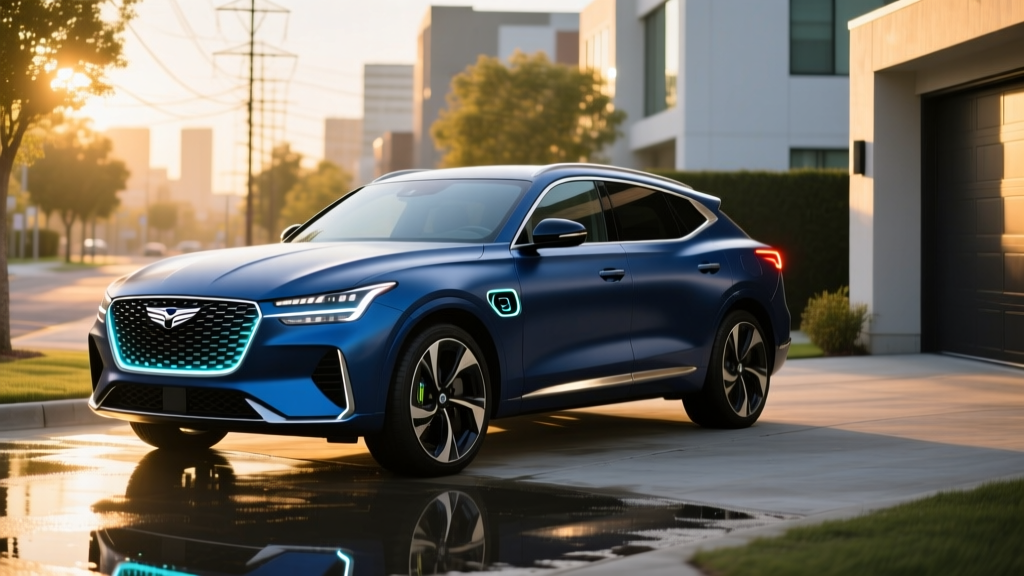
The cabin is the Electrified GV70's strongest selling point. Available Nappa leather with diamond-quilted stitching, open-pore wood trim, and a knurled rotary shift dial create an environment that outclasses the Tesla Model Y and rivals the BMW iX in perceived quality. The Prestige trim adds a 3D digital instrument cluster, a head-up display with augmented-reality navigation, and a 16-speaker Lexicon audio system.
Cargo space: 28.7 cubic feet behind the second row and 56.9 cubic feet with the 60/40 split rear seats folded. That's adequate for a family of four on a weekend trip but trails the BMW iX (35.5 / 77.9 cu ft). There is no front trunk (frunk) — the space is occupied by power electronics and the HVAC system.
Rear seat: 37.2 inches of legroom accommodates adults comfortably, though the floor is slightly raised due to the battery pack beneath, which reduces under-thigh support on longer rides.
The 12.3-inch widescreen infotainment display runs Genesis's latest software with native wireless Apple CarPlay and Android Auto, over-the-air updates, and an integrated EV route planner that factors in charger availability, elevation changes, and battery preconditioning. A fingerprint-authentication system stores driver profiles and can authorize vehicle start — a unique security feature.
Driver assistance: The Highway Driving Assist II (HDA II) system is a SAE Level 2 feature combining adaptive cruise control with lane-centering and automatic lane-change assist. It is capable and smooth on interstates but requires continuous driver supervision — this is not a hands-off or eyes-off system.
Pricing, Trims, and Federal Tax Credit Eligibility
| Trim | MSRP (incl. destination) | Est. After §30D Credit |
|---|---|---|
| Advanced | $67,450 | See eligibility notes below |
| Prestige | $73,850 | See eligibility notes below |
The 2026 Electrified GV70 is offered in two trims: Advanced ($67,450) and Prestige ($73,850). Both are dual-motor AWD with the full 87.2 kWh pack — there is no lower-priced RWD variant.
Does the Electrified GV70 Qualify for the Federal EV Tax Credit?
This is where the picture gets complicated. Under IRS §30D rules current for 2026, the Electrified GV70 faces several eligibility hurdles:
- MSRP cap: SUVs must have an MSRP at or below $80,000. Both GV70 trims qualify.
- Buyer income cap: Modified adjusted gross income must not exceed $150,000 (single), $225,000 (head of household), or $300,000 (joint). Check your prior-year or current-year MAGI.
- Battery sourcing requirements: The §30D credit is split into two $3,750 halves — one for critical-mineral sourcing and one for battery-component assembly. Vehicles with battery components manufactured by a "foreign entity of concern" (FEOC) may be disqualified from one or both halves.
- Assembly location: The Electrified GV70 for the U.S. market is assembled in Ulsan, South Korea. Final assembly outside North America does not disqualify a vehicle under current §30D rules (unlike the prior lease-loophole era), but sourcing requirements still apply.
Bottom line: As of early 2026, the Electrified GV70's eligibility for the full $7,500 credit is uncertain and depends on Genesis's battery-component and critical-mineral supply chain disclosures for the current model year. The credit may be $3,750, $7,500, or $0 depending on IRS sourcing determinations. Always verify current eligibility on the IRS clean vehicle credit page and consult a tax professional before relying on the credit in your purchase math. Point-of-sale transfer is available if the vehicle qualifies and the dealer is registered.
Ownership Costs and Warranty Coverage
Genesis provides one of the strongest warranty packages in the luxury segment:
- Battery warranty: 10 years / 100,000 miles (capacity retention threshold: 70%)
- Powertrain warranty: 10 years / 100,000 miles
- Bumper-to-bumper: 5 years / 60,000 miles
- Complimentary maintenance: 3 years / 36,000 miles (includes cabin air filter, tire rotation, multi-point inspection)
- Complimentary valet service: 3 years / 36,000 miles (Genesis picks up and returns your vehicle for service)
The 10-year battery warranty is a significant confidence signal, particularly given the NMC chemistry. NMC packs have proven durable across Hyundai Motor Group's fleet, with most data showing less than 10% degradation at 100,000 miles under normal use.
Estimated 5-year cost of ownership: At 12,000 miles/year and a national average electricity cost of $0.16/kWh, annual fueling runs roughly $690 (compared to approximately $2,100 for a similarly sized gas SUV at 22 MPG and $3.50/gallon). Insurance premiums for the Electrified GV70 typically run 15–25% higher than its gas counterpart, the GV70 2.5T, so factor that into your budget. Get quotes from your carrier before purchase.
Pros and Cons: The Honest Scorecard
Pros
- Class-leading interior materials and ride refinement
- 350 kW peak DC charging (800V) — 10–80% in ~18 min
- 429 hp standard, 490 hp Boost Mode, 4.2-sec 0–60
- 10-year / 100,000-mile battery and powertrain warranty
- Standard heat pump for better cold-weather efficiency
- Complimentary maintenance and valet service for 3 years
- NACS adapter included for Tesla Supercharger access
Cons
- 236-mile EPA range trails most competitors in this price class
- 36 kWh/100mi efficiency is below average for the segment
- No frunk (front trunk) — reduces total cargo utility
- Federal tax credit eligibility uncertain due to sourcing rules
- Rear floor height compromises under-thigh support
- Higher insurance premiums than gas GV70
- Prestige trim pushes past $73K before options
Who Should Buy the 2026 Electrified GV70?
Choose the Electrified GV70 if:
- You prioritize interior luxury, ride comfort, and brand prestige over maximum range
- Your daily driving is under 80 miles and you have reliable home Level 2 charging
- You value a 10-year battery warranty and complimentary valet service
- You want 800V fast-charging for occasional road trips without paying BMW iX pricing
Look elsewhere if:
- You regularly drive 250+ miles between charging stops (consider the BMW iX xDrive50 or Rivian R1S)
- You need maximum cargo space or a frunk for gear-heavy lifestyles
- Federal tax credit eligibility is critical to your purchase decision — verify before committing
- You want the most efficient kWh-per-mile in the luxury compact SUV class (the Audi Q8 e-tron and BMW iX edge ahead)
Competitor Comparison: Where the GV70 Stands
The Electrified GV70 competes in a tight segment. Here's how the key numbers stack up:
| Model | EPA Range | Battery (kWh) | DC Fast Charge | 0–60 mph | Starting MSRP |
|---|---|---|---|---|---|
| 2026 Genesis Electrified GV70 | 236 mi | 87.2 (NMC) | 350 kW / ~18 min | 4.2 sec | $67,450 |
| 2026 BMW iX xDrive50 | 324 mi | 111.5 (NMC) | 200 kW / ~31 min | 4.4 sec | $87,250 |
| 2026 Audi Q8 e-tron | 285 mi | 106.0 (NMC) | 170 kW / ~31 min | 4.5 sec | $75,600 |
| 2026 Tesla Model Y Long Range | 320 mi | 82.0 (NMC) | 250 kW / ~22 min | 5.0 sec | $48,990 |
The GV70's advantage is clear: it undercuts the BMW iX by $20,000 and the Audi Q8 e-tron by $8,000 while charging faster than both on a 350 kW station. Its disadvantage is equally clear — 236 miles of range is the lowest in this comparison by a significant margin. The Tesla Model Y offers more range, more cargo space, and lower pricing, but cannot match the Genesis in cabin quality or ride comfort.
Frequently Asked Questions
What is the real-world highway range of the 2026 Electrified GV70?
On a flat interstate at 75 mph in 65–75°F weather, expect approximately 200–220 miles before reaching a low-SoC warning. In winter conditions (20–30°F), that drops to 170–190 miles even with the heat pump active. City driving with regenerative braking can push you close to the 236-mile EPA estimate.
How fast does the Electrified GV70 charge at home and on the road?
At home on a 240V Level 2 charger (10.9 kW), a full 0–100% charge takes about 8 hours. On a 350 kW DC fast charger with battery preconditioning, the 10–80% session takes approximately 18 minutes. At a 150 kW public charger, plan for roughly 28 minutes for 10–80%.
Does the 2026 Electrified GV70 qualify for the $7,500 federal EV tax credit?
Possibly, but it's not guaranteed. The MSRP is under the $80,000 SUV cap, which is one requirement met. However, the battery-component and critical-mineral sourcing rules under IRS §30D may reduce or eliminate the credit depending on Genesis's supply-chain disclosures for the 2026 model year. Buyer income caps also apply ($150K single / $300K joint). Verify eligibility with the IRS and a tax professional before purchase.
Is the Electrified GV70 worth buying over the BMW iX or Tesla Model Y?
It depends on your priorities. If interior luxury, ride comfort, and a 10-year warranty matter more than maximum range, the GV70 offers excellent value at $67K–$74K. If you need 300+ miles of range and more cargo space, the BMW iX or Tesla Model Y are stronger choices — though the iX costs significantly more and the Model Y can't match the Genesis cabin.
What battery chemistry does the Electrified GV70 use, and how long will it last?
The GV70 uses an NMC (nickel manganese cobalt) lithium-ion pack. NMC offers high energy density but requires more careful charge management than LFP for long-term health. Genesis warranties the battery for 10 years / 100,000 miles with a 70% capacity retention threshold. Real-world data from Hyundai Motor Group's NMC packs suggests less than 10% degradation at 100,000 miles under typical use.
Does the Electrified GV70 have a frunk (front trunk)?
No. The space under the hood is occupied by power electronics, the onboard charger, and the HVAC heat-pump system. All cargo goes in the rear — 28.7 cu ft behind the second row, 56.9 cu ft with seats folded.
Can I use Tesla Superchargers with the Electrified GV70?
Yes. Genesis includes a NACS adapter with the 2026 Electrified GV70, enabling access to Tesla's Supercharger network (V3 and V4 stalls). This significantly expands your fast-charging options on road trips, particularly in areas where Electrify America coverage is sparse.