Quick Verdict: The Mach-E's 2026 Sweet Spot
The 2026 Ford Mustang Mach-E enters its sixth model year with a formula that's matured considerably since its polarizing debut. Ford has standardized the extended-range battery on more trims, added native NACS (Tesla Supercharger) compatibility across the lineup, and refined its BlueCruise hands-free system. The result is a midsize electric crossover that competes directly with the Tesla Model Y, Hyundai Ioniq 5, and Kia EV6 — and in several measurable categories, it beats them.
But the Mach-E isn't flawless. Its real-world highway range falls noticeably short of the EPA sticker in cold weather, its peak DC fast-charging rate lags behind Hyundai-Kia's 800V architecture, and Ford's build quality remains inconsistent across batches. This review breaks down every number that matters — from usable kWh to 10-80% charge minutes — so you can decide whether the 2026 Mach-E earns a spot in your driveway.
Range, Efficiency & Real-World Expectations
The 2026 Mach-E lineup offers two battery packs and three drivetrain configurations, each producing different EPA range estimates. Here's the full breakdown:
| Trim / Config | Battery (usable kWh) | Drivetrain | EPA Range (mi) | MPGe (city/hwy/combined) | kWh/100 mi |
|---|---|---|---|---|---|
| Select RWD (Std Range) | 72 kWh (LFP) | RWD | 250 | 111 / 94 / 103 | 33 |
| Premium RWD (Ext Range) | 91 kWh (NMC) | RWD | 320 | 111 / 94 / 103 | 32 |
| Premium AWD (Ext Range) | 91 kWh (NMC) | AWD Dual-Motor | 290 | 101 / 86 / 94 | 35 |
| GT AWD (Ext Range) | 91 kWh (NMC) | AWD Dual-Motor | 280 | 94 / 80 / 88 | 38 |
| Rally AWD (Ext Range) | 91 kWh (NMC) | AWD Dual-Motor | 275 | 92 / 78 / 86 | 39 |
The LFP (lithium iron phosphate) battery in the Select RWD Standard Range deserves special mention. LFP chemistry sacrifices roughly 10–15% energy density compared to the NMC (nickel manganese cobalt) packs in higher trims, but it offers two major ownership advantages: Ford recommends you can charge LFP to 100% daily without accelerated degradation, and LFP cells show slower long-term capacity loss over 1,000+ cycles. If your daily commute is under 120 miles round-trip and you want maximum battery longevity, the Select RWD is the sleeper pick.
Charging Speed: DC Fast, Level 2 & Home Setup
The 2026 Mach-E ships with a native NACS charge port, meaning it plugs directly into Tesla Supercharger V3 and V4 stalls without the adapter that earlier model years required. For CCS-network chargers (Electrify America, EVgo), Ford includes a NACS-to-CCS adapter in the glovebox.
| Charging Level | Connector | Peak Power (kW) | Speed (mi/hr added) | 10–80% Time |
|---|---|---|---|---|
| Level 1 (120V household) | NACS / J1772 adapter | 1.4 kW | ~3–4 mi/hr | N/A (overnight top-up only) |
| Level 2 (240V home/public) | NACS / J1772 adapter | 10.5 kW (48A) | ~30–35 mi/hr | ~8.5 hrs (0–100%, Ext Range) |
| DC Fast Charge | NACS (native) / CCS (adapter) | 150 kW peak | ~59 mi in 10 min (peak) | ~36 min (10–80%, Ext Range) |
Charging-curve reality: The Mach-E's 150 kW peak rate applies only between roughly 10–35% State of Charge on the Extended Range NMC pack. After 50% SoC, the rate tapers to ~90 kW, and above 80% it drops below 40 kW. This is why the 10–80% time is 36 minutes rather than the ~22 minutes you'd calculate from peak rate alone. On road trips, the most time-efficient strategy is to charge from 10% to 55–60% (about 18–20 minutes) and hit the next charger rather than waiting for 80%.
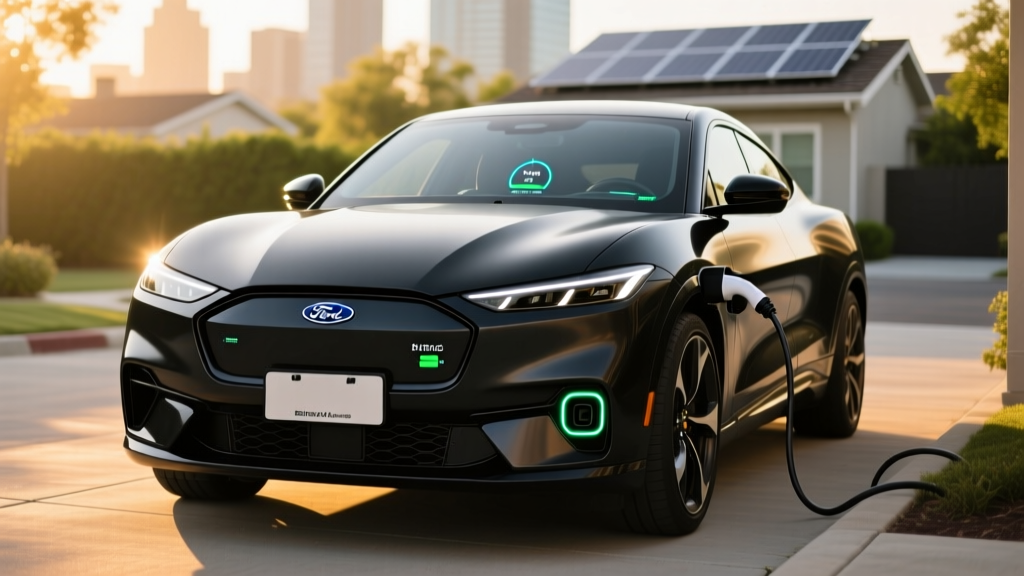
For home Level 2 charging, Ford's Connected Charge Station (48-amp, hardwired) adds roughly 30 miles of range per hour on Extended Range models and 26 on Standard Range. A full overnight charge from 20% to 100% takes approximately 7.5–8.5 hours — well within a typical overnight window. The onboard charger tops out at 10.5 kW, so installing a 60-amp circuit (which supports up to 48A continuous draw) is the maximum useful investment; an 80-amp circuit won't charge the Mach-E any faster.
Home installation cost: Expect $800–$1,500 for a straightforward Level 2 install (charge station + 240V/50A circuit within 30 feet of the panel). If your home's electrical panel needs a 200-amp service upgrade, budget an additional $1,500–$3,500. Always get a quote from a licensed electrician — panel capacity varies enormously by home age and existing load.
Performance: 0–60 Times, Horsepower & Drivetrain
The Mach-E's performance credentials vary dramatically by trim. Here's what each configuration delivers:
| Trim | Drivetrain | Horsepower | Torque (lb-ft) | 0–60 mph | Towing Capacity |
|---|---|---|---|---|---|
| Select RWD (Std Range) | Single motor, RWD | 266 hp | 387 | 6.3 sec | 2,200 lbs |
| Premium RWD (Ext Range) | Single motor, RWD | 290 hp | 387 | 5.8 sec | 2,200 lbs |
| Premium AWD (Ext Range) | Dual motor, AWD | 365 hp | 428 | 4.8 sec | 2,200 lbs |
| GT AWD (Ext Range) | Dual motor, AWD | 480 hp | 634 | 3.5 sec | 2,200 lbs |
| Rally AWD (Ext Range) | Dual motor, AWD | 500 hp | 674 | 3.4 sec | 2,200 lbs |
The GT and Rally trims deliver genuine sports-car acceleration — the GT's 3.5-second 0–60 time rivals a Porsche 911 Carrera from a decade ago. But the real-world sweet spot for most buyers is the Premium AWD at 4.8 seconds: quick enough to merge confidently onto any freeway, and it doesn't sacrifice range as heavily as the GT (290 miles vs. 280 miles EPA).
All trims feature regenerative braking with one-pedal driving capability. Ford's "Whisper," "Engage," and "Unbridled" drive modes adjust throttle mapping, steering weight, and regen intensity. The Rally trim adds a specific suspension tune with raised ride height and underbody protection for light gravel and dirt roads — but this is a crossover, not a body-on-frame off-roader.
Interior Space, Cargo & Daily Livability
The Mach-E's cabin dimensions make it a practical family hauler, though it gives up some cargo volume to the Tesla Model Y:
- Front headroom: 40.4 inches
- Front legroom: 43.3 inches
- Rear headroom: 38.9 inches
- Rear legroom: 38.1 inches
- Cargo behind rear seats: 29.7 cu ft
- Cargo with rear seats folded: 59.7 cu ft
- Front trunk (frunk): 4.7 cu ft (drainable, useful for wet gear or groceries)
Compared to the Model Y (30.2 cu ft rear / 76.2 cu ft max), the Mach-E trails by a few cubic feet in maximum cargo, but its rear seat comfort — bolstered cushions, adequate thigh support, and a flat floor — is noticeably better for adult passengers on long trips. The drainable frunk is a standout feature: it's ideal for muddy hiking boots, ice for a tailgate, or a wet charging cable.
The 15.5-inch portrait-oriented touchscreen runs Ford's SYNC 4A system with wireless Apple CarPlay and Android Auto. Physical climate controls are absent — everything routes through the screen, which frustrates some drivers. A 10.2-inch digital cluster behind the wheel handles speed and range information. BlueCruise, Ford's SAE Level 2 hands-free driving system, is available on mapped divided highways (over 130,000 miles of coverage in the US and Canada as of 2026).
Pricing, Trims & Federal Tax Credit Eligibility
The 2026 Mach-E starts at $39,995 (including destination) and climbs to $62,995 for the Rally. Here's the trim-by-trim pricing:
| Trim | Base MSRP | §30D Credit (est.) | Effective Price* |
|---|---|---|---|
| Select RWD (Std Range, LFP) | $39,995 | Up to $3,750 | ~$36,245 |
| Premium RWD (Ext Range) | $46,995 | Up to $7,500 | ~$39,495 |
| Premium AWD (Ext Range) | $49,995 | Up to $7,500 | ~$42,495 |
| GT AWD (Ext Range) | $57,995 | Up to $7,500 | ~$50,495 |
| Rally AWD (Ext Range) | $62,995 | Up to $7,500 | ~$55,495 |
*Effective price assumes full credit eligibility. Actual credit depends on battery sourcing, buyer income, and MSRP caps. See checklist below.
- MSRP cap: Vehicle must have an MSRP at or below $55,000 (SUVs/crossovers). The GT ($57,995) and Rally ($62,995) exceed this cap and do NOT qualify.
- Buyer income cap: Modified AGI must not exceed $150,000 (single), $225,000 (head of household), or $300,000 (joint filing).
- Battery sourcing: The credit splits into two halves — $3,750 for critical-mineral sourcing and $3,750 for battery-component manufacturing. The Select RWD's LFP battery (sourced primarily from CATL supply chains) currently qualifies for only the critical-minerals half ($3,750). Extended-range NMC models assembled with North American-sourced components may qualify for the full $7,500 — verify on IRS.gov before purchase.
- Point-of-sale transfer: You can transfer the credit to the dealer at purchase to reduce the purchase price directly (rather than waiting for a tax refund).
- US assembly: The Mach-E is assembled in Cuautitlán, Mexico. Under current §30D rules, this does NOT disqualify it — the North American final assembly requirement was removed for the new-vehicle credit (it applies to used EV credits under §25E). Confirm current rules at purchase time.
A well-equipped Premium AWD — the volume trim — lands around $52,000–$54,000 after typical options (panoramic roof, BlueCruise subscription, upgraded wheels), with an effective post-credit price of roughly $44,500–$46,500. That positions it squarely against a similarly equipped Tesla Model Y Long Range AWD and undercuts the Kia EV6 GT-Line AWD.
Warranty, Ownership Costs & Reliability
Ford backs the 2026 Mach-E with competitive warranty coverage:
- Battery & electric powertrain: 8 years / 100,000 miles (whichever comes first), with a capacity retention threshold of 70%. If the high-voltage battery drops below 70% of original capacity within the warranty period, Ford will repair or replace it.
- Bumper-to-bumper: 3 years / 36,000 miles
- Corrosion perforation: 5 years / unlimited miles
- Roadside assistance: 5 years / 60,000 miles
Total cost of ownership (5-year estimate, Premium RWD Ext Range):
- Electricity (15,000 mi/yr at $0.14/kWh avg): ~$4,700 total
- Equivalent gas vehicle fuel (25 MPG combined at $3.50/gal): ~$10,500 total
- Maintenance savings: ~$1,800 over 5 years (no oil changes, reduced brake wear from regen)
- Insurance: Expect 10–20% higher premiums vs. a comparable gas crossover (average $1,800–$2,200/yr depending on state and driving record)
- Depreciation: The Mach-E has historically held ~45–50% of value after 5 years, trailing the Model Y (~55–60%) but matching the Ioniq 5
For a detailed breakdown, reference the EPA's Fuel Economy comparison tool for specific trim efficiency data and annual fuel cost estimates.
Pros, Cons & Who Should Buy the 2026 Mach-E
- Native NACS port — direct Tesla Supercharger access with no adapter friction
- LFP battery option on Select trim for maximum longevity and daily 100% charging
- BlueCruise hands-free on 130,000+ miles of divided highways (SAE Level 2)
- Comfortable rear seat with flat floor — better for adult passengers than Model Y
- Drainable frunk adds genuine utility
- GT and Rally trims deliver sub-3.5-second 0–60 performance
- Competitive pricing after federal tax credit on Premium trims
- 150 kW peak DC charge rate trails Ioniq 5/EV6 (240 kW on 800V) and Model Y (~250 kW)
- Real-world highway range 12–18% below EPA sticker — cold weather worsens this gap
- No physical climate controls — all HVAC functions are screen-only
- GT and Rally trims exceed the $55,000 MSRP cap for the §30D tax credit
- Cargo volume (29.7 cu ft) trails Model Y (30.2) and Ioniq 5 (36.3 behind rear seats)
- Build quality inconsistencies reported across early 2026 production batches
- BlueCruise requires a paid subscription after the initial trial period (~$75/mo or $800/yr)
- Choose the Select RWD (Std Range, LFP) if: You commute under 100 miles daily, want the longest-lasting battery chemistry, and want the lowest entry price with at least $3,750 in federal credit.
- Choose the Premium RWD (Ext Range) if: You want maximum range (320 mi EPA), don't need AWD, and want the full $7,500 credit potential. This is the efficiency champion of the lineup.
- Choose the Premium AWD (Ext Range) if: You live in a snow-belt state and need all-weather traction. The 290-mile EPA range and 4.8-second 0–60 make this the best all-around trim for most families.
- Choose the GT if: You prioritize 480 hp and 3.5-second acceleration over tax credit eligibility and maximum range. Accept the $57,995 MSRP and reduced credit.
- Look elsewhere if: You need maximum cargo space (Model Y or Ioniq 5), the fastest possible DC charging (Ioniq 5/EV6 at 240 kW), or you regularly road-trip in extreme cold where a heat pump and larger battery buffer matter more.
Frequently Asked Questions
What is the real-world range of the 2026 Ford Mustang Mach-E?
The EPA rates the Premium RWD Extended Range at 320 miles, but real-world highway driving at 70–75 mph yields approximately 260–280 miles. In cold weather (below 32°F), expect 220–240 miles due to battery resistance and cabin heating load. The Standard Range LFP model's 250-mile EPA rating translates to roughly 200–215 miles on the highway.
How fast does the 2026 Mach-E charge at home and on the road?
At home on a 240V Level 2 charger (48A), the Mach-E adds about 30–35 miles of range per hour, fully charging an Extended Range pack overnight in 8–9 hours. On DC fast chargers, it peaks at 150 kW and charges from 10–80% in approximately 36 minutes on the Extended Range battery. The native NACS port gives direct access to Tesla Superchargers.
How much does the 2026 Mach-E cost after the federal tax credit?
The Select RWD starts at $39,995 and may qualify for $3,750 in credit, bringing it to ~$36,245. The Premium RWD and AWD (both under the $55,000 MSRP cap) may qualify for the full $7,500, reducing effective prices to roughly $39,495 and $42,495 respectively. The GT and Rally exceed the MSRP cap and do not qualify. Always verify eligibility on IRS.gov — battery sourcing rules change periodically.
Is the 2026 Mach-E worth buying over the Tesla Model Y or Hyundai Ioniq 5?
It depends on your priorities. The Mach-E Premium AWD offers a more comfortable rear seat and native Supercharger access at a competitive post-credit price. The Model Y wins on cargo volume and Supercharger network maturity. The Ioniq 5 wins on DC charging speed (240 kW vs. 150 kW) and interior space behind the rear seats (36.3 vs. 29.7 cu ft). If you value ride comfort and highway driving assist (BlueCruise), the Mach-E is compelling. If you prioritize fast road-trip charging, the Ioniq 5 is harder to beat.
Does the 2026 Mustang Mach-E qualify for the federal EV tax credit?
The Select, Premium RWD, and Premium AWD trims all fall under the $55,000 MSRP cap for SUVs and can qualify — but the actual credit amount ($3,750 or $7,500) depends on battery-critical-mineral sourcing and component manufacturing origin, plus your income level. The GT ($57,995) and Rally ($62,995) exceed the MSRP cap and are ineligible. Check the latest fueleconomy.gov tax credit listings for VIN-specific eligibility at purchase time.
What is the battery warranty on the 2026 Mach-E?
Ford covers the high-voltage battery and electric drivetrain components for 8 years or 100,000 miles, whichever comes first. The warranty guarantees at least 70% of original battery capacity. If degradation drops below that threshold within the warranty period, Ford will repair or replace the battery at no cost. This is standard for the EV industry and matches Tesla, Hyundai, and Kia coverage.
Can the 2026 Mach-E use Tesla Superchargers?
Yes. The 2026 Mach-E has a native NACS charge port, meaning it plugs directly into Tesla Supercharger V3 (150 kW) and V4 stalls without any adapter. For non-Tesla CCS chargers (Electrify America, EVgo, ChargePoint CCS cables), Ford provides a NACS-to-CCS adapter included with the vehicle.