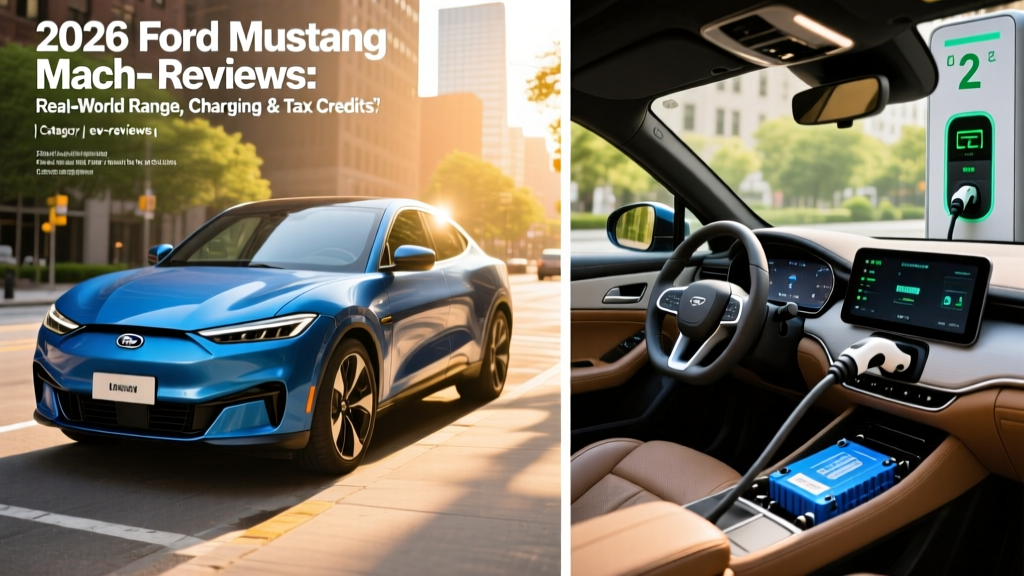
The Ford Mustang Mach-E has matured from an early EV pioneer into one of the most well-rounded electric crossovers on the market. For 2026, Ford has refined the Mach-E's battery options, expanded its DC fast-charging capabilities, and adjusted pricing to stay competitive in a segment now crowded with the Tesla Model Y, Hyundai Ioniq 5, Kia EV6, and Chevrolet Blazer EV. If you've been reading Mustang Mach-E reviews and trying to separate marketing from measurable reality, this profile delivers the exact numbers you need — from EPA range and real-world highway efficiency to the nuances of LFP versus NMC battery chemistry and current §30D federal tax credit rules.
Quick Verdict: Who the 2026 Mach-E Is For
Choose the Mustang Mach-E if: you want a practical two-row electric crossover with strong highway manners, available BlueCruise hands-free driving, a competitive real-world range above 270 miles (Extended Range), and Ford dealer service infrastructure nationwide.
Look elsewhere if: you need three rows (check the Kia EV9 or Tesla Model X), you demand the absolute fastest DC charging in class (the Ioniq 5's 800V architecture still leads), or you want the lowest possible starting price (the base Equinox EV undercuts it).
2026 Mustang Mach-E Specs at a Glance
| Spec | Select (Std Range) | Premium (Ext Range RWD) | GT (Ext Range AWD) |
|---|---|---|---|
| EPA Range | 250 mi | 320 mi | 290 mi |
| Usable Battery | 72 kWh (LFP) | 91 kWh (NMC) | 91 kWh (NMC) |
| Horsepower | 266 hp | 290 hp | 480 hp |
| Torque (lb-ft) | 387 | 387 | 634 |
| 0–60 mph | 6.3 sec | 5.9 sec | 3.5 sec |
| Drivetrain | RWD (single motor) | RWD (single motor) | AWD (dual motor) |
| Max DC Fast Charge | 135 kW | 150 kW | 150 kW |
| 10–80% DC Time | ~36 min | ~41 min | ~41 min |
| Level 2 Home Rate | 10.5 kW (~30 mi/hr) | 10.5 kW (~30 mi/hr) | 10.5 kW (~30 mi/hr) |
| EPA Efficiency (MPGe) | 100 MPGe | 98 MPGe | 84 MPGe |
| Base MSRP | $39,995 | $45,995 | $55,995 |
Sources: fueleconomy.gov, Ford Motor Company 2026 spec sheets. Prices exclude $1,395 destination charge.
Range & Efficiency: EPA Sticker vs. the Real World
EPA Estimated Range: 250 mi (Standard Range) / 320 mi (Extended Range RWD) / 290 mi (GT AWD)
Real-World Expectation: In mixed driving at 70 mph highway speeds, expect the Extended Range RWD to deliver approximately 270–285 miles. In cold weather (below 30°F), range drops 20–30%, yielding roughly 210–240 miles for the Extended Range model. The GT, with its stickier summer tires and dual-motor draw, typically achieves 245–260 miles in mild conditions and can dip below 200 miles in freezing temperatures with cabin heat running.
The Mach-E Extended Range uses a 91 kWh usable NMC (nickel manganese cobalt) battery pack. NMC chemistry offers higher energy density than LFP, which is why Ford reserves it for the longer-range trims. The Standard Range models use a 72 kWh LFP (lithium iron phosphate) pack — lower energy density but inherently more stable, longer cycle life, and Ford recommends you can charge LFP to 100% daily without accelerated degradation concerns.
Efficiency-wise, the Premium RWD at 98 MPGe translates to roughly 34 kWh per 100 miles. That's competitive with the Tesla Model Y Long Range (106 MPGe) but slightly behind the Hyundai Ioniq 5 RWD (110 MPGe). The GT's performance-oriented tuning drops efficiency to 84 MPGe, or about 40 kWh/100 mi — a meaningful difference if you're paying $0.16/kWh at public DC chargers.
Charging: Home Level 2, DC Fast Charging & the Charge Curve
| Charging Level | Power | Miles Added per Hour | Notes |
|---|---|---|---|
| Level 1 (120V household) | 1.4 kW | ~4 mi/hr | Emergency/trickle only; ~80 hours for full Standard Range charge |
| Level 2 (240V, 48A) | 10.5 kW | ~30 mi/hr | Full Standard Range in ~7.5 hrs; Extended Range in ~10 hrs |
| DC Fast Charge (Standard Range) | Peak 135 kW | ~150 mi in 20 min (10–60%) | Tapers significantly above 80% SoC |
| DC Fast Charge (Extended Range) | Peak 150 kW | ~155 mi in 20 min (10–60%) | Sustains ~130 kW to ~55%, then curves down; 10–80% in ~41 min |
A critical nuance often missing from Mustang Mach-E reviews: the 150 kW peak charge rate applies only to the Extended Range NMC battery and only when the pack is preconditioned (warmed to optimal temperature). If you arrive at a DC fast charger with a cold battery — say, after a winter highway drive without using the navigation-based preconditioning feature — peak rates may start closer to 60–80 kW, extending your stop substantially.
The Mach-E's 400V architecture means it cannot match the 800V platforms in the Ioniq 5 or EV6, which peak above 230 kW and achieve 10–80% in roughly 18 minutes. For road-trippers who DC fast-charge frequently, that 20+ minute difference per stop adds up. However, for daily drivers who charge at home overnight, the Mach-E's 10.5 kW Level 2 rate is perfectly adequate — plug in at 10 PM, wake up to a full battery every morning.
Home Level 2 installation typically requires a 240V/60A circuit with a hardwired 48A charger (such as the Ford Charge Station Pro or a ChargePoint Home Flex). Expect $800–$2,000 for a straightforward installation; older homes needing a panel upgrade from 100A to 200A service can see costs reach $3,000–$5,000. Always get a quote from a licensed electrician before purchasing equipment.
Performance, Ride & Drivetrain
The Mach-E lineup spans a wide performance envelope. The base Select RWD at 266 hp and a 6.3-second 0–60 time is more than adequate for merging and passing — this is a torque-rich electric motor delivering 387 lb-ft from zero RPM. The GT Performance Edition, at 480 hp and 3.5 seconds to 60 mph, enters sports-car territory and will outrun most gas-powered SUVs off the line.
Ride quality is firm but composed. Ford tuned the suspension with a slightly European bias — body motions are well-controlled, but you'll feel sharper potholes more than in a Hyundai Ioniq 5. The GT's MagneRide adaptive dampers (standard on Performance Edition) improve this considerably, offering a comfortable cruise mode and a genuinely taut sport mode.
All AWD trims use a dual-motor setup with independent front and rear motors. Unlike some competitors, the Mach-E does not offer a dedicated front-motor disconnect for efficiency gains in RWD-only cruising — a minor efficiency trade-off versus the Tesla Model Y's motor deactivation strategy.
Interior, Cargo & Technology
Cargo Volume: 29.7 cu ft behind the rear seats; 59.7 cu ft with rear seats folded. The front trunk (frunk) adds 4.7 cu ft with a drain plug — useful for tailgate ice storage. Compared to the Model Y (30.2 / 76.2 cu ft), the Mach-E gives up some maximum cargo space due to its more coupe-like roofline.
Passenger Space: Front legroom is 43.3 inches; rear legroom is 38.9 inches. The rear seat is comfortable for two adults on longer trips, though the sloping roofline cuts into headroom for passengers over 6 feet.
Infotainment: The 15.5-inch vertical touchscreen running SYNC 4A remains the centerpiece. Wireless Apple CarPlay and Android Auto are standard. The interface has improved with recent OTA updates, but some owners note the lack of physical climate controls requires extra taps. A 10.2-inch digital instrument cluster provides speed, range, and navigation ahead of the driver.
Driver Assistance: Ford Co-Pilot360 2.0 is standard, including adaptive cruise control, lane-centering, blind-spot monitoring, and rear cross-traffic braking. The available BlueCruise system enables hands-free driving on over 130,000 miles of pre-mapped divided highways in the U.S. and Canada.
SAE Automation Level: BlueCruise is a Level 2 driver-assistance system. Despite hands-free capability on approved roads, you must remain alert and ready to resume control at any time. The driver-monitoring camera will issue warnings if your attention lapses. This is not autonomous or "self-driving" — only Level 4 robotaxi services like Waymo operate without a human driver.
Pricing, Trim Levels & Federal Tax Credit Eligibility
| Trim | Base MSRP | Destination | Est. §30D Credit | Effective Price (if eligible) |
|---|---|---|---|---|
| Select (Std Range RWD) | $39,995 | $1,395 | Up to $3,750 | ~$37,640 |
| Premium (Ext Range RWD) | $45,995 | $1,395 | Up to $3,750 | ~$43,640 |
| Premium (Ext Range AWD) | $48,995 | $1,395 | Up to $3,750 | ~$46,640 |
| GT (Ext Range AWD) | $55,995 | $1,395 | Up to $3,750 | ~$53,640 |
| GT Perf. Edition (AWD) | $61,995 | $1,395 | Up to $3,750 | ~$59,640 |
Federal §30D EV Tax Credit — 2026 Rules (per IRS.gov):
- Maximum credit: $7,500, split into $3,750 for critical minerals sourcing + $3,750 for battery component sourcing. The Mach-E's current battery supply chain qualifies for the critical minerals half ($3,750) as of early 2026; battery component eligibility varies by build date and should be confirmed with your dealer's VIN-level certification.
- MSRP cap: Vans/SUVs/pickups must be ≤$80,000. All Mach-E trims qualify.
- Buyer income cap: Modified AGI ≤$150,000 (single) / ≤$300,000 (joint). If your income exceeds these limits, you are ineligible regardless of the vehicle.
- Point-of-sale transfer: You may transfer the credit to the dealer at purchase, reducing your out-of-pocket cost immediately rather than waiting for a tax refund.
- Assembly: Must be assembled in North America. The Mach-E is built in Cuautitlán, Mexico — which qualifies.
Tax credit rules change frequently. Always verify current eligibility on IRS.gov and consult a tax professional before relying on credit amounts for purchase decisions.
Warranty, Ownership Costs & Long-Term Battery Outlook
Ford covers the Mach-E with a 3-year/36,000-mile basic warranty and a 8-year/100,000-mile battery and electric powertrain warranty. The battery warranty guarantees that the high-voltage pack will retain at least 70% of its original capacity during the coverage period. If degradation exceeds 30%, Ford will repair or replace the pack at no cost.
Real-world degradation data from early 2021–2023 Mach-E owners (tracked on forums and via Recurrent Auto) suggests NMC packs lose approximately 5–8% capacity over the first 60,000 miles, with the curve flattening significantly thereafter. LFP packs in the Standard Range models show even slower degradation, consistent with LFP's known longevity advantage — often cited at 3,000+ full cycles versus ~1,000–1,500 for NMC.
Insurance costs for the Mach-E tend to run 15–25% higher than comparable gas crossovers, consistent with the EV insurance premium trend. Expect annual premiums of $1,800–$2,600 depending on trim, location, and driving record. Get quotes before purchasing — the GT in particular can be notably more expensive to insure.
Pros
- Strong real-world range on Extended RWD (270–285 mi)
- BlueCruise hands-free highway driving is polished and expanding
- LFP option on Standard Range for buyers prioritizing battery longevity
- Spacious, practical interior with useful frunk
- Competitive pricing after tax credit
- Nationwide Ford dealer network for service
Cons
- DC fast charging slower than 800V competitors (Ioniq 5, EV6)
- Cold-weather range loss is significant (~25–30%)
- No physical climate controls — touchscreen-only HVAC
- Maximum cargo space trails the Model Y
- Insurance premiums above gas-crossover averages
- Tax credit may be limited to $3,750 depending on battery sourcing certification
How the Mach-E Stacks Up Against Key Competitors
The Mach-E's closest rivals are the Tesla Model Y Long Range (EPA 330 mi, 106 MPGe, ~$47,990), the Hyundai Ioniq 5 (EPA 303 mi RWD, 800V charging, ~$46,500), and the Kia EV6 (EPA 310 mi, similar 800V platform, ~$45,900). The Mach-E wins on BlueCruise availability and Ford dealer service accessibility. It loses on DC fast-charge speed (the 800V Hyundai/Kia twins add ~150 miles in 18 minutes vs. the Mach-E's ~30+ minutes for similar gains) and on maximum cargo volume versus the Model Y.
For buyers who road-trip more than 4–5 times a year and rely on public DC fast charging, the Ioniq 5's charging advantage is substantial. For daily commuters who charge at home and want hands-free highway assist, the Mach-E with BlueCruise is arguably the more livable daily driver.
Frequently Asked Questions
What is the real-world range of the 2026 Mustang Mach-E?
The Extended Range RWD model delivers approximately 270–285 miles in mixed real-world driving at highway speeds. In cold weather (below 30°F), expect 210–240 miles. The Standard Range LFP model typically achieves 220–235 miles in mild conditions.
How fast does the Mach-E charge at home and on the road?
On a 240V Level 2 home charger (48A), the Mach-E adds roughly 30 miles of range per hour — a full charge overnight in 7.5 to 10 hours depending on battery size. On DC fast chargers, the Extended Range peaks at 150 kW and charges 10–80% in about 41 minutes with a preconditioned battery. The Standard Range peaks at 135 kW with a 10–80% time of approximately 36 minutes.
Does the 2026 Mustang Mach-E qualify for the federal EV tax credit?
Yes, partially. As of early 2026, the Mach-E qualifies for up to $3,750 of the $7,500 §30D credit (the critical minerals half). Eligibility also depends on your income (≤$150K single / ≤$300K joint) and the vehicle's MSRP (all trims fall under the $80K SUV cap). Confirm the exact credit with your dealer and a tax professional, as battery sourcing certifications can change by build date.
Is the Mustang Mach-E worth buying over a Tesla Model Y?
The Mach-E offers a more traditional dealership purchase experience, BlueCruise hands-free driving on mapped highways, and competitive pricing after incentives. The Model Y wins on range (330 mi EPA), Supercharger network access, and maximum cargo space. If you value dealer service and highway assist over maximum efficiency and charging infrastructure, the Mach-E is the stronger pick.
What battery chemistry does the Mach-E use?
Standard Range trims use LFP (lithium iron phosphate) — prized for longevity and the ability to charge to 100% daily without degradation concerns. Extended Range and GT trims use NMC (nickel manganese cobalt) — higher energy density for longer range but Ford recommends charging to 80–90% for daily use to maximize battery life.
Can I tow with the Mustang Mach-E?
Yes, but modestly. The Mach-E is rated for up to 2,300 pounds when properly equipped (available tow package required on select trims). That's enough for a small utility trailer or a pair of jet skis, but not a full-size camper. Towing also reduces range by 30–50%, so plan charging stops accordingly.