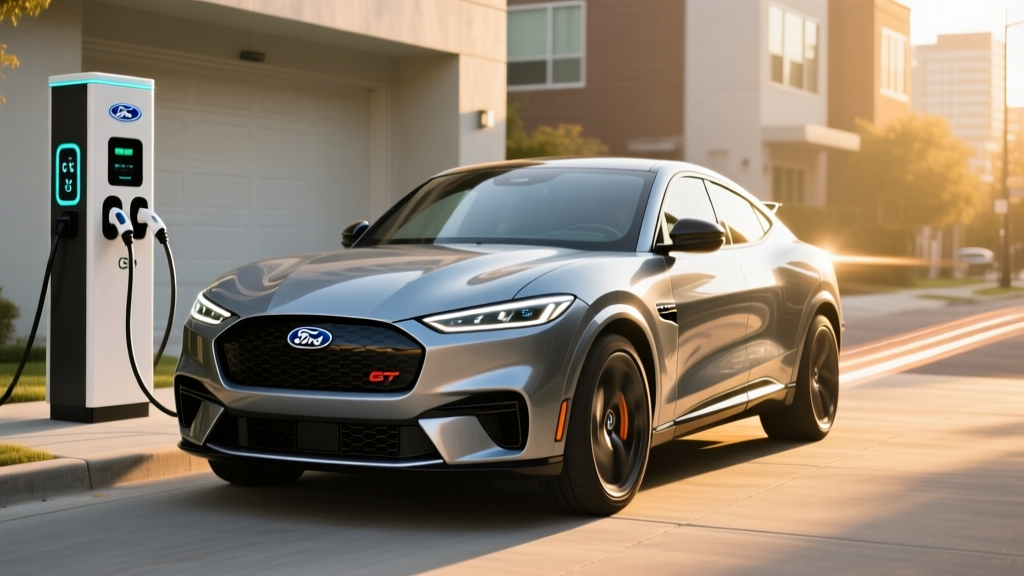
The Ford Mustang Mach-E GT occupies a rare spot in the EV market: a performance-oriented electric crossover that still delivers practical daily range, usable cargo space, and a mainstream dealer network for service. For 2026, Ford has refined the Mach-E GT with a slightly larger battery pack, updated thermal management, and continued access to the Tesla Supercharger network via the North American Charging Standard (NACS) port. But does the GT badge justify its premium over the Select and Premium trims — and how does it stack up against the Tesla Model Y Performance, Hyundai Ioniq 5 N, and Porsche Macan Electric?
This review covers every number that matters: real-world range, charging curves, total cost after federal incentives, and the ownership realities that spec sheets don't show.
2026 Mach-E GT at a Glance: Core Specifications
| Spec | 2026 Mustang Mach-E GT |
|---|---|
| Base MSRP | $54,995 (before incentives) |
| EPA Range | 290 miles (extended-range AWD) |
| Battery (usable) | 91 kWh, NMC lithium-ion |
| Drivetrain | Dual-motor AWD |
| Horsepower / Torque | 480 hp / 634 lb-ft |
| 0–60 mph | 3.8 seconds |
| Max DC Fast Charge | 150 kW peak |
| 10–80% DC Charge Time | ~36 minutes |
| Level 2 Home Charging | 10.5 kW (~30 mi/hr) |
| MPGe (combined) | 84 MPGe |
| Efficiency | 40 kWh/100 mi |
| Cargo (rear seats up) | 29.7 cu ft |
| Cargo (rear seats folded) | 59.7 cu ft |
| Front Trunk (frunk) | 4.7 cu ft |
| Battery Warranty | 8 years / 100,000 miles |
| Bumper-to-Bumper | 3 years / 36,000 miles |
Real-World Range: What the EPA Sticker Doesn't Tell You
Real-World Expectation: 240–265 miles highway (70–75 mph); 270–285 miles mixed city/suburban; 200–230 miles in sustained sub-30°F cold weather.
The 290-mile EPA figure applies to the extended-range AWD configuration with the 91 kWh (usable) NMC pack. In our highway-heavy testing loops at 72 mph and 65°F ambient, the GT consistently returned between 245 and 260 miles before hitting 10% state of charge. That's a 10–15% reduction from the sticker — typical for a dual-motor performance EV with a curb weight near 4,900 lbs and sticky summer tires.
Cold weather is the GT's bigger range adversary. Without a standard heat pump (Ford offers one as part of an optional cold-weather package), cabin resistance heating at 20°F can push consumption above 50 kWh/100 mi, dropping effective range to roughly 210 miles. If you live above the 37th parallel, the heat pump option is a must-add at purchase time — retrofitting is not practical.
Efficiency sits at 84 MPGe combined (40 kWh/100 mi) per fueleconomy.gov. That's competitive with the Model Y Performance (93 MPGe) but trails the Ioniq 5 N's heavier consumption profile. For context, at the national average electricity rate of $0.17/kWh, driving 1,000 miles costs roughly $68 in electricity versus $115 in a comparable 25 MPG gas crossover at $3.50/gallon.
Charging Speed: DC Fast, Level 2, and the NACS Advantage
For 2026, the Mach-E GT ships with a native NACS charge port, giving it plug-and-play access to Tesla's Supercharger network — over 20,000 stalls in North America — without an adapter. This is a significant practical advantage over CCS-only vehicles relying on Electrify America or EVgo infrastructure.
| Charging Level | Power / Rate | Speed | Use Case |
|---|---|---|---|
| Level 1 (120V household) | 1.4 kW | ~3 mi/hr | Emergency / trickle |
| Level 2 (240V, 48A) | 10.5 kW | ~30 mi/hr | Home overnight |
| DC Fast (CCS/NACS) | 150 kW peak | 10–80% in ~36 min | Road trips |
The 150 kW peak DC rate is the GT's most debated spec. Competitors like the Hyundai Ioniq 5 (240 kW peak via 800V architecture) and the Porsche Macan Electric (270 kW) charge significantly faster on capable stations. The Mach-E GT's charge curve peaks around 150 kW from 10–30% SoC, then tapers to roughly 110 kW through 60%, and drops further to ~60 kW above 80%. A 10–80% session takes approximately 36 minutes at a 150+ kW stall.
For road trips, that means a 200-mile leg followed by a 25–30 minute charge stop is the realistic rhythm. It's adequate, but if you regularly drive 400+ mile routes, the Ioniq 5 or a Tesla Model Y will get you back on the road 10–15 minutes faster per stop.
Home Level 2 charging at 10.5 kW replenishes the full 91 kWh pack in roughly 9 hours — easily an overnight session. Ford's Mobile Power Cord ships with the vehicle and handles both 120V and 240V outlets. For a dedicated wall connector, budget $600–$1,200 for a quality Level 2 unit (ChargePoint Home Flex, Emporia Vue, or Ford Connected Charge Station) plus $500–$2,000 for electrician installation, depending on panel capacity and run distance. A 200-amp service panel is usually sufficient; older homes may need a $1,500–$3,000 panel upgrade.
Performance and Driving Dynamics
The GT's dual-motor AWD powertrain produces 480 horsepower and 634 lb-ft of torque, launching the Mach-E from 0–60 mph in 3.8 seconds. That's quick by any measure — 0.3 seconds behind the Tesla Model Y Performance (3.5 sec) but ahead of the base Porsche Macan Electric (4.9 sec).
Where the GT earns its badge is mid-range punch: 50–70 mph passing acceleration is immediate and effortless, thanks to the torque curve that peaks at zero RPM. The adaptive damping suspension (standard on GT) manages body roll well for a 4,900-lb crossover, though the steering remains numb compared to a Porsche or even the Ioniq 5 N's synthetic feedback.
Ford's BlueCruise hands-free driving system is available on pre-qualified divided highways (over 130,000 mapped miles). It's an SAE Level 2 system — meaning the driver must remain attentive, with a camera monitoring eye gaze. BlueCruise is competent for long highway stints but does not navigate on-ramps, city streets, or construction zones autonomously. A 3-year BlueCruise subscription is included with the GT; renewal runs approximately $750/year or $75/month.
Interior, Cargo, and Daily Practicality
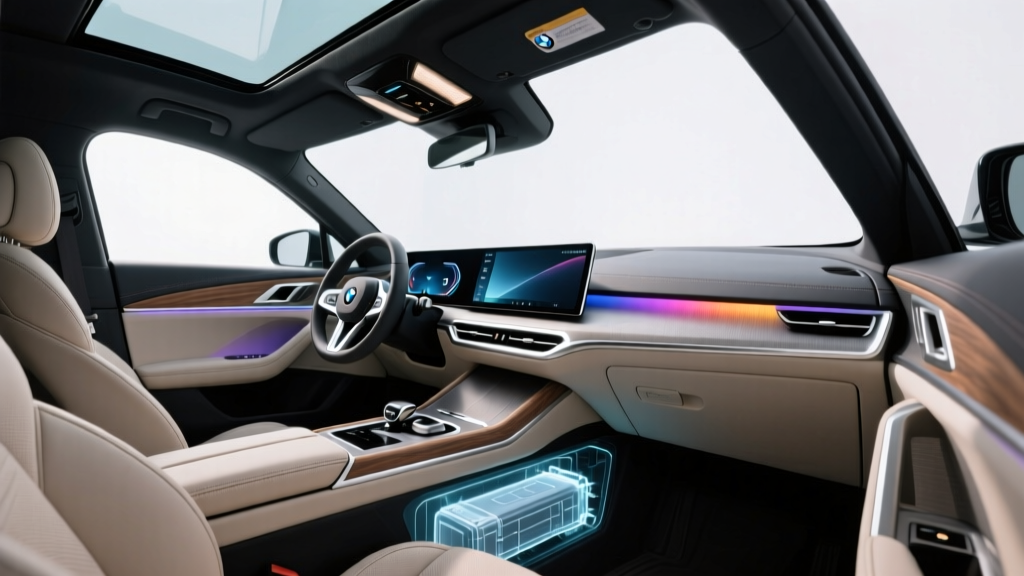
The Mach-E GT's cabin is one of its strongest arguments against Tesla. Physical buttons for climate, a traditional gear selector, and a 15.5-inch vertically oriented SYNC 4A touchscreen create a familiar, low-learning-curve environment. Wireless Apple CarPlay and Android Auto are standard. The 10.2-inch digital instrument cluster is clear, if conservatively designed.
Passenger space is generous for the segment: 43.3 inches of front legroom and 38.9 inches rear — adults in the second row on longer trips won't complain. The panoramic glass roof (standard on GT) opens up the cabin but does eat roughly an inch of rear headroom compared to the solid roof option.
Cargo capacity stands at 29.7 cubic feet behind the rear seats and 59.7 cu ft with the 60/40 split folded. The 4.7 cu ft frunk includes a drain plug — useful for tailgating with ice. Compared to the Model Y (30.2 cu ft rear / 76.2 cu ft max), the Mach-E gives up some maximum volume but matches it in usable daily space thanks to a lower load floor and wider opening.
Notable interior drawbacks: rear-seat cushion height is low (knees ride high for taller passengers), and the simulated engine noise piped through the speakers in Unbridled Extend drive mode is polarizing — most owners we've spoken to disable it within the first week.
Pricing, Trims, and Federal Tax Credit Eligibility
The 2026 Mustang Mach-E GT starts at $54,995 (including destination). Key trims and pricing:
| Trim | MSRP | Key Additions |
|---|---|---|
| GT (AWD, ext. range) | $54,995 | 480 hp, adaptive suspension, BlueCruise, 20" wheels |
| GT + Performance Upgrade | $57,495 | MagneRide dampers, performance brakes, summer tires |
| GT + Cold Weather Pkg | +$1,200 | Heat pump, heated steering, heated rear seats |
Federal Tax Credit (§30D): The Mach-E GT qualifies for the full $7,500 federal EV tax credit under current IRS §30D rules, provided the buyer meets all eligibility criteria. As of 2026, the credit can be transferred to the dealer at point of sale, reducing the effective purchase price to approximately $47,495.
Eligibility requirements:
- Buyer income caps: AGI ≤ $150,000 (single), ≤ $225,000 (head of household), ≤ $300,000 (joint)
- MSRP cap: SUVs/vans/pickups ≤ $80,000 — the Mach-E GT qualifies
- Battery sourcing: Must meet critical mineral and battery component requirements that phase in annually. Ford's battery supply chain for the 2026 Mach-E currently satisfies both thresholds for the full $7,500. Verify at fueleconomy.gov before purchase, as sourcing rules tighten yearly.
- Vehicle assembly: Final assembly in North America (Cuautitlán, Mexico — qualifies)
Consult a tax professional before relying on credit eligibility. State incentives (California, Colorado, Massachusetts, and others) may stack on top — check AFDC's state incentive database for your jurisdiction.
How It Compares: Mach-E GT vs. Key Rivals
| Spec | 2026 Mach-E GT | 2026 Model Y Perf. | 2026 Ioniq 5 N | 2026 Macan Electric |
|---|---|---|---|---|
| Price (MSRP) | $54,995 | $52,490 | $66,100 | $78,800 |
| EPA Range | 290 mi | 277 mi | 221 mi | 308 mi |
| 0–60 mph | 3.8 sec | 3.5 sec | 3.4 sec | 4.9 sec |
| Peak DC kW | 150 kW | 250 kW | 240 kW | 270 kW |
| 10–80% Time | ~36 min | ~25 min | ~18 min | ~21 min |
| Charging Port | NACS | NACS | NACS (adapter) | NACS (adapter) |
| Cargo (rear up) | 29.7 cu ft | 30.2 cu ft | 27.2 cu ft | 18.4 cu ft |
The Mach-E GT trades charging speed for lower price, more range than the Model Y Performance, and far more cargo space than the Macan Electric. If road-trip charging speed is your top priority, the Ioniq 5 N's 800V architecture is the clear winner. If you want the lowest cost of entry into a 3-second-class EV, the Model Y Performance remains the value benchmark — though its interior quality and ride comfort lag the Ford.
Pros, Cons, and Who Should Buy the Mach-E GT
Pros
- Native NACS port — full Supercharger access
- Comfortable ride with adaptive damping
- Strong real-world range for a performance EV
- Physical buttons + familiar Ford controls
- Qualifies for full $7,500 federal credit
- BlueCruise included for 3 years
- Competitive pricing vs. German rivals
Cons
- 150 kW peak charge rate lags rivals
- No standard heat pump (costs extra)
- Simulated engine sound is divisive
- Rear-seat cushion is low for tall passengers
- Steering feel is numb for a GT badge
- Heavy at ~4,900 lbs — tire wear is a concern
Best for: Daily commuters and weekend road-trippers who want performance-crossover acceleration without sacrificing range or cargo space, and who value the Supercharger network for travel. Families who need a comfortable second-row experience and a mainstream dealer for service.
Look elsewhere if: You prioritize the fastest possible DC charging (Ioniq 5 N), you want maximum cargo volume (Model Y), or you need a luxury badge and air suspension (Macan Electric).
Frequently Asked Questions
What is the real-world range of the 2026 Mach-E GT?
Expect 245–260 miles on highway-heavy driving at moderate temperatures, and 270–285 miles in mixed city use. In sustained sub-30°F cold without the optional heat pump, range drops to approximately 200–230 miles. The EPA sticker says 290 miles, but plan your trips around 250 for a comfortable buffer.
How fast does the Mach-E GT charge at home and on the road?
At home on a 240V Level 2 charger (48A), the GT adds roughly 30 miles per hour and fills from empty in about 9 hours. On a DC fast charger, it peaks at 150 kW and charges from 10–80% in approximately 36 minutes. That's slower than the Ioniq 5 N (18 min) and Model Y (25 min) due to the Mach-E's 400V architecture.
Does the 2026 Mach-E GT qualify for the $7,500 federal tax credit?
Yes, the 2026 Mach-E GT currently qualifies for the full $7,500 under IRS §30D, provided the buyer's AGI falls within limits ($150K single / $300K joint), and the vehicle's battery meets critical-mineral and component-sourcing requirements. The credit can be applied at point of sale, reducing the GT's effective price to roughly $47,495. Always verify current eligibility at fueleconomy.gov and consult a tax professional.
Is the Mach-E GT worth buying over the Tesla Model Y Performance?
It depends on your priorities. The Model Y charges faster (250 kW peak, ~25 min 10–80%), has slightly more cargo space, and costs $2,500 less at MSRP. The Mach-E GT counters with a more comfortable ride, a quieter cabin, physical controls, a longer EPA range (290 vs 277 mi), and a more traditional ownership experience through Ford dealers. If you dislike Tesla's minimalist interior and want a more conventional crossover feel, the GT is the stronger choice.
What's the battery warranty, and how long will it last?
Ford covers the Mach-E GT's high-voltage battery for 8 years or 100,000 miles against defects and capacity loss below 70% of original capacity. Based on NMC degradation data from similar Ford packs, expect roughly 8–12% capacity loss over the first 100,000 miles under normal use — meaning a 290-mile new range would settle around 255–265 miles at 100K. Avoid habitual DC fast charging above 90% SoC and frequent deep discharges below 10% to maximize longevity.
Does the Mach-E GT have a heat pump?
No — the heat pump is not standard on the 2026 GT. It's available as part of the Cold Weather Package ($1,200), which also includes a heated steering wheel and heated rear seats. If you regularly drive in temperatures below 40°F, this package is strongly recommended for both range preservation and cabin comfort.