Quick Verdict: The Electric Truck That Works Like a Truck
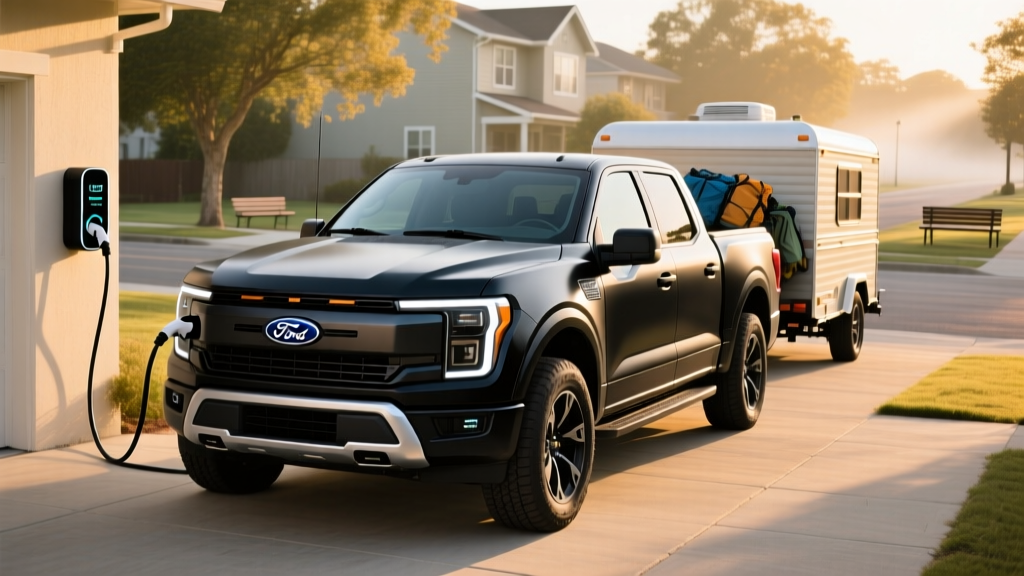
The 2026 Ford F-150 Lightning remains the benchmark for full-size electric pickups that balance daily-driver comfort with genuine work-truck utility. Ford has refined the formula since the Lightning's 2022 debut, carrying over the extended-range battery option with an EPA-estimated 320 miles while sharpening infotainment, expanding BlueCruise hands-free zones, and adjusting pricing to stay competitive against the Rivian R1T, Chevrolet Silverado EV, and the returning Tesla Cybertruck. If you need a crew-cab pickup that can tow, haul, power your home during an outage, and commute silently on electrons, the Lightning still makes the strongest all-around case.
But real-world range, charging-curve behavior, and tax-credit eligibility are where buyers get tripped up. This review walks through every number that matters before you sign.
Range, Battery, and Efficiency
Ford offers the 2026 Lightning with two battery packs across its trim lineup:
- Standard Range: ~98 kWh usable (NMC chemistry), EPA-estimated 240 miles
- Extended Range: ~131 kWh usable (NMC chemistry), EPA-estimated 320 miles (Lariat, King Ranch, Platinum trims)
Both packs use nickel-manganese-cobalt (NMC) lithium-ion cells. NMC offers higher energy density than LFP (lithium iron phosphate), which is critical in a full-size truck where packaging space for cells is finite. The trade-off is that NMC cells benefit more from staying between 20-80% state of charge for long-term longevity, whereas LFP packs tolerate regular 100% fills.
EPA 320 miles (Extended Range) is measured on a mix of city and highway cycles at moderate temperatures. In our experience and consistent with third-party testing:
- Highway-only at 70 mph: expect ~255-275 miles before needing a charger
- Cold weather (below 30°F): range drops 20-30%, yielding ~225-255 miles on the Extended Range pack
- Towing a 5,000-lb trailer: range roughly halves — plan for 130-160 miles between stops
- City/suburban commuting: you can match or slightly exceed the EPA sticker thanks to regenerative braking
Source: fueleconomy.gov
Efficiency for the Extended Range AWD model is rated at approximately 70 MPGe combined, translating to roughly 48 kWh per 100 miles. That's typical for a 6,500-pound electric truck — the Silverado EV and Rivian R1T land in the same neighborhood.
| Spec | Standard Range | Extended Range |
|---|---|---|
| Battery (usable) | ~98 kWh (NMC) | ~131 kWh (NMC) |
| EPA Range | 240 mi | 320 mi |
| Horsepower | 452 hp | 580 hp |
| Torque | 775 lb-ft | 775 lb-ft |
| 0-60 mph | ~5.0 sec | ~3.8 sec |
| Drivetrain | AWD (dual-motor) | AWD (dual-motor) |
| Max Tow Capacity | 7,700 lbs | 10,000 lbs (w/ Max Tow Pkg) |
| Payload | ~2,235 lbs | ~1,952 lbs |
| MPGe (combined) | ~76 MPGe | ~70 MPGe |
Charging Speed: DC Fast, Level 2, and Home Setup
Charging a 131 kWh battery is a time commitment if you don't plan ahead. Here's exactly what to expect at each level:
| Charging Level | Power (kW) | Speed | Typical Use Case |
|---|---|---|---|
| Level 1 (120V outlet) | ~1.4 kW | ~3 mi/hr | Emergency trickle; not practical for daily use |
| Level 2 (240V, 32A) | 7.7 kW | ~20 mi/hr | Standard home charging; ~16 hrs for 10-100% |
| Level 2 (240V, 48A) | 11.5 kW | ~30 mi/hr | Upgraded home charger; ~11 hrs for 10-100% |
| Level 2 (240V, 80A – Ford Charge Station Pro) | 19.2 kW | ~50 mi/hr | Fastest home option; ~7 hrs for full charge; enables Pro Power Home integration |
| DC Fast Charge (peak) | 150 kW | 10-80% in ~41 min | Road trips; Electrify America, EVgo networks |
The charging-curve reality: The Lightning peaks at 150 kW on a DC fast charger, but only between roughly 15-45% state of charge. Above 60%, the rate tapers to ~90 kW, and above 80%, it drops further to protect battery health. A 10-80% session takes approximately 41 minutes on a 150+ kW station. If you're on a 350 kW Electrify America stall, the Lightning won't use the extra headroom — its charge port is capped at 150 kW.
For home charging, the 80A Ford Charge Station Pro ($1,299 hardware, plus installation) is the sweet spot for Extended Range owners. It refills the 131 kWh pack overnight and enables Intelligent Backup Power — the ability to power your home during an outage at up to 9.6 kW through a transfer switch (professional electrical installation required, typically $2,000-$5,000 for the transfer switch and panel work).
Performance and Drivetrain
Every 2026 Lightning is dual-motor all-wheel drive. The Extended Range variant's 580 hp and 775 lb-ft of torque launch this 6,500-pound truck to 60 mph in approximately 3.8 seconds — quicker than a base Porsche Cayenne. The Standard Range model is no slouch at 452 hp and a ~5.0-second sprint.
Ride quality benefits from the independent rear suspension (a first for the F-150 lineup when the Lightning debuted). Without a solid rear axle, the Lightning handles broken pavement and expansion joints more gracefully than any gas F-150. The low center of gravity from the floor-mounted battery pack also reduces body roll in corners, though this is still a tall, heavy truck — don't expect sports-sedan dynamics.
The Pro Power Onboard system remains a standout: 2.4 kW standard (two 120V bed outlets), upgradeable to 9.6 kW with the Max Tow package (adds 240V and additional 120V outlets). That 9.6 kW output can run a welder, power tools at a job site, or keep your refrigerator and lights on during a blackout.
Interior, Cargo, and Tech
The Lightning's cabin mirrors the 14th-gen F-150: spacious, functional, and increasingly screen-forward. Key dimensions:
- Front legroom: 43.9 inches
- Rear legroom (SuperCrew): 43.6 inches — genuinely comfortable for adults on long trips
- Bed length: 5.5 feet (standard on all Lightning trims)
- Bed volume: 52.8 cu ft
- Front trunk (frunk): 14.1 cu ft — the Mega Power Frunk offers lockable, drainable, weather-sealed storage with 400 lbs of payload capacity and four 120V outlets
- Max towing: 10,000 lbs (Extended Range with Max Trailer Tow Package)
On the tech front, the 2026 model continues with a 12-inch digital instrument cluster and either a 12-inch (Pro, XLT) or 15.5-inch portrait touchscreen (Lariat and above) running SYNC 4A. Wireless Apple CarPlay and Android Auto are standard. The available BlueCruise hands-free driving system operates on over 130,000 miles of pre-mapped divided highways in North America.
BlueCruise is a Level 2 driver-assistance system. It controls steering, acceleration, and braking on approved highways and allows hands-off operation with a driver-monitoring camera confirming your attention. You must remain alert and ready to take over at any time. This is not self-driving (Level 4/5). BlueCruise costs $2,100 for a 3-year subscription or $75/month after the trial period.
Pricing, Trims, and Federal Tax Credit
Ford has repositioned Lightning pricing for 2026 to remain competitive as more electric trucks enter the market. Here's the trim-by-trim breakdown:
| Trim | Battery | Base MSRP | Est. After §30D Credit* |
|---|---|---|---|
| Pro | Standard Range | $54,995 | ~$47,495 |
| XLT | Standard Range | $59,995 | ~$52,495 |
| Lariat | Extended Range | $71,995 | ~$64,495 |
| King Ranch | Extended Range | $82,995 | ~$75,495 |
| Platinum | Extended Range | $90,875 | ~$83,375 |
*Destination charge ($1,995) not included. Tax credit estimates assume full §30D eligibility — see requirements below.
The IRS allows up to $7,500 in federal tax credits, but eligibility depends on meeting ALL of the following:
- MSRP cap: Pickup trucks must have an MSRP at or below $80,000 (the Platinum trim exceeds this and is ineligible)
- Buyer income cap: Modified AGI must not exceed $300,000 (joint), $225,000 (head of household), or $150,000 (single)
- Battery sourcing: A percentage of critical minerals and battery components must be sourced from the U.S. or free-trade-agreement countries. Ford has worked to qualify, but the exact credit amount ($3,750 or $7,500) depends on current-year sourcing thresholds — verify at purchase
- Point-of-sale transfer: You can transfer the credit to the dealer at purchase for an immediate price reduction, or claim it on your tax return
- Final assembly: Must occur in North America (the Lightning is built in Dearborn, MI — qualifies)
Always verify current eligibility at irs.gov or with your tax professional before purchasing. Rules and sourcing requirements have changed annually since 2023.
Warranty and Ownership Costs
Ford backs the Lightning with competitive coverage:
- Battery warranty: 8 years / 100,000 miles (retains at least 70% of original capacity)
- Powertrain warranty: 5 years / 60,000 miles
- Bumper-to-bumper: 3 years / 36,000 miles
- Roadside assistance: 5 years / 60,000 miles
The 70% capacity retention threshold is industry-standard but worth noting: if your 131 kWh pack degrades to 91.7 kWh within 8 years, Ford considers that within spec. In practice, NMC packs in liquid-cooled systems like Ford's typically retain 85-90% after 100,000 miles based on data from earlier model-year Lightnings and similar platforms.
Estimated 5-year cost of ownership for an Extended Range Lariat (assuming 15,000 miles/year, $0.14/kWh home charging, no tax credit for conservative comparison):
- Electricity: ~$7,560 (vs. ~$11,250 for a gas F-150 at $3.50/gal and 18 MPG)
- Maintenance: ~$1,800 (no oil changes, fewer brake replacements due to regen; cabin air filter and tire rotations are the main items)
- Insurance: Expect premiums 15-25% higher than a gas F-150 — EV-specific collision repair costs drive this
Pros, Cons, and Who Should Buy
- Class-leading frunk (14.1 cu ft) with 400-lb payload and integrated power outlets
- Pro Power Onboard up to 9.6 kW — genuine job-site and home-backup utility
- Independent rear suspension delivers best-in-class ride quality for a full-size truck
- Extended Range offers 320 EPA miles — viable for road trips with planning
- BlueCruise hands-free highway driving on 130,000+ miles of roads
- Built in Dearborn, MI — qualifies for North American assembly requirement
- Strong tow rating (10,000 lbs) for an electric truck
- 150 kW peak DC charging is slower than Rivian R1T (~200 kW) and Silverado EV (~350 kW)
- Towing slashes range to ~130-160 miles — long tows require careful route planning
- Platinum trim exceeds $80K MSRP cap — ineligible for federal tax credit
- Only a 5.5-foot bed — no long-bed option available
- Heavy at ~6,500 lbs — tire wear and replacement costs are above average
- Extended Range trims are expensive; the value proposition narrows vs. well-equipped gas F-150s
- Choose the Lightning if: you need a full-size crew-cab truck for daily commuting, weekend towing, job-site power, and home backup — and you can charge at home. The Pro Power Onboard and Intelligent Backup Power features are unmatched.
- Look at the Rivian R1T if: you prioritize faster DC charging, a more adventure-oriented design, or a smaller footprint for trails. The R1T is more expensive but charges at up to ~200 kW.
- Look at the Chevy Silverado EV if: you need 350 kW DC fast-charging capability and a longer bed option. The Silverado EV 4WT targets commercial fleets; the RST is the consumer equivalent.
- Stick with a gas F-150 if: you regularly tow over 7,000 lbs on long routes, live in a charging desert, or can't install a Level 2 charger at home.
Frequently Asked Questions
What is the real-world range of the 2026 F-150 Lightning?
The Extended Range model is EPA-rated at 320 miles, but expect 255-275 miles on sustained highway driving at 70 mph, and 225-255 miles in sub-freezing temperatures. City driving with regenerative braking can match or slightly exceed the EPA number. Towing cuts range roughly in half.
How fast does the F-150 Lightning charge?
On a DC fast charger, the Lightning peaks at 150 kW and charges from 10-80% in approximately 41 minutes. At home on a 240V/80A Ford Charge Station Pro, it adds about 50 miles per hour of charging, refilling the Extended Range pack in roughly 7 hours. On a standard 240V/32A outlet, plan for ~16 hours for a full charge.
Does the 2026 F-150 Lightning qualify for the federal EV tax credit?
Most trims do, but with caveats. The truck is assembled in Dearborn, MI (qualifies for North American assembly). Trims with an MSRP at or below $80,000 qualify if the buyer meets income caps ($150K single / $300K joint) and the battery meets current-year critical-mineral and component sourcing thresholds. The Platinum trim ($90,875 MSRP) exceeds the cap and does not qualify. Verify current rules at fueleconomy.gov.
Is the F-150 Lightning worth buying vs. the Rivian R1T or Silverado EV?
The Lightning wins on value, frunk utility, Pro Power Onboard, and home backup capability. The Rivian R1T offers faster DC charging, better off-road geometry, and a quad-motor option but starts ~$15,000 higher. The Silverado EV boasts 350 kW charging but is newer with less real-world track record. For most truck buyers who need utility over adventure cachet, the Lightning remains the default pick.
Can the F-150 Lightning power my house?
Yes, with the available 80A Ford Charge Station Pro and a professionally installed home transfer switch (total hardware and install: roughly $3,500-$6,500). The Intelligent Backup Power system delivers up to 9.6 kW — enough to run essentials (refrigerator, lights, HVAC fan, internet) for up to 3 days on a full Extended Range charge, or longer with selective load management.
What is the towing range penalty?
Towing a 5,000-lb trailer at highway speeds reduces range to approximately 130-160 miles on the Extended Range pack. Heavier loads near the 10,000-lb max will push that lower. Ford's onboard range calculator adjusts estimates in real time when a trailer is connected, and the SYNC navigation system can route you through DC fast chargers on longer tows.