Quick Verdict: The 2026 Escalade Electric (IQ)
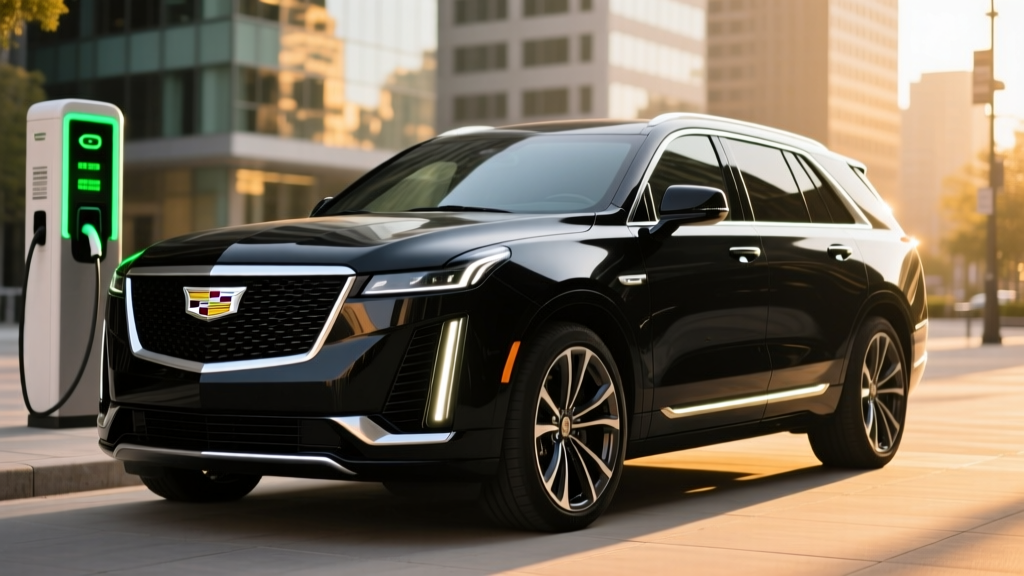
The 2026 Cadillac Escalade IQ — Cadillac's fully electric flagship SUV — starts at $129,990 (Luxury 1 trim) and targets 460 miles of EPA-estimated range from a massive 200+ kWh Ultium battery pack. It supports 800-volt DC fast charging at up to 350 kW peak, theoretically adding ~100 miles in 10 minutes. With 750 horsepower in the IQ-V trim, a 0–60 time near 4.0 seconds, and three rows of seating, it's the most expensive and most capable electric luxury SUV on the market. But real-world range at highway speeds will likely land between 360–400 miles, and buyers must weigh a six-figure price against meaningful fuel and maintenance savings versus the gas Escalade.
What Is the 2026 Escalade IQ? Cadillac's Electric Flagship Explained
The Escalade IQ is not a converted gas Escalade — it rides on GM's dedicated BT1 electric truck platform (shared with the Silverado EV and Sierra EV), giving it a flat floor, enormous battery, and available four-wheel steering. Cadillac positions it as the apex of American luxury EVs, competing with the Mercedes EQS SUV, BMW iX, and Rivian R1S, while also cannibalizing sales from its own gas-powered Escalade.
Key things first-time EV buyers should understand about a vehicle in this class:
- kWh is energy capacity (think gallons in the tank). The IQ's ~200 kWh pack is roughly double the size of a Tesla Model Y's battery.
- kW is charging power (think flow rate at the pump). The IQ's 350 kW peak rate is among the fastest available.
- EPA range is a laboratory estimate. Real-world highway driving at 75+ mph, cold weather, and towing will reduce range by 15–30%.
- Home Level 2 charging is essential for a battery this large. A standard 120V outlet (Level 1) would take days to refill it.
Range, Battery, and Charging: The Real Numbers
| Spec | Luxury 1 / Sport 1 | Luxury 2 / Sport 2 (IQ-V) |
|---|---|---|
| Battery Capacity (usable, est.) | ~200 kWh (Ultium, NMC chemistry) | ~200 kWh (Ultium, NMC) |
| EPA Range (est.) | ~460 miles | ~430–440 miles |
| Horsepower | ~680 hp | ~750 hp (V-Series) |
| 0–60 mph | ~4.5 sec | ~4.0 sec |
| Peak DC Fast Charge Rate | Up to 350 kW (800V architecture) | Up to 350 kW |
| 10–80% DC Charge Time (est.) | ~20–25 minutes | ~20–25 minutes |
| Level 2 Charge Rate (est.) | ~19.2 kW (80A capable) | ~19.2 kW |
| Drivetrain | AWD (dual motor) | AWD (dual motor) |
| Towing Capacity (est.) | ~8,000 lbs | ~8,000 lbs |
| Starting MSRP | $129,990 | $149,990 |
Real-World Range vs. EPA Sticker
EPA estimate: ~460 miles (Luxury 1)
Expect in reality:
- Mixed city/highway (moderate climate): ~400–430 miles
- Sustained 75+ mph highway: ~350–380 miles
- Cold weather (below 32°F, highway): ~300–340 miles
- Towing a 5,000-lb trailer: ~200–250 miles
The IQ's massive battery provides a buffer most EVs can't match — even at a 30% cold-weather loss, you still have 300+ miles. But physics governs all EVs: a 7,000+ lb SUV pushing air at 80 mph uses energy fast. Cadillac has confirmed a heat pump for cold-climate efficiency, which mitigates but does not eliminate winter range drop.
Charging Reality: What 350 kW Actually Means
The 800V architecture allows peak charging at 350 kW — but like all EVs, the IQ will not sustain that rate for the entire session. Expect a charge curve that peaks near 350 kW around 10–30% SoC, then tapers progressively. A realistic 10–80% session at a 350 kW-capable station (like newer Electrify America or EVgo stalls) should take 20–25 minutes. At a more common 150 kW station, plan on 35–45 minutes.
For home charging, the IQ supports up to 19.2 kW on Level 2 (requiring a hardwired 100-amp circuit). At that rate, you add roughly 50–55 miles per hour of charging, meaning a full 0–100% refill takes about 10–12 hours — ideal for overnight. On a standard 48-amp Level 2 circuit (11.5 kW), double that time.
Escalade IQ vs. Gas Escalade: Cost and Capability Compared
The most common cross-shopping decision: do you buy the electric Escalade IQ or stick with the 6.2L V8 gas Escalade? Here's how they stack up on paper.
| Attribute | Escalade IQ (Electric) | Gas Escalade (6.2L V8) |
|---|---|---|
| Starting MSRP | $129,990 | ~$93,000 |
| EPA Range / Tank Range | ~460 mi | ~440 mi (26 gal × 17 MPG) |
| Fuel/Energy Cost per Mile | ~$0.05–0.07 (home charging) | ~$0.22–0.28 (premium at $3.80/gal) |
| Annual Fuel Cost (12,000 mi) | ~$600–840 | ~$2,640–3,360 |
| Horsepower | 680–750 hp | 420 hp |
| 0–60 mph | ~4.0–4.5 sec | ~5.9 sec |
| Oil Changes / Year | None | 2–3 (~$200–350 total) |
| Federal Tax Credit (§30D) | Up to $7,500 (see eligibility below) | None |
| Home "Refueling" Convenience | Plug in overnight, wake up full | Weekly gas station visits |
The fuel savings are real: driving 12,000 miles per year, the IQ saves roughly $1,800–2,500 annually on energy versus premium gasoline, assuming mostly home charging at $0.14/kWh national average. Over five years, that's $9,000–12,500 in fuel savings alone, plus another $1,000–1,500 in avoided oil changes and reduced brake wear (thanks to regenerative braking).
But the price gap is enormous: the IQ starts $37,000+ higher than a comparable gas Escalade. Even with $7,500 in federal tax credits and five years of fuel/maintenance savings (~$12,000), the IQ remains significantly more expensive to purchase. This is a luxury and performance upgrade first, a cost-savings play second.
Ownership Costs: 5-Year Breakdown
| Cost Category | Escalade IQ (Electric) | Gas Escalade (6.2L V8) |
|---|---|---|
| Purchase Price (base) | $129,990 | $93,000 |
| Federal Tax Credit (§30D) | −$7,500 (if eligible) | $0 |
| Estimated Depreciation (5 yr) | ~$52,000 (40%) | ~$42,000 (45%) |
| Fuel / Energy (5 years) | ~$3,500 | ~$14,000 |
| Maintenance (5 years) | ~$1,500 | ~$4,500 |
| Insurance (5 years, est.) | ~$18,000 | ~$14,000 |
| Home Charger Install (one-time) | ~$1,500–3,000 | $0 |
| Total 5-Year Cost (est.) | ~$198,990–200,490 | ~$167,500 |
Key takeaways from the cost data:
- Insurance is higher for the IQ — EVs in this price range carry premiums 20–35% above their gas counterparts due to repair costs and battery replacement risk. Get quotes before buying.
- Depreciation is the wildcard. Luxury EVs have depreciated faster than luxury gas vehicles in recent years, though the gap is narrowing. A 40% five-year depreciation estimate for the IQ is optimistic; some analysts project 45–50%.
- Home charging installation for a 19.2 kW charger requires a 100-amp dedicated circuit. If your electrical panel is 200 amps and near capacity, a panel upgrade ($2,000–4,000) may be necessary. Consult a licensed electrician for a site assessment.
- Energy savings scale with mileage. If you drive 20,000+ miles per year, the IQ's fuel advantage grows substantially. Below 8,000 miles/year, the savings barely register against the price premium.
Federal Tax Credit: Does the Escalade IQ Qualify?
Under the current IRS §30D Clean Vehicle Credit, the Escalade IQ may qualify for up to $7,500 — but several conditions apply:
§30D Eligibility Checklist (2026 Rules)
- Vehicle MSRP cap: SUVs must be ≤$80,000. The Escalade IQ at $129,990+ exceeds this cap and is NOT eligible for the new-vehicle §30D credit.
- Buyer income cap: AGI ≤$150K single / $300K joint (for vehicles that do qualify).
- Battery sourcing: Critical minerals and battery components must meet phased-in domestic/free-trade requirements.
- Point-of-sale transfer: Eligible credits can be applied at the dealer to reduce the purchase price.
This is a critical point many buyers miss: the Escalade IQ's MSRP places it well above the §30D cap for SUVs ($80,000). Unlike the Chevrolet Equinox EV or even the Cadillac Lyriq, the Escalade IQ does not qualify for the $7,500 federal new-vehicle tax credit. There is no work-around for this under current law.
Some buyers may be eligible for state-level incentives (California, Colorado, and others offer rebates for EVs at various price points), but these vary by jurisdiction and often have their own income or price caps. Check your state energy office or the Alternative Fuels Data Center for current local incentives.
Common Misconceptions About the Escalade IQ
| Myth | Fact |
|---|---|
| "460 miles of range means I'll always get 460 miles." | EPA estimates use a mixed driving cycle at moderate temperatures. Sustained highway driving at 75+ mph typically yields 80–85% of EPA range (~370–390 miles). Cold weather further reduces this. |
| "I can charge it from any standard outlet overnight." | A 120V Level 1 outlet delivers ~1.4 kW — adding roughly 3–4 miles per hour. Fully recharging a 200 kWh pack would take 6+ days. A Level 2 home charger (48–80 amp, 240V) is effectively mandatory. |
| "It qualifies for the $7,500 federal tax credit." | The §30D credit caps SUV pricing at $80,000 MSRP. At $129,990+, the IQ does not qualify. |
| "Electric means no maintenance." | Tires, cabin air filters, brake fluid, windshield washer fluid, wiper blades, and 12V battery replacement are still required. EV tires wear faster due to vehicle weight and instant torque. |
| "The battery will need replacement in 5 years." | GM's Ultium batteries carry an 8-year/100,000-mile warranty covering defects and capacity loss below ~70% of original capacity. Industry data shows modern NMC packs losing 10–15% capacity over 10 years under normal use. |
| "Super Cruise means it drives itself." | GM's Super Cruise is an SAE Level 2 driver-assistance system. You must remain attentive, keep your eyes on the road, and be ready to take over at any time. It is not autonomous driving. |
Super Cruise: SAE Level 2, Not Self-Driving
The Escalade IQ will feature GM's latest Super Cruise with hands-free driving on 750,000+ miles of compatible roads in North America. Despite the impressive capability — automatic lane changes, adaptive speed, and driver monitoring via infrared camera — this is an SAE Level 2 system. The driver is legally and practically responsible for the vehicle at all times. Only Waymo-style robotaxi services operating in geofenced areas qualify as Level 4.
Real-World Ownership: What First-Time EV Buyers Must Know
Home Charging Is Non-Negotiable for This Vehicle
If you cannot install a Level 2 home charger (240V, 48–80 amp), owning a 200 kWh EV is impractical. Public DC fast charging works for road trips, but daily reliance on it is expensive ($0.35–0.55/kWh at most networks — two to four times the cost of home electricity) and adds wear from frequent high-rate charging. Renters and condo dwellers without dedicated parking should seriously evaluate this before committing.
For the IQ's 19.2 kW maximum Level 2 rate, you need a hardwired wall connector on a 100-amp breaker. Most homes with a 200-amp main panel can accommodate this, but homes with older 100- or 150-amp panels will need an upgrade ($2,000–4,000 additional). A licensed electrician should perform a load calculation before you order equipment.
Climate Matters More Than You Think
The IQ's heat pump helps in cold weather, but any EV loses range in freezing temperatures — typically 20–30% at highway speeds below 32°F. In extreme cold (below 0°F), losses can reach 35–40%. If you live in the upper Midwest or Northeast and regularly drive 300+ mile highway routes in winter, plan charging stops conservatively. Preconditioning the battery (warming it before a fast-charge session via the vehicle's navigation routing) is critical for achieving advertised charge speeds in cold weather.
Road Trip Charging: The Network Question
GM vehicles now have access to Tesla Superchargers via a NACS adapter, in addition to CCS networks like Electrify America and EVgo. This dual-network access is a significant advantage for long-distance travel. At 350 kW-capable stations, the IQ can add ~100 miles in roughly 10 minutes — enough for a quick rest stop. Plan road trips around charging infrastructure using the built-in route planner or apps like A Better Routeplanner.
Decision Framework: Should You Buy the 2026 Escalade IQ?
Choose the Escalade IQ If:
- You want a three-row luxury SUV with best-in-class electric range (460 mi EPA) and don't need the full $7,500 tax credit
- You can install a Level 2 home charger (100-amp circuit) and have access to reliable overnight charging
- You value instant torque (680–750 hp), near-silent cruising, and hands-free Super Cruise highway driving
- You drive 12,000+ miles/year and will capture meaningful fuel savings ($1,800–2,500 annually)
- You want the latest Cadillac tech: 55-inch LED dashboard display, executive rear seating, AKS 36-speaker audio
- You have access to DC fast charging for road trips (NACS Supercharger + CCS compatibility)
Stick With the Gas Escalade (or Consider Alternatives) If:
- The $37,000+ price premium over the gas Escalade doesn't justify itself through features, performance, or fuel savings alone
- You cannot install a home Level 2 charger — daily public charging with a 200 kWh pack is expensive and time-consuming
- You regularly tow heavy loads (5,000+ lbs) over long distances — range drops dramatically when towing, often to 200–250 miles
- You live in a region with extreme cold and limited DC fast charging infrastructure
- You want a vehicle that qualifies for the $7,500 federal tax credit — consider the Cadillac Lyriq ($58,590, ~314 mi range) or Chevrolet Equinox EV ($33,600, ~319 mi range) instead
- You plan to sell within 3 years — luxury EV depreciation remains a risk factor
Frequently Asked Questions
How long does it take to charge the Escalade IQ at home?
On a maximum 19.2 kW Level 2 home charger (100-amp circuit), a full 0–100% charge takes approximately 10–12 hours. On a more common 48-amp Level 2 charger (11.5 kW), expect 17–20 hours for a full charge. In practice, most owners plug in nightly and rarely deplete below 20%, so a typical overnight session (8–10 hours) adds 250–400 miles — more than enough for daily driving.
Does the Escalade IQ qualify for any tax credits?
Not the federal §30D new-vehicle credit — its MSRP exceeds the $80,000 SUV cap. State incentives vary. Some states (e.g., Colorado's innovative motor vehicle credit) may offer partial rebates regardless of MSRP. Consult a tax professional and your state's energy office for specifics.
What is the battery warranty on the Escalade IQ?
GM covers the Ultium battery with an 8-year/100,000-mile limited warranty against defects and excessive capacity degradation (typically defined as falling below ~70% of original capacity). The powertrain (motors, power electronics) carries similar coverage. This is standard across the industry for luxury EVs.
Can the Escalade IQ tow? How does towing affect range?
Estimated towing capacity is ~8,000 lbs. However, towing a 5,000+ lb trailer at highway speeds can cut range by 40–55%, reducing the 460-mile EPA estimate to roughly 200–250 miles. If you tow frequently over long distances, plan for more frequent charging stops and consider whether a diesel or gas heavy-duty truck better serves that use case.
Is the Escalade IQ self-driving?
No. Super Cruise is an SAE Level 2 hands-free driver-assistance system. It controls steering, acceleration, and braking on compatible highways, but the driver must remain attentive, eyes on the road, and ready to intervene. It does not handle construction zones, unmapped roads, or complex urban environments autonomously.
How does the Escalade IQ compare to the Mercedes EQS SUV or Rivian R1S?
The IQ undercuts the EQS SUV 580 (~$105,550, ~305 mi range) on range but costs more. Versus the Rivian R1S (~$79,900, ~410 mi range on Max Pack), the IQ is significantly more expensive but offers more luxury, a larger cabin, and Super Cruise. The R1S is better suited for off-road use; the IQ targets traditional luxury sedan buyers stepping into an SUV.
Sources: Cadillac official specifications, fueleconomy.gov (EPA estimates), IRS §30D Clean Vehicle Credit rules, GM Ultium platform documentation. Specifications for the 2026 Escalade IQ are based on manufacturer-announced data as of the latest model-year release; final EPA certifications may vary. Always verify current pricing and eligibility with your dealer and a qualified tax professional.