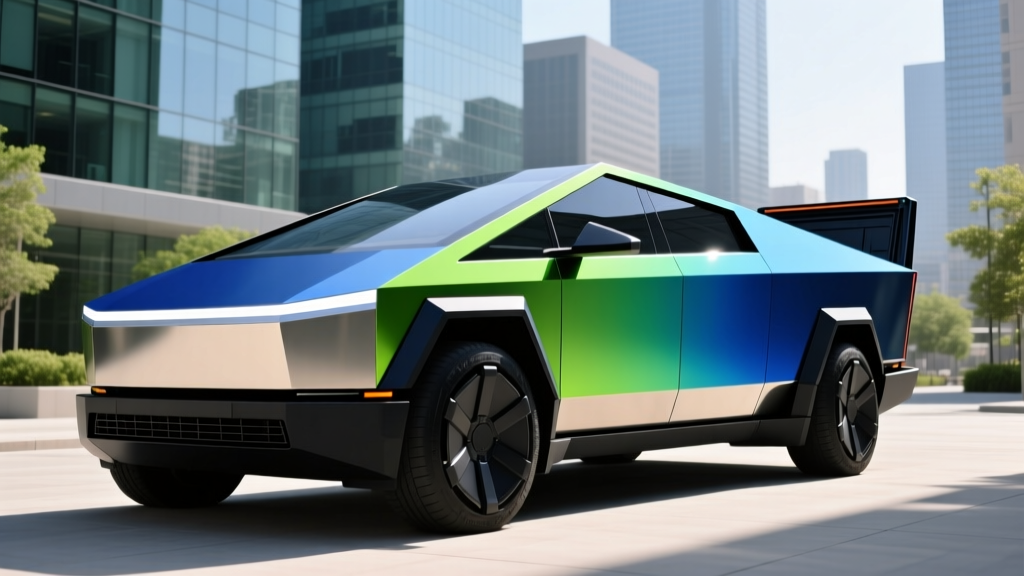
For years, the Tesla Cybertruck was synonymous with bare stainless steel — a monochromatic wedge that polarized onlookers and defined the EV truck segment by sheer audacity. Now in 2026, Tesla has expanded factory color offerings beyond wraps, giving buyers genuine painted finishes that alter not just the truck's appearance but its thermal behavior, resale profile, and total cost. This review examines the colored Cybertruck lineup across all three trims, breaking down EPA range, charging performance, real-world efficiency, and whether those new paint options justify their premium.
Quick Verdict: Who the Colored Cybertruck Is For
The colored Cybertruck targets buyers who want the polarizing angular design and 48-volt architecture of Tesla's truck but refuse to settle for steel or dealer-applied vinyl. It remains a niche vehicle: a 6,800-pound stainless-steel exoskeleton with a 6-foot bed, best suited for tech-forward truck buyers who prioritize acceleration, on-road presence, and Supercharger network access over traditional towing capacity or off-road articulation. If you need a work truck that blends into a commercial fleet, look at the Ford F-150 Lightning or Rivian R1T. If you want the most talked-about EV on the road and have the budget for paint protection, the colored Cybertruck delivers.
EPA Range, Battery, and Real-World Efficiency
Tesla equips the Cybertruck with a structural battery pack using 4680-format cells. The chemistry is NMC (nickel manganese cobalt), chosen for its higher energy density compared to LFP, which is necessary to hit range targets in a vehicle this heavy.
| Trim | Battery (usable kWh) | Chemistry | EPA Range (mi) | MPGe (combined) | kWh/100 mi |
|---|---|---|---|---|---|
| Dual Motor AWD | ~123 kWh | NMC (4680) | 340 | 66 MPGe | 51 |
| Cyberbeast (Tri-Motor) | ~123 kWh | NMC (4680) | 320 | 62 MPGe | 54 |
| RWD (announced) | ~123 kWh | NMC (4680) | ~350 (est.) | ~70 MPGe (est.) | ~48 |
The EPA sticker says 340 miles for the Dual Motor, but real-world testing tells a different story. At sustained highway speeds of 75 mph with no tailgate cover, expect 260–280 miles in mild weather. The Cybertruck's flat stainless-steel panels and angular profile generate substantial aerodynamic drag — a factor the EPA test cycle underweights. In cold weather (below 32°F), range drops an additional 20–30%, putting winter highway range closer to 200–220 miles. City driving with regenerative braking recovers meaningful energy and can push real-world figures closer to the EPA number, but this is not a road-trip-efficient vehicle by EV standards.
Charging Speed: DC Fast, Level 2, and the 48-Volt Advantage
The Cybertruck's 800-volt-class architecture enables impressive DC fast-charging speeds, though the charge curve tells the full story.
| Charging Level | Max Power | Speed / Time | Notes |
|---|---|---|---|
| DC Fast Charge (peak) | 350 kW | 10–80% in ~20 minutes | Peak sustained only to ~55% SoC; tapers sharply above 80% |
| DC Fast Charge (avg 10-80%) | ~250 kW avg | ~150 miles added in 15 min | On V4 Supercharger or equivalent |
| Level 2 Home (11.5 kW) | 11.5 kW / 48A | ~37 miles per hour of charging | Full charge in ~11 hours |
| Level 2 Home (7.7 kW) | 7.7 kW / 32A | ~25 miles per hour of charging | Common on NEMA 14-50 without panel upgrade |
| Level 1 (120V) | ~1.4 kW | ~4 miles per hour | Emergency/trickle only |
The 350 kW peak is genuinely useful, but only if you arrive at the charger with a low state of charge and the battery is preconditioned via Tesla's navigation routing. Without preconditioning, peak rates may be limited to 200–250 kW initially. The charge curve above 80% SoC drops dramatically — expect 80–100% to take an additional 25–30 minutes, making it impractical to charge past 80% on road trips. Per fueleconomy.gov, the Dual Motor consumes approximately 51 kWh per 100 miles, making it one of the least efficient EVs in its class — a direct consequence of its weight and aerodynamics.
Factory Paint Colors and Pricing Breakdown
For 2026, Tesla offers the Cybertruck in five factory paint colors, replacing the wraps-only approach of the launch year. Each color adds to the base MSRP, and paint protection is a near-mandatory expense given the Cybertruck's panel size and repair complexity.
| Configuration | Base MSRP | Paint Add-On | As-Tested Price* | §30D Credit Eligible |
|---|---|---|---|---|
| Dual Motor AWD / Solid Black | $79,990 | $0 (no-cost) | $81,990 (w/ destination) | No — exceeds $80K truck cap |
| Dual Motor AWD / Satin White | $79,990 | $2,500 | $84,490 | No |
| Dual Motor AWD / Stealth Grey | $79,990 | $2,500 | $84,490 | No |
| Dual Motor AWD / Avalanche Blue | $79,990 | $3,000 | $84,990 | No |
| Dual Motor AWD / Solar Orange | $79,990 | $3,000 | $84,990 | No |
| Cyberbeast / Any Color | $99,990 | $0–$3,000 | $101,990–$104,990 | No |
*As-tested prices include $2,000 destination fee. Excludes state/local incentives.
Federal Tax Credit Eligibility: The Hard Truth
Under current IRS §30D rules, new pickup trucks must have an MSRP at or below $80,000 to qualify for the federal EV tax credit of up to $7,500. The Cybertruck Dual Motor starts at $79,990 — but once you add any color beyond the no-cost black, destination fees, or options, the MSRP exceeds the cap. The Cyberbeast at $99,990 is far above the threshold regardless of configuration.
- ❌ MSRP cap for trucks: $80,000 max — Cybertruck exceeds with any color or option
- ❌ Buyer income cap: $300K joint / $150K single (many Cybertruck buyers exceed this)
- ⚠️ Battery sourcing: 4680 cell critical-mineral and component sourcing requirements apply
- ✅ Point-of-sale transfer: Would apply if eligible, but MSRP disqualifies most configs
Bottom line: budget for the full MSRP. Do not factor the $7,500 federal credit into your purchase decision for any colored Cybertruck configuration. Some state incentives (e.g., California, Colorado) may still apply — check your local DMV or energy office.
Performance, Drivetrain, and Towing
The Cybertruck's performance numbers remain staggering for a vehicle of its size, particularly in Cyberbeast trim.
| Spec | Dual Motor AWD | Cyberbeast (Tri-Motor) |
|---|---|---|
| Horsepower | 600 hp | 845 hp |
| Torque | 743 lb-ft | 740 lb-ft |
| 0–60 mph | 3.9 seconds | 2.6 seconds |
| Top Speed | 112 mph | 130 mph |
| Drivetrain | Dual Motor AWD | Tri-Motor AWD (torque vectoring) |
| Max Towing | 11,000 lbs | 11,000 lbs |
| Payload Capacity | 2,500 lbs | 2,500 lbs |
The 2.6-second 0–60 time in the Cyberbeast makes it one of the quickest production trucks ever built. However, towing at the 11,000-pound max rating will slash range by roughly 40–50%, putting highway towing range around 150–170 miles — a serious limitation for anyone planning to tow a trailer on road trips. The steer-by-wire system and rear-wheel steering give the Cybertruck a surprisingly tight 35-foot turning circle, which is genuinely useful in parking lots and trailheads.
Cargo, Interior Space, and Daily Usability
The Cybertruck seats five, though the rear bench is tighter than a full-size F-150 Lightning or Silverado. Interior materials have improved since launch year, but hard plastics remain in lower door panels and the center console base.
| Dimension | Measurement |
|---|---|
| Bed Length | 6 ft (72 in) |
| Bed Width (between wheel wells) | 48 in |
| Cargo Volume (bed) | ~67 cu ft |
| Front Cargo (frunk) | ~7 cu ft |
| Front Headroom | 40.9 in |
| Front Legroom | 41.2 in |
| Rear Headroom | 38.1 in |
| Rear Legroom | 35.2 in |
| Curb Weight | ~6,800 lbs |
The motorized tonneau cover is standard and integrates with the bed's 120V and 240V power outlets — a standout feature for job-site use or tailgating. The 48-volt electrical architecture (a first for a production vehicle) enables thinner wiring harnesses and more efficient power delivery to accessories. However, the 6-foot bed is shorter than most competitors, and the angular bed walls limit the width of flat cargo like plywood sheets (4×8 sheets do not fit flat between the wheel wells).
Driver Assistance, Tech, and the FSD Reality
The Cybertruck ships with Tesla's latest Hardware 4 (AI4) computer and a camera-only sensor suite — no radar, no ultrasonic sensors. Autopilot (adaptive cruise + lane centering) is standard; Full Self-Driving (Supervised) is a $8,000 option or $99/month subscription.
Tesla's FSD (Supervised) is an SAE Level 2 driver-assistance system. It does not make the Cybertruck autonomous. The driver must remain fully attentive, keep hands on the yoke (or steering wheel, depending on configuration), and be prepared to take over at any moment. No production consumer vehicle sold today is Level 3 or above. Only commercial robotaxi services like Waymo operate at Level 4 in geofenced areas.
The 18.5-inch front touchscreen and 9.4-inch rear screen run Tesla's latest software with Netflix, YouTube, and gaming while parked. The Cybertruck also features a unique "frunk" with a powered latch, adaptive air suspension with 16 inches of ground clearance at max height, and an armored glass windshield that has been revised since the infamous launch-year cracking incidents.
- Visibility: Thick A-pillars and the angular roofline create significant blind spots — the camera-based mirror system helps but takes adaptation
- Repair costs: Stainless steel panels require specialized body shops; collision repair quotes are 2–3x conventional trucks
- Insurance: Expect premiums 30–50% higher than an equivalent F-150 Lightning due to repair cost and performance data
- Ride quality: The adaptive suspension is firm; empty-bed ride on rough roads is noticeably harsher than body-on-frame competitors
- Panel gaps and paint: Early colored units showed inconsistent panel gaps and paint thickness variation — inspect carefully at delivery
Warranty and Battery Longevity
Tesla provides the following coverage for the 2026 Cybertruck:
- Basic Vehicle Warranty: 4 years / 50,000 miles
- Battery & Drive Unit Warranty: 8 years / 120,000 miles (whichever comes first), with minimum 70% capacity retention guaranteed
- Rust-Through (perforation): 12 years, unlimited miles (stainless exoskeleton)
- Roadside Assistance: 4 years / 50,000 miles
The 4680 NMC cells have shown promising longevity data so far. Tesla's structural pack design makes individual cell replacement impractical — a full pack replacement out of warranty is estimated at $18,000–$25,000 based on current Tesla service pricing. Degradation data from high-mileage Model 3/Y packs with 4680 cells suggests approximately 10–12% capacity loss at 100,000 miles under normal use, which is competitive with NMC packs industry-wide.
Colored Cybertruck vs. Key Competitors
| Spec | Cybertruck Dual Motor | Ford F-150 Lightning Lariat | Rivian R1T Dual Large | Chevy Silverado EV 4WT |
|---|---|---|---|---|
| EPA Range | 340 mi | 320 mi | 352 mi | 492 mi |
| Battery | 123 kWh NMC | 131 kWh NMC | 141 kWh NMC | 200 kWh NMC |
| 0–60 mph | 3.9 sec | 4.4 sec | 4.5 sec | 4.5 sec |
| Max Towing | 11,000 lbs | 10,000 lbs | 11,000 lbs | 10,000 lbs |
| Bed Length | 6 ft | 5.5 ft | 4.5 ft (54.5 in) | 5 ft 11 in |
| Starting MSRP | $79,990 | $69,995 | $79,900 | $77,900 |
| §30D Credit | No (MSRP cap) | Yes (select trims) | No (MSRP cap) | No (MSRP cap) |
- Class-leading acceleration and powertrain technology
- Distinctive design with genuine factory color options for 2026
- Integrated 120V/240V bed power and motorized tonneau
- Tight turning radius via rear-wheel steering
- Access to Tesla Supercharger network (NACS native)
- 48-volt architecture enables future accessory ecosystem
- Poor real-world highway range vs. EPA sticker
- No federal tax credit at any colored configuration
- High insurance and collision repair costs
- Short bed and narrow wheel-well width limits cargo
- Harsh empty-bed ride quality
- Panel gap and paint consistency concerns on colored units
- You want the most visually distinctive EV truck on the road and value factory paint over wraps
- Acceleration and tech-forward features matter more than maximum range or towing practicality
- You have reliable home Level 2 charging and don't regularly drive 300+ miles between charges
- Budget allows for $82K–$105K without relying on the federal tax credit
- You need maximum range for road trips (Silverado EV 4WT at 492 mi)
- Federal tax credit eligibility is essential (F-150 Lightning select trims)
- You tow frequently and need 200+ miles of range while towing
- You need a conventional bed size for 4×8 sheets or full-size pallets
Frequently Asked Questions
What is the real-world range of the colored Cybertruck?
The EPA rates the Dual Motor at 340 miles, but real-world highway driving at 75 mph yields 260–280 miles in mild weather and 200–220 miles in freezing conditions. City driving with regenerative braking can approach 300+ miles. Plan road trips around 220-mile segments for a safety buffer.
How fast does the colored Cybertruck charge?
On a V4 Supercharger or equivalent 350 kW DC fast charger, the Cybertruck charges from 10–80% in approximately 20 minutes with battery preconditioning enabled. The average rate across that session is around 250 kW. At home on an 11.5 kW Level 2 charger, expect about 37 miles of range added per hour, or a full charge in roughly 11 hours.
How much does the colored Cybertruck cost after tax credits?
The federal §30D tax credit does not apply to any colored Cybertruck configuration because the MSRP exceeds the $80,000 truck cap once paint or options are added. Budget for the full $81,990–$104,990 depending on trim and color. Some state incentives may still apply — check your state's energy office or DMV for current programs.
Does the colored Cybertruck qualify for the federal EV tax credit?
No, in practical terms. While the base Dual Motor MSRP is $79,990 (at the $80K truck cap), adding any premium color ($2,500–$3,000) pushes the MSRP above the threshold. The Cyberbeast at $99,990 is well above regardless. Per IRS guidelines, the MSRP cap includes all factory-installed options and destination charges.
Is the colored Cybertruck worth buying vs. competitors?
It depends on your priorities. If design distinction, acceleration, and Tesla's Supercharger ecosystem are top factors, the colored Cybertruck is unmatched in presence. If you need maximum range, tax credit eligibility, or a conventional bed for work use, the F-150 Lightning or Silverado EV are more practical choices. The Rivian R1T offers a better balance of off-road capability and range but at a similar price without the credit.
What are the biggest pros and cons of the colored Cybertruck?
Pros: Stunning performance, unique factory paint, integrated bed power, rear-wheel steering, Supercharger access, 48V architecture. Cons: Real-world range significantly below EPA, no federal tax credit, high insurance premiums, short bed, harsh unloaded ride, panel/paint quality inconsistency.
How do I protect the colored Cybertruck's paint?
Paint protection film (PPF) is strongly recommended, especially on the large flat panels and front fascia. Budget $3,500–$6,000 for a full-body PPF installation from a reputable shop. Ceramic coating alone is not sufficient for a vehicle with this much exposed panel area and the likelihood of parking-lot contact. Tesla's factory paint on colored units has shown improvement over launch-year wraps, but the stainless-steel substrate means any dent requires panel replacement rather than traditional paintless dent repair.