The Real Math Behind a 2026 Chevy Equinox EV Deal
The 2026 Chevrolet Equinox EV has positioned itself as one of the most accessible long-range electric crossovers on the market. With an EPA-estimated range reaching 319 miles on the LT FWD trim and a starting MSRP around $33,600 (before incentives), it undercuts competitors like the Hyundai Ioniq 5 and Ford Mustang Mach-E on price while delivering comparable range. But sticker price is only the opening move. The real question for buyers eyeing a 2026 Chevy Equinox EV deal is what happens after you drive it off the lot.
This guide breaks down every ownership cost layer — from the federal tax credit mechanics under IRS §30D to real-world charging costs, insurance premiums, maintenance savings, and the depreciation curve that EVs face in 2026. We use concrete numbers, not marketing promises.
Battery: 85 kWh usable (NMC chemistry) | EPA Range: 285–319 mi (trim-dependent) | DC Fast Charge: peak 150 kW, 10–80% in ~30 min | Level 2: 11.5 kW (AC) | 0–60 mph: ~7.9 sec (FWD), ~5.4 sec (AWD RS/SS) | Horsepower: 213 hp (FWD) / 288 hp (AWD) | Warranty: 8 yr / 100,000 mi battery
5-Year Total Cost of Ownership: Equinox EV vs. Gas Equinox
To understand whether a 2026 Chevy Equinox EV deal makes financial sense, we compare it head-to-head with the gasoline Equinox (1.5L turbo, FWD, ~28 MPG combined) over five years and 75,000 miles of driving. The numbers below assume $0.14/kWh for home charging (national average), $3.50/gallon regular unleaded, and the federal tax credit applied at point of sale for qualifying buyers.
| Cost Category | 2026 Equinox EV LT FWD | 2026 Equinox Gas LT FWD |
|---|---|---|
| Purchase Price (MSRP) | $33,600 | $30,100 |
| Federal Tax Credit (§30D) | −$7,500 (if eligible) | $0 |
| Effective Purchase Price | $26,100 | $30,100 |
| Fuel / Charging (75,000 mi) | $3,570 | $9,375 |
| Maintenance (5 yr) | $1,800 | $3,750 |
| Insurance (5 yr avg.) | $10,200 | $8,400 |
| Est. Depreciation (5 yr) | $13,050 (50%) | $12,040 (40%) |
| 5-Year Total Cost | $54,720 | $63,665 |
| Net Savings (EV vs. Gas) | ~$8,945 over 5 years | |
The Equinox EV wins on total cost if you qualify for the full $7,500 credit. Without it, the EV's effective purchase price climbs to $33,600, narrowing the gap to roughly $1,445 in savings — still positive, but far less dramatic. This is why understanding the credit's eligibility rules is non-negotiable before signing.
Federal Tax Credit: Do You Actually Qualify for $7,500?
The IRS §30D Clean Vehicle Credit can reduce your federal tax liability by up to $7,500 — and as of 2024, it can be transferred to the dealer at point of sale, effectively reducing your purchase price on the spot. But eligibility depends on a matrix of requirements that trip up many buyers.
- Buyer Income Caps (Modified AGI): $150,000 single / $225,000 head of household / $300,000 joint filers
- Vehicle MSRP Cap: $80,000 for SUVs, vans, and pickup trucks (Equinox EV qualifies at ~$33,600–$43,400 MSRP)
- Battery Sourcing Requirements: Battery components must be manufactured or assembled in North America (percentage thresholds increase annually through 2029)
- Critical Minerals Requirement: A percentage of critical minerals must be sourced from the US or a free-trade-agreement country (threshold rises yearly)
- Final Assembly: Vehicle must undergo final assembly in North America (the Equinox EV is built at GM's Spring Hill, Tennessee plant — qualifies)
- Point-of-Sale Transfer: You can elect to transfer the credit to the dealer, reducing your out-of-pocket cost immediately rather than waiting for tax filing
- One Credit Per Vehicle: The vehicle must be new, purchased for personal use, and not previously claimed
The Equinox EV has consistently qualified for the full $7,500 since its launch, as GM sources battery cells from its Ultium Cells joint-venture plants in Ohio and Tennessee. However, the critical-minerals sourcing thresholds tighten each January. Always verify current eligibility on fueleconomy.gov before committing to a purchase, as component-sourcing rules can shift mid-year when manufacturers change suppliers.
State, Local, and Utility Incentives: The Stacking Opportunity
Federal incentives are only part of the picture. Depending on your zip code, a 2026 Chevy Equinox EV deal can improve substantially with state and utility rebates layered on top.
- California (CVRP): Up to $7,000 for income-qualified buyers (under 400% federal poverty level), stackable with federal credit
- Colorado: State EV tax credit of $5,000 for vehicles under $80,000 MSRP (as of 2026 legislation)
- New York (Drive Clean Rebate): Up to $2,000 point-of-sale rebate for qualifying BEVs
- Utility Rebates: Many utilities (e.g., Xcel Energy, PG&E, ConEdison) offer $250–$1,500 rebates for home Level 2 charger installation or off-peak charging programs
- HOV Lane Access: Several states grant single-occupant HOV lane access to EVs — a non-monetary perk worth hundreds in time savings annually
State and local incentives change frequently. Check the AFDC State Laws and Incentives database for your specific location before purchasing.
A buyer in Colorado who qualifies for both the $7,500 federal credit and the $5,000 state credit could effectively purchase an Equinox EV LT for under $22,000 — a price point that competes directly with base-model gas crossovers.
Charging vs. Gas: The Per-Mile Cost Reality
The Equinox EV achieves an EPA-rated efficiency of approximately 3.0 miles per kWh (around 112 MPGe combined). Let's translate that into real dollars.
| Metric | Equinox EV | Gas Equinox (28 MPG) |
|---|---|---|
| Energy Source Cost | $0.14/kWh (home avg.) | $3.50/gallon |
| Efficiency | 3.0 mi/kWh | 28 mi/gal |
| Cost Per Mile | $0.047/mi | $0.125/mi |
| Cost for 15,000 mi/yr | $705 | $1,875 |
| Annual Fuel Savings | $1,170/year | |
That's a 63% reduction in per-mile energy cost when charging at home. The math shifts if you rely heavily on DC fast charging — networks like Electrify America and EVgo charge $0.35–$0.55/kWh in many markets, pushing per-mile cost to $0.12–$0.18/mi, which erases most or all of the fuel advantage. This is why home Level 2 charging access is practically a prerequisite for EV ownership economics to work.
Real-world range note: The Equinox EV LT FWD carries an EPA rating of 319 miles. In mixed highway driving at 70 mph with climate control active, expect roughly 260–280 miles. In cold weather (below 30°F), range can drop 15–25% due to battery heating demands and cabin HVAC load, landing around 240–270 miles. The AWD RS and SS trims, with their higher power draw, are rated closer to 285 miles EPA — plan for 230–250 real-world miles on a road trip.
Maintenance Savings: Where EVs Quietly Win
Electric vehicles eliminate the largest recurring maintenance items that gas-car owners accept as routine. The Equinox EV's Ultium powertrain has far fewer moving parts than a turbocharged 1.5L engine with a 6-speed automatic.
| Maintenance Item | Equinox EV (5 yr) | Gas Equinox (5 yr) |
|---|---|---|
| Oil Changes | $0 (not required) | $500–$750 |
| Transmission Fluid | $0 (single-speed reduction gear) | $150–$300 |
| Brake Pads/Rotors | $0–$200 (regen extends life 2–3×) | $600–$1,000 |
| Spark Plugs | $0 | $200–$400 |
| Coolant Flush | $100 (at ~5 yr) | $200 |
| Tire Rotation & Replacement | $800 (EV tires wear ~15% faster due to weight/torque) | $700 |
| Cabin Air Filter & Wipers | $200 | $200 |
| Total (5 yr est.) | ~$1,800 | ~$3,750 |
The regenerative braking system deserves special mention. By using the electric motor to decelerate (especially in one-pedal driving mode), the Equinox EV dramatically reduces friction-brake use. Many EV owners report original brake pads lasting 80,000–100,000 miles. The trade-off: EV-specific tires are more expensive and wear slightly faster due to the vehicle's heavier curb weight (~4,700 lbs) and instant torque delivery.
Insurance Costs: The Uncomfortable Truth
EV insurance premiums are typically 15–25% higher than equivalent gas vehicles. The Equinox EV is no exception. Based on national average quotes for a 35-year-old driver with a clean record, expect annual premiums of $1,900–$2,200 for the Equinox EV versus $1,550–$1,800 for the gas Equinox.
The reasons are structural, not arbitrary:
- Higher repair costs: EV-specific components (battery pack, power electronics, thermal management) are expensive to replace after collision damage
- Specialized labor: Fewer body shops have high-voltage certification, increasing labor rates for EV repairs
- Total-loss thresholds: Battery damage often triggers a total-loss declaration even in moderate collisions, raising insurer risk exposure
- Vehicle MSRP: Even after incentives, insurers base premiums on the pre-credit MSRP
Some insurers now offer EV-specific policies with discounts for home charging, low mileage, or telematics-based driving data. Shopping quotes from at least three carriers — including EV-friendly insurers like Lemonade, Progressive, and Liberty Mutual — can narrow the premium gap to $150–$250/year rather than $400+.
Depreciation and Resale Value: What to Expect in 2026
EV depreciation has been the category's weakest financial link. Industry data from Kelley Blue Book and Recurrent Auto show that mainstream EVs have depreciated 45–55% over five years, compared to 35–45% for comparable gas vehicles. Several factors drive this:
- Rapid technology advancement: Newer EVs offer more range and faster charging at lower prices, making older models feel dated quickly
- Battery health uncertainty: Used buyers discount for potential battery degradation, even though most modern packs retain 85–92% capacity at 100,000 miles
- Tesla price cuts: Aggressive Tesla pricing in 2023–2025 cascaded through the entire used EV market, pulling resale values down across all brands
- Tax credit competition: A new Equinox EV buyer gets $7,500 off; a used buyer gets up to $4,000 (under the separate §25E used-EV credit), which compresses the used market's willingness to pay
For the Equinox EV specifically, we estimate a 5-year depreciation of approximately 50% from the effective purchase price (after federal credit). If you buy at $26,100 post-credit, expect a resale value around $13,000–$14,500 at the 5-year mark. That's competitive with the gas Equinox's ~40% depreciation from a $30,100 starting price (~$18,000 residual), but the EV's lower effective entry price means the absolute dollar loss is smaller.
The Equinox EV's 8-year/100,000-mile battery warranty (covering capacity below 70% of original) provides a floor of confidence for second-owners, which helps stabilize resale relative to EVs with shorter coverage.
Charging Speed and Infrastructure: The Practical Picture
The Equinox EV charges at a peak DC fast-charging rate of 150 kW via its NACS connector (Tesla Supercharger-compatible from the factory starting with the 2025 model year). Here's what that means in practice:
- DC Fast Charging: 10–80% in approximately 30 minutes at a 150+ kW station. The charge curve tapers significantly above 80% SoC — expect 80–100% to take an additional 25–35 minutes. For road trips, plan stops around the 10–80% sweet spot.
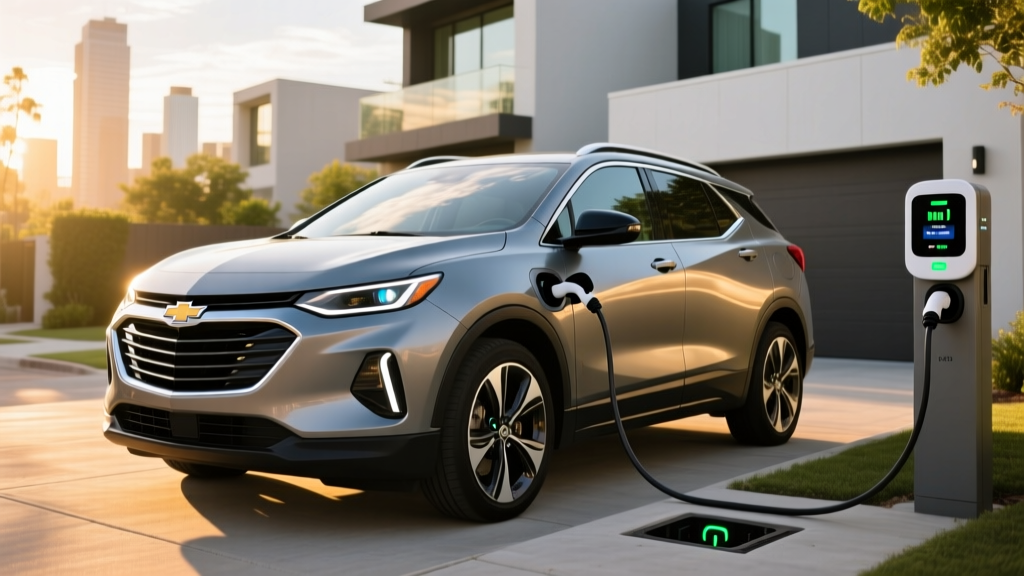
- Level 2 Home Charging (240V, 48A): 11.5 kW onboard charger adds roughly 34 miles of range per hour. A full 0–100% charge takes about 9.5 hours — ideal for overnight replenishment.
- Level 1 (120V, 12A): Adds approximately 3–4 miles per hour. Functional for low-mileage drivers or emergency top-ups but impractical as a primary strategy.
Home Level 2 installation typically costs $500–$2,500 depending on whether your electrical panel needs an upgrade (200A service is recommended). Many utilities offer rebates covering $250–$750 of this cost.
Frequently Asked Questions
How much does it really cost to own a 2026 Chevy Equinox EV over 5 years?
With the full $7,500 federal tax credit, our analysis shows a 5-year total cost of approximately $54,720 — roughly $8,945 less than a comparably equipped gas Equinox. Without the credit, the savings narrow to about $1,445. The biggest variables are your electricity rate, annual mileage, insurance premium, and whether you rely on home or public charging.
Do I qualify for the $7,500 federal tax credit on the Equinox EV?
You likely qualify if your modified AGI is under $150,000 (single) or $300,000 (joint), the vehicle MSRP is under $80,000 (it is), and the battery meets North American sourcing requirements (GM's Ultium Cells batteries currently qualify). The credit can be transferred to the dealer at point of sale for an immediate price reduction. Always verify current eligibility on fueleconomy.gov and consult a tax professional for your specific situation.
How much do I save on fuel and maintenance with the Equinox EV?
Combined fuel and maintenance savings average $1,950–$2,100 per year for a driver covering 15,000 miles annually and charging primarily at home ($0.14/kWh). Over five years, that totals roughly $9,750–$10,500 in operational savings. The savings shrink if you rely on expensive public DC fast chargers ($0.35–$0.55/kWh).
Are EVs more expensive to insure than gas cars?
Yes, typically 15–25% more. For the Equinox EV, expect $350–$400 more per year in premiums compared to the gas version. Higher repair costs, specialized labor requirements, and battery-damage total-loss risk drive the difference. Shopping multiple insurers and bundling with home insurance can reduce the gap.
How well does the 2026 Equinox EV hold its resale value?
Expect approximately 50% depreciation over five years from the effective purchase price. The EV market's rapid technology advancement and competitive new-vehicle pricing pressure used values. However, the Equinox EV's low starting price, 319-mile EPA range, 8-year battery warranty, and NACS Supercharger access give it stronger resale fundamentals than many early-generation EVs. The absolute dollar depreciation is smaller than the gas Equinox when the federal credit is applied.
What is the real-world range of the Equinox EV?
The EPA rates the LT FWD at 319 miles. Real-world mixed driving typically yields 260–280 miles. Cold weather (below 30°F) can reduce range to 240–270 miles. The AWD trims (285 miles EPA) deliver approximately 230–250 real-world miles. Preconditioning the battery while plugged in before departure helps mitigate cold-weather losses.
Does the Equinox EV use NACS or CCS for charging?
Starting with the 2025 model year, GM switched the Equinox EV to the NACS (North American Charging Standard) connector, providing native access to Tesla's Supercharger network — over 20,000 stalls nationwide as of 2026. No adapter is required for Superchargers. For legacy CCS stations, a NACS-to-CCS adapter (available from GM and third parties) enables compatibility.