Rivian R1S: The Electric SUV That Actually Tow
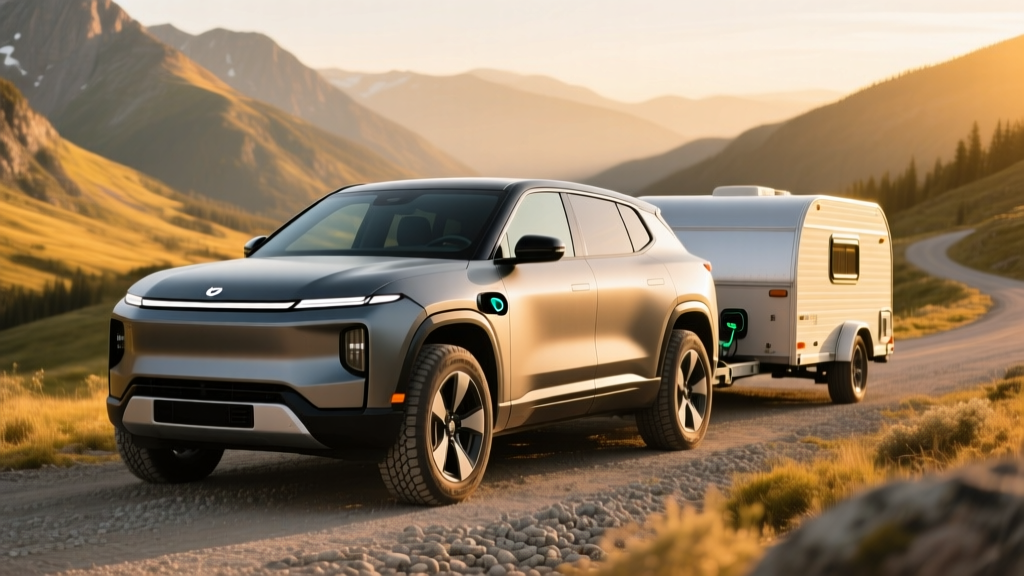
The Rivian R1S occupies a rare position in the EV market: a three-row electric SUV that doesn't ask you to sacrifice utility for electrons. For buyers who need serious towing capability without the fuel bill of a traditional body-on-frame SUV, the R1S delivers a manufacturer-rated 7,700-pound maximum towing capacity—enough for a mid-size travel trailer, a pair of jet skis, or a loaded horse trailer. But towing is only part of the equation. This review breaks down the R1S's real-world range, charging performance, pricing after federal tax credits, and whether its tow rating holds up when you factor in the range penalty that comes with pulling a trailer.
Spec Snapshot: Rivian R1S at a Glance
| Specification | Dual-Motor (Standard Battery) | Dual-Motor (Large Battery) | Quad-Motor (Max Battery) |
|---|---|---|---|
| EPA Range | 270 miles | 352 miles | 410 miles (est.) |
| Usable Battery Capacity | 92 kWh (NMC) | 128 kWh (NMC) | 149 kWh (NMC) |
| Horsepower | 533 hp | 533 hp | 1,025 hp |
| 0-60 mph | 4.5 seconds | 4.5 seconds | 3.0 seconds |
| Drivetrain | Dual-Motor AWD | Dual-Motor AWD | Quad-Motor AWD |
| Max DC Fast Charge | 200 kW | 220 kW | 220 kW |
| 10-80% DC Charge Time | ~27 minutes | ~30 minutes | ~35 minutes |
| Level 2 Home Charge Rate | 11.5 kW (~25 mi/hr) | 11.5 kW (~25 mi/hr) | 11.5 kW (~25 mi/hr) |
| Max Towing Capacity | 7,700 lbs | 7,700 lbs | 7,700 lbs |
| MPGe (Combined) | 73 MPGe | 77 MPGe | 70 MPGe (est.) |
| Starting MSRP | $75,900 | $82,400 | $99,900 |
Source: fueleconomy.gov, Rivian official specifications. Quad-Motor Max figures are estimated based on manufacturer disclosures; EPA certification pending as of early 2026.
Real-World Range: What the EPA Sticker Doesn't Tell You
The Dual-Motor Large Battery R1S carries an EPA-estimated 352 miles of range. In real-world mixed driving at moderate temperatures (60-75°F), expect approximately 300-320 miles before needing to charge. Highway-only driving at 75 mph drops this to roughly 270-290 miles, owing to the R1S's boxy aerodynamics and 5,900-pound curb weight.
In cold weather (below 32°F), range loss of 20-30% is typical, bringing effective range down to 210-250 miles for the Large Battery pack. Using the built-in heat pump and preconditioning the battery while plugged in mitigates some of this loss, but physics is physics—a large, heavy SUV pushing cold, dense air will consume more energy.
Towing Range: The Hard Truth
If you're researching the Rivian R1S towing capacity for actual trailer use, here's the number that matters most: expect to lose 40-55% of your range when towing near the max rating. Pulling a 5,000-7,000 lb travel trailer at highway speeds reduces the Large Battery's effective range to approximately 150-180 miles. This isn't a Rivian flaw—it's the reality of towing with any EV, where aerodynamic drag and rolling resistance compound exponentially at speed.
For context, a Ford F-150 Lightning with the extended-range battery sees a similar percentage drop. The difference is that the R1S can't simply add a larger fuel tank. Plan charging stops every 120-150 miles when towing heavy, and use Rivian's built-in tow mode, which adjusts throttle response, regen braking, and thermal management for sustained load.
Charging Speed: DC Fast and Home Level 2
The R1S uses the NACS (North American Charging Standard) connector natively on 2025 and later models, giving it seamless access to Tesla Supercharger stations—over 25,000 stalls across North America—as well as Electrify America, EVgo, and other networks via adapter or direct compatibility.
| Charging Level | Power (kW) | Speed (Miles of Range per Hour) | Notes |
|---|---|---|---|
| Level 1 (120V household) | 1.4 kW | ~3 mi/hr | Emergency/trickle only; ~115 hours for full charge (Large Battery) |
| Level 2 (240V home) | 11.5 kW | ~25 mi/hr | ~11 hours for 10-100% (Large Battery); ideal overnight setup |
| DC Fast Charge | 220 kW peak | ~550 mi/hr (peak) | 10-80% in ~30 min; tapers significantly above 80% SoC |
Understanding the Charge Curve
Rivian's peak 220 kW rate is not sustained across the entire session. The R1S holds near-peak speed from roughly 10% to 45% State of Charge (SoC), then tapers progressively. From 80% to 100%, charging slows to roughly 40-50 kW to protect the NMC battery cells. This is standard practice for lithium-ion battery longevity. For road trips, plan to charge from 10-80% and skip topping off unless you need the final miles—the last 20% can add 25-35 minutes to your stop.
At home, an 11.5 kW Level 2 wall connector on a 60-amp circuit adds approximately 25 miles of range per hour, or a full overnight replenishment. Installation costs for a 240V/60A circuit typically run $800-$2,500 depending on panel proximity and whether your home's electrical panel needs an upgrade to 200A service.
Pricing, Trims, and Federal Tax Credit Eligibility
The 2026 Rivian R1S is offered in three primary configurations. Pricing below reflects base MSRP before options, destination fees, or incentives.
| Trim / Configuration | Base MSRP | Federal §30D Credit | Effective Price (Est.) |
|---|---|---|---|
| Dual-Motor Standard Battery (Adventure) | $75,900 | Up to $7,500 | ~$68,400 |
| Dual-Motor Large Battery (Adventure) | $82,400 | Up to $7,500 | ~$74,900 |
| Quad-Motor Max Battery (Ascend) | $99,900 | Up to $7,500 | ~$92,400 |
Federal Tax Credit: Do You Qualify?
The R1S may qualify for the full $7,500 federal EV tax credit under IRS §30D, but eligibility hinges on several requirements that change periodically. As of 2026, the key criteria include:
- MSRP Cap: SUVs must have an MSRP at or below $80,000. The Dual-Motor Standard and Large Battery trims qualify; the Quad-Motor Max at $99,900 does not.
- Buyer Income Limits: Modified adjusted gross income (MAGI) must not exceed $300,000 (joint filers), $225,000 (head of household), or $150,000 (individual).
- Battery Component Sourcing: A percentage of battery components must be manufactured or assembled in North America, and critical minerals must be sourced from the U.S. or free-trade-agreement partners. Rivian has been working to meet these thresholds, but exact eligibility can shift by model year and production batch.
- Point-of-Sale Transfer: As of 2024, buyers can transfer the credit to the dealer at purchase, reducing the out-of-pocket price immediately rather than waiting for a tax refund.
Always verify current eligibility at IRS.gov and consult a tax professional. Sourcing rules and eligible vehicle lists are updated regularly by the U.S. Treasury.
Interior Space, Cargo, and Family Practicality
The R1S seats up to seven passengers across three rows. Unlike many three-row SUVs where the third row is punitive, the R1S offers genuine usability for adults on shorter trips.
- First-row legroom: 41.4 inches
- Second-row legroom: 38.9 inches
- Third-row legroom: 32.3 inches
- Cargo behind third row: 10.4 cu ft
- Cargo behind second row (third row folded): 46.7 cu ft
- Max cargo (all rear seats folded): 91.6 cu ft
- Front trunk (frunk): 11.0 cu ft — lockable, weatherproof, ideal for charging cables or groceries
The frunk is one of the R1S's most practical features for families. Combined with a flat load floor when seats are folded, total enclosed storage exceeds what most mid-size SUVs offer. The gear tunnel option (available on certain configurations) adds an additional pass-through storage compartment behind the second row.
Performance, Tech, and Driver Assistance
Even the base Dual-Motor R1S produces 533 horsepower and 610 lb-ft of torque, launching to 60 mph in 4.5 seconds—a remarkable figure for a 5,900-pound SUV. The Quad-Motor variant, with independent motors at each wheel, drops the 0-60 time to approximately 3.0 seconds and enables tank turns (a party trick more than a daily feature, but useful on tight trail switchbacks).
Driver Assistance: SAE Level 2
Rivian's driver-assistance suite—branded as Rivian Driver+ —is a Level 2 system. It combines adaptive cruise control, lane-centering steering, and automatic lane changes on divided highways. The driver must remain engaged with hands on the wheel and eyes on the road at all times. This is not a self-driving system and does not operate without supervision. Only Level 4 services (such as Waymo robotaxis in designated zones) operate without a human driver.
Standout Technology
- 15.6-inch center touchscreen with native navigation, streaming apps, and over-the-air (OTA) software updates
- Electric air suspension with adjustable ride height (up to 14.9 inches of ground clearance for off-road use, auto-lowering at highway speed for efficiency)
- Camp Mode — keeps climate control running while parked, with customizable ventilation and power outlet access
- Integrated tow hitch with 7-pin wiring harness, trailer brake controller, and trailer light check via the touchscreen
- V2L (Vehicle-to-Load) capability through bed and cabin outlets, powering devices up to 2,400W (camping appliances, power tools, emergency backup)
Pros and Cons
- Class-leading 7,700-lb towing for an electric SUV
- Up to 410 miles EPA range (Max Battery) covers most road trips with one stop
- Native NACS connector = full Tesla Supercharger network access
- Genuine three-row seating with usable third row
- Excellent off-road capability with air suspension and quad-motor torque vectoring
- Frunk + gear tunnel + 91.6 cu ft max cargo = best-in-class storage
- OTA updates continuously improve the vehicle post-purchase
- Towing cuts range by 40-55% — plan charging carefully on trailer hauls
- High starting price; Quad-Motor exceeds $80K MSRP cap for federal credit
- 220 kW peak DC charge rate trails some competitors (Hyundai Ioniq 9, Lucid Gravity)
- Service center network still expanding — rural owners may face longer wait times
- No Apple CarPlay or Android Auto (Rivian uses a proprietary infotainment stack)
- Cold-weather range loss is significant for the Standard Battery pack
Who Should Buy the Rivian R1S?
The R1S is purpose-built for a specific buyer profile. It makes the most sense if you:
- Need to tow regularly — boat, camper, utility trailer — and want to eliminate fuel costs on those hauls (while accepting more frequent charge stops)
- Have a family of 5-7 and need three rows but refuse to drive a minivan
- Enjoy outdoor recreation — skiing, mountain biking, overlanding — and want ground clearance plus cargo flexibility
- Can charge at home — the R1S's 128-149 kWh battery is expensive to fill on public DC fast chargers ($0.35-$0.50/kWh nationally) but very economical on home Level 2 ($0.12-$0.18/kWh in most markets)
It's a less ideal match if you primarily commute solo, live in an apartment without charging access, or rarely tow. For those use cases, a smaller, lighter EV like the Hyundai Ioniq 5 or Tesla Model Y will deliver better efficiency and lower cost.
Frequently Asked Questions
What is the real-world range of the Rivian R1S when towing?
With a 5,000-7,000 lb trailer at highway speeds, expect 150-180 miles from the Large Battery (128 kWh) pack. The Standard Battery drops to roughly 110-130 miles under the same conditions. Always pre-condition the battery before a tow and use Rivian's tow mode for optimized energy management.
How fast does the Rivian R1S charge on a road trip?
On a compatible 350 kW DC fast charger, the R1S peaks at 220 kW, adding 10-80% in approximately 30 minutes (Large Battery). Actual session times vary based on battery temperature, SoC at arrival, and charger availability. Preconditioning via the navigation system warms the battery for faster charging.
Does the Rivian R1S qualify for the $7,500 federal EV tax credit?
The Dual-Motor Standard and Large Battery trims (under $80,000 MSRP) may qualify for up to $7,500 under IRS §30D, subject to buyer income limits, battery sourcing requirements, and point-of-sale transfer rules. The Quad-Motor Max Battery at $99,900 exceeds the SUV MSRP cap and does not qualify. Verify current eligibility at IRS.gov.
Is the Rivian R1S worth buying over the Tesla Model X or BMW iX?
The R1S wins on towing (7,700 lbs vs. Model X's 5,000 lbs), off-road capability, and cargo versatility. The Model X offers faster DC charging, a larger Supercharger ecosystem (though Rivian now has access), and a lower starting price. The BMW iX is a luxury two-row crossover and doesn't compete on towing or seating. Choose the R1S if towing, three rows, and adventure capability are non-negotiable.
What is the Rivian R1S battery warranty?
Rivian provides an 8-year/175,000-mile battery and drive unit warranty for the R1S, covering defects and excessive capacity degradation (typically defined as loss beyond 30% of original capacity). The limited vehicle warranty covers 5 years/60,000 miles. Rivian uses NMC (nickel manganese cobalt) chemistry across all current R1S packs.
Can the Rivian R1S charge on Tesla Superchargers?
Yes. Starting with 2025 model-year production, the R1S comes equipped with a native NACS charge port, compatible with Tesla Supercharger stalls without an adapter. Older R1S vehicles with CCS ports can use a Tesla-approved adapter for Supercharger access.
Warranty and Long-Term Ownership
Rivian backs the R1S with one of the more competitive warranty packages in the EV SUV segment:
- Battery & Drive Unit: 8 years / 175,000 miles (whichever comes first)
- Limited Vehicle Warranty: 5 years / 60,000 miles
- Corrosion Perforation: 5 years / unlimited miles
- Roadside Assistance: 5 years / 60,000 miles
The 175,000-mile battery coverage is notably higher than the industry-standard 100,000 miles offered by most competitors, reflecting Rivian's confidence in its thermal management system and NMC cell selection. Real-world degradation data from early R1T and R1S owners (2022-2024 models) suggests approximately 5-8% capacity loss at 50,000 miles, which is within expected NMC parameters. Long-term data beyond 100,000 miles is still accumulating.
Safety ratings: Check the latest NHTSA and IIHS results for the R1S, as ratings are updated annually and may vary by model year.