The Chevrolet Bolt returns for 2026 with a new platform, faster charging, and an LFP battery — addressing the two biggest complaints about the original Bolt EV and Bolt EUV. At a starting MSRP near $27,000, it remains one of the least expensive new electric vehicles sold in the United States. But does the second-generation Bolt deliver enough range, charging speed, and tech to compete in a market now crowded with rivals from Hyundai, Kia, Nissan, and Tesla? This Chevy Bolt review breaks down every number that matters.
2026 Chevy Bolt: Quick Verdict
The 2026 Bolt is a practical, no-nonsense commuter EV that punches above its price in city efficiency and interior space. The switch to an LFP (lithium iron phosphate) battery means better long-term degradation resistance and the ability to charge daily to 100% without stress. DC fast-charging is dramatically improved over the outgoing model — from a painful 55 kW peak to a much more usable 150 kW. However, highway efficiency remains modest, cold-weather range loss is noticeable without a heat pump, and the interior materials still reflect the Bolt's budget positioning. If you need an affordable daily driver with solid range and can charge mostly at home, the 2026 Bolt is one of the strongest values in the EV market.
Range, Battery, and Efficiency
| Spec | Value |
|---|---|
| EPA Range | 255 miles |
| Battery Capacity (usable) | 65 kWh |
| Battery Chemistry | LFP (Lithium Iron Phosphate) |
| Drivetrain | FWD, Single Motor |
| Horsepower | 200 hp |
| Torque | 236 lb-ft |
| 0–60 mph | ~7.0 seconds |
| Efficiency (combined) | 120 MPGe / 28 kWh/100 mi |
| Max DC Fast Charge | 150 kW |
| 10–80% DC Charge Time | ~28 minutes |
| Level 2 Charge Rate | 11.5 kW (~38 mi/hr) |
| Cargo Volume (behind rear seats) | 22.0 cu ft |
| Cargo Volume (seats folded) | 54.5 cu ft |
| Rear Legroom | 36.0 inches |
| Battery Warranty | 8 years / 100,000 miles |
| Base MSRP (LT trim) | $26,995 |
Real-World Range: What to Actually Expect
EPA sticker: 255 miles. Real-world highway (70–75 mph, moderate temps): expect roughly 210–225 miles. Cold weather (below 30°F, highway): 160–185 miles. The Bolt's single-speed FWD setup and lack of a standard heat pump (available on 2LT) mean efficiency drops noticeably at sustained highway speeds and in freezing conditions. City driving with regenerative braking set to maximum can match or slightly exceed the EPA number in mild weather.
The 65 kWh LFP pack is a significant change from the outgoing Bolt's 65 kWh NMC battery. LFP chemistry trades some energy density for far superior cycle life and thermal stability. Chevrolet and GM's Ultium platform have engineered this pack to allow routine 100% charging — something NMC owners are typically advised to avoid for daily use. That means usable daily range is effectively the full 255 miles, not the ~80% (204 miles) that NMC best practices recommend.
Efficiency is rated at 120 MPGe combined (28 kWh per 100 miles) per fueleconomy.gov. That's competitive for the compact hatchback segment, though the Hyundai Ioniq 5 and Tesla Model Y are slightly more efficient at highway speeds due to more aerodynamic profiles.
Charging Speed: The Bolt's Biggest Upgrade
| Charging Level | Power / Rate | Time or Miles Added |
|---|---|---|
| Level 1 (120V household) | ~1.4 kW | ~4 miles per hour |
| Level 2 (240V, 48A home charger) | 11.5 kW | ~38 miles per hour; full charge in ~6.5 hours |
| DC Fast Charge (CCS) | 150 kW peak | 10–80% in ~28 minutes |
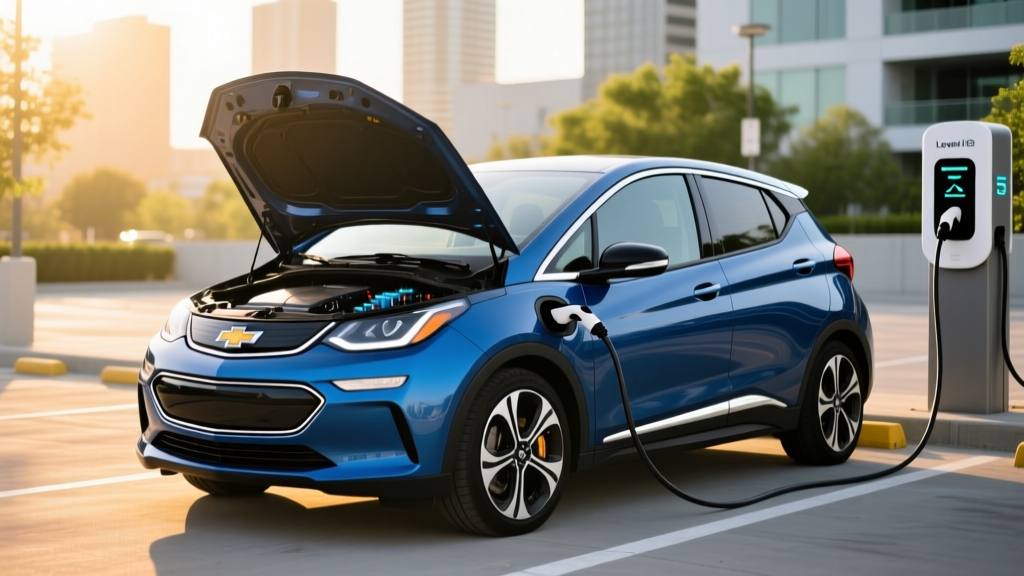
The original Bolt's 55 kW peak DC charge rate was its single biggest flaw — a 10–80% charge took over an hour, making road trips frustrating. The 2026 model's 150 kW peak is a massive improvement. On a properly preconditioned battery at a 150+ kW CCS station (Electrify America, EVgo, or any compatible network), you'll see 10–80% in roughly 28 minutes.
Charge-curve reality check: Like all EVs, the Bolt doesn't sustain 150 kW for the full session. Peak rate holds roughly from 10–40% SoC, then tapers to ~100 kW through 60%, and drops further above 80%. Plan DC stops to end around 80% — charging from 80–100% on DC is slow and unnecessary for road-trip efficiency.
Level 2 home charging at 11.5 kW is solid for the segment. With a 48-amp Level 2 wall connector on a dedicated 60-amp circuit, you'll recover the full 255 miles overnight in about 6.5 hours. If your home electrical panel supports it, this is the optimal daily charging setup. Level 1 trickle charging is best reserved as a backup — at 4 miles per hour, a full charge takes over 60 hours.
Performance and Driving Impressions
The 2026 Bolt produces 200 horsepower and 236 lb-ft of torque from a single front-mounted motor. The 0–60 mph time of approximately 7.0 seconds is adequate for merging and passing but won't thrill anyone coming from a dual-motor EV. The FWD layout means torque steer is mildly perceptible under hard acceleration, especially on wet surfaces.
Where the Bolt excels is low-speed responsiveness. Electric torque delivery from 0 rpm makes it genuinely quick off the line in city traffic, and the regenerative braking system — adjustable through multiple levels including one-pedal driving — is intuitive and effective. The ride is compliant, the steering is light, and the turning radius is tight. This is an EV engineered for urban and suburban duty, and it shows.
Highway manners are acceptable but not exceptional. Wind and tire noise are more prominent than in pricier competitors, and the suspension transmits sharper bumps into the cabin at speed. There is no AWD or dual-motor option — if you need all-weather traction beyond what winter tires provide, look at the Hyundai Ioniq 5 or Subaru Solterra.
Pricing, Trims, and Federal Tax Credit
| Trim | Base MSRP | Est. After §30D Credit* |
|---|---|---|
| LT | $26,995 | ~$19,495 |
| 2LT | $29,995 | ~$22,495 |
*Assumes full $7,500 federal tax credit eligibility. Actual credit depends on buyer income, battery sourcing, and MSRP caps. See IRS §30D rules below.
The 2026 Bolt starts at $26,995 for the LT trim, making it one of the cheapest new EVs available in the U.S. market. The 2LT adds features like a heat pump (critical for cold-climate buyers), heated front seats, a 360-degree camera, and upgraded driver-assist features for $29,995.
Does the 2026 Bolt Qualify for the §30D Federal Tax Credit?
Potentially yes — but eligibility depends on several IRS requirements that change periodically. Under current IRS §30D rules:
- MSRP cap: The Bolt qualifies (cap is $55,000 for sedans/hatchbacks).
- Buyer income cap: Modified AGI must not exceed $150,000 (single), $225,000 (head of household), or $300,000 (joint).
- Battery sourcing: A percentage of critical minerals and battery components must be sourced from the U.S. or free-trade-agreement countries. GM has been working to meet these thresholds, but the exact credit amount ($3,750 or $7,500) depends on the specific model year's supply chain compliance.
- Point-of-sale transfer: Eligible buyers can transfer the credit to the dealer at purchase, reducing the upfront cost immediately rather than waiting for a tax refund.
Always verify current-year eligibility with your tax professional and the IRS before purchasing. Sourcing requirements tighten annually, and a vehicle that qualifies in early 2026 may see changes later in the year.
Tech, Interior, and Cargo
The 2026 Bolt features an 11-inch diagonal touchscreen running GM's latest infotainment software with wireless Apple CarPlay and Android Auto. The digital instrument cluster is a 10.2-inch display. Physical buttons for climate controls are retained — a welcome choice for drivers who prefer tactile adjustments over touchscreen menus.
Standard driver-assist features include automatic emergency braking, lane-keeping assist, adaptive cruise control, and following-distance indicator. The 2LT adds enhanced automatic emergency braking, HD surround vision, and rear cross-traffic braking. This is SAE Level 1–2 driver assistance — the driver must remain fully engaged at all times. There is no hands-free driving system like GM's Super Cruise available on the Bolt.
Cargo space is generous for the hatchback form factor: 22.0 cubic feet behind the rear seats and 54.5 cubic feet with the 60/40 split rear seats folded. Rear legroom at 36.0 inches is adequate for adults on shorter trips but tighter than a compact SUV. The absence of a frunk (front trunk) is a missed opportunity — the motor is compact enough to accommodate one, but GM has not included it.
Pros
- Lowest starting MSRP in the EV segment (~$27K)
- LFP battery allows daily 100% charging with minimal degradation
- 150 kW DC fast charging is a massive upgrade over the previous generation
- Strong city efficiency and one-pedal driving experience
- Generous cargo space for a compact hatchback
- Heat pump available on 2LT for cold-weather range preservation
Cons
- Highway range drops noticeably at 70+ mph
- No AWD option — FWD only
- No frunk for additional storage
- Interior materials feel budget-tier compared to Hyundai/Kia rivals
- No Super Cruise or hands-free driving option
- CCS connector (not NACS) — may require adapter for Tesla Supercharger access
Who Should Buy the 2026 Chevy Bolt?
Decision Framework
Choose the 2026 Bolt if: You want the most affordable new EV with 250+ miles of range, primarily commute in city/suburban conditions, can install a Level 2 charger at home, and don't regularly take 300+ mile road trips.
Look elsewhere if: You need AWD for snow-belt winters without swapping to winter tires, frequently drive highway miles at 75+ mph (the Ioniq 5 or Model Y are more efficient), want the fastest DC charging in the segment (Hyundai's E-GMP platform charges 10–80% in ~18 minutes), or want hands-free highway driving (GM's Super Cruise is not offered on the Bolt).
Warranty and Long-Term Ownership
Chevrolet backs the Bolt's battery and powertrain with an 8-year/100,000-mile warranty, covering defects and capacity loss below a specified threshold (typically 60–70% retention, per GM's warranty documentation). The LFP chemistry should mean slower degradation than the outgoing NMC Bolt — real-world data from LFP packs in other GM and global-market vehicles suggests 90%+ capacity retention after 100,000 miles is realistic.
The limited vehicle warranty is 3 years/36,000 miles, which is standard for the segment but trails Hyundai/Kia's 5-year/60,000-mile bumper-to-bumper coverage. Insurance costs for the Bolt tend to be moderate — lower than Tesla but slightly higher than comparable gas hatchbacks, per industry averages.
Frequently Asked Questions
What is the real-world range of the 2026 Chevy Bolt?
The EPA rates it at 255 miles combined. In real-world highway driving at 70–75 mph in moderate temperatures, expect 210–225 miles. In cold weather (below 30°F), range can drop to 160–185 miles on the highway. City driving with regen maximized can match or slightly beat the EPA number.
How fast does the 2026 Bolt charge?
On a DC fast charger, it peaks at 150 kW and charges from 10–80% in approximately 28 minutes. On a Level 2 home charger (11.5 kW), a full charge takes about 6.5 hours. Level 1 (120V) adds roughly 4 miles per hour.
How much does the 2026 Bolt cost after the federal tax credit?
The LT starts at $26,995. If you qualify for the full $7,500 §30D credit (income limits, battery sourcing, and MSRP caps apply), the effective price drops to roughly $19,495. The 2LT starts at $29,995, falling to ~$22,495 with full credit. Verify eligibility with a tax professional and the IRS before purchase.
Is the 2026 Bolt worth buying over competitors?
If price is your primary factor, yes — nothing else matches the Bolt's combination of sub-$27K MSRP, 255-mile range, and 150 kW DC charging. If you need more highway range, AWD, faster charging, or a more premium interior, the Hyundai Ioniq 5, Kia EV6, or Tesla Model Y are stronger choices at higher price points.
Does the 2026 Bolt have a heat pump?
The heat pump is not standard on the LT trim but is included on the 2LT. If you live in a climate with sustained sub-freezing winters, the 2LT's heat pump is strongly recommended — it can reduce cold-weather range loss by 15–25%.
Is the 2026 Chevy Bolt self-driving?
No. The Bolt offers SAE Level 1–2 driver-assist features (automatic emergency braking, lane-keeping, adaptive cruise). The driver must remain fully attentive and in control at all times. GM's hands-free Super Cruise system is not available on the Bolt.